
Who Answers When an AI Agent Gets It Wrong?
Wharton/GBK's Oct 2026 survey splits blame for agent errors four ways, and no single owner reaches 30%. Name an owner for each class of action before an agent acts.
Jonathan Kvarfordt · Published October 17, 2026 · Last updated October 17, 2026 · 8 min read
Wharton/GBK asked who is held responsible when AI working on its own makes a consequential error. The answers split four ways, and no single owner reaches 30%.
When AI software acting on its own makes a costly mistake, who answers for it? Wharton/GBK put that question to 1,007 US managers and executives in July 2026. No single answer reached 30%.
An AI agent is software that takes an action on its own: it sends the email, updates the record, issues the credit or places the order. A person may approve each step, check a sample afterward, or not look at all. When an agent gets something wrong, a customer, a ledger or a contract carries the result, and somebody has to answer for it.
The Wharton/GBK answers show how far that question is from settled. The most common owner draws 28% of managers and above, and the split runs widest among the managers and directors who run the work.
What the survey found
In October 2026, Wharton Human-AI Research and GBK Collective published the fourth year of their enterprise AI study, which surveyed 1,416 people at US companies with 1,000 or more employees and more than $50 million in revenue, from July 9 to 29, 2026. The figures below come from the 1,007 respondents at manager level and above (Wharton/GBK report).
Agents are already in the work. 67% of departments use AI agents in some form, but only 17% let agents act without a person approving each step. In 48%, AI does the work and a human approves before execution.
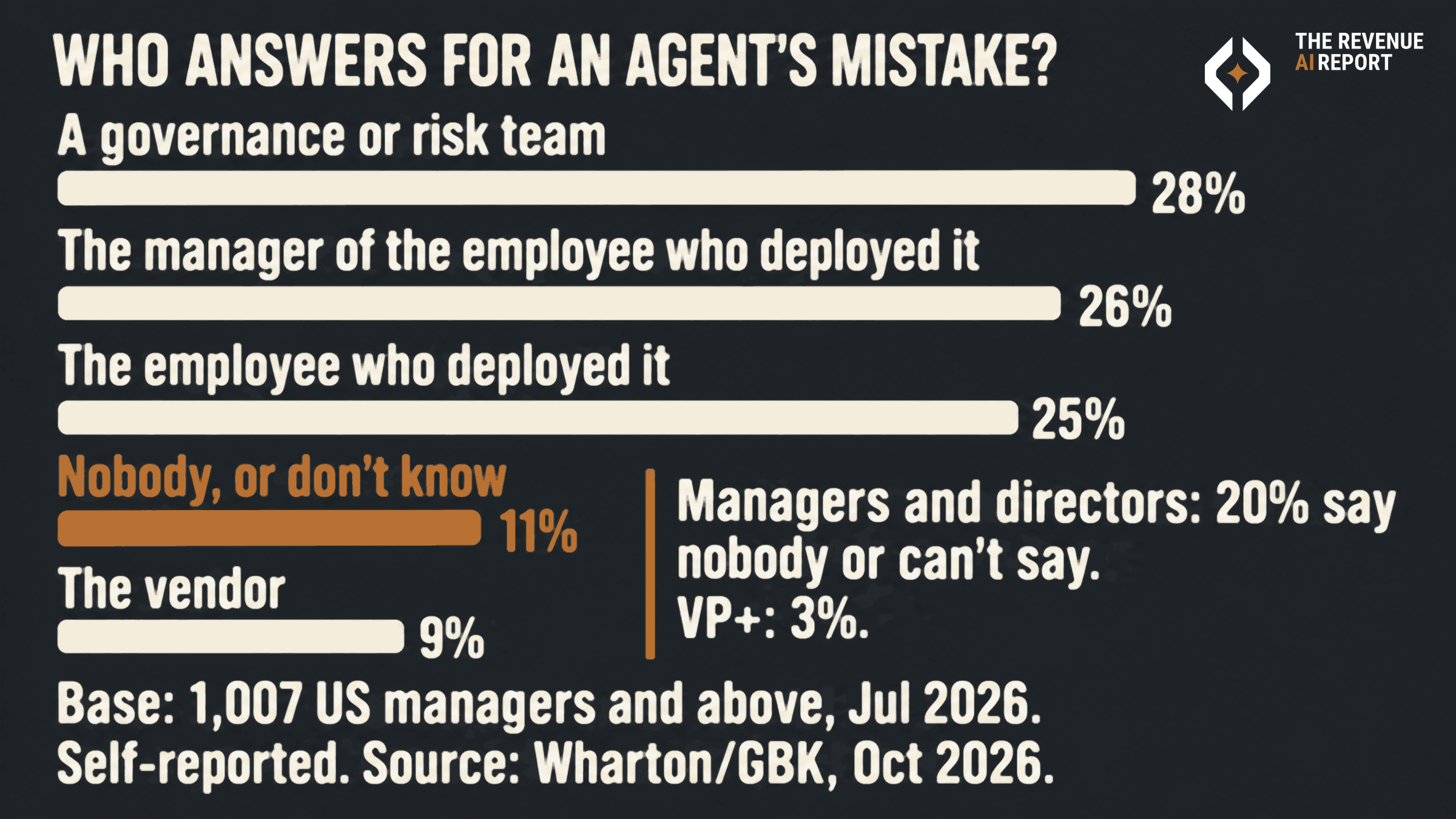
Then the survey asked who is held most responsible when AI working on its own makes a consequential error. The answers:
| Who is held responsible | Share of managers and above |
|---|---|
| A governance or risk team | 28% |
| The manager of the employee who deployed it | 26% |
| The employee who deployed it | 25% |
| The vendor | 9% |
| Nobody, or don't know | 11% |
No single owner reaches 30%. And the gap grows lower in the hierarchy: 20% of managers and directors say nobody is accountable or that they can't say, against 3% of VP+. Those two answers are combined in the report. Across all managers and above, the figure is 11%.
The seniority split shows up again on authority. "42% of C-suite respondents say their department lets AI take irreversible actions, against 24% of managers and directors (Wharton/GBK, Oct 2026)." The question asked what each department allows AI to do, so the answers describe the permissions departments have granted. An irreversible action is one you cannot take back with an edit: a payment sent, a contract signed, a customer told a price.
Put together, the executives report more authority granted to AI and more certainty that someone owns the error, and the managers who run the work report less of both.
What AI policies cover
In Littler's employer survey of more than 300 US C-suite executives, in-house lawyers and HR professionals (May 2026), 68% of employers report a formal policy governing workplace AI use. Only about 55% have a review or approval process or restrictions on what information may be entered, and 13% have no measures at all (Littler).
A vendor survey points the same way. In an Okta-commissioned survey (March 2026, 492 knowledge workers who use AI and 292 executives, 7 countries), 65% of executives called their AI usage policies "very clear," while 57% of the knowledge workers said those policies were unclear, hard to find or nonexistent (Okta).
Check whether your own policy names who answers when an allowed action goes wrong.
Read it as a role-mix signal
Reviewing and answering for AI output is becoming a large share of the job. Wharton/GBK found 72% of managers and above agree their focus has shifted from creating outputs to managing AI-generated outputs (56% of entry and mid-level employees agree). BCG's 2026 worker survey (11,749 workers, 14 markets) found 47% spend more time managing and directing AI than doing the work itself (BCG).
The role mix shifts toward approving, checking and owning what agents do. If nobody's name is on that work, it falls to whoever happens to notice.
Where this evidence stops
Every figure here is self-reported. Wharton/GBK covers large US firms only, and it is a repeated cross-section, so it does not track the same people over time. The survey shows a split and offers no evidence on which owner model produces fewer errors. Okta sells identity and AI-agent security, and Littler is a law firm that advises on AI risk; both benefit when buyers worry about governance, so weigh their framing with that in mind. The counter-view is real too: a governance team that owns every agent error can slow a sales or service team to a crawl, and some leaders will argue speed matters more than paperwork at this stage.
Operator Playbook: an owner for every action class
Program ownership is a separate question, covered in Nobody Owns AI in Your Revenue Org, and It Shows: one charter per capability, with a named business owner. This playbook works one level down, at the single action an agent takes.
1. Sort what the agent may do into four action classes
- Internal draft. The agent writes something a person will read before anyone else does.
- Routine update. An internal record changes, within set limits.
- Customer-facing. A customer or partner sees what the agent sends.
- Money or contract. The agent moves money, commits a price or changes terms. Treat this class as irreversible.
2. Write one owner line per class
For each class, write: the named role that answers for an error, the approval rule (before, sample after, or none), who gets told when it goes wrong, and how to undo it. If the undo step is blank, the class needs approval before execution.
3. Grant authority and ownership in the same document
The C-suite and the managers in the Wharton/GBK data describe different levels of authority. Close that gap on paper. Whoever approves an agent's authority for a class signs the owner line in the same sitting, and the manager who runs the work reads it back.
4. Price the review you just assigned
Owner lines create review work, and that time needs counting. G2 2026 AI Agents Report: Price the Distrust Tax Per Outcome shows how to price an agent per acceptable outcome, review time included.
Two composite examples outside software
These are composites built to show the playbook. Neither is a reported case.
A regional bank's deposit operations team. An agent drafts fee-reversal decisions for customer disputes. Internal drafts go to an analyst. Reversals under a set amount post as routine updates, with the operations manager named as owner and a weekly sample check. Anything above the limit counts as money, needs approval before execution, and names the branch operations lead as owner. When a reversal posts twice, the line says who calls the customer and who fixes the ledger.
A manufacturer's inside sales desk. An agent answers lead-time questions and drafts quotes. Lead-time replies are customer-facing, owned by the inside sales manager, with a daily sample. Quotes commit a price, so they count as contract actions: a rep approves each one, and the sales director owns any quote that goes out wrong.
What to do this week
List every action your agents can take today. Sort each into the four classes. For any class without a named owner, an approval rule and an undo step, switch it to approval before execution until the line is written. Then ask three managers who run the work to tell you, without looking, who answers for an agent's error. If their answers differ, start writing owner lines with that class.
Related
- Nobody Owns AI in Your Revenue Org, and It Shows
- G2 2026 AI Agents Report: Price the Distrust Tax Per Outcome
Sources
- Wharton Human-AI Research and GBK Collective, "The Adaptive Advantage: Who's Winning With AI and How," Oct 2026. 1,416 US respondents at firms with 1,000+ employees and >$50M revenue (1,007 managers and above, 409 entry and mid-level), Jul 9 to 29, 2026: knowledge.wharton.upenn.edu
- Littler, "Annual Employer Survey Report," May 2026. 300+ US C-suite executives, in-house lawyers and HR professionals: littler.com
- Okta, "AI Agents at Work 2026," May 27, 2026. Vendor-commissioned survey by Apprize360, March 2026, 292 executives and 492 AI-using knowledge workers in 7 countries: okta.com
- BCG, "AI at Work 2026," Jun 3, 2026. 11,749 workers, 14 markets: bcg.com
Frequently asked questions
- What did Wharton/GBK find about accountability for AI agent errors?
- Among managers and above, 28% say a governance or risk team is held most responsible, 26% the deploying employee's manager, 25% the employee and 9% the vendor. 11% say nobody is clearly accountable or do not know.
- Is it true that 1 in 5 managers say nobody is accountable?
- Only with the full wording. 20% of managers and directors say nobody is accountable or that they can't say, against 3% of VP+. The report combines those two answers. Across all managers and above the figure is 11%.
- How many companies let AI agents act on their own?
- In the Wharton/GBK survey, 67% of departments use AI agents in some form, but only 17% let agents act without a person approving each step.
- What is an irreversible AI action?
- An action you cannot undo with an edit, such as sending a payment, signing a contract or quoting a price to a customer. 42% of C-suite respondents say their department lets AI take irreversible actions, against 24% of managers and directors.
- How do I assign ownership for agent mistakes?
- Sort agent actions into four classes: internal draft, routine update, customer-facing, and money or contract. For each class, write the role that answers for errors, the approval rule, who gets told and how to undo it.
Keep reading
Playbook
The Reversal Ledger: Counting the AI Decisions Your Team Had to Undo
Every revenue org tracks what AI did. Almost none track what humans had to reverse. That second number is the one that tells you whether your agents are earning trust or borrowing it.
Playbook
Renewal and Expansion Planning When Agents Watch the Account
Risk detection can be automated. The renewal conversation cannot. Here is the split, the four signal classes worth acting on, and a 120-day renewal plan that says exactly which steps a machine owns.