
When AI Does the Starter Work, Where Will Your Next Reps Learn?
Anthropic's Oct 16 reports show fewer junior technical hires and a wide AI expectations gap. How revenue leaders train new reps when agents do the starter work, count agent hours and close the gap.
Jonathan Kvarfordt · Published October 17, 2026 · Last updated October 17, 2026 · 7 min read
Anthropic's own data on junior hiring and agent hours, and what revenue leaders should change in their role mix.
Entry-level revenue jobs teach the trade. A new customer service rep at an insurance agency learns coverage by processing endorsements. A new inside sales rep at a manufacturer learns the catalog by building quotes. When AI agents take over that starter work, the people who would have learned from it lose their training ground, and you lose your future bench.
On October 16, 2026, Anthropic published two reports built on its own internal data and surveys. Anthropic economist Peter McCrory co-authored both. They show what happens to entry seats at a company where agents do a large share of the work, and how far apart the expectations of heavy AI users and everyone else have drifted.
What Anthropic reported
The first report, How employment is changing at Anthropic, looks at hiring and work inside the company.
Anthropic's own internal data show junior roles fell from 27% to 9% of its technical hires, while junior staff slipped from 21% to 14% of its technical departments since early 2025.
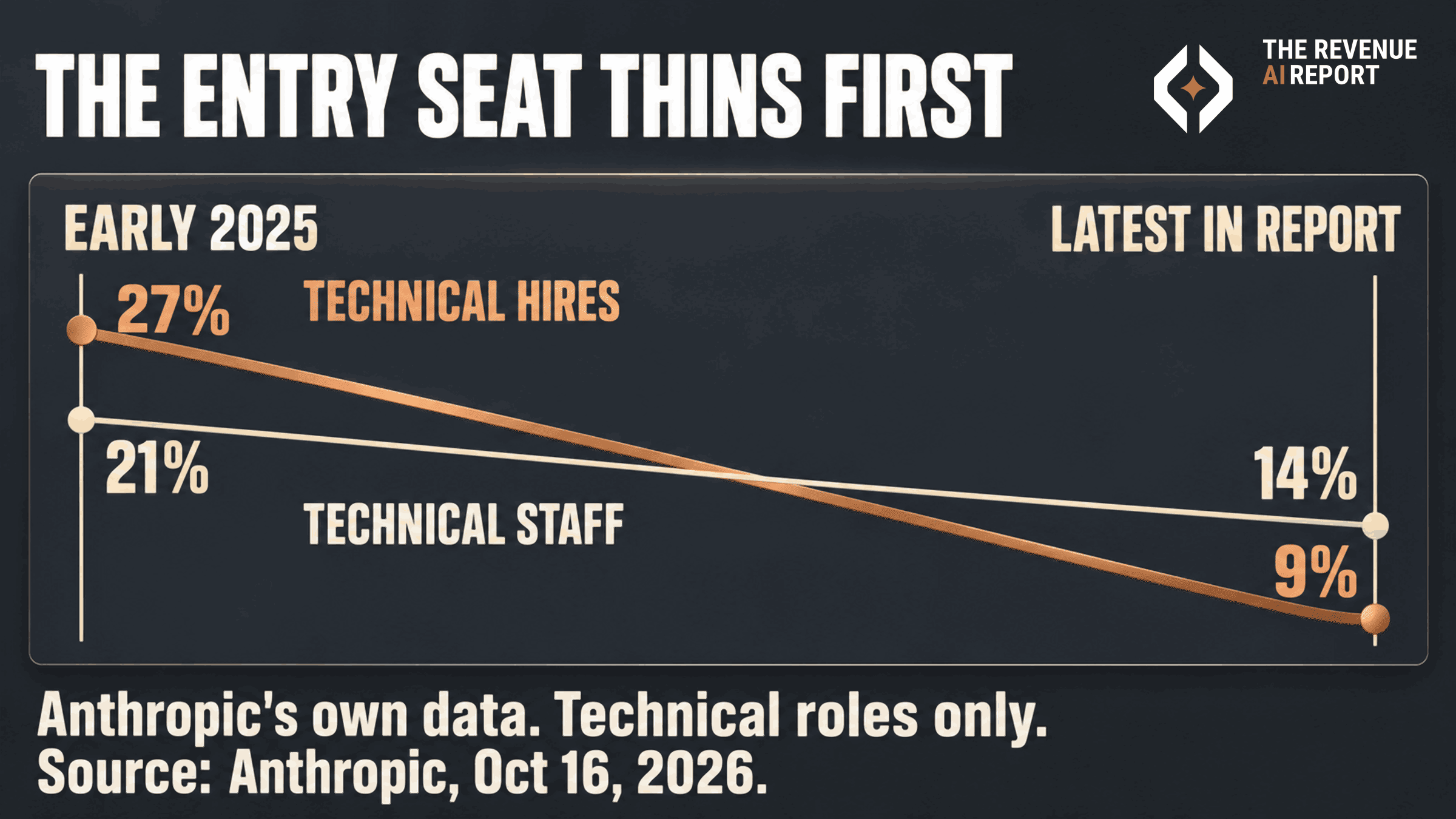
Technical hiring still grew in absolute terms over that stretch. Hiring in sales, finance and recruiting grew faster. Hiring managers' scorecards put more weight on autonomy and judgment and less on narrow domain expertise.
The same report measured agent work. By August 2026, AI agents directed by Anthropic employees logged about six times as many runtime hours as those employees' standard work hours, by Anthropic's own measure. The measure counts only interactive sessions an employee started, counts agent runtime, and drops long waits. The report adds that most interactive session time is agents sitting idle, waiting on a person, which makes human attention the limit on how much gets done.
The second report, The AI expectations gap, compares beliefs. Anthropic surveyed 10,980 US adults through Morning Consult (Aug 11 to 23, 2026) and 1,334 of its own staff in an internal poll (Aug 9 to 12, 2026).
On average, Anthropic staff said AI will be able to do 75% of their current work hours by 2030, compared with 28% for employed US adults.
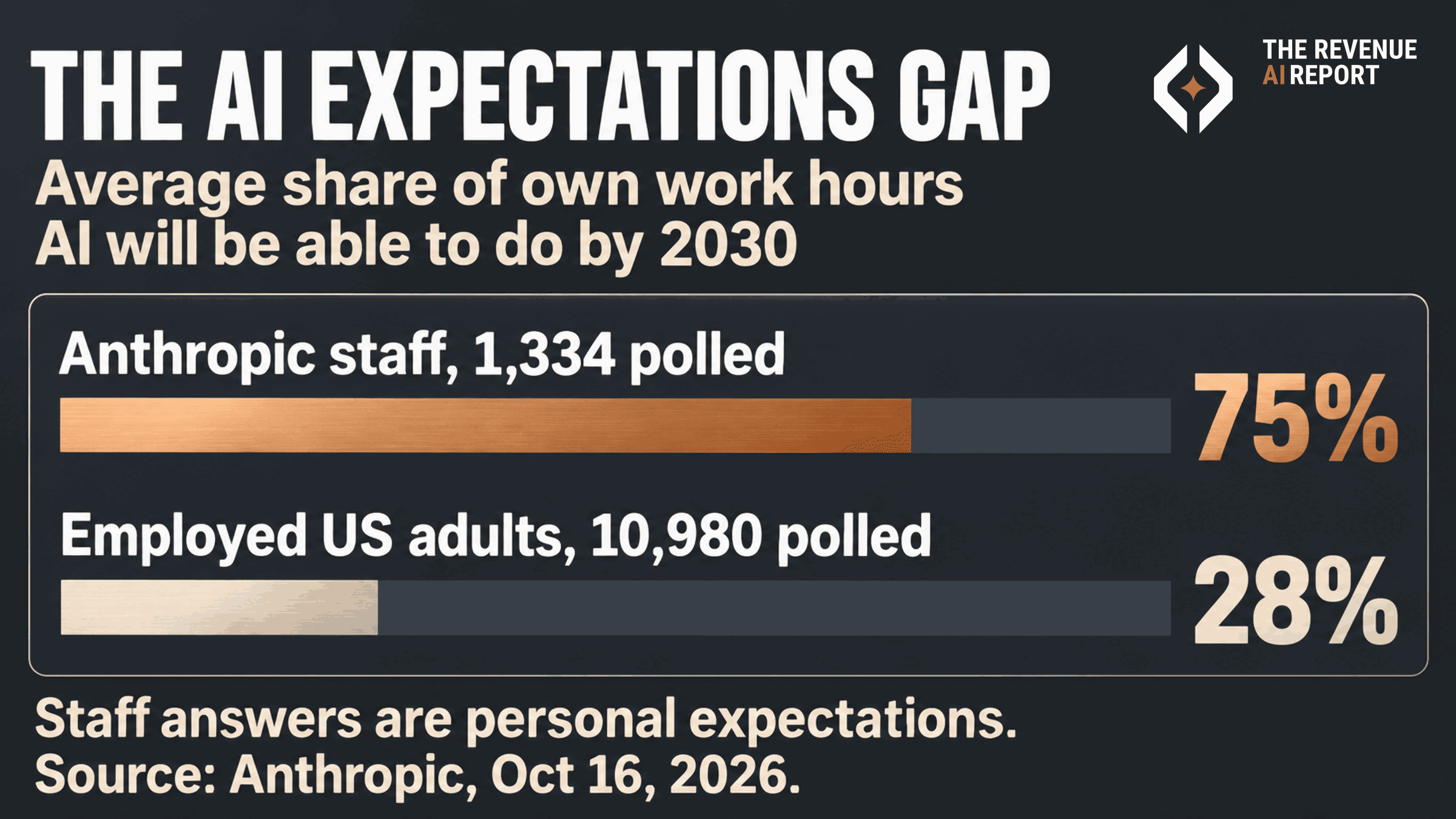
Staff answers are personal expectations from an internal poll, and the report labels its headcount answers that way directly, with no company plan or forecast behind them.
Read it as a role-mix signal
Anthropic's own data point to a shift in role mix: fewer junior technical hires and more weight on judgment in hiring, though the 27% to 9% figure covers technical roles at one AI lab and its sales hiring kept growing.
For a revenue team, the pattern to watch is the starter task. Agents absorb drafting, logging, first-pass research and routine follow-up. Those tasks were how juniors built skill. The authors flag the same problem in their own words: "Employment protections for incumbents will not benefit those not hired to begin with."
Where this evidence stops
This is one company reporting on itself. The data are internal, self-reported and not peer reviewed. The hiring figures cover technical roles only. Anthropic sells AI, its staff build and use frontier models all day, and they are not typical workers. The report itself says many of Anthropic's employment practices "cannot be replicated across the economy."
Staff work closest to the technology, so they may see further ahead, and they may also be the most optimistic group you could poll. The report notes that US adults who use AI regularly at work hold views closer to staff than the general public does. I read these numbers as a signal from the far edge of adoption and would build any forecast for your own team from your own data.
Operator Playbook: three moves
1. Rebuild the entry seat around judgment reps
When an agent drafts the work, the junior's job becomes checking it, so I teach that skill on purpose.
- Have new hires do a small set of starter tasks by hand first, so they know what a correct quote or endorsement looks like.
- Then move them to reviewing agent drafts against a written checklist, with a senior grading their corrections each week.
- Ask for each fix to be explained out loud. That way the grader can tell product knowledge from typo spotting.
That is the loop in LOPAFT in Action: learn, observe, practice, apply, get feedback, then teach. Reviewing agent output is the new practice rung.
2. Count agent hours honestly
Use this before you accept any agent-hours or hours-saved number, whether it comes from a vendor or your own team. Anthropic wrote down exactly what it counted, and I'd ask for the same.
- Define agent time: runtime only, idle waits excluded.
- Count human time too, including the hours people spend reviewing and fixing agent output.
- Put agent hours next to accepted outputs in every report, since accepted work is the result you are paying for.
If review time grows faster than accepted work, the agent moved the bottleneck onto your best people. I laid out the per-workflow proof in Companies Are Pulling Back on AI. What Revenue Leaders Should Prove First. That post covered Meta asking some staff to move back into manager roles to own AI output. Anthropic's data show the same pull toward review and judgment work.
3. Close the expectations gap inside your org
Every revenue org has a small version of this gap. A few people run agents all day, while most of the team uses AI lightly or not at all. Plans written by the first group assume speeds the second group has never seen.
- Ask every team one task question: "Which of your tasks could an agent draft today, and what would you still need to check?" Compare answers between heavy agent users and everyone else.
- Pair a heavy user with a skeptic on one live workflow for a month. Both report what the agent got right and what it got wrong.
- Share agent mistakes in the open, next to the wins.
- Set targets from what the middle of the team can do with the tools today, and raise them as adoption spreads.
Two illustrative examples outside software
These are composites built to show the moves. Neither is a reported case.
An insurance agency. An agent now drafts certificates of insurance and routine policy changes. The agency keeps hiring junior service reps but changes the first month. New reps process changes by hand, then review agent drafts against a coverage checklist while a senior account manager grades their calls on what they caught. The agency tracks review hours per accepted change, so the owner can see whether the agent saves senior time or eats it.
A manufacturer's inside sales team. An agent builds first-draft quotes from part numbers and pricing rules. The sales director asks the team, "Which of your tasks could an agent draft today, and what would you still need to check?" The heavy agent users list far more tasks than everyone else, and the veterans list far more checks. The director pairs each heavy user with a veteran rep on live quotes. The veteran catches pricing exceptions the agent misses, and the heavy user shows faster ways to check a draft. Junior reps learn the catalog by reviewing those quotes with both.
What to do this week
List the starter tasks your junior sellers, SDRs and service reps do today. Mark which ones an agent now drafts. For each marked task, name how a new hire will still learn it and who grades them. Then ask your AI owners for one agent hours number with the definition written next to it.
Related
- Companies Are Pulling Back on AI. What Revenue Leaders Should Prove First
- LOPAFT in Action: Two Teams, the Tools They Already Have, and the Climb to Mastery
Sources
- Nathan Wilmers, Regina Catipon, Maxim Massenkoff, Peter McCrory, "How employment is changing at Anthropic," The Anthropic Institute, Oct 16, 2026: anthropic.com
- Szymon Sacher, Tess Cotter, Charles I. Jones, Anton Korinek, Peter McCrory, "The AI expectations gap," The Anthropic Institute, Oct 16, 2026: anthropic.com
Frequently asked questions
- What did Anthropic's employment report find about junior hiring?
- Anthropic's own internal data show junior roles fell from 27% to 9% of its technical hires, while junior staff slipped from 21% to 14% of its technical departments since early 2025. Technical hiring still grew in absolute terms, and sales hiring grew faster.
- What is the AI expectations gap?
- It is the distance between what Anthropic staff and US adults expect AI to do. On average, Anthropic staff said AI will be able to do 75% of their current work hours by 2030, compared with 28% for employed US adults. Staff answers are personal expectations from an internal poll, separate from any company plan.
- Who is Peter McCrory?
- Anthropic economist Peter McCrory co-authored both October 16, 2026 reports, How employment is changing at Anthropic and The AI expectations gap.
- Does this mean AI will replace junior sales and service roles?
- The data come from one AI lab and cover technical roles. They point to a change in what juniors do. Agents take starter tasks, and juniors need a new path to build judgment, such as reviewing agent drafts with a senior grading the work.
- How should a revenue team measure agent hours?
- Write the definition first. Count agent runtime only, exclude idle waits, add human review and fix time, and report agent hours next to accepted outputs.
Keep reading
Playbook
The Reversal Ledger: Counting the AI Decisions Your Team Had to Undo
Every revenue org tracks what AI did. Almost none track what humans had to reverse. That second number is the one that tells you whether your agents are earning trust or borrowing it.
Playbook
Renewal and Expansion Planning When Agents Watch the Account
Risk detection can be automated. The renewal conversation cannot. Here is the split, the four signal classes worth acting on, and a 120-day renewal plan that says exactly which steps a machine owns.