
LOPAFT in Action: Two Teams, the Tools They Already Have, and the Climb to Mastery
Most teams run a weekly training and then wonder why nothing sticks. People sit through the session, nod along, and go back to doing the job the old way. Their skills don't improve. The weekly training is one piece of what it takes. Five other pieces are missing, and a team needs all six to become high-performing.
Jonathan Kvarfordt · Published October 16, 2026 · Last updated October 16, 2026 · 16 min read
Most teams run a weekly training and then wonder why nothing sticks. People sit through the session, nod along, and go back to doing the job the old way. Their skills don't improve. The weekly training is one piece of what it takes. Five other pieces are missing, and a team needs all six to become high-performing.
This post lays out those six pieces, shows two teams using them, and explains how to start with the tools you already have.
The problem: training covers one piece out of six
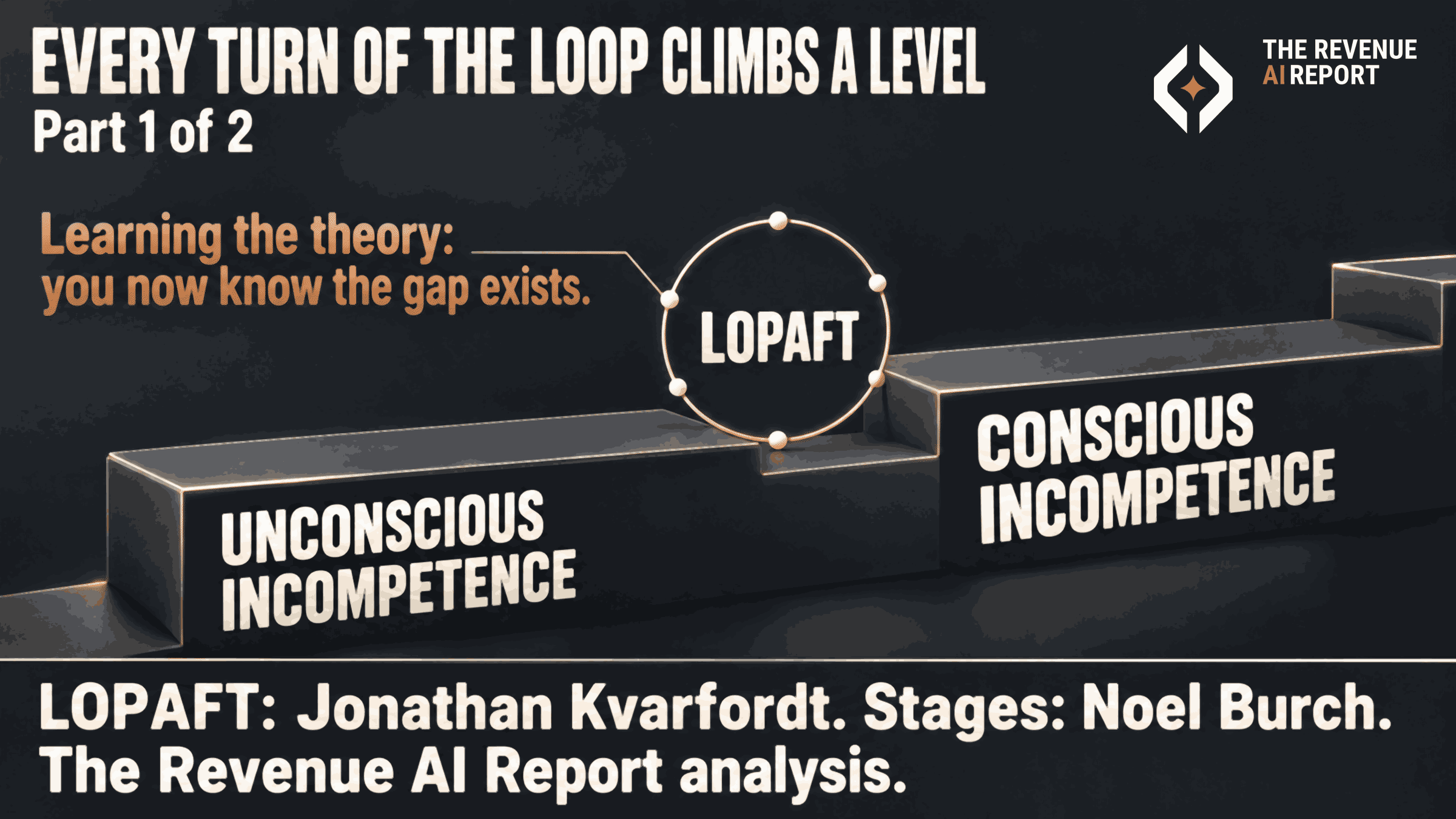
Trainers use a simple model of four stages people go through when they learn a skill. The model is credited to Noel Burch of Gordon Training International (Gordon Training International). Picture a new driver:
- Unconscious incompetence. You're bad at it and don't know it. The teenager who thinks driving looks easy.
- Conscious incompetence. You're bad at it and now you know it. The first lesson, stalling at a green light.
- Conscious competence. You can do it, but only if you concentrate. Hands at ten and two, radio off.
- Unconscious competence. You do it without thinking. Mastery. The commute you don't remember driving.
A training session can move someone from stage one to stage two. They learn what good looks like and realize they aren't doing it. Getting from stage two to stage four takes more than another session.
I built a framework called LOPAFT to cover that whole climb. It has six parts, run in order as a loop:
- Learn. Get the theory: what the skill is and how it works.
- Observe. Watch good and bad examples so you can see the difference.
- Practice. Try it in a safe place, with no customer and no manager watching.
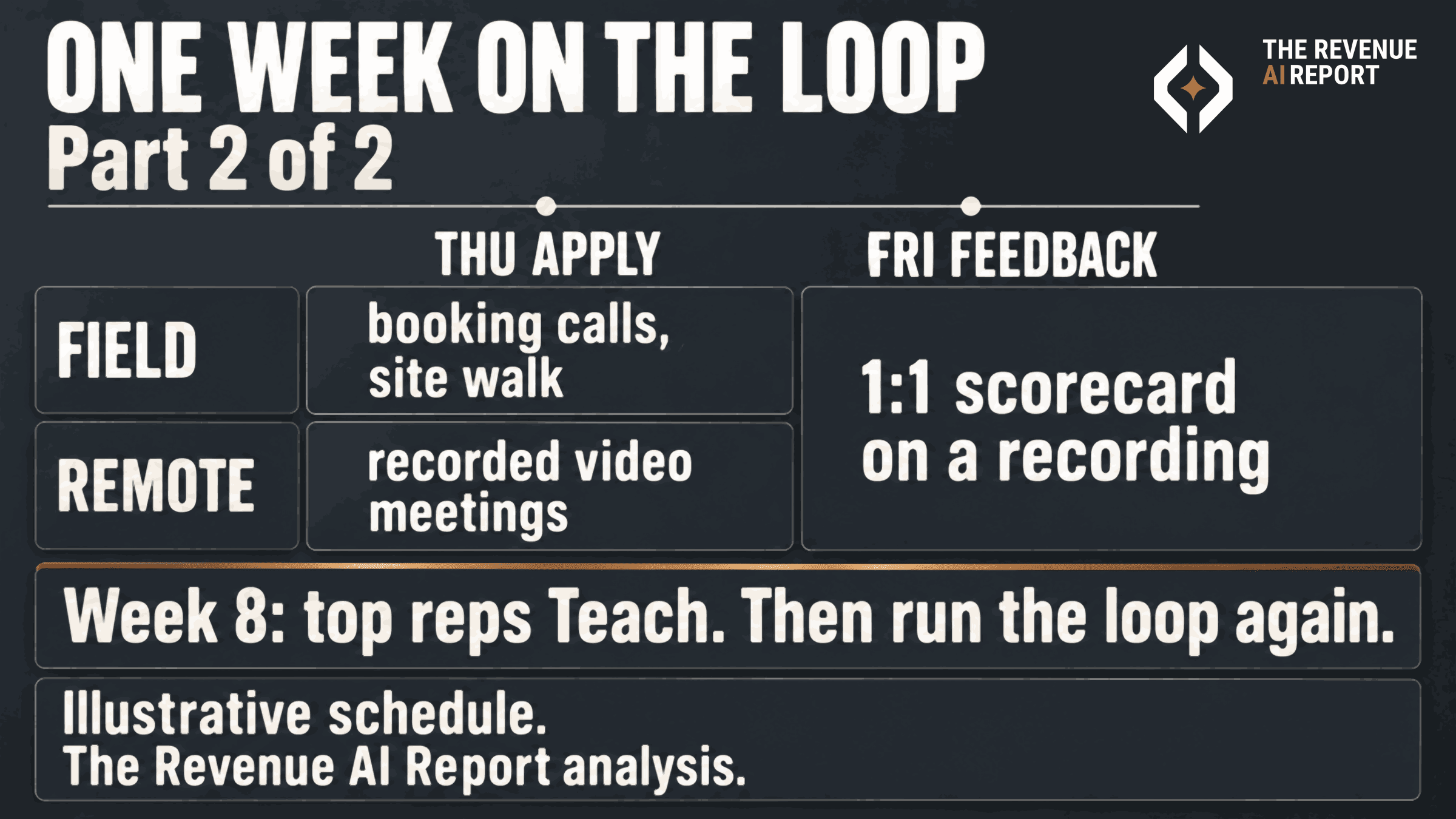
- Apply. Use it in real work, where the stakes are real.
- Feedback. Get an honest score against a clear standard.
- Teach. Explain it to someone else, which locks it in.
The weekly training covers Learn. That's the gap. The other five parts are where people get better.
A few terms before we go on. Enablement is the work of training and equipping a sales or customer team to do its job. An LMS, or learning management system, is the software that hosts online courses and tracks who finished them. A role-play is a practice conversation where one person plays the customer. A rep is a salesperson. An objection is a reason a customer gives for not buying, and a talk track is the suggested way to answer it.
Here is what's ahead. First, two teams and the goal each one has. Then the usual way they'd train, and why it fails. Then the same teams run all six parts of LOPAFT. After that: how the loop moves people up the four stages, what the research says, where AI tools fit, and a checklist for starting with what you already have.
Two teams
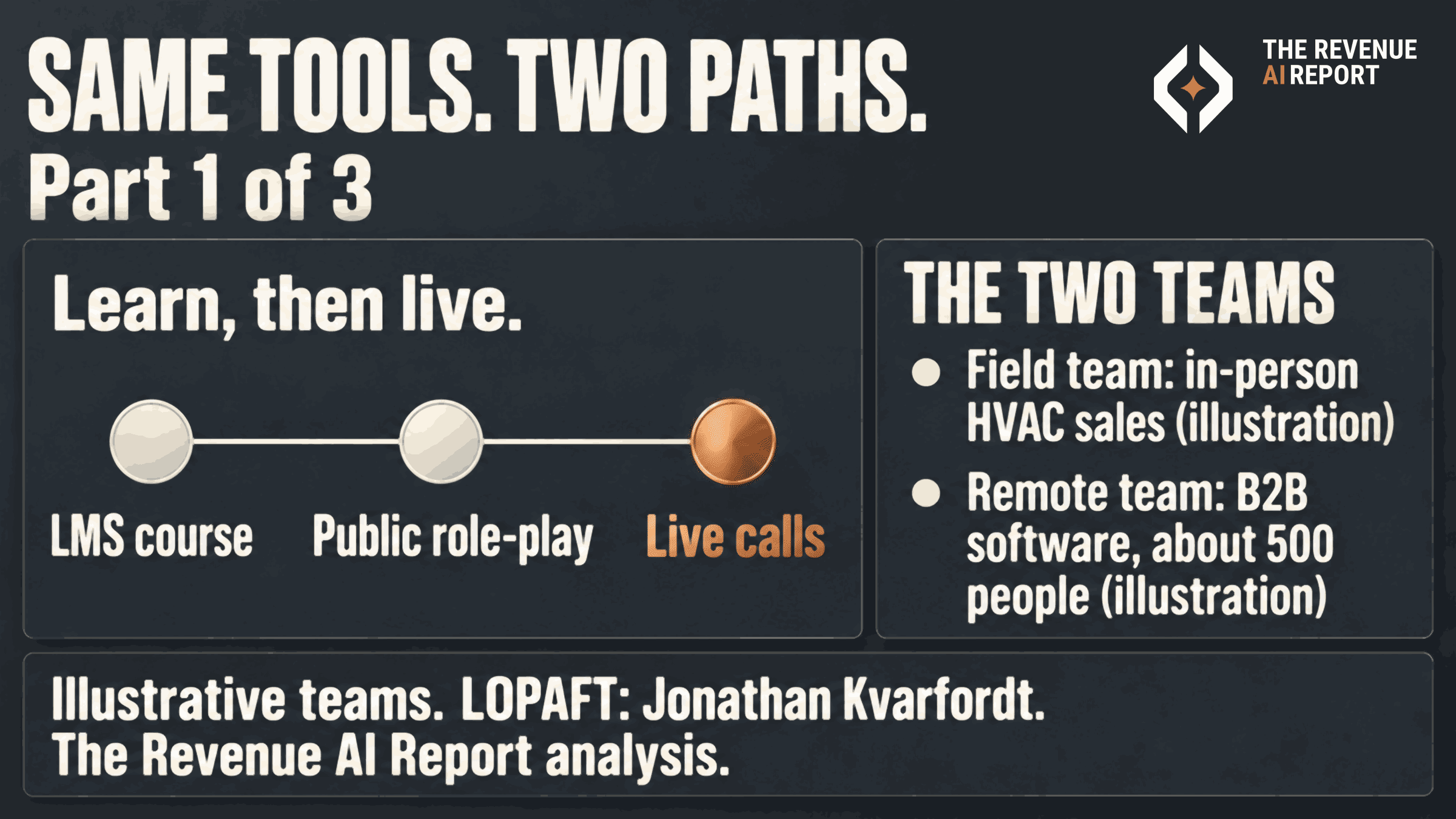
Both teams are illustrations. I made them up to show the mechanics, which come from the framework and the research cited below. One sells in person outside software. One sells software remotely.
The field team. Twelve reps at a regional commercial HVAC company. They sell maintenance contracts to property managers, mostly in person: site walks, lobby meetings, the occasional lunch. They book those visits by phone. They have a Monday morning meeting in the branch, recorded phone calls, an LMS the company bought for safety training, and two managers who do ride-alongs. Swap in a bank branch selling business accounts, a medical device team calling on clinics, or a staffing agency. The mechanics hold.
The remote team. A mid-market B2B software company of about 500 people. Twenty account executives work from home in four time zones. Every customer meeting happens on video and gets recorded. They have a weekly team video call, a call-recording tool, an LMS, and three managers who run one-on-ones on video.
Each team has a quarter goal. The field team has to beat "we already have a guy," the line property managers use when a local repair contractor has the work. The remote team has to beat "we're going to build this ourselves," the line a buyer's internal IT lead uses to stall a deal.
Version one: typical enablement
First, the way most teams would handle this goal.
Week one, enablement builds a 20-minute LMS module on the objection. Reps complete it, and completion hits the dashboard.
Week two, the weekly meeting covers the same talk track. A manager reads it off a slide. Two reps role-play it in front of everyone. In the branch, both get laughed at a little. On the video call, the remote reps keep their cameras off and nobody volunteers.
Week three, managers coach in one-on-ones. In practice that means asking how the deal is going, and nobody plays a recording against a written standard.
Week six, the objection still kills deals. Leadership asks for another training.
The forgetting curve predicts this. Hermann Ebbinghaus first charted how memory fades without review, and a 2015 replication by Jaap Murre and Joeri Dros in PLOS ONE reproduced his curve (Murre and Dros, 2015). A meta-analysis of spaced practice by Cepeda and colleagues pooled 839 assessments from 317 experiments and found that the gap between study sessions and the length of time you need to remember "operate jointly to affect final-test retention" (Psychological Bulletin, 2006). In plain terms, when you review matters as much as whether you review. One LMS module is one exposure, and nothing in version one spaced it out.
Version one taught theory, staged one public role-play, and moved straight to live calls. Observe, Feedback and Teach never happened.
Version two: both teams run LOPAFT
Now the same people with the same tools run all six parts. Here is the quarter, one part at a time. I call each part a rung, as in a ladder.
L: Learn
Keep the LMS module and cut it to the one objection and the three moves in the talk track. On the framework page I define Learn as knowledge transfer, or learning about a concept or skill. Completion is the deliverable. This is the cheapest rung, and most programs already do it well.
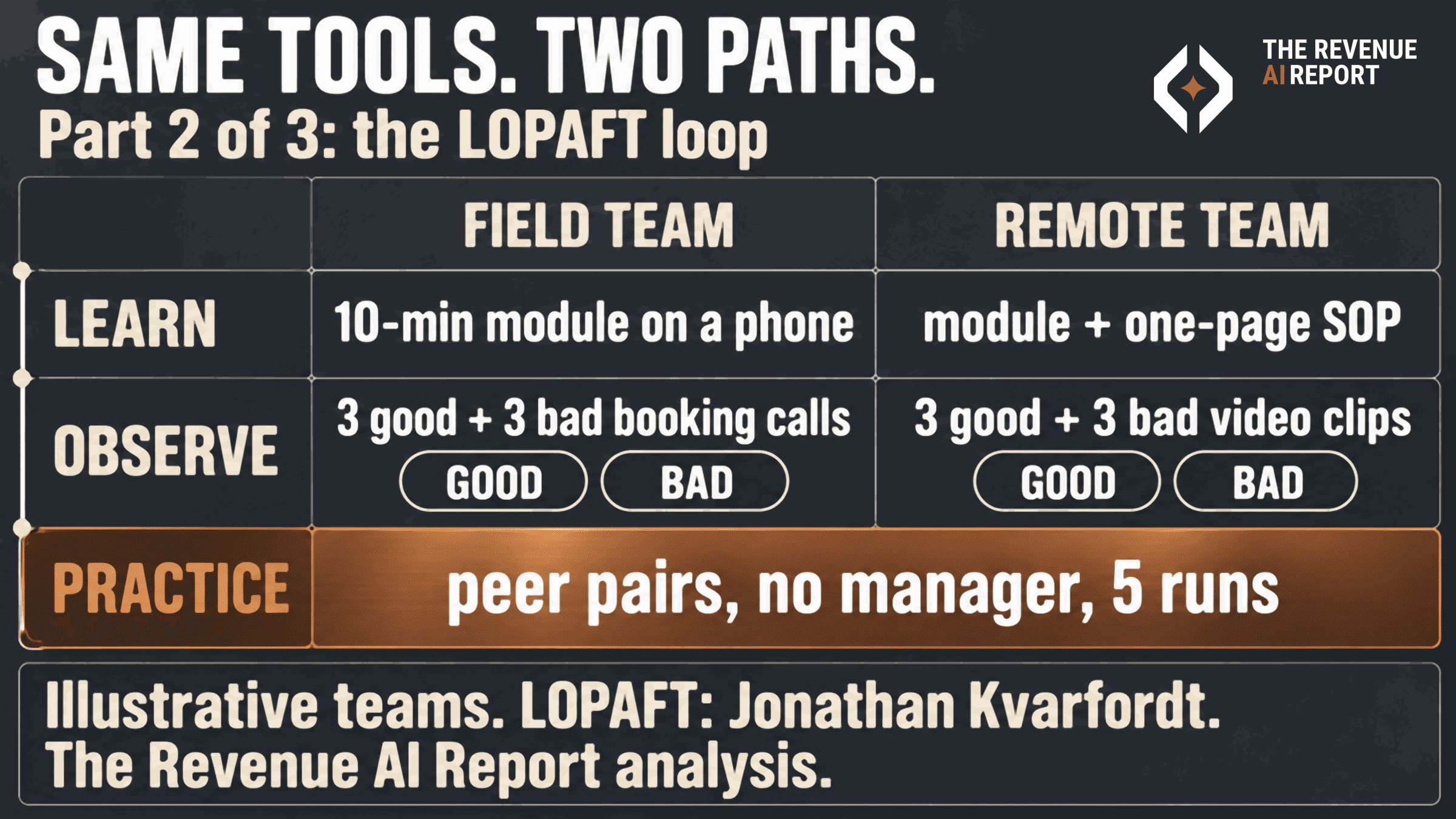
The field team gets a ten-minute version reps can finish on a phone in the truck. The remote team gets the same module plus a one-page written version pinned in the team channel.
O: Observe
People need to see what good looks like and what bad looks like, side by side. A rep who only sees the winning call has nothing to compare their own call against. The framework page says the same: without both, a person cannot tell where they stand.
For the field team, enablement pulls three recorded booking calls where a rep got past "we already have a guy" and set a site walk, and three where the call died. The Monday meeting plays one good and one bad, and a manager adds one ride-along story of each kind.
The remote team works from video. Enablement clips three moments where an AE handled "we'll build it ourselves" and three where the deal stalled, the weekly call plays one of each, and reps vote in chat on what the good rep did in the first 15 seconds.
Both rooms end up on the same question: what did the good rep do that the other one didn't? Once people answer it out loud, the gap is easy to see.
P: Practice
Remember the reps who got laughed at in week two? Version one broke here. A role-play in front of the whole team feels like a performance review with an audience.
Practice needs a safe place to try, fail and try again. No stakes, no judgment, no live customer, and no manager watching.
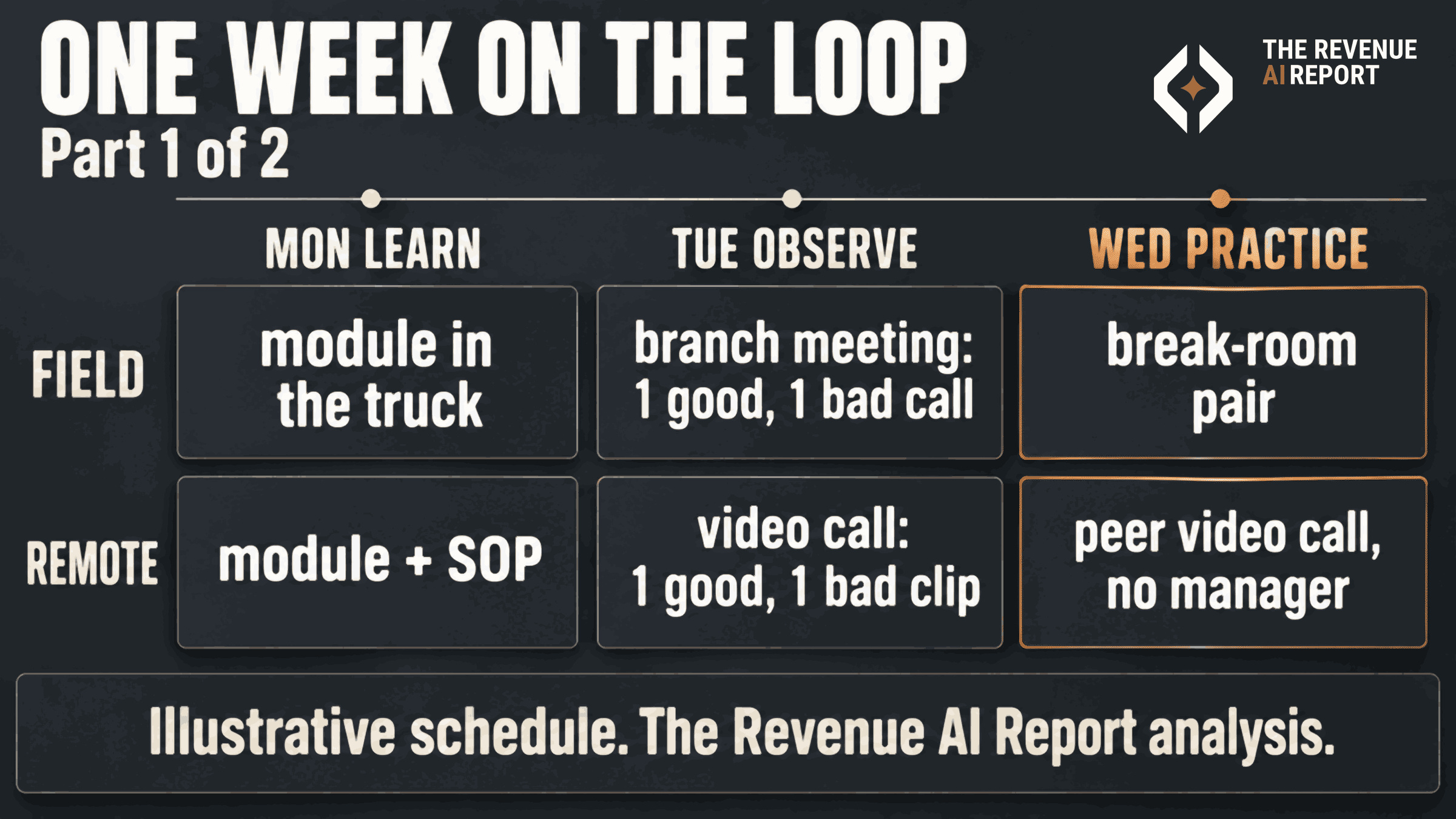
- Field team: pairs of reps take ten minutes in the truck or the branch break room, running the objection five times each and swapping roles.
- Remote team: pairs meet across time zones on a 15-minute video call with no manager invited, using the same five runs and the same swap.
A: Apply
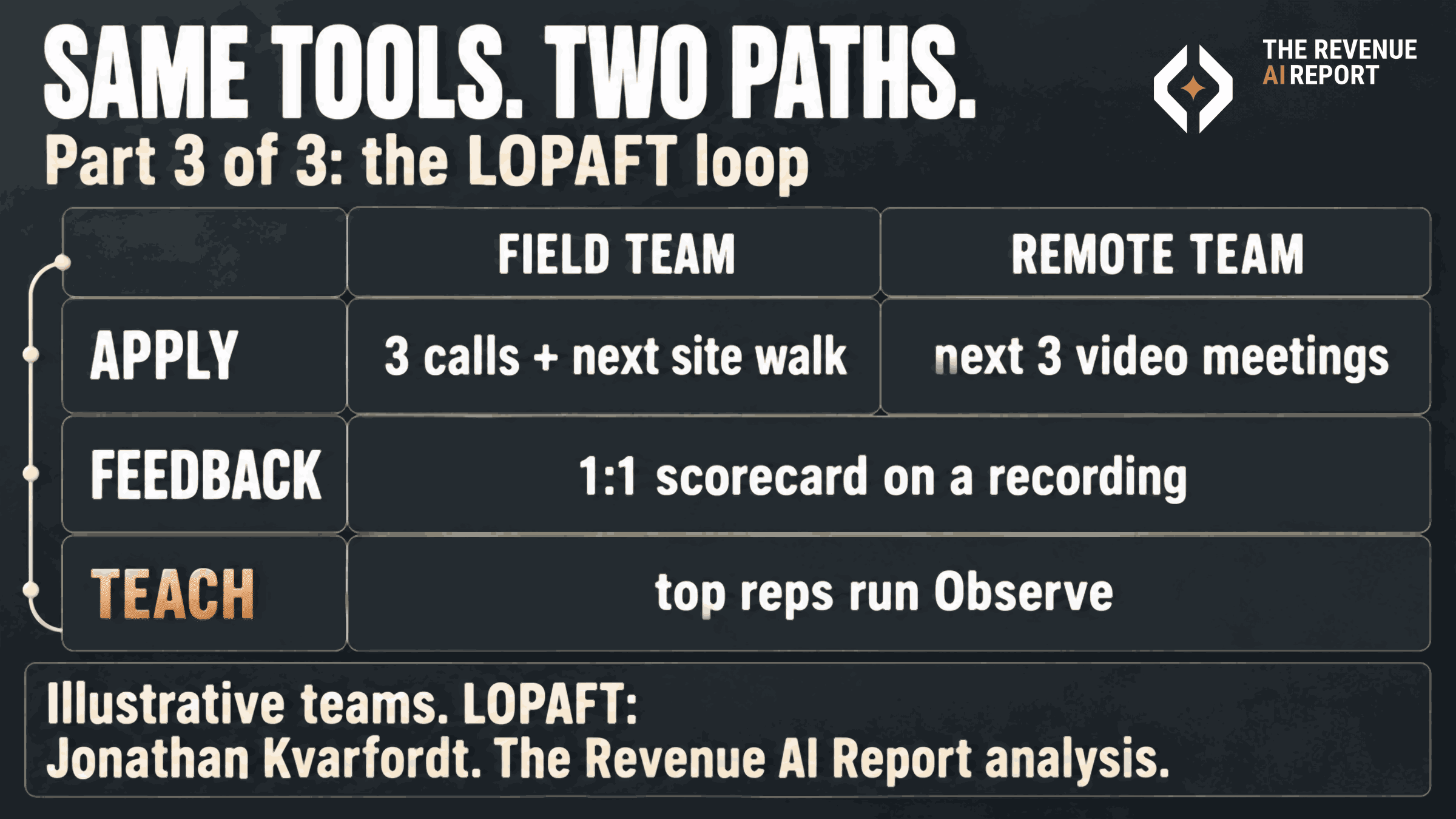
Now it's real deals with real risk. Each rep uses the talk track on the next three conversations that raise the objection. For the field team that means the next three booking calls, plus the next site walk where it comes up in person. The remote team uses it on the next three video meetings, which get recorded the way they always do, so there's nothing new to buy.
F: Feedback
This is where the week-three one-on-ones get fixed. "How did the deal go?" gave the rep nothing to work with. I define this rung as feedback that shows the rep how to improve and match what good looks like, measured against a written standard.
Managers get a one-page scorecard with the three moves from the Learn rung. In each one-on-one, the manager plays one of the rep's recorded attempts and scores it against the card. Keep it private, because feedback in front of peers kills adoption. A field manager scores one recorded booking call and one ride-along moment. A remote manager scores one recorded video meeting, with timestamps, before the one-on-one starts.
The research backs the private, task-focused version. Kluger and DeNisi's 1996 meta-analysis in Psychological Bulletin covered 607 effect sizes and found feedback interventions improved performance on average, and that more than a third of them decreased performance. The authors found effectiveness "decreases as attention moves up the hierarchy closer to the self and away from the task." My read is that a scorecard on three moves keeps attention on the task, while a public critique pulls it toward the rep's sense of self.
T: Teach
By week eight, the two reps on each team with the highest scorecard marks run the Observe segment of the weekly meeting. They pick the good and bad clips and explain the moves. Teaching forces them to name what they do by instinct. That's the rung as I define it: the learner takes what they know and teaches someone else. The skill also stays on the team when one of them leaves.
The loop moves people up the levels of competence
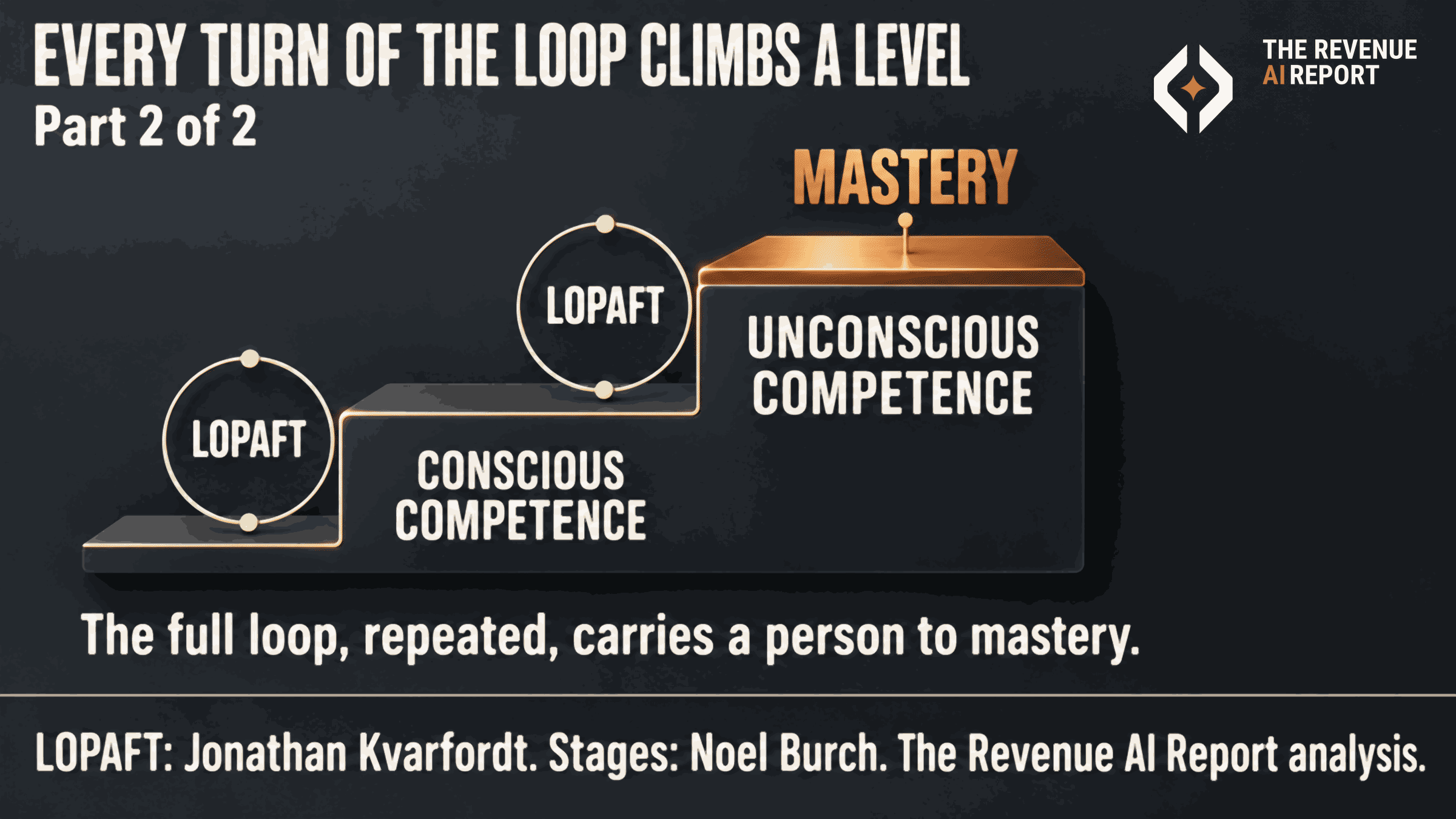
Back to the four stages from the top of this post. In LOPAFT, the whole loop moves a person up a level. Learning the theory starts it: a rep who fumbled the objection without knowing it now knows the gap exists. That is the first step, from unconscious incompetence to conscious incompetence. Each full turn of the loop, from Observe through Teach, carries the rep higher, toward conscious competence and then toward doing it without thinking.
One pass is rarely enough. The field team runs the loop again on the next objection, then circles back to the first one a month later. The remote team does the same. Every turn adds reps, feedback and a chance to teach. Mastery is the goal, and the loop is how you climb to it.
Why most teams stop at Learn
Next, the research on why the extra rungs get skipped and what happens when they don't.
Learn is the only rung that shows up on a dashboard by default. Course completion is easy to count. Observe needs someone to curate good and bad clips. Practice needs scheduled time with no customer. Feedback needs managers who score against a standard. Teach needs leaders willing to hand the microphone to a rep.
Each rung after Learn costs attention, and attention is what enablement teams have least of. So programs run Learn again and call it reinforcement.
The research says the design of training decides its effect. Arthur and colleagues' 2003 meta-analysis in the Journal of Applied Psychology found medium to large effects for organizational training, including a mean d of 0.62 on behavioral criteria across 122 effect sizes, and reported that "the training method used, the skill or task characteristic trained, and the choice of evaluation criteria were related to the effectiveness of training programs." Put simply, how a program is built has a lot to do with whether it works.
So who shapes the design once the module ends? My read is that the manager often does. Sales researcher Dr. Stefanie Boyer of Bryant University has studied how managers shape that. In a 2012 Marketing Management Journal study, she and her co-authors report that "sales managers can have a positive influence on the self-directed learning efforts of salespeople by providing them with self-management training and supervisory support," and that projects "where salespeople can chose [sic] the projects they feel they need" lead to "higher levels of perceived performance" (Boyer et al., 2012).
A second study points the same way. In a 2014 Journal of Marketing Channels study, Boyer and her co-authors, Andrew Artis, David Fleming and Paul Solomon, surveyed 392 insurance salespeople in over 170 firms and found that "salespeople encouraged to use elective SDL projects reported higher levels of performance than those required to use compulsory SDL projects." One caution: both studies measure self-reported performance. For LOPAFT, the lesson sits in Feedback and Teach: the manager's support decides whether reps keep working the skill after the module ends.
Boyer's work also covers practice. A study she co-authored with Jonathan Ross Gilbert in the Journal of Selling tested improv training on confidence and empathy and found "a global benefit of improv training for both women and men" (Gilbert and Boyer, Journal of Selling). Disclosure: Boyer also co-founded RNMKRS, an AI platform for training and assessing sales talent (Bryant University).
There's a limit to what practice can show, though. A 2025 Journal of Selling study by Dover, Freling and Forbes provides "small-sample evidence that student performance in competitive role-play events... does not predict, nor correlate with, student performance in live-selling activities" (Dover et al., 2025). That is why Apply and Feedback follow Practice. A good role-play score earns the rep a live attempt, and the scored live attempt is what shows the skill.
How to run it with what you already have
Here is the whole loop as a checklist. Use it for the next skill either team rolls out.
- Learn: one short LMS module or written SOP. One skill at a time.
- Observe: three good and three bad examples, played in the weekly meeting. Field teams add ride-along stories. Remote teams use recorded video.
- Practice: peer pairs without the manager. Five runs each. Break room or video call.
- Apply: a named number of live attempts by a named date.
- Feedback: a written scorecard, used one-on-one on a real recording.
- Teach: the top performers run the next Observe session.
- Repeat: run the loop again on the same skill a month later.
All of it runs on the weekly meeting, re-cut, and managers given a standard to score against. No new contract.
Where AI speeds up each rung
This section covers how AI tools fit the loop, and where they stop.
AI shortens the time each rung takes and shifts the human role toward judgment: choosing the standard, picking which good and bad examples teach the most, reading the edge cases, deciding what to coach next. A manager who spent an hour finding clips can spend that hour on the one call that needs a human read. The remote team gets the most from this first, because every meeting is already recorded. The field team gets it on phone calls, and still needs ride-alongs for what happens in the lobby.
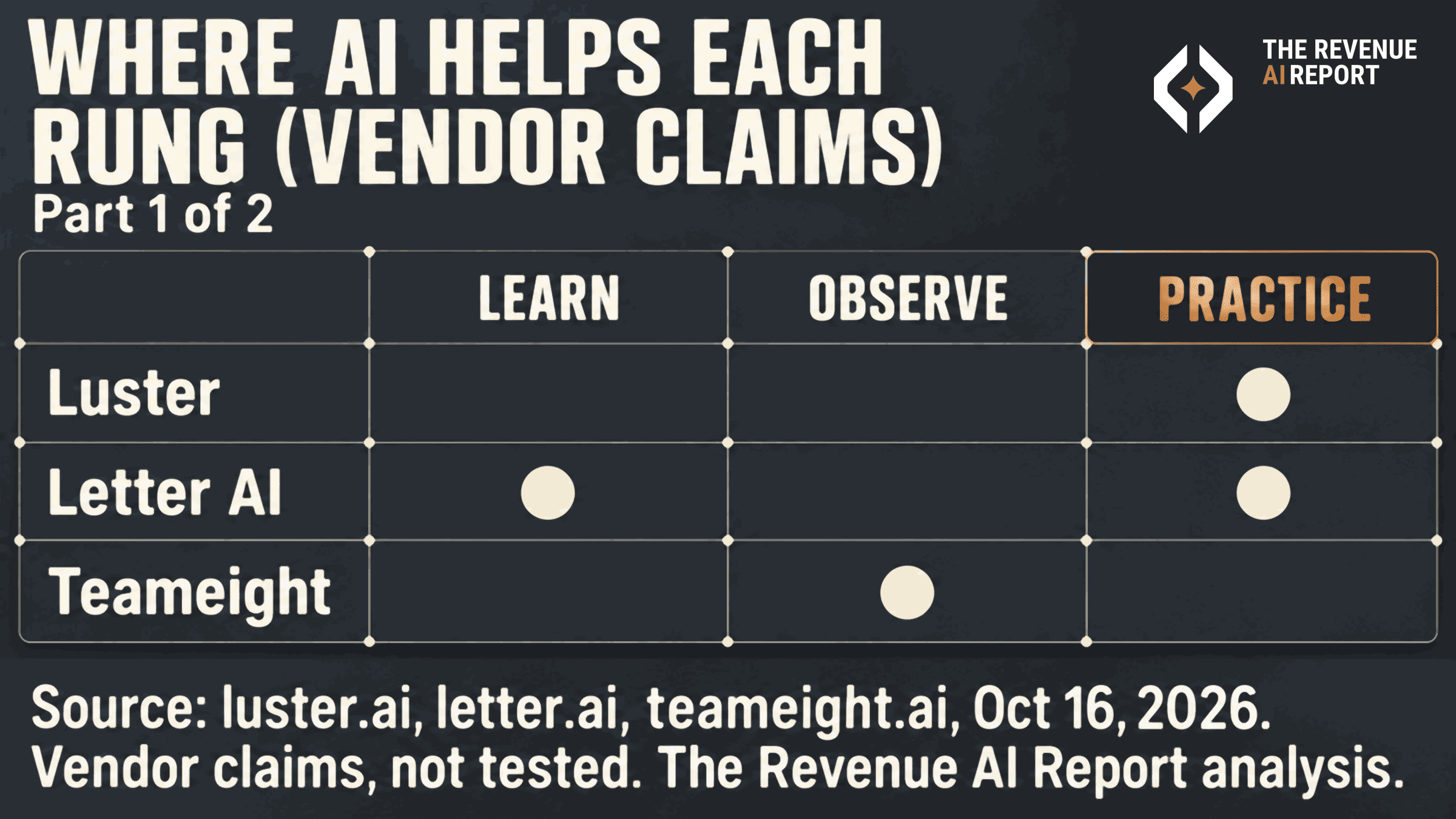
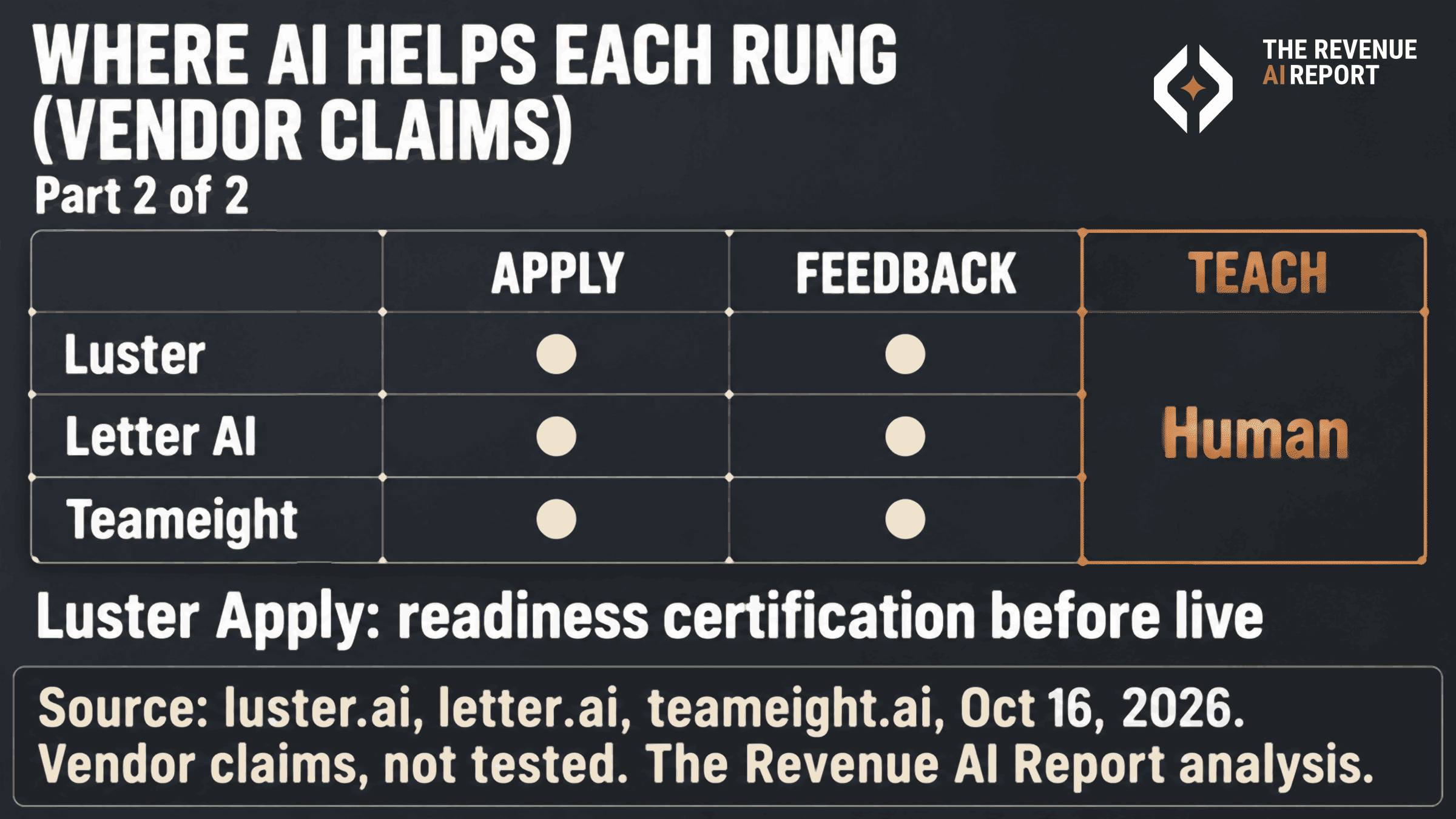
Three products show how this is being sold. Everything in the "vendor claims" lines comes from each company's own homepage, read on October 16, 2026. I have not tested these claims.
Luster (luster.ai)
Vendor claims, from luster.ai: Luster calls itself a "Predictive Enablement" platform. It says it diagnoses skill gaps, predicts readiness risk and prescribes personalized practice before customer conversations. It lists AI roleplay for rehearsing high-stakes scenarios with targeted feedback, readiness certification, AI coaching tools for frontline managers, and a feature called EchoIQ that it says analyzes real customer calls to detect skill application.
Rungs it targets: Practice (roleplay), Feedback (call analysis, manager coaching), and the step from Practice into Apply (readiness certification).
Letter AI (letter.ai)
Vendor claims, from letter.ai: Letter AI describes AI-generated interactive training and "hyper-realistic AI roleplay generated in minutes," content creation and management, an AI agent indexed on company data, conversational intelligence, deal coaching and meeting prep.
Rungs it targets: Learn (generated training and content), Practice (roleplay), Apply (meeting prep, in-deal agent help) and Feedback (conversational intelligence, deal coaching).
Teameight (teameight.ai)
Vendor claims, from teameight.ai: Teameight calls its product an "AI Revenue Team Augmentation Platform." It says its agents surface insight to reps during meetings without a bot joining the call, learn which behaviors move deals forward across the team, and coach reps on those behaviors against the team's latest methodology.
Rungs it targets: Observe (it says it finds the winning moves across real deals), Apply (in-meeting guidance) and Feedback (continuous coaching grounded in real deals).
Where the tools stop
None of the three claims to cover Teach. That rung stays human.
AI roleplay has a ceiling too. A 2025 study in Cognitive Science compared conversations generated by large language models with real human ones. The model conversations showed exaggerated agreement and were dissimilar to human conversations in openings and closings (Cognitive Science, 2025). A property manager who already has a guy is less agreeable than that. A 2025 exploratory study of medical students practicing hard conversations with a voice AI found gains in self-reported confidence, flagged limited emotional range, and positioned AI as a complement to human-run simulation (Cureus, 2025). That study measured confidence. Skill on a live call would need its own test, and the Dover study above suggests role-play scores alone won't supply it.
On feedback, a 2020 meta-analysis in Frontiers in Psychology pooled 435 studies and found "a medium effect (d = 0.48) of feedback on student learning," with impact "substantially influenced by the information content conveyed" (Wisniewski et al., 2020). In other words, what the feedback says matters. An AI score is only as useful as the standard behind it, and a human writes that standard.
Use AI for more Practice reps and faster Feedback. Keep a human reading live calls and deciding what good looks like.
Pick the rung
Take the skill your team trained on last quarter. Score it against the six rungs. Any rung you cannot answer yes to is where you start Monday.
Frequently asked questions
- What does LOPAFT stand for?
- Learn, Observe, Practice, Apply, Feedback, Teach. Six rungs, run as a loop. The full definitions are on the LOPAFT framework page.
- How does LOPAFT relate to the four stages of competence?
- The whole loop moves a person up the levels. Learning the theory takes someone from unconscious incompetence to conscious incompetence. Each full turn of the loop carries them toward conscious competence and, with repetition, unconscious competence, which is mastery.
- Do I need new software to run LOPAFT?
- No. A weekly meeting, recordings, an LMS and managers with a written scorecard cover all six rungs, for an in-person field team or a remote one. AI tools make some rungs faster.
- Why show bad examples in Observe?
- A rep who only sees good calls has nothing to measure their own call against. Seeing good and bad side by side shows the gap, and the gap is what Practice works on.
- Can AI roleplay replace live coaching?
- The evidence says no. Research on model-generated conversation finds it more agreeable than real people, a 2025 study of an AI practice tool measured gains in confidence only, and role-play scores have not predicted live-selling results in at least one small study. AI adds practice reps while a human manager makes the judgment calls on live work.
Keep reading
Playbook
The Reversal Ledger: Counting the AI Decisions Your Team Had to Undo
Every revenue org tracks what AI did. Almost none track what humans had to reverse. That second number is the one that tells you whether your agents are earning trust or borrowing it.
Playbook
Renewal and Expansion Planning When Agents Watch the Account
Risk detection can be automated. The renewal conversation cannot. Here is the split, the four signal classes worth acting on, and a 120-day renewal plan that says exactly which steps a machine owns.