
Where AI Models Stand, October 2026: Who Leads and Why
Meta's Muse Wonder lands near the top. Independent scores, vendor claims, and cost per task across Anthropic, OpenAI, Google, Meta, SpaceXAI and open models.
Jonathan Kvarfordt · Published October 12, 2026 · Last reviewed October 13, 2026 · 7 min read
The short answer
What is the best AI model in October 2026?
Evidence
- The Proof Gap has a measured size Every GTM function adopted AI faster than it produced revenue. One dataset measures both sides in the same sample.
- Is Meta's Muse Wonder better than Claude and GPT? On Meta's own chart, Muse Wonder Full leads on five benchmarks, two of them Meta-built. On the independent Artificial Analysis index it scores 56, two points behind Claude Opus 5.5 and three ahead of GPT-6 Astra.
Last reviewed
Meta shipped a new frontier model on Oct 12. The launch chart says it wins five out of five. The independent board says it is fourth.
Both can be true. Here is what the numbers say, who made them, and what to do with them if you buy or run AI for a revenue team.
The argument
How this reality check breaks down
A map of the sections ahead, in the order the case is made. The sourced charts are in the research library.
Contents diagram for Where AI Models Stand, October 2026: Who Leads and Why, listing the sections: The short version, What Meta released on Oct 12, Where every major lab stands, The counter-view: read launch charts with care, What this means if you buy or run AI for revenue, Bottom line.
The short version
- Top of the independent board: Claude Opus 5.5 scores 58 on the Artificial Analysis Intelligence Index. Muse Wonder Full and Claude Sonnet 5.5 sit at 56. Claude Fable 5.1, GPT-6 Astra and Gemini 4 Argon tie at 53 after rounding, with Fable's unrounded score the highest of the three. (Artificial Analysis, Oct 12, 2026)
- Top of the human-vote board: Gemini 4 Argon leads LMArena's text ranking at 1525, a preliminary score. Claude Opus 5.5 is next at 1507. (LMArena, Oct 8, 2026)
- The new entrant: Meta's Muse Wonder Full leads Meta's own chart on all five benchmarks shown. Two of the five are Meta-built tests. Its lead over the best non-Meta model is 3.9 points on its own Personal Superintelligence Index and 4.8 points on the third-party DeepSWE test.
- Price per job varies a lot: at similar scores, Artificial Analysis lists cost per index task from $0.72 (GPT-6.1 Sol) to $7.63 (Claude Fable 5.1). These cost figures are unconfirmed. (Artificial Analysis, Oct 12, 2026)
- The gap is small: six models sit within five points of the top.
Reality Check
Where AI Models Stand, October 2026: Who Leads and Why
Source-cited charts live in the research library.
Where AI Models Stand, October 2026: Who Leads and Why. Diagram showing Evidence, Analysis, Decision, Outcome.What Meta released on Oct 12
Meta announced Muse Wonder and Muse Wonder Full on October 12, 2026. Muse Wonder is on the Meta Model API and Muse Code. Muse Wonder Full is only in Muse Code for subscribers, with no API yet. (Meta Newsroom, Oct 12, 2026)
API price for Muse Wonder is $4 per million input tokens and $20 per million output tokens. (Artificial Analysis via Techmeme, Oct 12, 2026) That matches Claude Opus 5.5's list price of $4 and $20. (Anthropic, Sep 22, 2026)
Meta's launch chart (vendor-reported)
All values come from Meta's charts, at max reasoning effort. Values marked * were read off the chart image. Sources: Meta's research blog and model card, Oct 12, 2026.
| Benchmark | Who built it | Muse Wonder Full | Muse Wonder | Claude Opus 5.5 | GPT-6 Astra | Claude Fable 5.1 |
|---|---|---|---|---|---|---|
| Personal Superintelligence Index | Meta (internal composite) | 59.1 | 54.3* | 55.2 | 54.5 | 49.9* |
| MemoryBench | Meta (internal) | 85.5 | 85.6 | 81.5 | 81.4 | 79.0 |
| SWE-Marathon | Abundant AI | 57.5 (xhigh) | 53.1 | 46.3 | 42.5 | 45.6 |
| DeepSWE v1.1 | Datacurve | 79.0 | 78.8 | 74.2 | 74.1 (OpenAI-reported) | 67.4* (Anthropic-reported) |
On DeepSWE, the GPT-6 Astra and Claude Fable 5.1 scores were reported by OpenAI and Anthropic and compiled by Meta; the other three come from Datacurve, per Meta's model card.
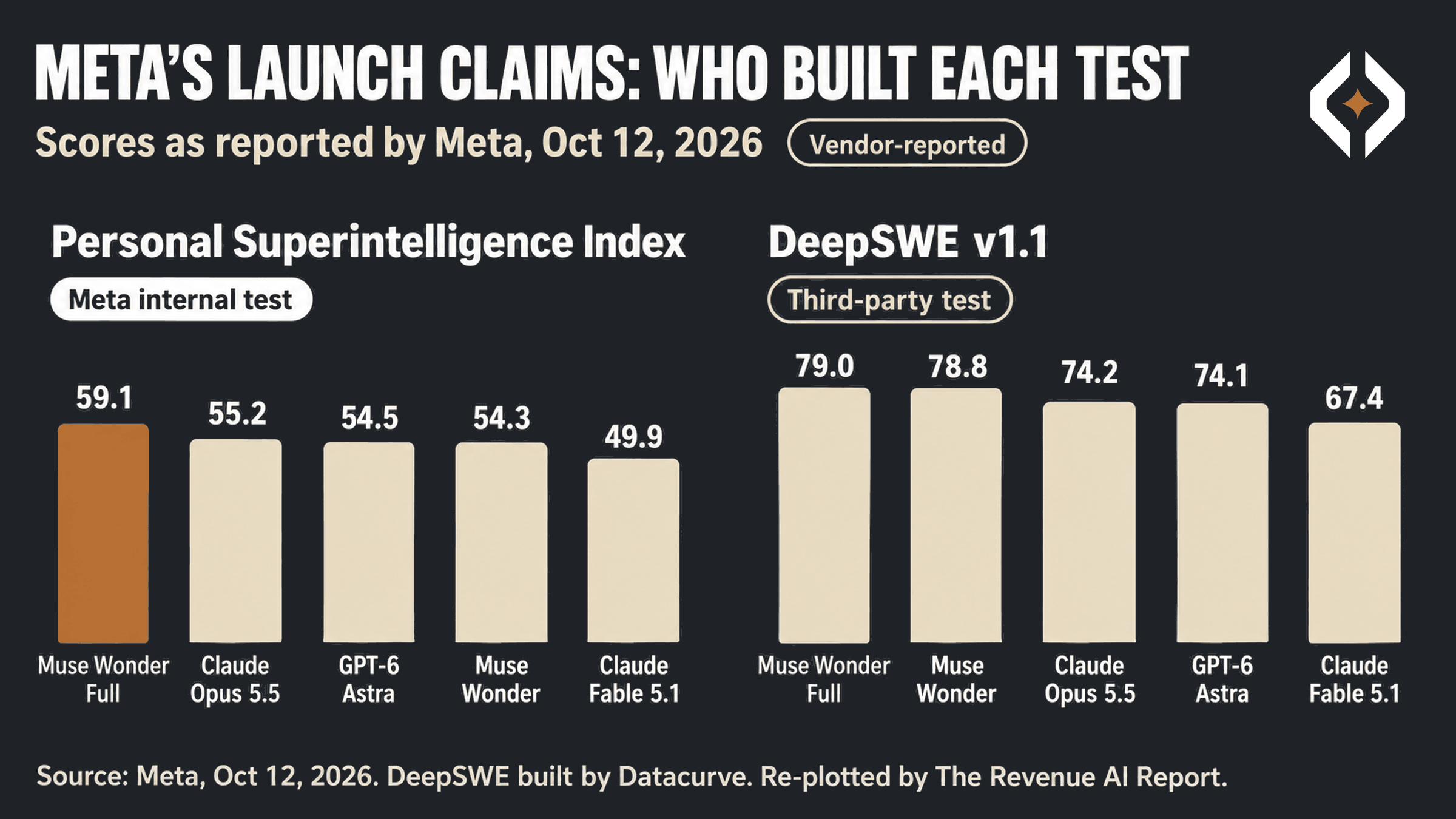
Meta's own model card also shows where it does not lead. Claude Opus 5.5 wins ProgramBench (70.5 vs 59.0) and OSWorld V2.1 computer use (81.8 vs 78.4). (model card, via AgentOne summary, Oct 12, 2026)
What independent testers found
Artificial Analysis posted results the same day. Muse Wonder Full scores 56, tied for second. Muse Wonder, the version you can buy through the API, scores 52. (Artificial Analysis, Oct 12, 2026)
Artificial Analysis also found a weak spot. On its knowledge test, AA-Omniscience, Muse Wonder Full scores 30. Claude Opus 5.5 scores 46, GPT-6 Astra 43, Gemini 4 Argon 42. It notes the Meta model also has a very low hallucination rate. (Artificial Analysis via Techmeme, Oct 12, 2026)
Vals AI says Muse Wonder Full debuts at #5 on its Vals Index. (Vals AI on X, Oct 12, 2026)
Where every major lab stands
Scores below are the Artificial Analysis Intelligence Index v4.3, checked Oct 12, 2026. Cost per task is as listed by Artificial Analysis and not yet confirmed. One source, one method, same tests for everyone. (Artificial Analysis)
| Lab | Best model on the board | Index score | Cost per index task (unconfirmed) | Status |
|---|---|---|---|---|
| Anthropic | Claude Opus 5.5 (max) | 58 | $5.98 | Released Sep 22, 2026 (Anthropic) |
| Meta | Muse Wonder Full (max) | 56 | not listed | Released Oct 12; API version scores 52 at $4.52 per task |
| OpenAI | GPT-6 Astra (max) | 53 | $3.26 | Preview Sep 3, public Sep 4, 2026 (OpenAI) |
| OpenAI | GPT-6.1 Sol (max) | 52 | $0.72 | Newest OpenAI model per OpenAI |
| Gemini 4 Argon (high) | 53 | $1.99 | Generally available Oct 13, 2026: Gemini API, Gemini for business, Gemini app (Ultra/Pro); $2/$10 per 1M tokens through Nov 30, then $4/$20 (Google) | |
| SpaceXAI (formerly xAI) | Grok 4.7 (xhigh) | 46 | $3.74 | Released Sep 21, 2026 (SpaceXAI) |
| Xiaomi | MiMo-V2.6-Pro | 46 | $0.13 | Top open-weights model on the board |
| Alibaba | Qwen3.8 Max | 45 | $5.41 | |
| DeepSeek | DeepSeek V4.1 Flash (max) | 39 | $0.27 | |
| Mistral | Mistral Large 4 Preview | 38 | $1.13 |

Two things stand out. The top three US labs plus Meta are packed within five points. Open-weights models trail the top by about 12 points, at a fraction of the cost.
The counter-view: read launch charts with care
Meta picked the tests, and wrote two of them. The Personal Superintelligence Index is "an internal composite of seven personal and knowledge-work evaluations." MemoryBench is "an internal benchmark." (Meta model card, Oct 12, 2026) Nobody outside Meta can rerun them yet.
Meta says how it chose scores. Where no third-party result exists, Meta uses "the highest of our internally validated run, self-reported score, or official leaderboard score." It also says competitor runs "may not be optimally tuned for proprietary models." (Meta model card) That is honest disclosure. It also means the rival bars are not a clean, same-setup test.
One row is not apples to apples. Meta's card says the SWE-Marathon results for GPT-6 Astra and Claude Fable 5.1 ran in Codex and Claude Code, "so this row is not a controlled common-harness comparison." (Meta model card)
Every lab does this. Each launch shows the tests where the new model looks best. Meta's chart is a normal example of the practice.
Many benchmarks stop telling models apart. A 2026 study of 60 widely used benchmarks found "nearly half" show saturation, and the share rises as benchmarks age. (Akhtar et al., arXiv 2602.16763, Feb 2026)
Test leakage is real and hard to catch. A 2026 review of contamination research found reported effects of roughly 6% to 40% on major benchmarks, and no detection method that works in every setting. (GEM 2026 review)
Even the independent board has caveats. Artificial Analysis runs its own tests, but its index is still a blend of tests. A 2-point gap at the top is close enough that your own workload will decide more than the ranking.
What this means if you buy or run AI for revenue
- Ask for the independent score first. When a vendor pitches "built on the newest model," ask which one, and check it on Artificial Analysis or LMArena. Treat a vendor's own composite index as marketing until someone else reruns it.
- Price the job. Cost per completed task is the number that matters. At similar scores, the listed spread is about 10x (unconfirmed). A team running thousands of account research or call-summary jobs a month will feel that.
- Check what you can actually use. Gemini 4 Argon went generally available on Oct 13 at an intro API price of $2/$10 per million tokens that doubles to $4/$20 on Dec 1, so price any plan at the Dec 1 rate. Muse Wonder Full has no API. A top score you cannot buy is not in your plan this quarter.
- Test on your own work. Pick three real tasks: a renewal brief, a pipeline review summary, a campaign brief from messy notes. Run two or three models side by side. Score on accuracy, edits needed, and cost.
- Plan to switch. Five labs announced new top models between Sep 3 and Oct 12. Contracts and tools that lock you to one model age fast. Ask vendors if you can swap the model underneath.
- Mind the knowledge gap. Muse Wonder Full scores lower on general knowledge in independent testing. For work that leans on facts, such as market research or competitor briefs, give any model your own sources and check the output.
Bottom line
Meta is now in the top group. Anthropic still holds the top independent score. Google's Argon leads on human votes and is now generally available, at an intro price that doubles Dec 1. OpenAI has the cheapest near-frontier option per task on Artificial Analysis's listed costs. The spread at the top is small. Your costs and your own tests should drive the choice more than any one chart.
Want this kind of read every week, with the receipts? Subscribe to The Revenue AI Report.
Take it to the room
The short list from this piece
Pulled from the argument above, written so you can read it out in a pipeline or board review.
Checklist diagram summarising Where AI Models Stand, October 2026: Who Leads and Why: Ask for the independent score first; Price the job; Check what you can actually use; Test on your own work; Plan to switch.Frequently asked questions
- What is the Personal Superintelligence Index?
- An internal Meta composite of seven evaluations, per Meta's model card. Outside groups have not yet rerun it.
- Which frontier model is cheapest to run?
- Among models scoring 52 or higher on the Artificial Analysis index, GPT-6.1 Sol has the lowest listed cost per index task at $0.72, per Artificial Analysis (unconfirmed).
- Should revenue teams trust vendor benchmark charts?
- Use them as a starting point. Check independent results, then test on your own tasks and price the cost per completed job.
Subscribe
Get the next Reality Check before you sign the order form.
Keep reading
Reality Check
AI Review Time Is a Line Item. Price It and Name the Owner.
On TextQL's Argo-Bench the best AI model fully solved 34.8% of 210 data tasks. Put review time and a named owner into your AI business case.
Reality Check
Call Center Headcount Is Falling. Can You Prove AI Did It?
Revelio Labs says global call-center headcount is 5.3% below its Dec 2023 peak. Revelio: "The decline is surely multifaceted." How to test your own org.