
AI Review Time Is a Line Item. Price It and Name the Owner.
On TextQL's Argo-Bench the best AI model fully solved 34.8% of 210 data tasks. Put review time and a named owner into your AI business case.
Jonathan Kvarfordt · Published October 12, 2026 · 8 min read
The short answer
What is Argo-Bench?
Evidence
- The Proof Gap has a measured size Every GTM function adopted AI faster than it produced revenue. One dataset measures both sides in the same sample.
- How did the best model score on Argo-Bench v1.1? Claude Opus 5.5 scored 95 or higher on 34.8% of tasks and averaged 59.5 points out of 100, the top result among 13 leaderboard models.
Last reviewed
Ask AI which deals close this quarter. You get a clean report in a minute. It counts a deal that slipped to next quarter and misses a discount that changes the value. Your analyst rebuilds it by hand. The tool finished the report. Your team finished the work.
Review time costs money. So does the person who keeps the workflow running. Both belong in the business case before anyone signs.
The argument
How this reality check breaks down
A map of the sections ahead, in the order the case is made. The sourced charts are in the research library.
Contents diagram for AI Review Time Is a Line Item. Price It and Name the Owner., listing the sections: What Argo-Bench measured, The Proof Gap, Price the review: a worked example, Fund the builder, Order Form lines, Eight-Seat Read.What Argo-Bench measured
TextQL, which sells a data-agent platform, built Argo-Bench to test AI agents on realistic analyst work [Verified primary]. Version 1.1 has 210 tasks across trust and safety, marketplace operations, FP&A, accounting, and growth. The setting is a simulated New York food-delivery platform with 81 million orders in 2024, stored in a 235-table warehouse modeled on Oracle E-Business Suite with about 7.5 billion rows [Verified primary]. Agents take actions, such as banning fraud accounts or filing forecasts, and the grader scores each action by its consequences in the simulation.
A task counts as solved at 95 out of 100 or higher. The top model, Claude Opus 5.5 at its highest reasoning setting, solved 34.8% of tasks and averaged 59.5 points. Eight of the thirteen models on the leaderboard average under 30 [Verified primary].
Reality Check
AI Review Time Is a Line Item. Price It and Name the Owner.
Source-cited charts live in the research library.
AI Review Time Is a Line Item. Price It and Name the Owner.. Diagram showing Evidence, Analysis, Decision, Outcome.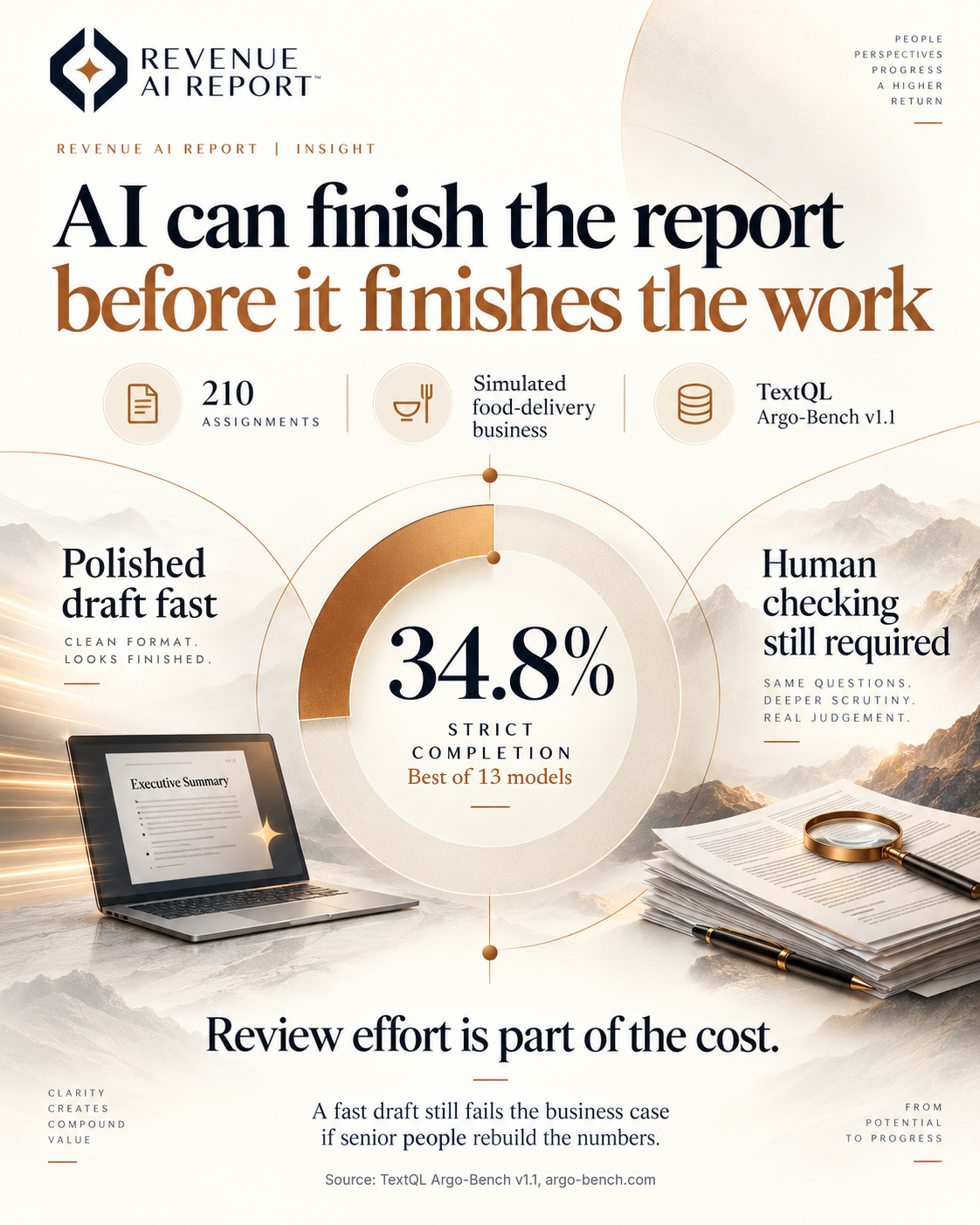
Three findings from the paper map straight onto revenue work [Verified primary]:
- Right shape, wrong numbers. Across dashboard tasks, 66.9% of the data tables that passed their format check scored zero on their values. The tile looked finished. The figures were wrong.
- Confident forecasts miss. Forecasts filed with an 80% range contained the actual value 44.8% of the time.
- Business rules decide the answer. In one membership task, 24 failing runs read membership off contract dates. The passing runs replayed billing history and caught a seven-day grace period. Your pipeline report has rules like that in every stage definition.
The benchmark compares agents and makes no estimate of performance on a real company's warehouse. The simulated warehouse is also deliberately clean, with no drifted or duplicate tables [Verified primary]. Your CRM has both.
The Proof Gap
What the benchmark shows: on hard, multi-step data work in one vendor-built simulated business, the best model fully solved about one task in three, with partial credit on many more.
What a buyer still needs:
- Review and correction minutes per output, measured on your own records.
- The error types that hurt you: wrong record, wrong rule, wrong quantity.
- Behavior on missing data and exceptions, including when the tool stops and asks.
- The loaded cost of whoever checks the work.
Model cost is the small number. Claude Opus 5.5 averaged $4.71 of model API spend per task, warehouse queries excluded [Verified primary]. A few minutes of a senior analyst costs more than that.
Price the review: a worked example
All numbers below are hypothetical. Swap in your own.
Your team handles 500 inbound requests a month. Preparing each account takes 15 minutes, checking included. At an assumed $60 an hour loaded cost, that is 125 hours, valued at $7,500 a month.
AI cuts hands-on time to 6 minutes per request, corrections included. That is 50 hours, or $3,000. Add an assumed $1,000 monthly software and usage bill: $4,000 total. The monthly difference is $3,500. A $6,000 setup pays back in about 1.7 months, in value of time.
Now let review creep to 10 minutes. Labor rises to $5,000, the total to $6,000, the difference falls to $1,500, and payback stretches to 4 months.
Breakeven review time = current minutes − (monthly tool cost ÷ (monthly volume × loaded cost per minute)).
Here: 15 − (1,000 ÷ (500 × $1)) = 13 minutes. Above 13 minutes of hands-on time per request, the tool costs more each month than the old process, before setup. Put that number in the pilot plan.
Then run the cash view. If payroll stays flat, you added a $1,000 monthly bill and a $6,000 setup, and you freed 75 hours. Finance needs to hear what those hours buy: an avoided hire, more qualified pipeline, or a deliberate service upgrade. More on separating those claims in Three Tests Before Your Next AI Purchase.
Fund the builder. Name the owner.
On October 2, 2026, Anthropic committed $100 million to Claude Frontier Academy, aiming to train 10,000 "Frontier Deployed Engineers" by the end of 2027 [Vendor-reported; 10,000 is a target]. Nominated engineers arrive with a named project to lead. After an in-person program that walks a simulated deployment from use case through security review to handover, they spend a 12-week residency leading a real use case at their own company [Verified primary].
A model maker is spending nine figures on the people who put AI into production. Put that person's hours in your budget. If they already carry a full load, decide what stops. A new "AI owner" title with the same workload leaves the project competing with everything else.
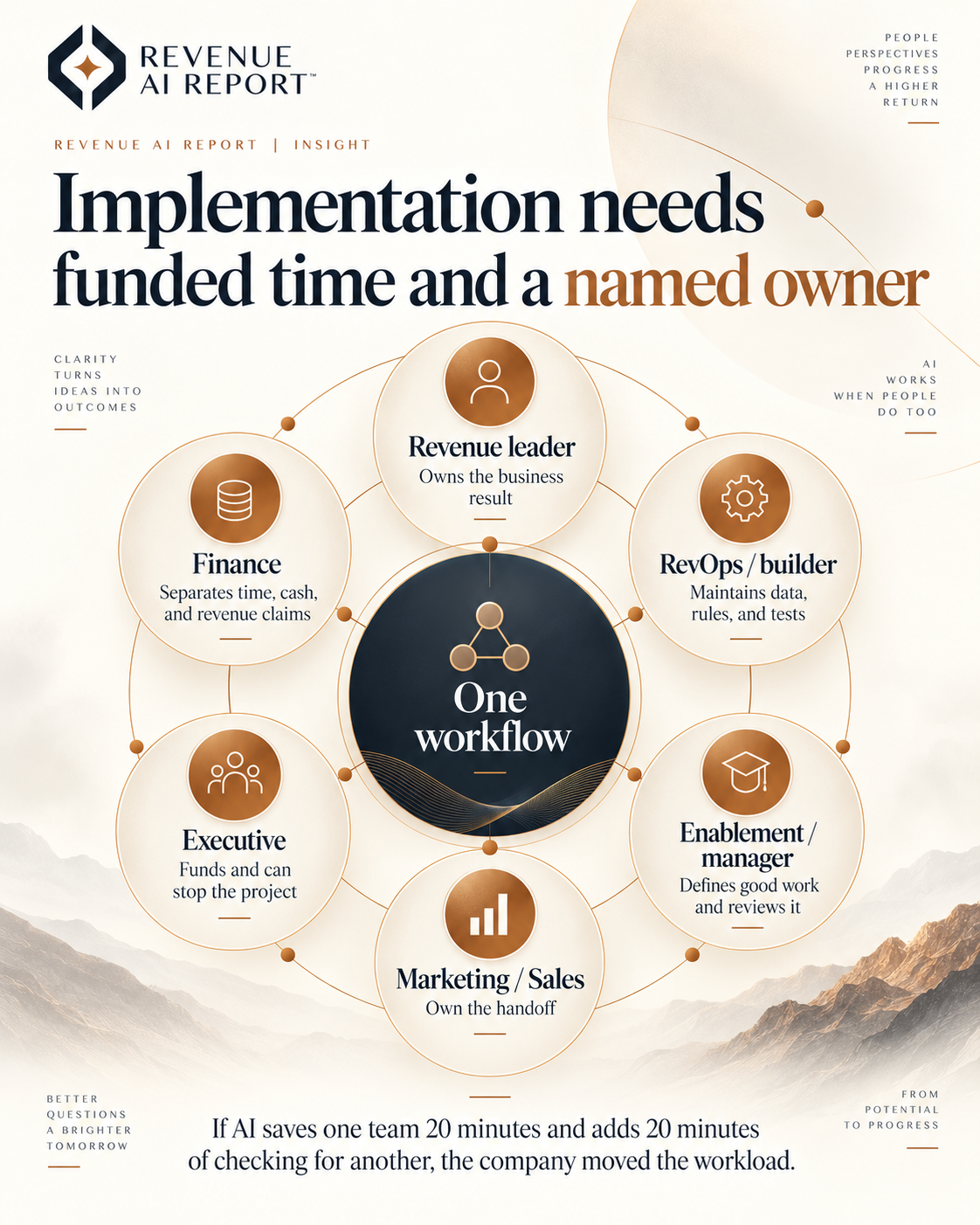
Measure across teams. If AI saves a seller 20 minutes and adds 20 minutes of checking in RevOps, the company moved the workload. If accuracy also improves, claim that benefit by name.
Set authority to match supervision. Keep external messages, prices, and commitments behind approval. Log what data the tool used, what it did, and who approved it. Retest when the model, instructions, connectors, or business rules change.
Review weekly: rejected outputs, repeated corrections, open exceptions, wait time. Fix the shared process so reps stop solving the same problem in private chat windows.
Order Form lines
Buyer advisory. Fill the brackets and take them to your AE and legal.
- Your-data acceptance test. "Before signature, Vendor runs [20+] redacted Buyer cases, including incomplete records, exceptions, and escalation cases. Buyer reviewers log correction minutes per case."
- Review-time ceiling. "If average review and correction time exceeds [breakeven minutes] per item for two consecutive months, Buyer may [pause / reduce scope / exit] without penalty."
- Authority tiers. "The service may read and draft. Customer messages, pricing, and commitments require named human approval until Buyer signs off on [test]."
- Action log. "Vendor retains inputs used, actions taken, and approver for each action for [N] days, exportable on request."
- Retest on change. "Vendor gives [N] days notice before model, instruction, or connector changes. Buyer may rerun the acceptance test before the change applies."
- Named owner and hours. "Buyer names an owner with [X]% allocated time. Vendor commits [N] implementation hours through go-live."
Eight-Seat Read
- CEO: Fund the builder's time with the license. Give one owner authority to stop a weak workflow.
- CFO: Ask for breakeven review minutes on every AI case. Challenge any case that assumes zero checking.
- CRO: Judge the tool on the forecast or deal job you need done. A leaderboard rank is background.
- CMO: Check AI-built dashboards on values, beyond format. A tidy tile with wrong numbers misleads the funnel.
- RevOps: Own the acceptance cases, the correction log, and the retest trigger. Count work pushed onto your team.
- Sales leader: Track minutes reps spend fixing AI output. That number decides the return.
- CS leader: Keep customer-facing sends behind approval until error rates on your cases are known.
- Enablement: Teach reviewers what to check: the record, the rule, the quantity. Turn repeated fixes into process changes.
Why we might be wrong
- Models improve fast. On the same leaderboard, Claude Sonnet 5.5 solved 28.6% of tasks; its predecessor, Claude Sonnet 5, solved 9.5% [Verified primary]. A year from now 34.8% may look quaint.
- Argo-Bench tasks are harder than most revenue workflows. An account brief carries far less risk than a fraud ban.
- Partial credit has value. A draft that saves ten minutes after review can justify its price at a modest score.
- The benchmark is vendor-built. TextQL sells a data-agent platform built around business context, so it has a stake in showing that raw models struggle without that context.
Sources
- Argo-Bench site (TextQL), v1.1 leaderboard and versions: argo-bench.com (read Oct 7, 2026)
- Tomitsuka et al., "Argo-Bench: Evaluating Data Agents on Enterprise-Scale Workflows," arXiv:2610.02122, TextQL: arxiv.org/abs/2610.02122 (read Oct 7, 2026)
- Anthropic, "Anthropic invests $100 million to train 10,000 engineers and tackle the enterprise AI talent gap," Oct 2, 2026: anthropic.com/news/claude-frontier-academy (read Oct 7, 2026)
Get the weekly read on where AI is moving revenue. Subscribe to the Report.
Take it to the room
The short list from this piece
Pulled from the argument above, written so you can read it out in a pipeline or board review.
Checklist diagram summarising AI Review Time Is a Line Item. Price It and Name the Owner.: Argo-Bench site (TextQL), v1.1 leaderboard and; Tomitsuka et al., "Argo-Bench: Evaluating Data; Anthropic, "Anthropic invests $100 million to train.Frequently asked questions
- How do you include review time in AI ROI?
- Measure hands-on minutes per item, including checking and corrections, on your own records. Compare against the breakeven: current minutes minus monthly tool cost divided by volume times loaded cost per minute.
- Who should own an AI workflow in a revenue team?
- One named owner with funded time and authority to pause it, backed by RevOps for data and tests and enablement for review standards.
- What contract terms limit AI review cost?
- A your-data acceptance test, a review-time ceiling, approval tiers for customer-facing actions, an action log, retest on model changes, and committed implementation hours.
Subscribe
Get the next Reality Check before you sign the order form.
Keep reading
Reality Check
Call Center Headcount Is Falling. Can You Prove AI Did It?
Revelio Labs says global call-center headcount is 5.3% below its Dec 2023 peak. Revelio: "The decline is surely multifaceted." How to test your own org.
Reality Check
Where AI Models Stand, October 2026: Who Leads and Why
Meta's Muse Wonder lands near the top. Independent scores, vendor claims, and cost per task across Anthropic, OpenAI, Google, Meta, SpaceXAI and open models.