
Three Tests Before Your Next AI Purchase: Result, Trust, Ownership
Before you buy AI, answer three questions: what result improves, how much checking remains, and who owns it. Proof rules and Order Form lines inside.
Jonathan Kvarfordt · Published October 12, 2026 · 8 min read
The short answer
What are the three tests before buying an AI tool?
Evidence
- The Proof Gap has a measured size Every GTM function adopted AI faster than it produced revenue. One dataset measures both sides in the same sample.
- What did Barclays report about its AI deployment? Per Anthropic's October 1, 2026 announcement, more than 16,000 Barclays colleagues have adopted a Claude-powered knowledge assistant that has handled over one million searches, and a Global Markets system routes about 120,000 emails a day. The announcement publishes no handling-time, accuracy, cost, or ROI figures.
Last reviewed
A rep spends a quarter tuning prompts, skill files, and agents. At quarter end the win rate, cycle time, and revenue match everyone else on the team. That is a hobby with a software bill.
Every AI purchase should clear three tests. Result: what business outcome improves? Trust: how much checking remains after the tool finishes? Ownership: who runs it, approves it, and fixes it when it breaks? Ask all three before the purchase, during the pilot, and again at renewal.
The argument
How this reality check breaks down
A map of the sections ahead, in the order the case is made. The sourced charts are in the research library.
Contents diagram for Three Tests Before Your Next AI Purchase: Result, Trust, Ownership, listing the sections: Test 1: Result, Adoption at scale is a signal, The Proof Gap, Time, cash, and revenue need separate proof, Tests 2 and 3: Trust and Ownership, Order Form lines.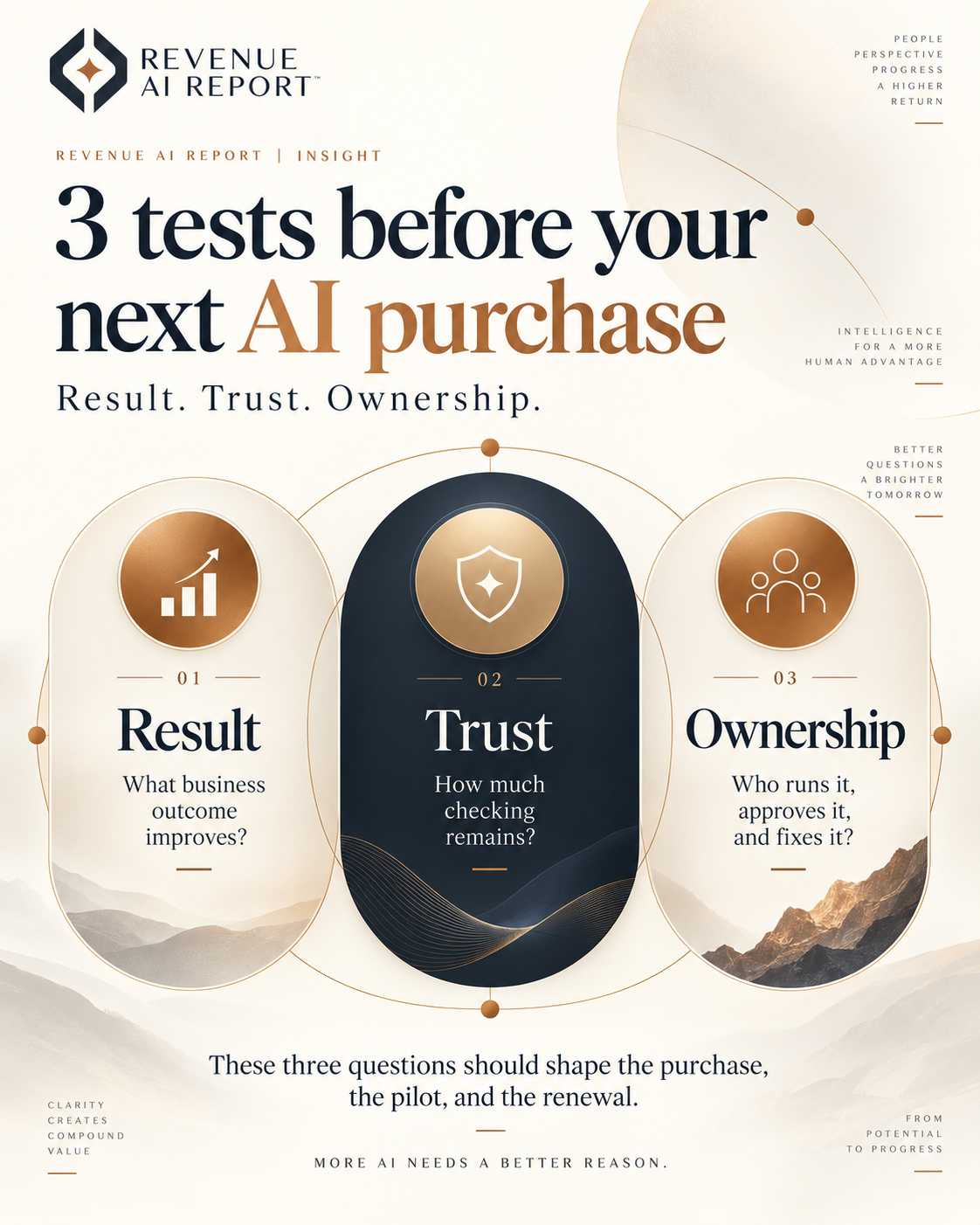
Test 1: Result. Start from the number.
Work backward from the outcome. If the goal is more qualified opportunities, find where good prospects stall. If the goal is lower cost, name the expense line that will move. If the goal is faster customer response, measure from the customer's question to a correct answer, including the time spent checking and fixing.
Reality Check
Three Tests Before Your Next AI Purchase: Result, Trust, Ownership
Source-cited charts live in the research library.
Three Tests Before Your Next AI Purchase: Result, Trust, Ownership. Diagram showing Evidence, Analysis, Decision, Outcome.Take an inbound request. The rep searches account history, checks ownership, and asks three colleagues what was promised last time. Each step is reasonable. Together they leave the buyer waiting. AI can assemble that brief in minutes. If the request then sits a day in an approval queue, the customer sees almost no change, and the next dollar belongs on the approval step.
Check the data first. If the CRM names one account owner and the territory rules name another, the system needs a written tie-break rule and a person who keeps it current.
Adoption at scale is a signal. Outcome data is the proof.
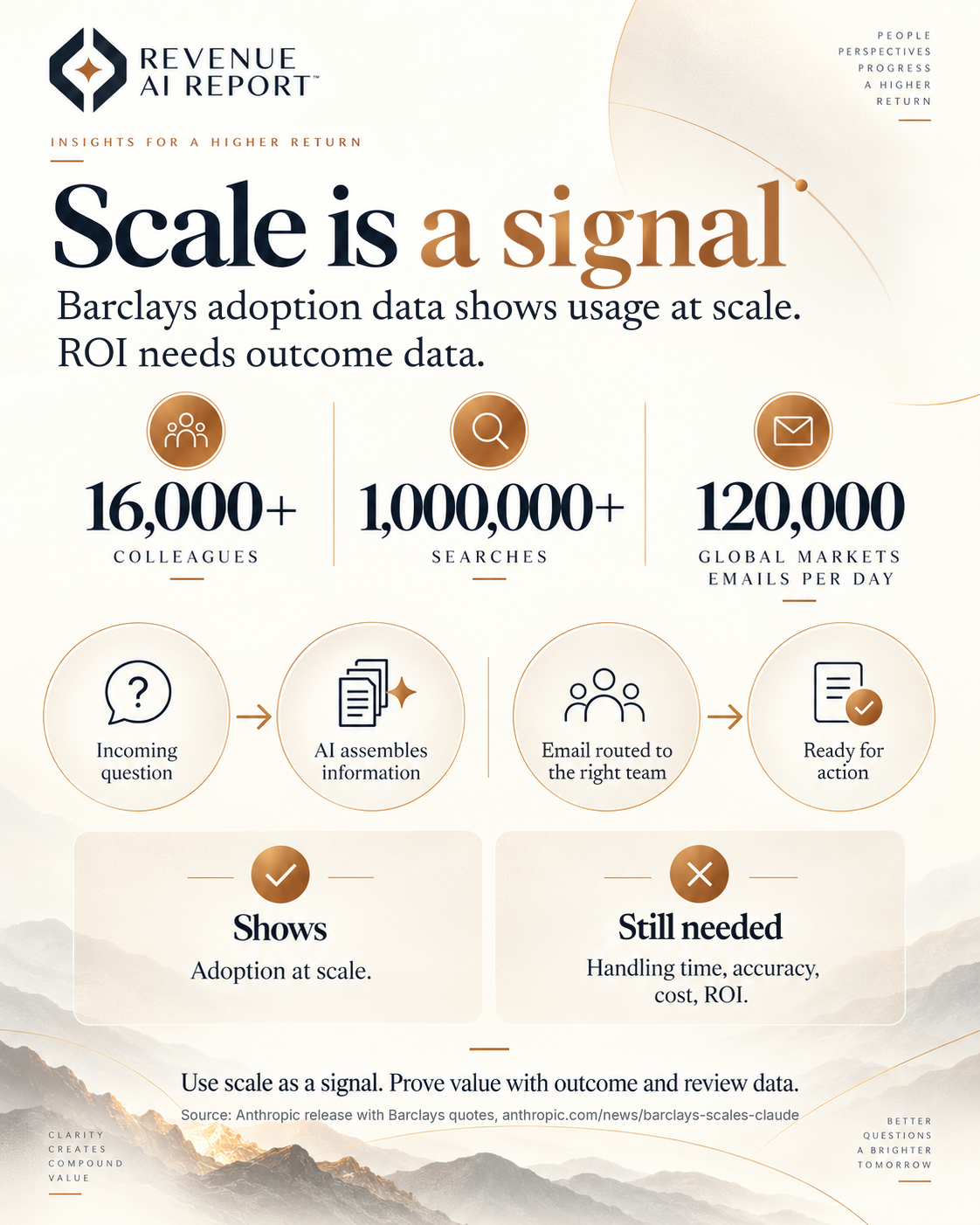
On October 1, 2026, Anthropic announced an expanded deployment at Barclays. The Colleague Knowledge Assistant, live since 2025, has been adopted by more than 16,000 colleagues and has handled over one million searches [Vendor-reported]. A separate Global Markets system classifies, enriches, and routes approximately 120,000 incoming emails a day [Vendor-reported]. The announcement says the work brings faster access to information and reduces manual handling. It publishes no figures for handling time, accuracy, cost, or return [Verified primary].
That is still a strong signal. A regulated bank runs both systems in production at volume. It is also a clean template for the questions a buyer should ask any vendor holding up a usage number.
The Proof Gap
| What the claim shows | What a buyer still needs |
|---|---|
| 16,000+ colleagues adopted the assistant | Weekly active share, and handle time per customer query before and after |
| 1,000,000+ searches handled | Answer accuracy on a sampled set, and repeat searches per question |
| ~120,000 emails a day classified and routed | Misroute rate, time to first action, rework by the receiving team |
| "Reduced manual handling" | Hours removed, where those hours went, and whether any expense changed |
Survey data shows the same gap at market level. BearingPoint surveyed 1,050 C-suite executives and senior leaders in 13 countries in August 2026. Among the 685 organizations that had implemented AI, 24% reported cost reductions of at least 10%, and 4% reported revenue or service-delivery gains of at least 10% [Self-reported survey]. Only 13% scaled AI fully in line with the original business case. Among the most mature group, 70% link most AI projects to financial KPIs; among "Implementers," 34% do [Self-reported survey].
The group that scales best is the group that ties AI to a financial number. Start there.
Time, cash, and revenue need separate proof
A tool that saves a seller an hour has created an hour. To claim a financial return, show what happened to it.
- Time recovered. The seller spends the hour preparing for complex accounts or following up with qualified buyers. Track whether that work happens and whether opportunities progress faster.
- Cash saved. A contractor bill, overtime, or a planned hire goes away because the work is covered. Finance confirms the expense changed and service quality held.
- Revenue added. More customers buy, expand, or stay. Compare similar groups where you can, and adjust for pricing, demand, and account mix.
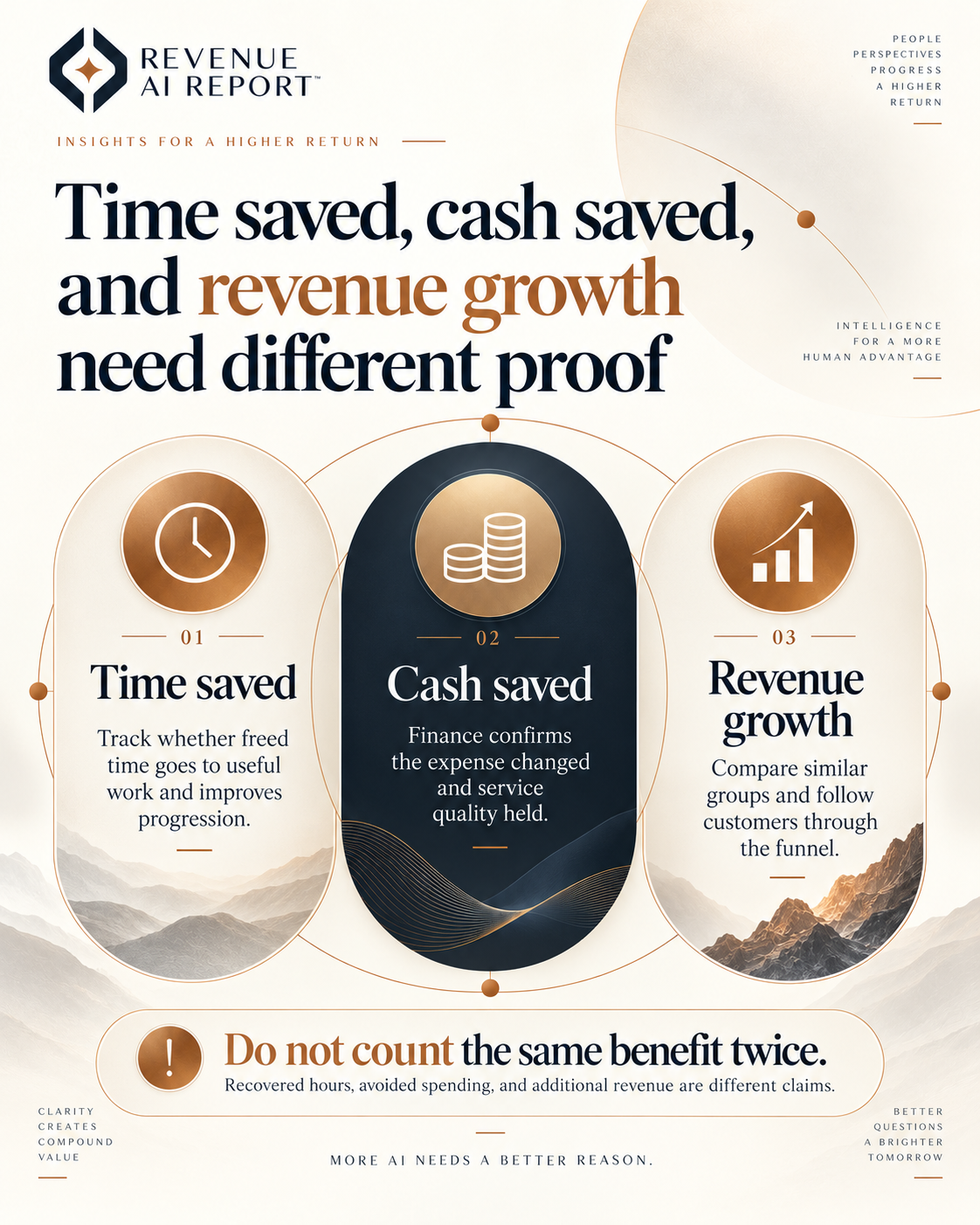
Count each benefit once. If the seller uses the hour to work more deals, the salary stays on payroll. Booking that hour as cash saved and also booking the resulting revenue overstates the return.
BearingPoint's respondents show why this matters: 62% say AI has already created workforce overcapacity of at least 10% [Self-reported survey]. That capacity is time. It becomes cash or revenue only when a manager decides what it buys. We covered where recovered hours leak in The Reinvestment Gap.
Tests 2 and 3: Trust and Ownership
Trust is the checking that remains. A fast draft still loses money if a senior analyst rebuilds every number. Ownership is the named person who maintains the data, approves actions, and can stop the workflow. Both carry cost, and both belong in the business case. The companion piece covers the review math and the owner model in detail: AI Review Time Is a Line Item.
Order Form lines
Buyer advisory. Fill the brackets, then put them in front of your AE and legal.
- Locked baseline. "Before go-live, Buyer records [metric] for [N] weeks from [system of record]. Success is measured against that baseline."
- One label per benefit. "Each claimed benefit is labeled time recovered, expense avoided, or revenue added, and counted in one category only."
- Outcome reporting. "Vendor reports monthly: volume, accuracy on a sampled set of [N] items, handling time, and correction hours, alongside usage."
- Checking time in the pilot. "Pilot results include human review and correction minutes per item, logged by the Buyer's reviewers."
- Owner and stop rule. "Buyer names one owner with authority to pause the workflow. The pilot pauses on [unauthorized disclosure, unauthorized action, or correction cost above $X per month]."
- Renewal gate. "Renewal at the committed rate applies after Buyer confirms [metric] moved [X%] against baseline. Below that, the term converts to [month-to-month / reduced scope]."
Eight-Seat Read
- CEO: Fund one workflow with one result. Agree up front what the pilot can prove and what needs a longer run.
- CFO: Split every AI case into time, cash, and revenue lines. Reject any case that books the same hour twice.
- CRO: Choose the deal problem first. Require a manager plan for recovered time before it becomes a revenue target.
- CMO: Follow the buyer through the new experience. Track qualified progression and where people drop.
- RevOps: Resolve conflicting ownership and definitions before you automate them. Own the baseline.
- Sales leader: Name the work the freed hours will fund and check weekly that it happens.
- CS leader: Track whether issues stay resolved and whether customers repeat themselves. A fast close that triggers a second ticket costs more.
- Enablement: Teach reps what to check in AI output and when to escalate. Feed repeated corrections back into the shared process.
Why we might be wrong
- Sustained adoption by 16,000 people may itself be good evidence of value. People drop tools that waste their time.
- Some value never reaches a ledger. Better service and faster answers can justify a tool before Finance can see it.
- The BearingPoint figures are self-reported, and the 4% growth figure blends revenue with service delivery. Real revenue impact may be higher, or lower.
- A two-week pilot cannot show revenue lift in a nine-month sales cycle. Demanding it early can kill a good tool.
Sources
- Anthropic, "Barclays scales Claude to upgrade operations and improve client experience," Oct 1, 2026: anthropic.com/news/barclays-scales-claude (read Oct 7, 2026)
- BearingPoint, "AI delivers value, but only 13% of organizations scale it as planned," Oct 1, 2026: bearingpoint.com (read Oct 7, 2026)
Get the weekly read on where AI is moving revenue. Subscribe to the Report.
Take it to the room
The short list from this piece
Pulled from the argument above, written so you can read it out in a pipeline or board review.
Checklist diagram summarising Three Tests Before Your Next AI Purchase: Result, Trust, Ownership: Anthropic, "Barclays scales Claude to upgrade; BearingPoint, "AI delivers value, but only 13% of.Frequently asked questions
- How should a business case separate time saved from cash saved?
- Time saved is recovered hours. Cash saved needs Finance to confirm a real expense changed. Revenue needs a comparison group. Label each benefit once.
- What share of companies report revenue gains from AI?
- In BearingPoint's August 2026 survey, 4% of organizations that had implemented AI reported revenue or service-delivery gains of at least 10%, and 24% reported cost reductions of at least 10%. Results are self-reported.
- What contract terms help prove AI ROI?
- A locked baseline, one label per benefit, monthly outcome reporting, logged review time, a named owner with a stop rule, and a renewal gate tied to the metric.
Subscribe
Get the next Reality Check before you sign the order form.
Keep reading
Reality Check
Call Center Headcount Is Falling. Can You Prove AI Did It?
Revelio Labs says global call-center headcount is 5.3% below its Dec 2023 peak. Revelio: "The decline is surely multifaceted." How to test your own org.
Reality Check
Where AI Models Stand, October 2026: Who Leads and Why
Meta's Muse Wonder lands near the top. Independent scores, vendor claims, and cost per task across Anthropic, OpenAI, Google, Meta, SpaceXAI and open models.