
GitHub Copilot “Default” Code Review Flips to Balanced Today: Dual Meters (AI Credits + Actions Minutes) with No Disclosed Model on the Review Path
Effective Mon Sep 28, 2026 MT, Copilot code-review Default resolves to Balanced. Explicit Lite is not auto-switched. Private-repo reviews burn AI Credits and Actions minutes together. Map pool math, paid-usage default-on, Actions budgets, attribution, and a named kill-switch owner.
Jonathan Kvarfordt · Published September 28, 2026 · 8 min read
The short answer
If our Copilot code-review default is still "Default," which Order Form / budget lines now burn when Balanced reviews auto-fire (AI Credits, Actions minutes, or both), and who owns the kill switch?
Decision rule
Refuse unsigned Default-left-on posture. Confirm org/repo effort (Default = Balanced as of Sep 28, 2026 MT), set explicit Lite where that is accepted cost posture, disable paid usage if you refuse overage, name AI Credits and Actions budget owners, and fill the accepted-outcome blank or flag Proof Gap.
Evidence
- https://github.blog/changelog/2026-08-28-upcoming-changes-to-github-copilot-policies-and-billing/
- https://github.blog/changelog/2026-08-07-copilot-code-review-effort-levels-are-generally-available/
- https://github.blog/changelog/2026-04-27-github-copilot-code-review-will-start-consuming-github-actions-minutes-on-june-1-2026/
- https://docs.github.com/en/copilot/concepts/billing/usage-based-billing-for-organizations-and-enterprises
- https://docs.github.com/en/copilot/reference/copilot-billing/models-and-pricing
- https://docs.github.com/en/copilot/concepts/agents/code-review
Operator action
Today: audit org + repo review effort (Default = Balanced), set explicit Lite where accepted, confirm paid-usage policy, set AI Credits and Actions budgets with named owners, and fill the accepted-outcome blank before leaving Balanced auto-fire on private repos.
Last reviewed
GitHub Copilot "Default" code review flips to Balanced today: dual meters (AI Credits + Actions minutes) with no disclosed model on the review path
Effective Monday Sep 28, 2026 MT, a Copilot code-review effort value of Default resolves to Balanced. Explicit Lite (org or repo setting away from Default) is not auto-switched. GitHub respects that selection (Upcoming changes to GitHub Copilot policies and billing, 28 Aug 2026).
The argument
How this reality check breaks down
A map of the sections ahead, in the order the case is made. The sourced charts are in the research library.
Contents diagram for GitHub Copilot “Default” Code Review Flips to Balanced Today: Dual Meters (AI Credits + Actions Minutes) with No Disclosed Model on the Review Path, listing the sections: GitHub Copilot Default Balanced code review Order Form, Copilot AI Credits Actions minutes dual meter, Copilot Business 1900 Enterprise 3900 AI credits, Copilot-pull-request-reviewer Actions minutes.If your org or repo still shows Default, Balanced reviews can auto-fire on private repos and burn both meters: AI Credits (tokens for the review itself) and Actions minutes (agentic context / tool use via `copilot-pull-request-reviewer` / `dynamic/agents/copilot-pull-request-reviewer`). Public-repo Actions minutes stay free. Do not treat "we bought Copilot seats" as unlimited Balanced review headroom.
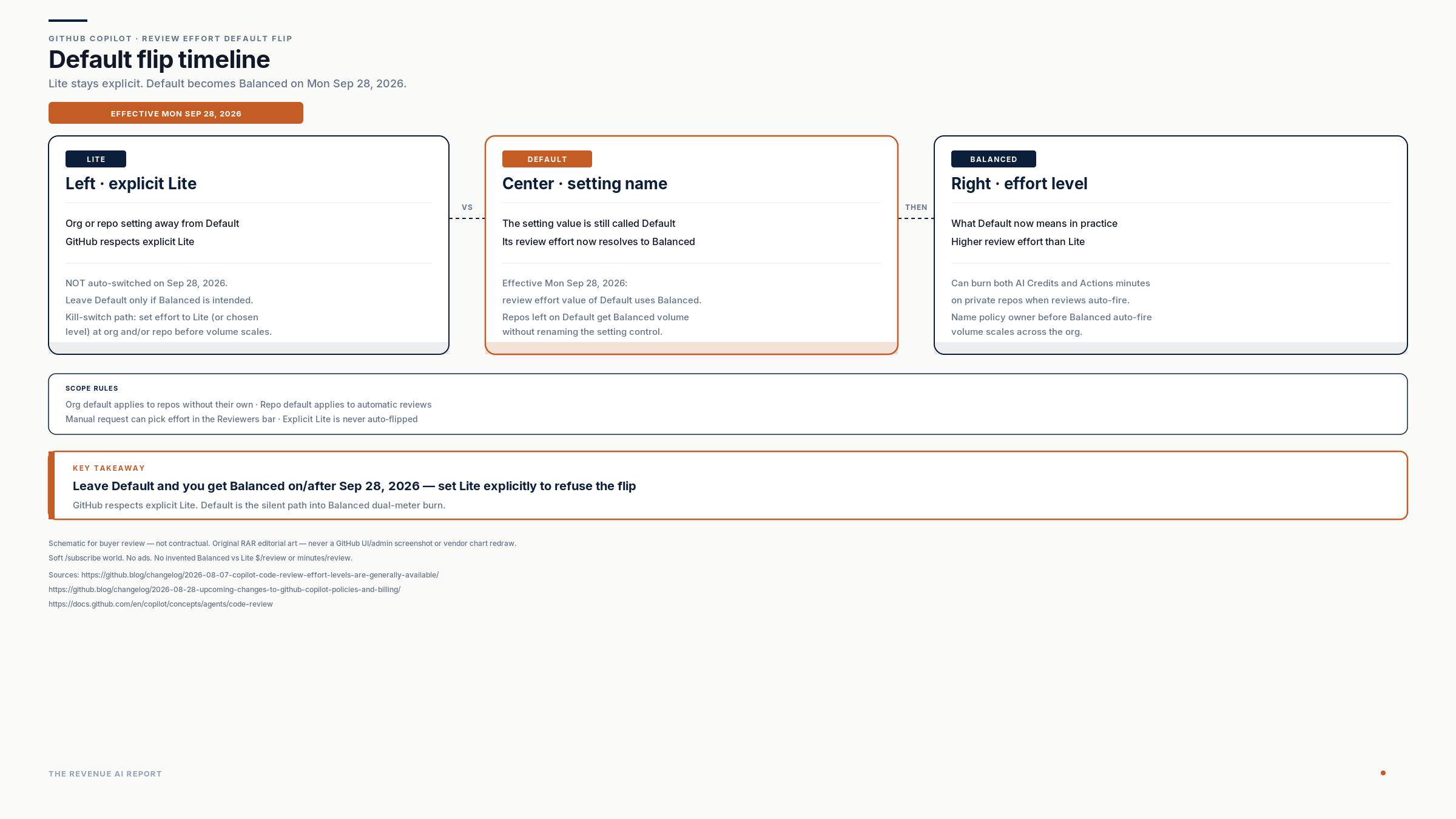
Dual meters on private-repo reviews (docs; HIGH confidence)
Reality Check
GitHub Copilot “Default” Code Review Flips to Balanced Today: Dual Meters (AI Credits + Actions Minutes) with No Disclosed Model on the Review Path
Source-cited charts live in the research library.
GitHub Copilot “Default” Code Review Flips to Balanced Today: Dual Meters (AI Credits + Actions Minutes) with No Disclosed Model on the Review Path. Diagram showing Evidence, Analysis, Decision, Outcome.Per GitHub Copilot code review will start consuming GitHub Actions minutes (in effect since 1 Jun 2026) and Models and pricing:
- AI Credits: tokens for the code review. The published conversion is 1 credit = $0.01. This does not establish a fixed $/review.
- Actions minutes: context gathering and tool use run via `copilot-pull-request-reviewer` / `dynamic/agents/copilot-pull-request-reviewer` on private repos.
- Public repositories: Actions minutes remain free for these reviews.
- Runners: self-hosted runners do not consume Actions minutes; larger GitHub-hosted runners bill at a higher per-minute rate.
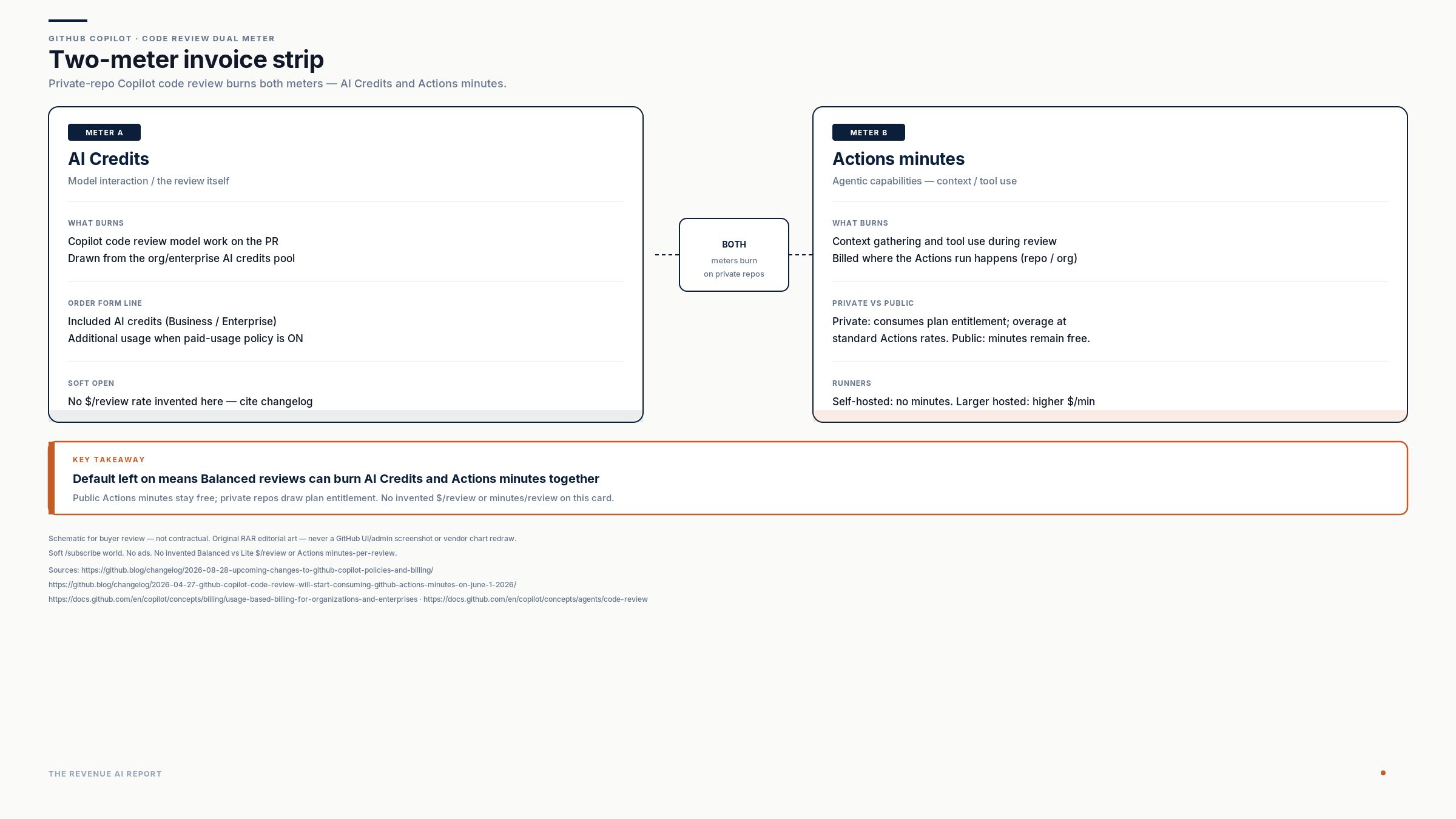
Soft open HIGH: model auto-selected, not disclosed
GitHub auto-selects the code review model and does not disclose a fixed model on the review path (About GitHub Copilot code review; Models and pricing). Per-token charges can vary. Do not invent a Balanced vs Lite dollar-per-review number. Measure your own usage before budgeting volume.
Pool math (Business / Enterprise)
The published AI Credits billing rules put included credits into a shared billing-entity pool. This is not a private wallet for each user:
- Copilot Business: 1,900 AI credits per user per month contribute to the shared pool.
- Copilot Enterprise: 3,900 AI credits per user per month contribute to the shared pool.
- Conversion: 1 AI credit = $0.01 for additional-usage math, not a promise of one review for one credit.
- Reset: unused credits do not roll over. The monthly allowance resets at 00:00:00 UTC on the 1st.
Completions and next-edit suggestions do not burn AI Credits. Agentic paths, including code review, draw from the pool. Seat count times included credits establishes the balance; it does not establish a number of reviews.
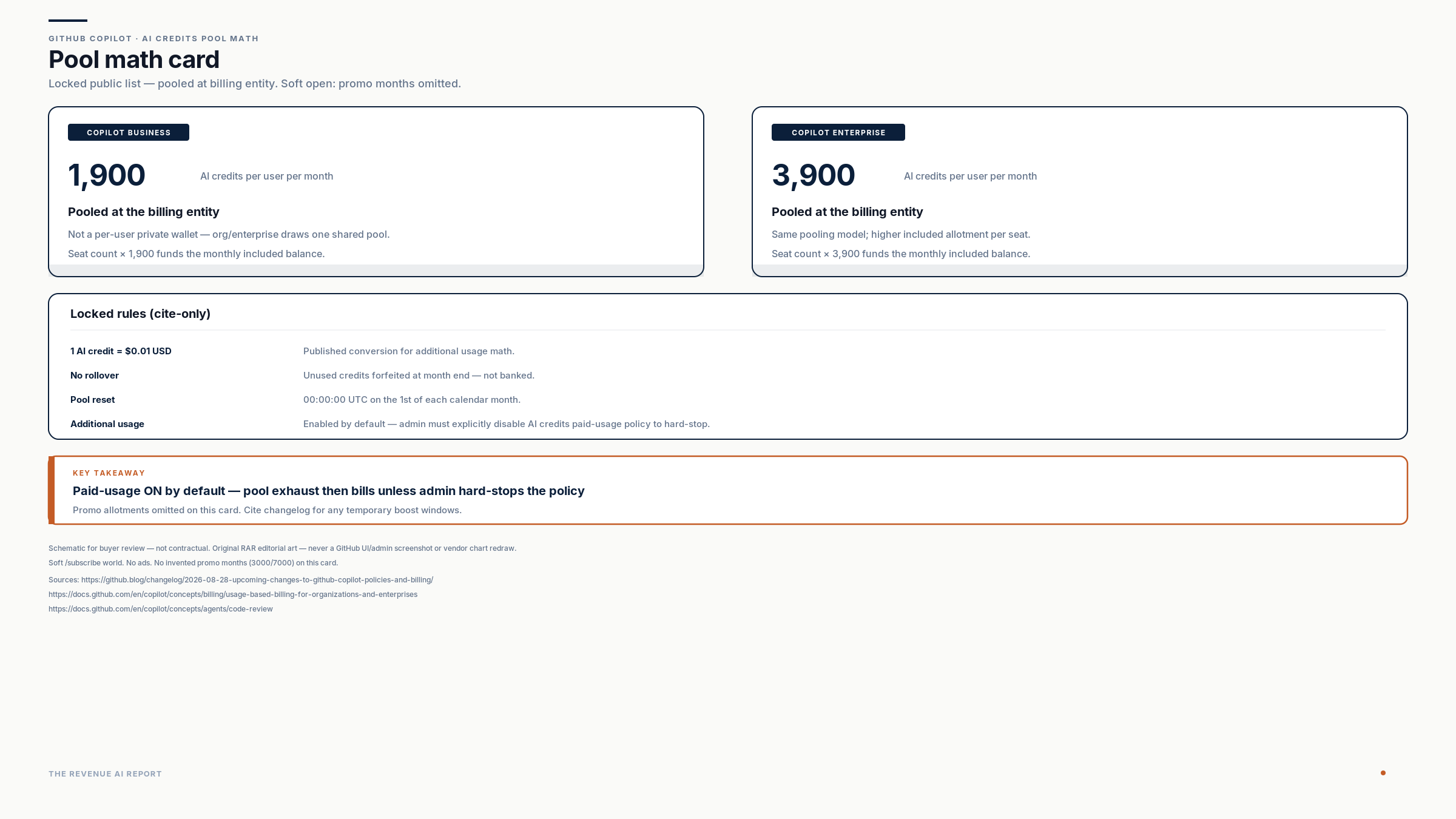
Kill switch #1: Additional usage default-on
Additional AI Credits usage is enabled by default under the usage-based billing policy. Disable the paid-usage policy if you refuse overage; otherwise spend can continue beyond the included pool until another configured cap intervenes. Write the policy state and the AI Credits budget owner down before volume scales.
Kill switch #2: set default to explicit Lite
Changing nothing is a choice: Default now means Balanced. Set the org or repo effort explicitly to Lite when that is the accepted cost posture. GitHub respects an explicit selection. Manual reviews can choose effort in the Reviewers bar (Code review effort levels are generally available; Aug 28 policy change). Name the GitHub admin who can make and audit this setting.
Kill switch #3: Actions budgets (separate meter)
Actions minutes are a separate billing and budget line from AI Credits on private repositories. Set Actions budgets and spend limits independently, including the repo or cost-center owner. Exact minutes per review depend on runner and work performed, so minutes/review remains blank until your own usage shows it. Do not use an AI Credits cap as a substitute for the Actions budget (Actions minutes change).
Attribution (who gets the bill)
AI Credits follow the person who triggered a manual review, or the PR author for an automatic review. When that author has no billable seat, usage can land on enterprise or cost-center additional usage; bot-authored and cloud-agent PRs can bill the organization. Confirm the exact attribution on your billing export, not a per-seat assumption (Usage-based billing).
Actions minutes follow the repository where the review runs, then its organization or enterprise allocation. That resource path is separate from the AI Credits attribution path; join both in the same chargeback review (Actions minutes change).
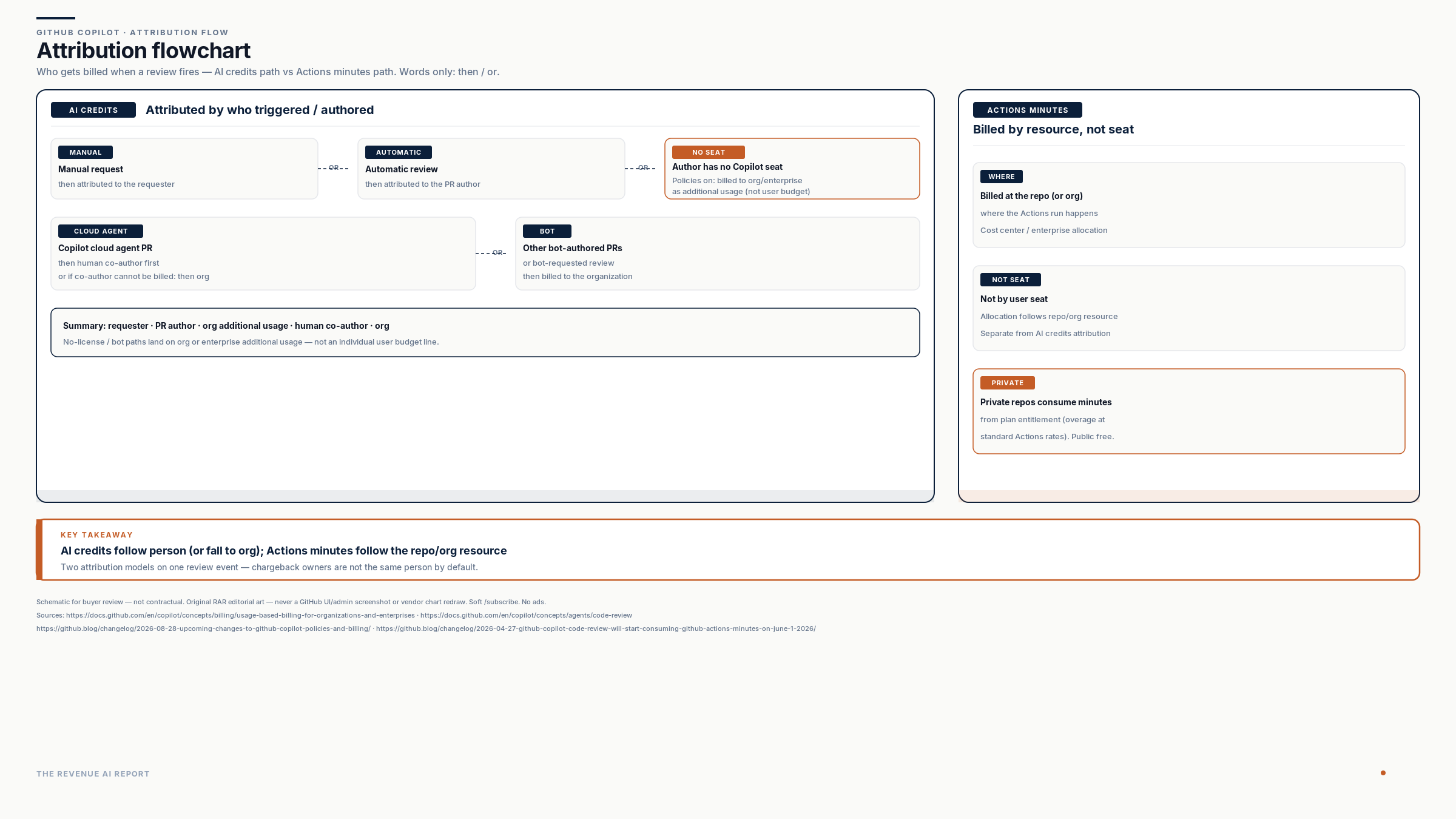
Soft open adjacent only (stay on code-review meters)
The adjacent Chat, Mobile, and cloud-agent billing unification changes no earlier than Sep 28, 2026 are separate from this decision. Do not blend their usage into a code-review quote. Audit the review path, the two review meters, and the specific policies here (Aug 28 changelog).
Soft opens (do not invent)
- Balanced vs Lite $/review: blank. Code review's model is auto-selected and not disclosed; per-token usage can vary.
- Minutes/review: blank. Runner and review workload determine the Actions minutes.
- Exact Order Form SKU strings: leave for GitHub and your purchasing paperwork. Do not reverse-engineer names from a usage dashboard.
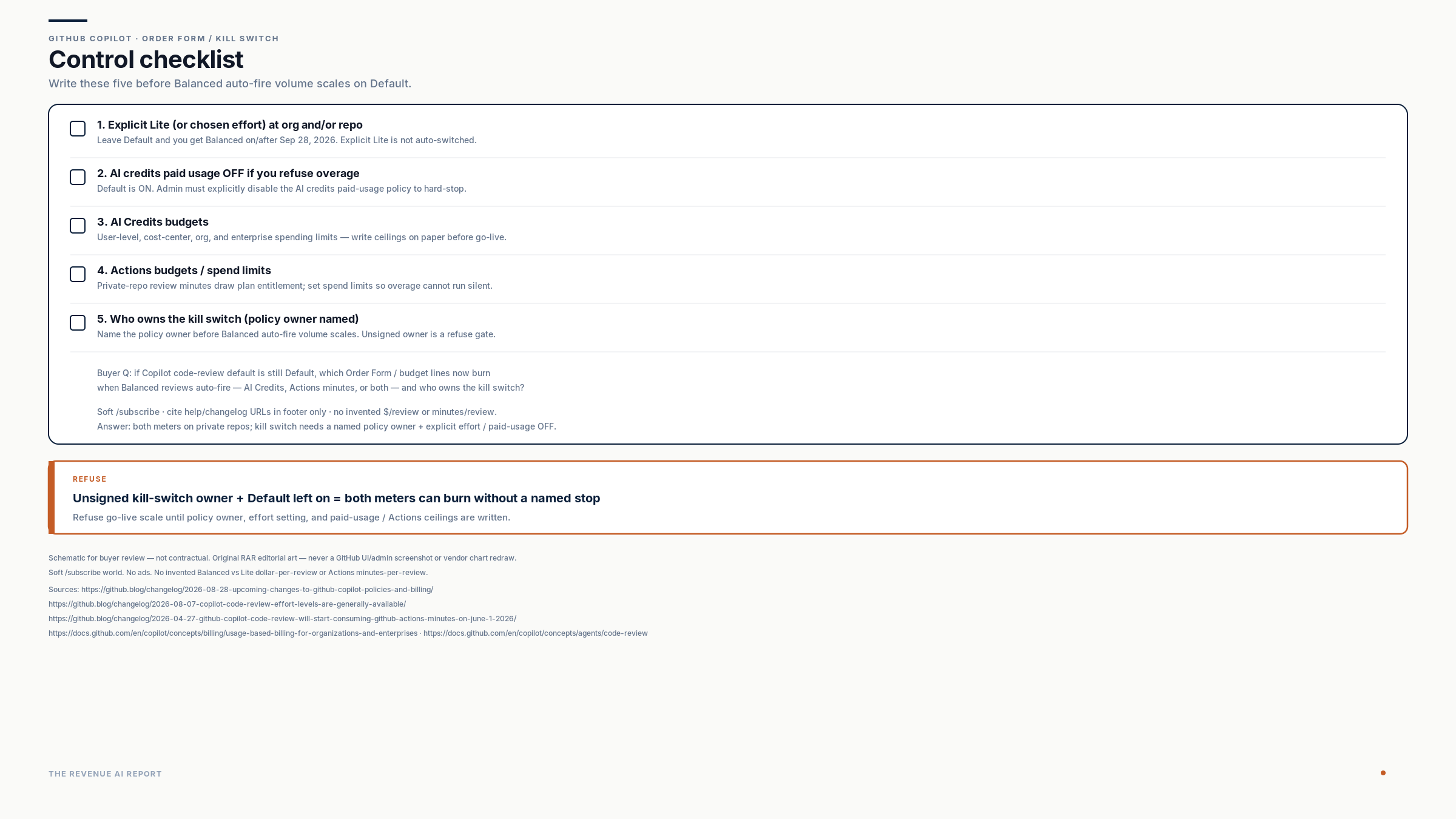
Order Form / kill-switch checklist
- Default posture: record which org and repo settings remain on Default, now Balanced as of Sep 28, 2026 MT.
- Explicit Lite: where accepted, set Lite at org or repo level and record the owner who can verify it.
- Paid usage OFF: if overage is not accepted, explicitly disable AI Credits additional usage; record on/off policy state.
- AI Credits budgets: include shared pool math, overage policy, spend ceiling, and named budget owner.
- Actions budgets: set separate private-repo minutes/spend ceilings, with repo and cost-center owners.
- Named policy owner: one accountable GitHub admin to change the effort setting and stop both meters before review volume scales.
- Accepted-outcome blank: write the merge quality, defect escape, or review result you will accept, and who measures it. Leave blank visibly until agreed; flag the Proof Gap rather than calling usage an outcome.
Proof Gap
The spend case is seats + pooled AI Credits (with additional usage default-on unless disabled) + private-repo Actions minutes. Both meters prove consumption, not merge quality, defect escape, or accepted review outcomes. Write an outcome measure and its owner next to the budget lines before declaring the review rollout successful.
Who reviews which line (Eight-Seat lite)
- RevOps / GTM engineering: map review automation to repo and PR cohorts and join usage with accepted outcomes.
- Revenue Finance: reconcile the pooled credits, paid usage, and Actions minutes to the correct cost centers.
- Platform / engineering and GitHub admin: inspect org/repo effort, runner choice, billing attribution, and both kill paths.
- Enablement: document when Lite is acceptable and when a manual reviewer chooses another effort level.
- Procurement: require the two meter lines, policy states, owners, and open price/SKU blanks on the paper.
Sources
- GitHub, Upcoming changes to GitHub Copilot policies and billing (28 Aug 2026): github.blog/changelog/2026-08-28-upcoming-changes-to-github-copilot-policies-and-billing/
- GitHub, Copilot code review effort levels generally available (7 Aug 2026): github.blog/changelog/2026-08-07-copilot-code-review-effort-levels-are-generally-available/
- GitHub, Code review starts consuming Actions minutes (27 Apr 2026; effective 1 Jun): github.blog/changelog/2026-04-27-github-copilot-code-review-will-start-consuming-github-actions-minutes-on-june-1-2026/
- GitHub Docs, Usage-based billing for organizations and enterprises: docs.github.com/en/copilot/concepts/billing/usage-based-billing-for-organizations-and-enterprises
- GitHub Docs, Models and pricing: docs.github.com/en/copilot/reference/copilot-billing/models-and-pricing
- GitHub Docs, About GitHub Copilot code review: docs.github.com/en/copilot/concepts/agents/code-review
Soft CTA
If you want the next Order Form decoder before the next dual-meter default flip, subscribe
Take it to the room
The short list from this piece
Pulled from the argument above, written so you can read it out in a pipeline or board review.
Checklist diagram summarising GitHub Copilot “Default” Code Review Flips to Balanced Today: Dual Meters (AI Credits + Actions Minutes) with No Disclosed Model on the Review Path: GitHub, Upcoming changes to GitHub Copilot policies; GitHub, Copilot code review effort levels generally; GitHub, Code review starts consuming Actions; GitHub Docs, Usage-based billing for organizations; GitHub Docs, Models and pricing.Frequently asked questions
- What happens to Default on Sep 28, 2026?
- Default resolves to Balanced. Explicit Lite is not auto-switched.
- Do private-repo Balanced reviews burn one meter or two?
- Both: AI Credits (tokens) and Actions minutes (agentic runner path). Public Actions minutes stay free.
- How big is the included AI Credits pool?
- Business 1,900 / Enterprise 3,900 AI credits per user per month, pooled at the billing entity. 1 credit = $0.01. No rollover. Resets 00:00:00 UTC on the 1st.
- What does not burn AI Credits?
- Completions and next-edit suggestions. Agentic paths including code review burn the pool.
- Who owns the kill switch?
- Name the owner of (1) explicit Lite default, (2) paid-usage OFF, (3) AI Credits budgets, and (4) Actions budgets. Unsigned owner + Default left on = both meters can burn without a named stop.
- Is there a published $/review or minutes/review?
- Soft open. Model for code review is auto-selected and not disclosed. Exact minutes/review is runner-dependent. Do not invent fixed OF lines; pull meters and ask the AE.
- What must be on the Order Form / runbook today?
- Default to Balanced posture; explicit Lite where accepted; paid-usage on/off; AI Credits + Actions budgets with named owners; attribution rules; accepted-outcome blank. Soft-open exact SKU strings and $/review.
Subscribe
Get the next Reality Check before you sign the order form.
Keep reading
Reality Check
Three Tests Before Your Next AI Purchase: Result, Trust, Ownership
Before you buy AI, answer three questions: what result improves, how much checking remains, and who owns it. Proof rules and Order Form lines inside.
Reality Check
AI Review Time Is a Line Item. Price It and Name the Owner.
On TextQL's Argo-Bench the best AI model fully solved 34.8% of 210 data tasks. Put review time and a named owner into your AI business case.