
Gong Credits Put AI Trackers and MCP on a Shared Pool: What Must Be on the Order Form Before Agents Go Live
Each paid core seat adds 2,000 credits/year to one company-wide pool that resets on the contract year. Question-based AI Trackers, MCP, APIs, and Deep research burn it. Map pool math, top-up, caps, workspace ceilings, and resume ownership before agents go live.
Jonathan Kvarfordt · Published September 28, 2026 · Last reviewed October 10, 2026 · 7 min read
The short answer
When Gong AI Trackers and MCP burn one shared credit pool, which Order Form lines (included pool math, top-up terms, workspace ceilings, monthly user caps, exhaustion/resume) must be written before agents go live, and what accepted outcome proves the burn was worth it?
Decision rule
Refuse agent go-live until included pool math (2,000 × core seats), explicit top-up terms ($ blank for AE), monthly caps, workspace ceilings if used (BETA), and a named kill/resume owner are on the Order Form. Fill the accepted-outcome blank or flag Proof Gap.
Evidence
- help.gong.io/docs/about-gong-credits (Sep 29, 2026): 2,000/core seat/year shared pool; annual reset; what burns / does not; rate card; purchased credits no rollover; monthly caps; workspace allocation; exhaustion + manual tracker resume; notifications 60/80/90/95/100%
- help.gong.io/docs/configure-gong-credit-controls (28 Sep 2026): workspace allocation BETA; unallocated stay unused
- help.gong.io/docs/how-mcp-server-tools-and-apis-consume-credits (9 Jun 2026): MCP ≡ API burn; ask_account / ask_deal / generate_brief; ask-entity / get-brief
- help.gong.io/docs/when-credits-run-out: buy via account team; usage page; reports
Operator action
This week: confirm 2,000 × paid core seats on the paper, write top-up (explicit buy, no rollover, $ blank for AE), set monthly caps and workspace ceilings if used, name who resumes AI Trackers after exhaustion, and fill the accepted-outcome blank before enabling continuous trackers and MCP.
Last reviewed
Update, Oct 2026: Gong changed the rate card without public notice
Gong rewrote its credit rate card inside a help doc. No blog post, no changelog, no announcement that we could find. If your pool forecast uses the June rates, it is wrong.
Receipts: a Wayback Machine copy of Gong's "About Gong credits" page, captured Jun 15, 2026, reads "Updated on Jun 8, 2026." The live page reads "Updated on Sep 29, 2026."
| Rate line | Jun 8, 2026 version | Sep 29, 2026 version |
|---|---|---|
| Calls up to 10 minutes | 0.5 credits | 0.3 credits |
| Calls longer than 10 minutes | 1 credit | 1 credit |
| Each email | 0.1 credits | 0.1 credits |
| Web search in a brief | no line | 10 credits per search |
The new line, verbatim: "Each web search carried out when generating a brief consumes 10 credits."
Our arithmetic from Gong's rates: one brief web search costs as much as 100 emails, or about 33 short calls.
Two caveats. Gong may have told customers privately; "no public notice" is the most desk research can show. And the short-call rate went down, so the net effect depends on each team's mix.
The buyer question: what stops a vendor from changing the credit rate card mid-term? Gong's own page says current credit allocations "may be updated from time to time." Put these lines on the Order Form:
- The credit rate card in force at signature, dated [__], is attached as an exhibit and fixed for the term.
- Gong gives 30 days' written notice before any change to per-unit credit rates or any new metered action.
- A new metered action does not draw from the pool unless the customer opts in, in writing.
- Admins can turn off web search in briefs.
For operators, this week:
- Pull last quarter's usage mix: short calls, long calls, emails, brief web searches.
- Price that mix on the June card and the September card. Send your CRO both numbers.
- List every API, MCP and automated brief that runs web search. The 10-credit charge lands there. Briefs run in the Gong interface use no credits.
Gong credits put AI Trackers and MCP on a shared pool: what must be on the Order Form before agents go live
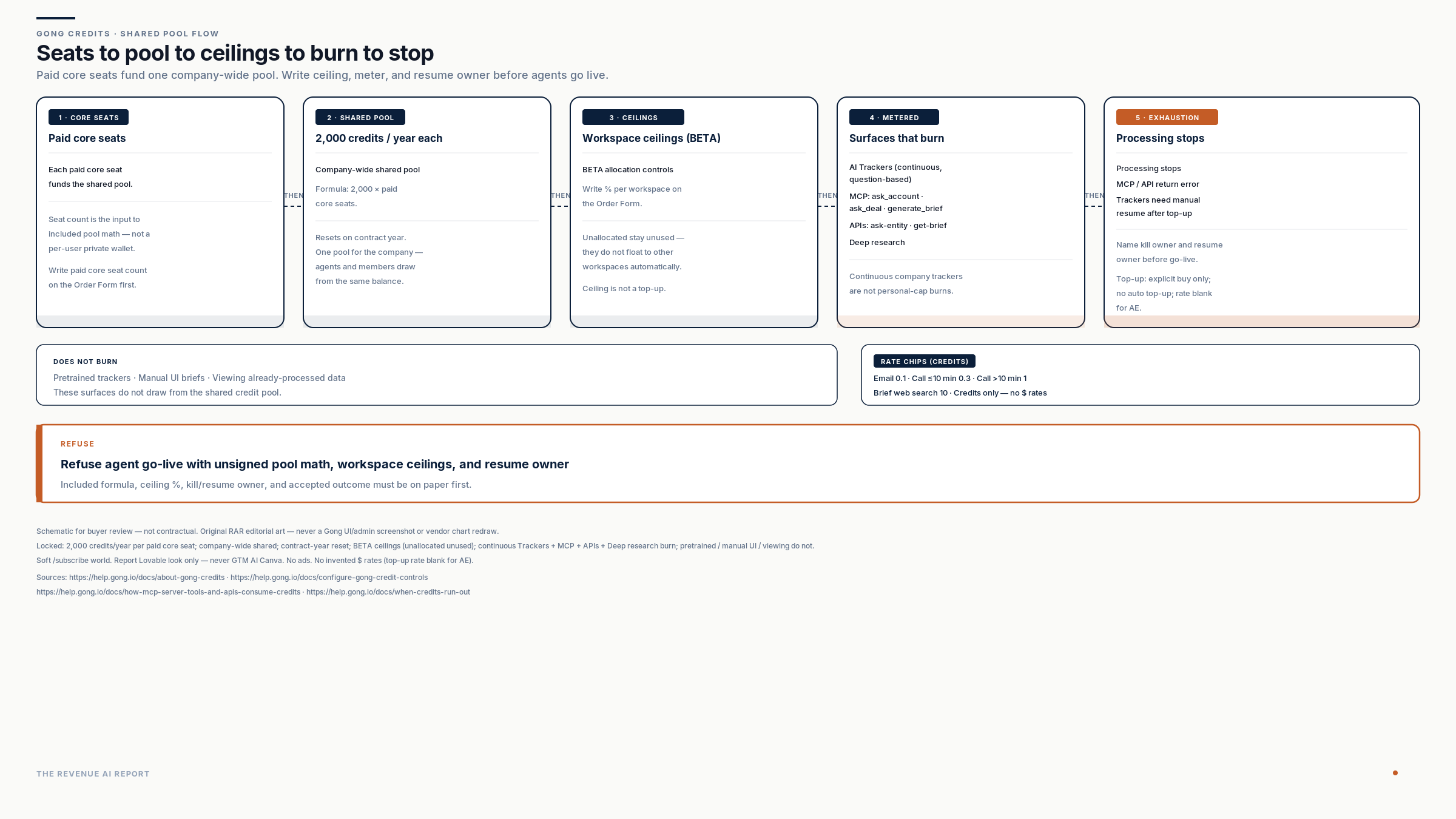
Gong credits are one company-wide pool. Each paid core seat adds 2,000 credits per year. The pool is shared across the company, not carved per person at allocation time. It resets at the start of each contract year (About Gong credits, updated Sep 29, 2026).
The argument
How this reality check breaks down
A map of the sections ahead, in the order the case is made. The sourced charts are in the research library.
Contents diagram for Gong Credits Put AI Trackers and MCP on a Shared Pool: What Must Be on the Order Form Before Agents Go Live, listing the sections: Gong credits shared pool Order Form, Gong AI Trackers MCP credits, Gong credits 2000 per core seat, Gong workspace credit allocation BETA.Question-based AI Trackers, MCP tools, APIs, and Deep research all burn that same pool. Seats buy access. Credits buy continuous trackers and agent asks. Do not treat "we bought Gong" as unlimited tracker and MCP headroom.
What burns the shared pool (docs; HIGH confidence)
Per About Gong credits and How MCP server tools and APIs consume credits:
Reality Check
Gong Credits Put AI Trackers and MCP on a Shared Pool: What Must Be on the Order Form Before Agents Go Live
Source-cited charts live in the research library.
Gong Credits Put AI Trackers and MCP on a Shared Pool: What Must Be on the Order Form Before Agents Go Live. Diagram showing Evidence, Analysis, Decision, Outcome.- Question-based AI Trackers: run continuously on new calls and emails (and historical data in scope). Credits burn as data is processed. Viewing results does not burn more.
- APIs: ask-entity and get-brief. Credits scale with data volume and request structure. Insufficient credits → error.
- MCP: ask_account, ask_deal, generate_brief. MCP uses the same underlying APIs. Equivalent MCP and API requests burn the same credits.
- Deep research: credit-based heavy processing.
Does not burn: pretrained trackers; generating a brief from the Gong UI; viewing already-processed data.
Rate card (credits, not dollars; docs only): Email 0.1 each (10 emails = 1 credit); Call ≤10 min 0.3 / call >10 min 1; Brief web search 10 credits per search. Do not invent a dollar top-up rate. Ask the AE.
Purchased credits and top-up (soft-open $)
Purchased credits are an explicit buy from your Gong account team (Managing credit usage). Docs do not describe auto top-up. Purchased credits are available until the end of the contract term and do not roll over into a new term. All credit types show as one shared balance; credits that expire first are consumed first.
$ top-up rate: blank for the AE. Put quantity, term end, and no-rollover on the Order Form. Leave list price to the paper.
Governance: monthly caps and workspace ceilings
Two controls sit on top of the shared pool (About Gong credits; Configure Gong credit controls, updated 28 Sep 2026):
- Monthly per-member caps: cap credits a member initiates (for example Gong Enrich). Company continuous trackers (smart / question-based trackers running for the whole company) do not count against personal monthly limits. Unused personal allotment does not carry over month to month. A member can still be blocked if the company pool is empty.
- Workspace allocation (BETA): ceilings drawn from the shared company pool. Unallocated credits stay in the company pool and are not used until assigned. Current allocation is a credit count per workspace; future additions can follow a percentage rule.
Name both on the Order Form if you use them. BETA status for workspace allocation is a soft open: confirm GA language with your AE before you treat it as contracted forever.
Exhaustion and resume (docs)
When the pool hits zero (About Gong credits; Managing credit usage):
- Credit-based processing stops. Existing data stays available but goes stale.
- MCP and API credit requests return an error.
- Automated briefs stop generating / updating.
- Question-based AI Trackers stop processing new data; new trackers cannot publish. After you add credits, AI Trackers need manual resume. API / MCP processing resumes with the top-up.
Notifications fire at 60 / 80 / 90 / 95 / 100% to tech and business admins. Useful for ops. They are not a substitute for Order Form kill/resume ownership.
Soft opens (do not invent)
- Top-up $ rate (blank for AE)
- Exact Order Form SKU strings
- Workspace allocation still BETA
- Prefer About + Configure + MCP consume. Do not rely on older transition pages such as gong-credits-new-ai-usage-model if they conflict.
Order Form checklist before agents go live
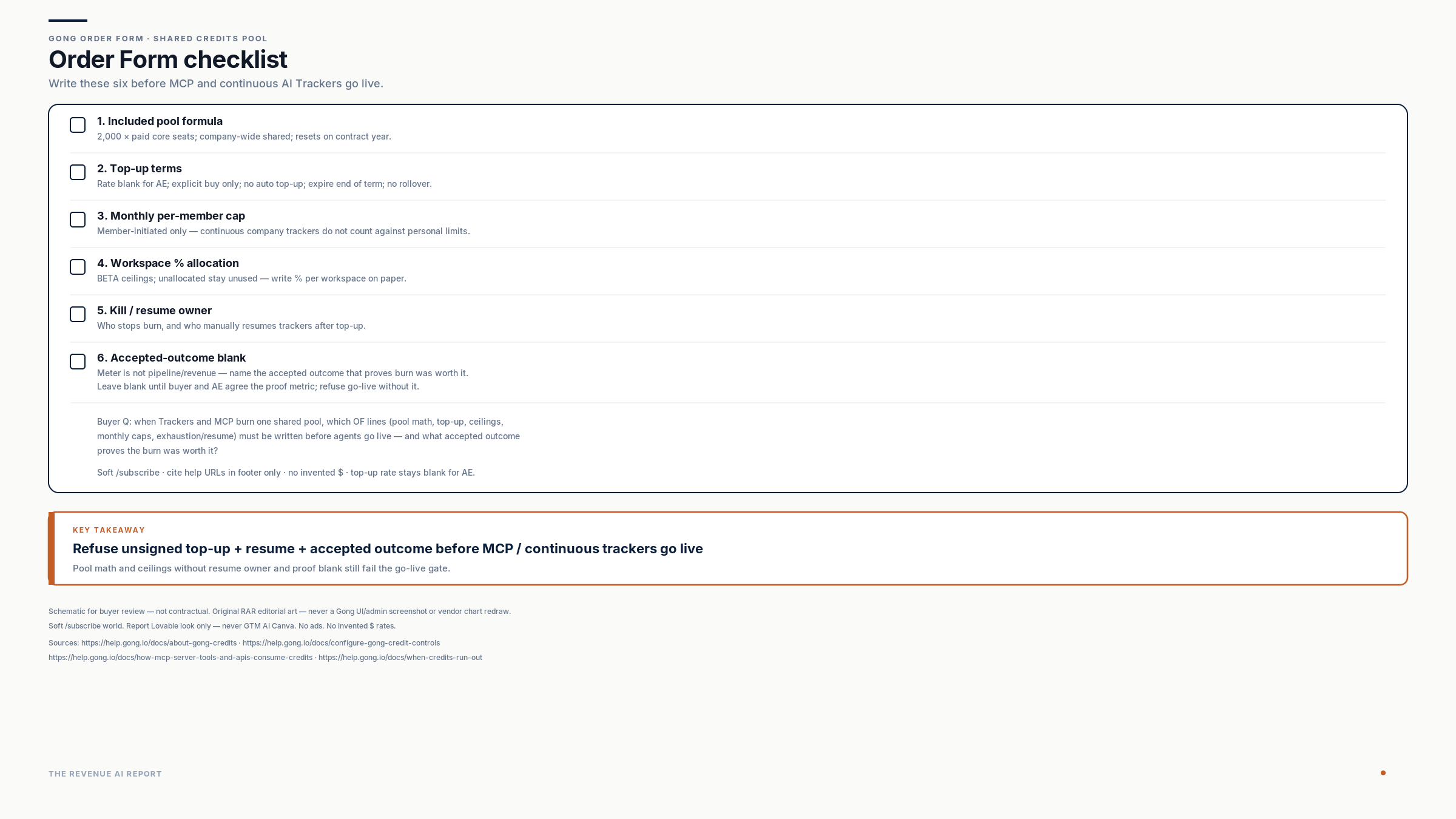
- Included pool math: 2,000 credits × paid core seats per contract year; company-wide shared; annual reset.
- Top-up terms: explicit purchase only; no auto top-up assumed; expire end of term; no rollover; $ rate blank for AE.
- Monthly per-member caps: on/off and value; note that company continuous trackers do not hit personal limits.
- Workspace allocation: ceilings / % rules if used; call out BETA; unallocated = unused.
- Kill / resume owner: who buys top-up; who manually resumes AI Trackers after top-up; who can unpublish trackers and disable MCP/API paths when burn runs hot.
- Accepted-outcome blank: if missing, flag Proof Gap. Metered credits are not pipeline or revenue.
Proof Gap
Spend = seats + any app fees + the metered pool (included + purchased). The meter proves credits burned. It does not prove accepted pipeline or revenue. Unit ≠ bill without OF ceilings, kill/resume ownership, and an accepted-outcome blank filled by the buyer.
Who reviews which line (Eight-Seat lite)
- RevOps / GTM eng: tracker publish map, MCP tool allowlist, workspace ceilings, kill path.
- Sales: which ask_account / ask_deal / generate_brief calls agents will run, and which question-based trackers stay on.
- Revenue Finance: included pool math (2,000 × core seats); purchased credit quantity and term; chargeback if workspaces get ceilings.
- Enablement: train pretrained / UI briefs first; gate continuous trackers and MCP until caps and resume owners exist.
- Tech admin / Business admin: credit controls, notifications, purchase path with the account team.
Sources
- Gong Help, About Gong credits (Sep 29, 2026): help.gong.io/docs/about-gong-credits
- Gong Help, Configure Gong credit controls / allocations (28 Sep 2026; workspace allocation BETA): help.gong.io/docs/configure-gong-credit-controls
- Gong Help, How MCP server tools and APIs consume credits (9 Jun 2026): help.gong.io/docs/how-mcp-server-tools-and-apis-consume-credits
- Gong Help, Managing credit usage / when credits run out: help.gong.io/docs/when-credits-run-out
Soft CTA
If you want the next Order Form decoder before the next shared-pool agent ship, subscribe
Take it to the room
The short list from this piece
Pulled from the argument above, written so you can read it out in a pipeline or board review.
Checklist diagram summarising Gong Credits Put AI Trackers and MCP on a Shared Pool: What Must Be on the Order Form Before Agents Go Live: Gong Help, About Gong credits (Sep 29, 2026); Gong Help, Configure Gong credit controls /; Gong Help, How MCP server tools and APIs consume; Gong Help, Managing credit usage / when credits run.Frequently asked questions
- How big is the included Gong credits pool?
- Each paid core seat includes 2,000 credits per year, shared company-wide, resetting at the start of each contract year.
- Do AI Trackers and MCP burn the same pool?
- Yes. Question-based AI Trackers, MCP (ask_account / ask_deal / generate_brief), APIs (ask-entity / get-brief), and Deep research burn the shared pool. MCP burn matches equivalent API requests.
- What does not consume credits?
- Pretrained trackers, manual UI briefs, and viewing already-processed data.
- Is there an auto top-up or published $ rate?
- Docs describe explicit purchase via the Gong account team. No auto top-up is documented. Dollar rate is blank for your AE. Purchased credits expire end of term with no rollover.
- Do monthly per-member caps cover continuous company trackers?
- No. Caps cover member-initiated credit actions. Company continuous trackers are not counted against personal monthly limits.
- What happens when credits hit zero?
- Processing stops for credit-based features. MCP/API return errors. Automated briefs stop. AI Trackers need manual resume after you add credits.
- What must be on the Order Form before agents go live?
- Included pool math (2,000 × core seats); top-up terms (explicit buy, no rollover, $ blank for AE); monthly caps; workspace ceilings if used (BETA); kill/resume owner; accepted-outcome blank. Soft-open exact SKU strings.
- Did Gong change its credit rates without notice?
- Gong's About Gong credits page, updated Jun 8, 2026, priced calls up to 10 minutes at 0.5 credits. The version updated Sep 29, 2026 prices them at 0.3 credits and adds 10 credits for each web search when generating a brief. We found no public notice. Ask for the rate card dated at signature, attached as an Order Form exhibit and fixed for the term.
Subscribe
Get the next Reality Check before you sign the order form.
Keep reading
Reality Check
Forgepoint Raised $9.8M for an AI Quote Desk. Price Speed Against Margin.
Forgepoint raised $9.8M seed Oct 14 for Frank, an AI inside sales rep that turns RFQs into quotes. Run a Reversal Ledger per RFQ: speed is not margin.
Reality Check
Nous Ranks the Models, Then Sells the Router. Who Signs the Savings?
Nous ranks 14 models by score and $ per task, then sells the router. Six order-form lines and one named owner prove a router cut cost per accepted outcome.