
81% of CEOs Expect AI Cost to Reshape Margins More Than Labor. Price the Swap First.
KPMG's Oct 15 CEO Outlook: 81% expect AI cost to reshape margins more than labor, and 9% call agents transformational. Six lines before labor budget moves.
Jonathan Kvarfordt · Published October 16, 2026 · Last updated October 16, 2026 · 6 min read
On October 15, 2026, KPMG released its 2026 U.S. CEO Outlook, a survey of 400 U.S. CEOs at companies with more than $500 million in annual revenue. One line belongs on every revenue leader's 2027 plan: 81% of CEOs believe the rising cost of AI will fundamentally reshape corporate margins more than labor costs over the next five years. (KPMG press release)
The same week, Workday told financial analysts it wants its AI agents funded from customers' labor and services budgets, with bills that grow with usage. (The Register)
Put the two together and next year's budget fight is visible. Vendors want the labor line. CEOs expect AI cost to be the bigger margin line. Before any dollar moves from people or outsourcing onto an agent meter, somebody has to price the swap.
What KPMG's CEOs said
- Spend is rising. 84% call AI a top investment priority over the next three years, and 65% will spend at least 10% of their capital budget on AI in the next year.
- Proof is thin. Only 9% say agents are transformational for their organization. 39% report significant improvements in efficiency or growth with agents, and 43% report moderate impacts with targeted use cases.
- Cost is hard to manage. One in two CEOs say managing the costs of implementing AI is mostly or very challenging. 88% are prioritizing realized AI value over strict adherence to token budgets.
- Payback is expected soon. 68% expect returns on AI investments in one to three years. 14% expect them in six months to a year.
Read the last two bullets together. Most of these CEOs will let the token bill run if value shows up, and most expect that value inside three years. The burden lands on whoever owns each use case: realized value, in dollars, by a date.
Headcount: the mix changes
KPMG's CEOs expect a bigger workforce. 89% plan to increase headcount over the next three years, most of them by less than 5%. Their two-to-five-year workforce plans include:
- 86% redesigning roles, career paths and team structure for human-AI collaboration
- 83% retaining and retraining high-potential talent
- 79% hiring new talent with AI and tech skills
- 53% planning workforce reductions in some areas
That is a role-mix shift. On a revenue team it looks like fewer transactional seats and more judgment seats: deal review, renewal risk, pricing calls, partner plays and coaching. The ledger below makes you name which seat grows when an agent takes a task.
What Workday asked for
At its October 13 financial analyst day, as reported by The Register on October 15:
- Chief AI Officer Joel Hellermark said automating work such as HR tasks could expand Workday's market "beyond the software budgets into the labor and services spend," where "customers are spending tens of millions of dollars on outsourcing."
- Hellermark claimed self-service AI agents had increased resolution rates for common tasks by 25 percent. That is Workday's number on Workday's tasks.
- CEO Aneel Bhusri expects customers to pay for AI agents based on consumption, with bills increasing as usage grows.
Workday sells HR and finance software. The pitch travels anyway. Any agent vendor in sales, service or marketing can make the same ask of a CRO or CMO: move part of the SDR, agency, contact center or outsourced operations budget onto our meter.
The labor-to-meter swap ledger
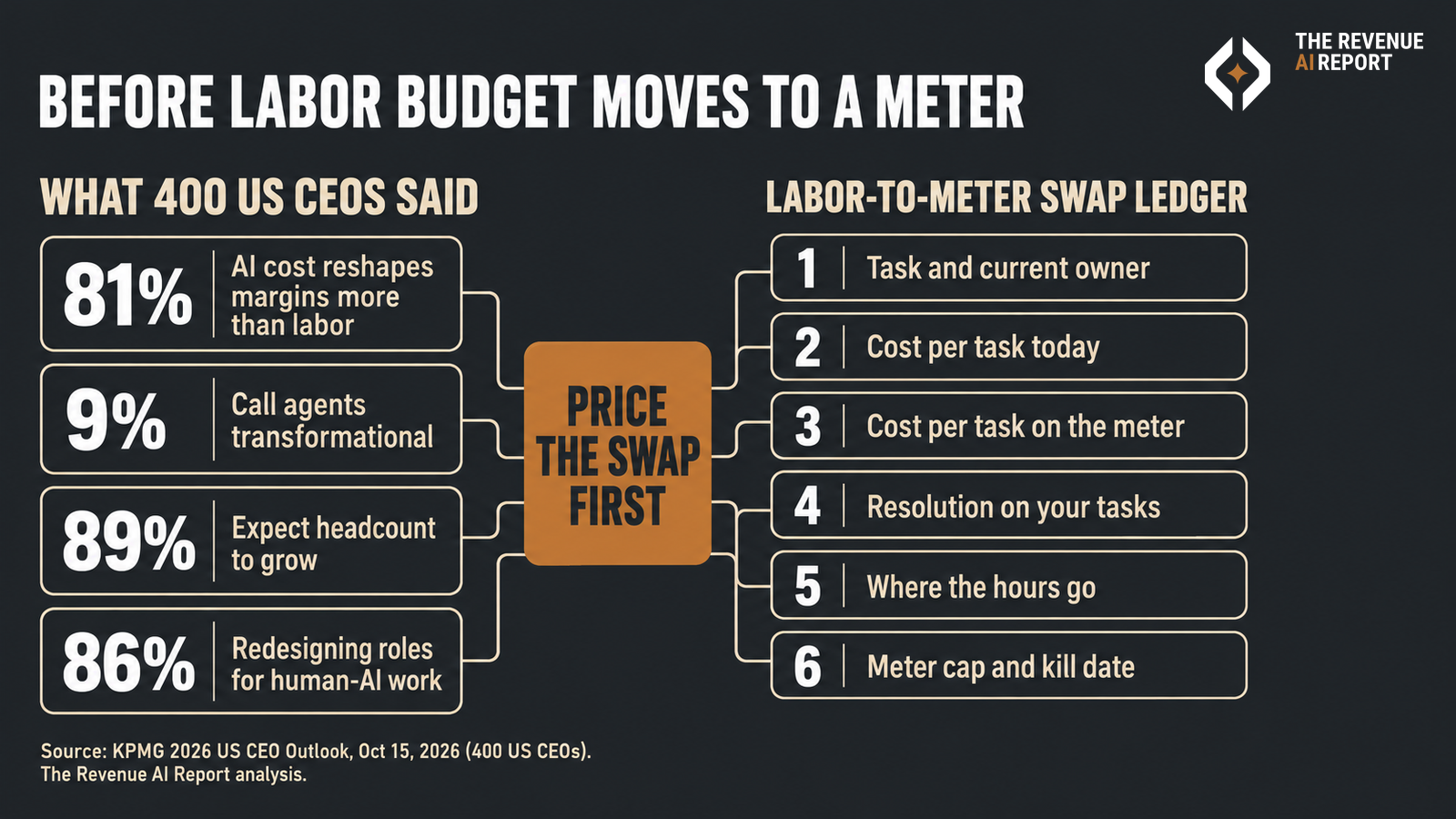
Before a labor or outsourcing dollar moves to an agent meter, put six lines on one page. One row per task.
- Task and current owner. The exact task, its monthly volume, and who does it today: a role on your team or an outside provider.
- Cost per completed task today. Fully loaded people cost or the provider's rate, divided by completed tasks. This is the baseline the agent has to beat.
- Cost per completed task on the meter. The consumption price after any introductory period ends, plus the human review time each agent output still needs.
- Resolution on your tasks. Your own pilot result on your own volume. A vendor's average on its own tasks is a hypothesis.
- Where the hours go. The seat that grows when the task moves: which judgment role, who moves into it, and the retraining plan.
- Meter cap and kill date. A monthly ceiling, a named owner, and a date to keep, cut or renegotiate.
Who owns which line
- CEO or CFO: lines 2, 3 and 6. The margin math and the ceiling. This is where the 81% worry gets answered with your own numbers.
- CRO, CMO or CCO: lines 1 and 5. Which tasks move, and which seats grow.
- RevOps or marketing ops: lines 3 and 4. The meter reading, the review time, and the pilot result on real volume.
- Enablement: line 5. The retraining plan for the people moving into judgment seats.
The same six lines work for an insurer's agency support desk, a distributor's order counter, a bank's onboarding team or a software company's SDR pod.
What to do this week
- List every AI proposal on your desk that references labor, staffing, agency or outsourcing spend.
- Fill in line 2 from your own numbers before you read the vendor's ROI slide.
- Ask for the post-introductory consumption price in writing, and model it at today's volume and at double.
- For each task that moves, name the judgment seat that grows and who fills it.
Related
- The Plan Price Held. The Cost of the Task Moved.
- Companies Are Pulling Back on AI. What Revenue Leaders Should Prove First
- Accenture's $29 Claude Allowance: A Six-Line Ledger Before You Approve Overage
- Call Center Headcount Is Falling. Can You Prove AI Did It?
- Reporting AI Impact to the Board: Four Rows per Workflow
Sources
- KPMG press release, "KPMG Survey: CEOs Confident in Their AI Progress and U.S. Economic Growth, but Cyber and Geopolitical Risks Intensify," Oct 15, 2026: kpmg.com
- KPMG, "2026 KPMG US CEO Outlook" (400 U.S. CEOs, all with annual revenue over US$500 million): kpmg.com
- The Register, "Workday wants a slice of customers' labour budget that its AI agents could replace," Oct 15, 2026: theregister.com
- Workday Investor Relations, "Workday to Hold Annual Financial Analyst Day on October 13, 2026": investor.workday.com
If you want the next labor-budget pitch priced the same way, subscribe.
Frequently asked questions
- What did KPMG's 2026 U.S. CEO Outlook find about AI cost?
- Released October 15, 2026, the survey of 400 U.S. CEOs found 81% believe the rising cost of AI will fundamentally reshape corporate margins more than labor costs over the next five years. One in two say managing AI implementation costs is mostly or very challenging.
- How many CEOs say AI agents are transformational?
- Only 9%. Another 39% report significant improvements in efficiency or growth with agents, and 43% report moderate impacts with targeted use cases.
- Do CEOs plan to cut headcount because of AI?
- Most expect growth. 89% expect to increase headcount over the next three years, mostly by less than 5%. 86% are redesigning roles for human-AI collaboration, and 53% plan workforce reductions in some areas.
- What should a revenue leader check before moving labor budget to an AI agent?
- Six lines per task: the task and current owner, cost per completed task today, cost per completed task on the meter after any introductory price, resolution on your own tasks, where the freed hours go, and a meter cap with a kill date.
Keep reading
Reality Check
Nous Ranks the Models, Then Sells the Router. Who Signs the Savings?
Nous ranks 14 models by score and $ per task, then sells the router. Six order-form lines and one named owner prove a router cut cost per accepted outcome.
Reality Check
Holo Raised €5M for Marketing Autopilot. Check Margin Before You Approve.
Holo raised €5M seed Oct 15 for AI marketing autopilot for small businesses. Run a Reversal Ledger on every campaign: output is not margin.