
Claude Opus 5.5 Fast Mode: Which Agent Calls Earn the 2x Meter?
Claude Opus 5.5 fast mode left research preview on Oct 15 at $8/$40 per million tokens, double standard. Six lines to decide which agent calls get it.
Jonathan Kvarfordt · Published October 16, 2026 · Last updated October 16, 2026 · 6 min read
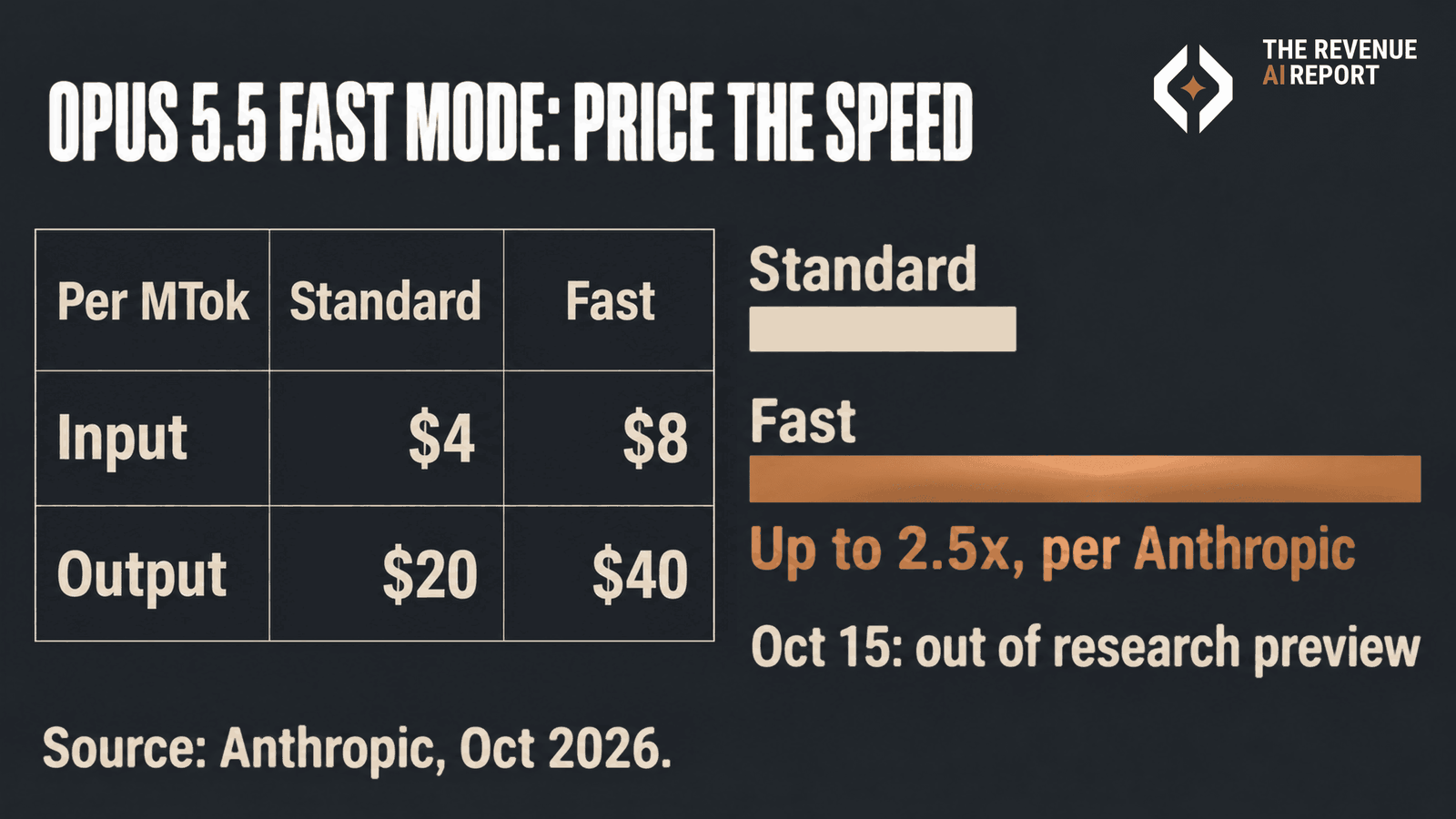
On Oct 15, 2026, Anthropic took fast mode for Claude Opus 5.5 out of research preview. Every agent call that flips to `speed: "fast"` now costs $8/$40 per million tokens, against a standard $4/$20.
That is one field in a request. By our math, it doubles the token bill for that call. Name the calls that earn it before anyone sets it as a default.
What changed on Oct 15
Anthropic's release notes for Oct 15 say: "Fast mode is out of research preview for Claude Opus 5.5, and you no longer need to request access." (Release notes, Fast mode docs, Pricing)
Here is what the documentation and pricing page confirm. Access and price first:
- As of Oct 15, 2026, fast mode for Claude Opus 5.5 is out of research preview on the Claude API. It needs no beta header or access request for organizations in the Start, Build, and Scale usage tiers.
- Fast mode for Claude Opus 5.5 costs $8 per million input tokens and $40 per million output tokens across the full context window, twice the standard Opus 5.5 rate of $4 and $20. (Twice is our calculation from Anthropic's list prices.)
- Anthropic says fast mode runs the same model with up to 2.5x higher output tokens per second. The gain is in output speed. Time to first token is a separate measure.
Limits and caching work differently from standard speed, which matters for fallback planning:
- Fast mode has its own rate limit, separate from standard Opus limits. Evaluation-tier organizations must move to Start, Build, or Scale to use it on Opus 5.5.
- Switching between fast and standard speed invalidates the prompt cache, so a fallback to standard speed starts with a cache miss.
Billing is visible per call:
- The response usage object reports which speed ran, "fast" or "standard", and Claude Managed Agents bills the fast premium when an agent's model.speed is set to "fast".
Platform coverage is narrower than for standard Opus 5.5:
- Fast mode is available on the Claude API, including Claude Managed Agents, and on Azure-hosted Claude in Microsoft Foundry. It is not available on Claude Platform on AWS, partner-operated cloud platforms, the Batch API, or Priority Tier.
On Opus 5.5, a fast request over the fast rate limit returns an error (a `429` with a `retry-after` header). Nothing drops to standard speed on its own. Your code decides whether to wait or to retry at standard speed, and that retry pays the cache miss.
Against OpenAI's list price
On OpenAI's pricing page, GPT-6.1 Sol Ultrafast lists at $12 per million input tokens and $60 per million output tokens for prompts up to 272K tokens, six times its standard $2 and $10.
The 6x ratio is OpenAI's. Anthropic's Opus 5.5 premium works out to 2x by our calculation. List prices only; we have no verified side-by-side speed figure.
The arithmetic
Take one agent call that writes 10,000 output tokens. At standard Opus 5.5 rates the output costs $0.20. On fast mode it costs $0.40. (Derived from the $20 and $40 per million list prices.)
Twenty cents is nothing on one call. Run that call 50,000 times a month and the gap is $10,000 a month for output alone. Input doubles too. So does every cached-prefix refill after a fallback.
Anthropic's speed claim is "up to 2.5x" on output tokens. Time to first token does not get the same claim. A call that spends most of its wall-clock time waiting on tools, retrieval or a human approval gains little. For those calls, the premium mostly pays for output that was not the bottleneck.
Who earns the meter: examples
Speed pays when a person or a clock waits on generated text, live.
- A live sales call. An agent drafts objection answers while the rep is still on the line. Seconds count. Candidate for fast.
- A hospital discharge desk. A nurse waits for a drafted after-visit summary while the patient sits in the chair. Candidate, with human review in place.
- A freight dispatcher. A carrier calls about a missed pickup and the agent rewrites the route and the customer note during the call. Candidate.
- An overnight account-research batch. Nobody reads it until 8 AM. Standard speed. Fast mode isn't even allowed on the Batch API.
- A weekly pipeline-hygiene sweep or a contract redline queue. Hours of slack. Standard speed.
- A law firm's discovery summaries. Reviewed the next day by associates. Standard speed. The reviewer would not see the difference.
The same test works in any industry. Fast mode is worth considering when a person reads the output as it streams. Work that waits in a queue can stay on standard speed.
The counter-view: where speed truly pays
There is a real case for going wider. Anthropic's docs say fast mode is "compatible with streaming, where the OTPS gain is most visible." Customer-facing chat, voice agents and live coaching all stream. In those flows, a slow answer has a cost of its own: the buyer hangs up, the patient leaves, the rep stops trusting the tool and goes back to the old way.
Long multi-step agent chains also stack output time. An agent that writes ten long intermediate steps waits on output ten times. Anthropic's up to 2.5x output speed on each step can turn a minutes-long run into something a person will sit through.
The argument for fast is strongest in live, streamed, output-heavy work. For most teams, that covers a small number of call types.
The order form: six lines before you flip `speed: "fast"`
Fill this in per workflow. A call type that is missing any line stays on standard speed.
- Default speed. Standard for every workspace. Fast is opt-in per call type.
- Allowlist. Name each call type allowed on fast and the person waiting on it (rep on a call, customer in chat, nurse at a desk). No waiting human, no fast.
- Rate-limit owner. One named owner per workspace watches the separate fast rate limit in the Claude Console and gets the `429` alerts.
- Fallback policy. On a fast-mode `429`, choose: wait for `retry-after`, or drop to standard. Write it down per call type.
- Cache-miss cost. If you drop to standard, price the prompt cache miss. Long system prompts make that miss expensive.
- Keep/cut date. Read `usage.speed` monthly. Tie `"fast"` tokens to an accepted outcome (a booked meeting, a resolved ticket, a signed note). Cut any call type that can't show one by the review date.
Revenue finance signs line 6. RevOps or GTM engineering owns lines 1 to 5.
What this does to the team
With fast mode, people spend less of the call waiting for output and more of it reviewing drafts. The rep spends less time watching a cursor and more time judging the draft. The dispatcher spends the saved seconds on the customer. The role mix shifts toward judgment: someone has to decide which outputs ship, and someone has to own the meter. Both are judgment roles, and planning should account for them.
Related
- GPT-6.1 Sol Ultrafast Costs 6x Standard. Which Calls Belong on the Faster Meter?
- Accenture's $29 Claude Allowance: A Six-Line Ledger Before You Approve Overage
- The Plan Price Held. The Cost of the Task Moved.
- Who Audits the Meter on Our AI Agents, and What Audit Rights Do We Need Before We Sign?
Sources
- Anthropic, Claude Platform release notes, Oct 15, 2026: platform.claude.com
- Anthropic, Fast mode documentation (accessed Oct 16, 2026): platform.claude.com
- Anthropic, Pricing (accessed Oct 16, 2026): platform.claude.com
- OpenAI, API pricing (accessed Oct 16, 2026): developers.openai.com
If you want the next AI meter priced the same way, subscribe.
Frequently asked questions
- Can any organization use Claude Opus 5.5 fast mode now?
- Anthropic says it is "out of research preview" for Opus 5.5 as of Oct 15, 2026, with no beta header or access request for organizations in the Start, Build, and Scale usage tiers. Opus 5 and Opus 4.8 fast mode remain in research preview.
- How much does fast mode cost?
- $8/$40 per million tokens, against a standard $4/$20 for Opus 5.5. That is 2x by our calculation. Prompt caching and data residency multipliers apply on top.
- Does fast mode change the model?
- Anthropic says fast mode runs the same model with up to 2.5x higher output tokens per second. The gain is in output speed. Time to first token is a separate measure.
- Can I use fast mode on partner-operated cloud platforms?
- No. Fast mode is available on the Claude API, including Claude Managed Agents, and on Azure-hosted Claude in Microsoft Foundry. It is not available on Claude Platform on AWS, partner-operated cloud platforms, the Batch API, or Priority Tier.
- What happens when I hit the fast mode rate limit?
- The API returns a `429` with a `retry-after` header. Nothing switches speed on its own. You can wait, or retry at standard speed, and switching speeds means a prompt cache miss.
Keep reading
Reality Check
Nous Ranks the Models, Then Sells the Router. Who Signs the Savings?
Nous ranks 14 models by score and $ per task, then sells the router. Six order-form lines and one named owner prove a router cut cost per accepted outcome.
Reality Check
Holo Raised €5M for Marketing Autopilot. Check Margin Before You Approve.
Holo raised €5M seed Oct 15 for AI marketing autopilot for small businesses. Run a Reversal Ledger on every campaign: output is not margin.