
GPT-6.1 Sol Ultrafast Costs 6x Standard. Which Calls Belong on the Faster Meter?
On Oct 8 2026 OpenAI put Ultrafast on gpt-6.1-sol. Short API list is $12 input / $0.60 cached / $15 cache write / $60 output per million tokens, 6x Sol Standard $2/$0.10/$2.50/$10. Long context (>272K) Ultrafast is $24/$1.20/$30/$90. Vendor claims up to 6x faster token generation in the API and up to 8x in Codex vs Sol Standard (not guaranteed end-to-end). API is open to all users with separate Ultrafast TPM (Build 1M / Launch 4M / Grow 40M). Codex and ChatGPT Work need Pro 500 or eligible Enterprise/Edu. US and EU data residency supported. Our Sep 29 Sol cite said Ultrafast had no Sol row. That line is now wrong. Map the Sol Ultrafast meter before agents default to it.
Jonathan Kvarfordt · Published October 8, 2026 · 7 min read
The short answer
When Sol Ultrafast costs 6x Standard list, which Order Form lines must we name before agents default to service_tier ultrafast on gpt-6.1-sol?
Decision rule
Budget the 6x list and the separate Ultrafast TPM pool, not the tok/s headline. Name when ultrafast is allowed, the short and long rates, chargeback, seat gate, regional uplift, and which latency-sensitive calls justify 6x before agents default to it.
Evidence
- developers.openai.com/api/docs/pricing (Ultrafast tab, retrieved 2026-10-08): gpt-6.1-sol short Ultrafast $12 / $0.60 / $15 / $60; long Ultrafast $24 / $1.20 / $30 / $90; Standard short $2 / $0.10 / $2.50 / $10; Fast short $4 / $0.20 / $5 / $20; Astra Ultrafast short $60 / $6 / $75 / $300
- developers.openai.com/api/docs/models/gpt-6.1-sol and Ultrafast mode guide (retrieved 2026-10-08): model gpt-6.1-sol + service_tier ultrafast; Ultrafast prices are 6x Standard; Sol Ultrafast default TPM Build 1M / Launch 4M / Grow 40M; Ultrafast has separate rate limits from Standard and Fast; US and EU data residency supported; WebSockets recommended for tool loops
- OpenAI Community + @OpenAIDevs (Oct 8 2026): Ultrafast rolling out for GPT-6.1 Sol in the API, Codex, and ChatGPT Work; Codex/Work on Pro 500, eligible usage-based Enterprise, and credit-based Edu; Enterprise admins must enable; vendor speed claims up to 6x API / 8x Codex vs Sol Standard
Operator action
Today: write gpt-6.1-sol + service_tier ultrafast on the Order Form only for named latency-sensitive routes, lock short and long Ultrafast rates, record your Ultrafast TPM tier, check Pro 500 or Ent/Edu admin enable for Codex/Work, name the chargeback owner, and measure cost per accepted task before Ultrafast becomes the default.
Last reviewed
Six times the Sol sticker just got a Sol row.
On Oct 8 2026 OpenAI put Ultrafast on gpt-6.1-sol in the API, Codex, and ChatGPT Work (OpenAI Community; @OpenAIDevs). Our Sep 29 Sol cite said Ultrafast had no Sol row. That line is now wrong.
The argument
How this reality check breaks down
A map of the sections ahead, in the order the case is made. The sourced charts are in the research library.
Contents diagram for GPT-6.1 Sol Ultrafast Costs 6x Standard. Which Calls Belong on the Faster Meter?, listing the sections: What landed, The list ladder (locked), Separate Ultrafast TPM, Region and transport, The speed claim, Decision rule.Someone on your team will flip an agent to it because it feels fast. This decoder covers what that flip costs and which lines belong on paper first.
What landed
You call it with model `gpt-6.1-sol` and `service_tier: "ultrafast"`. It is a serving tier, not a new model ID (GPT-6.1 Sol; Ultrafast mode).
Reality Check
GPT-6.1 Sol Ultrafast Costs 6x Standard. Which Calls Belong on the Faster Meter?
Source-cited charts live in the research library.
GPT-6.1 Sol Ultrafast Costs 6x Standard. Which Calls Belong on the Faster Meter?. Diagram showing Evidence, Analysis, Decision, Outcome.API Ultrafast is open to all API users. Codex and ChatGPT Work Ultrafast need Pro 500, eligible usage-based Enterprise, or credit-based Edu, and Enterprise admins must enable access (OpenAI Community). Seat packaging stays on Pro 200 / Pro 500 Ultrafast. Do not rehash that seat cut here.
The list ladder (locked)
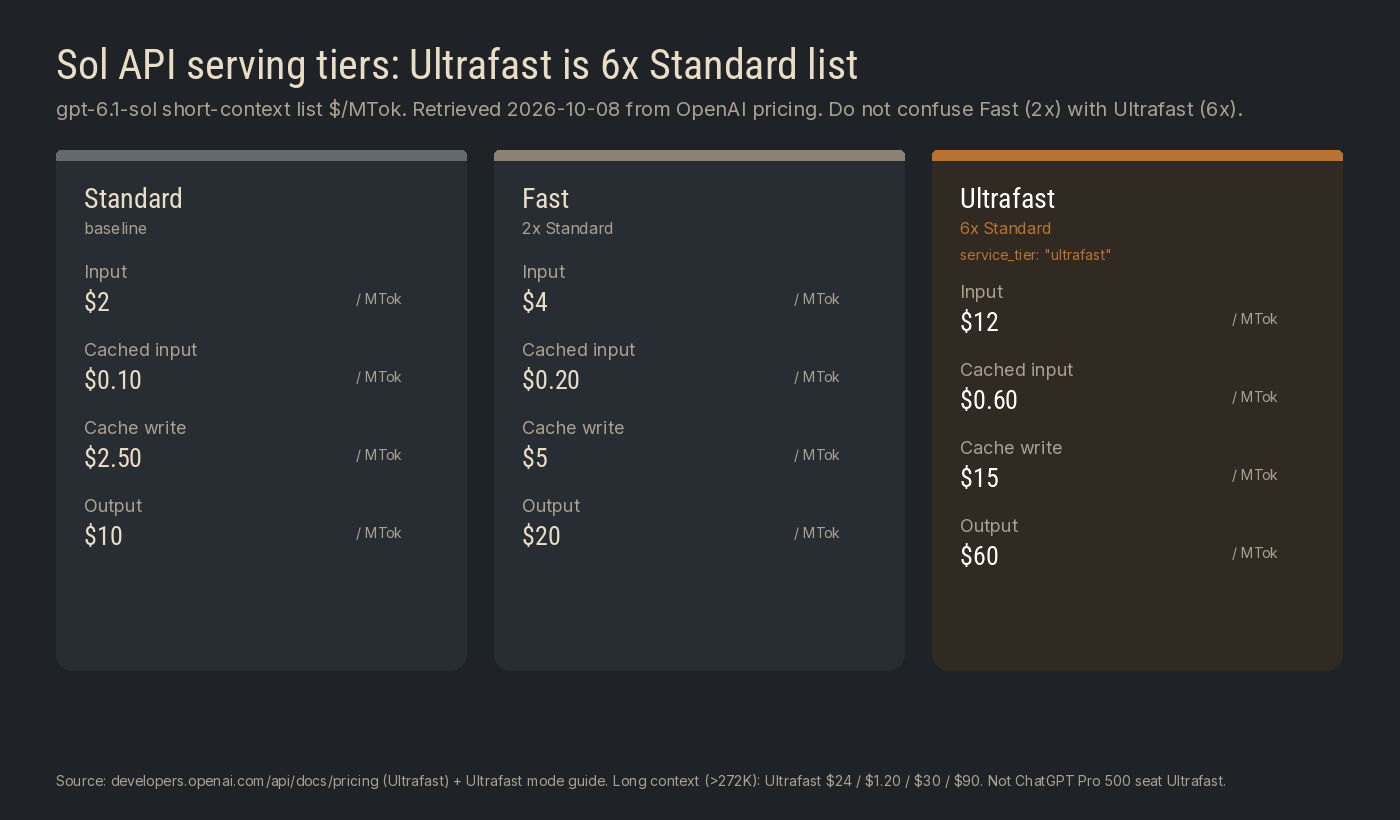
Short-context list, $ per million tokens (MTok), from the pricing Ultrafast tab, retrieved 2026-10-08 (OpenAI pricing). Order: input / cached input / cache write / output.
- Standard: $2 / $0.10 / $2.50 / $10 (baseline).
- Fast: $4 / $0.20 / $5 / $20 (2x Standard). Do not confuse Fast with Ultrafast.
- Ultrafast: $12 / $0.60 / $15 / $60 (6x Standard).
- Long Ultrafast (>272K input): $24 / $1.20 / $30 / $90.
Rough bill check: 1M input + 1M output is about $12 on Standard vs about $72 on Ultrafast before cache, long-context, or regional charges.
Sol Ultrafast short is about one-fifth of Astra Ultrafast $60 / $6 / $75 / $300 on input and output, with the same 6x multiplier pattern against each model's own Standard.
Separate Ultrafast TPM
Ultrafast has separate rate limits from Standard and Fast. Default Sol Ultrafast TPM by API usage tier (Ultrafast mode):
- Build: 1,000,000 TPM.
- Launch: 4,000,000 TPM.
- Grow: 40,000,000 TPM.
- Higher limits: request through your OpenAI account team.
A volume agent that hits the Ultrafast ceiling falls back or queues. Know which happens before go-live. Do not assume Standard or Fast headroom covers Ultrafast traffic.
Region and transport
Sol Ultrafast supports US and EU data residency and global processing (Ultrafast mode; model page). That is wider than Astra Ultrafast, which is US residency and global only. Regional processing still adds +10% where used.
OpenAI strongly recommends WebSockets for agentic tool loops. HTTP works, but connection overhead on every tool call can erase the latency you paid 6x to get.
The speed claim
OpenAI claims up to 6x faster token generation in the API and up to 8x in Codex versus Sol Standard. Tag it VENDOR. It measures tokens out per second, not end-to-end task time, and it is not a guarantee. Your agent still spends time in tool calls, retrieval, and retries.
Decision rule
Budget the 6x list and the separate Ultrafast TPM pool, not the tok/s headline. Name when ultrafast is allowed, the short and long rates, chargeback, seat gate, regional uplift, and which latency-sensitive calls justify 6x before Ultrafast is the default route. Cost per accepted agent task is the number that matters.
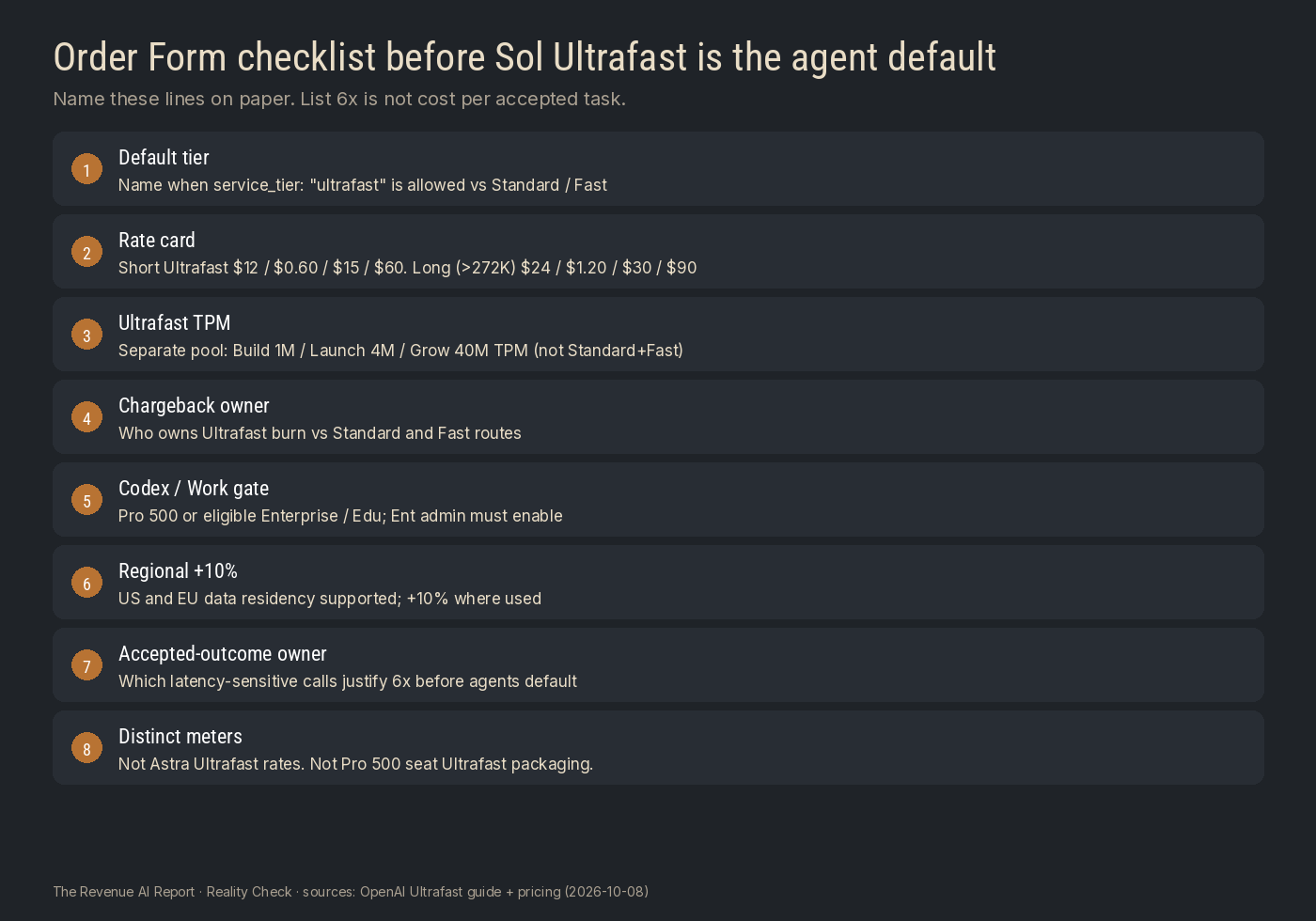
Order Form checklist
- Default tier: name when `service_tier: "ultrafast"` is allowed vs Standard and Fast.
- Rate card: short Ultrafast $12 / $0.60 / $15 / $60; long Ultrafast $24 / $1.20 / $30 / $90.
- Ultrafast TPM: separate pool Build 1M / Launch 4M / Grow 40M; not the Standard+Fast pool.
- Chargeback owner: who owns Ultrafast burn versus Standard and Fast.
- Codex / Work gate: Pro 500 or eligible Enterprise / Edu; Ent admin enable.
- Regional +10%: US and EU residency supported; print the uplift where used.
- Accepted-outcome owner: which latency-sensitive calls justify 6x before agents default.
- Distinct meters: not Astra Ultrafast rates; not Pro 500 seat Ultrafast packaging.
Keep the meters apart
- [GPT-6.1 Sol near-Astra at one-fifth price](/blog/gpt-6-1-sol-near-astra-fifth-price-task-cost-order-form): Sol Standard list and volume default. Ultrafast is now live; see this cite for the Ultrafast meter.
- [Astra Ultrafast API 6x](/blog/gpt-6-astra-ultrafast-api-6x-order-form): Astra Ultrafast rates, TPM, and US-only residency. Different model, different dollars.
- [Pro 200 / Pro 500 Ultrafast](/blog/openai-pro-200-usage-cut-pro-500-ultrafast-order-form): ChatGPT seat packaging for Codex/Work Ultrafast. Cross-link only.
Sources
- OpenAI API pricing, Ultrafast tab: developers.openai.com/api/docs/pricing
- OpenAI, GPT-6.1 Sol model docs: developers.openai.com/api/docs/models/gpt-6.1-sol
- OpenAI, Ultrafast mode guide: developers.openai.com/api/docs/guides/ultrafast-mode
- OpenAI Community, Ultrafast for GPT-6.1 Sol (Oct 8 2026): community.openai.com
- @OpenAIDevs (Oct 8 2026): status/2108262812489531498, status/2108262830348886150
If you want the next Order Form decoder before agents burn the 6x Sol tier, subscribe.
Take it to the room
The short list from this piece
Pulled from the argument above, written so you can read it out in a pipeline or board review.
Checklist diagram summarising GPT-6.1 Sol Ultrafast Costs 6x Standard. Which Calls Belong on the Faster Meter?: OpenAI API pricing, Ultrafast tab; OpenAI, GPT-6.1 Sol model docs; OpenAI, Ultrafast mode guide; OpenAI Community, Ultrafast for GPT-6.1 Sol (Oct 8; @OpenAIDevs (Oct 8 2026).Frequently asked questions
- What is Sol Ultrafast list price?
- Short context: $12 input, $0.60 cached input, $15 cache write, and $60 output per million tokens. That is 6x Sol Standard ($2 / $0.10 / $2.50 / $10). Long context (>272K): $24 / $1.20 / $30 / $90. Retrieved 2026-10-08 from the OpenAI pricing Ultrafast tab.
- How do I call Sol Ultrafast?
- Set model to gpt-6.1-sol and service_tier to ultrafast. It is a serving tier on the existing model, not a new model ID. WebSockets are recommended for tool-heavy agent loops.
- What are the default Sol Ultrafast TPM limits?
- Build 1,000,000 tokens per minute, Launch 4,000,000, and Grow 40,000,000. Ultrafast rate limits are separate from Standard and Fast. Higher limits go through your OpenAI account team.
- Is Fast the same as Ultrafast?
- No. Fast is 2x Standard ($4 / $0.20 / $5 / $20 short). Ultrafast is 6x Standard ($12 / $0.60 / $15 / $60 short). Keep them on separate Order Form lines.
- Does Sol Ultrafast support EU data residency?
- Yes. Sol Ultrafast supports US and EU data residency and global processing. Regional processing still adds +10% where used. Astra Ultrafast remains US residency and global only.
- Who can use Sol Ultrafast in Codex and ChatGPT Work?
- Pro 500, eligible usage-based Enterprise, and credit-based Edu. Enterprise admins must enable access. API Ultrafast is open to all API users. See the Pro 500 seat cite for packaging; do not mash the meters.
- Is Sol Ultrafast the same as Astra Ultrafast?
- No. Same 6x multiplier pattern, different dollars. Sol Ultrafast short is $12 / $60. Astra Ultrafast short is $60 / $300. Sol Ultrafast is about one-fifth of Astra Ultrafast on input and output. Separate TPM tables and residency rules.
Subscribe
Get the next Reality Check before you sign the order form.
Keep reading
Reality Check
AI Review Time Is a Line Item. Price It and Name the Owner.
On TextQL's Argo-Bench the best AI model fully solved 34.8% of 210 data tasks. Put review time and a named owner into your AI business case.
Reality Check
Call Center Headcount Is Falling. Can You Prove AI Did It?
Revelio Labs says global call-center headcount is 5.3% below its Dec 2023 peak. Revelio: "The decline is surely multifaceted." How to test your own org.