
Token Prices Fell. Which Order Form / Chargeback Lines Stop Unit Price Becoming an Unforeseeable Bill?
List $/MTok fell for GPT-6 Sol / Luna and Claude Opus 5.5. The invoice still moves with effort, long-context bands, Flex/Fast, cache write vs read, and which model served the turn. Map those bill lines on the Order Form before you forecast agent unit economics.
Jonathan Kvarfordt · Published September 25, 2026 · 8 min read
The short answer
Token prices fell. Which Order Form / chargeback lines stop unit price becoming an unforeseeable bill (effort modes, long-context multipliers, Flex/Fast, cache writes, fallback routing)?
Decision rule
Budget bill lines, not the press headline. Gate max/xhigh without a named owner. Separate cache write from cache read. Chargeback on serving model after fallback.
Evidence
- OpenAI GPT-6 Sol / Luna model pages + API pricing: list, cache, 272K whole-request step-up, Batch/Flex 50%, Fast 2x, regional +10%
- OpenAI Community 22 Sep 2026: Sol/Luna 50% lower vs GPT-5.6 promotional pricing
- Anthropic Opus 5.5 announcement + pricing: $4/$20, cache read $0.20, cache write $5/$8, Fast $8/$40, ~40% task-cost claim, flat long context for 4.6+
- Claude Help: cyber to Opus 4.8; bio/frontier to Opus 5; distillation block; API fallback opt-in
- Willison 22 Sep 2026: Opus 5.5 max hit 128K output cap (~$2.56 / ~20 min) on toy SVG
Operator action
This week: put effort caps, 272K / long-context ownership, mode (Standard/Flex/Fast), cache write vs read, and serving-model chargeback onto the quote review before you refresh agent unit-cost models.
Last reviewed
Token prices fell. Which Order Form / chargeback lines stop unit price becoming an unforeseeable bill (effort modes, long-context multipliers, Flex/Fast, cache writes, fallback routing)?
List dollars per million tokens fell. Your invoice still moves with effort, context band, processing mode, cache write vs read, and (on Anthropic) which model actually served the turn. Budget the bill lines, not the press headline.
The argument
How this reality check breaks down
A map of the sections ahead, in the order the case is made. The sourced charts are in the research library.
Contents diagram for Token Prices Fell. Which Order Form / Chargeback Lines Stop Unit Price Becoming an Unforeseeable Bill?, listing the sections: GPT-6 Sol Luna pricing Order Form, Claude Opus 5.5 cache read token cut, OpenAI 272K long context multiplier, Agent unit economics effort Fast Flex.What vendors publish
OpenAI GPT-6 Sol and Luna (API rate cards, 22 Sep 2026). Standard short-context list (prompts at or under 272K input tokens), per 1M tokens: gpt-6-sol input $2.00, cached input $0.20, cache writes $2.50, output $10.00. gpt-6-luna input $0.10, cached input $0.01, cache writes $0.125, output $0.50.
OpenAI states cached input is 10% of uncached input, and cache writes are 1.25x uncached input. Prompts with more than 272K input tokens are priced at 2x input and cache rates and 1.5x output for the full request. Batch and Flex are 50% of Standard. Fast mode is 2x applicable rates. Regional processing adds 10% where available. `reasoning.effort` supports none through max (default medium). Primary: GPT-6 Sol, GPT-6 Luna, Pricing. Community announcement: Sol/Luna API prices are 50% lower vs GPT-5.6 promotional pricing (OpenAI Developer Community, 22 Sep 2026). Promo half price is not a fixed monthly Order Form line.
Reality Check
Token Prices Fell. Which Order Form / Chargeback Lines Stop Unit Price Becoming an Unforeseeable Bill?
Source-cited charts live in the research library.
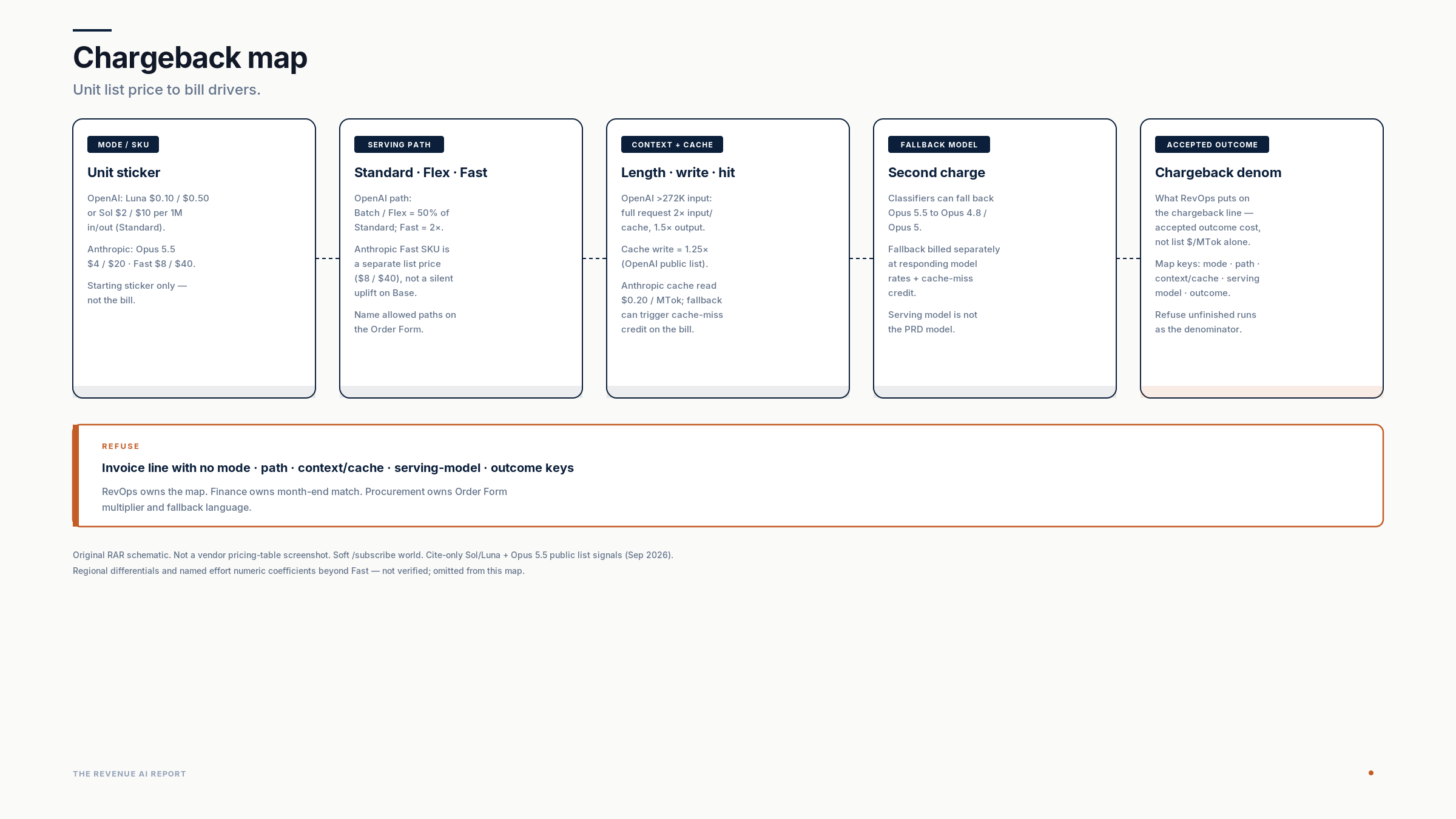
Token Prices Fell. Which Order Form / Chargeback Lines Stop Unit Price Becoming an Unforeseeable Bill?. Diagram showing Evidence, Analysis, Decision, Outcome.Anthropic Claude Opus 5.5 (announcement + platform pricing, 22 Sep 2026). List per 1M tokens: input $4, output $20 (20% below Opus 5 at $5 / $25). Cache read $0.20 (5% of base input; 60% below Opus 5 cache read at $0.50). Cache write $5 (5-minute) / $8 (1-hour). Anthropic's announcement claims typical workloads at default settings cost ~40% less than Opus 5 (token price cut plus fewer tokens per task). Tag that ~40% as a vendor claim until your eval reproduces it. Fast mode (research preview on Claude API): $8 / $40 input/output. Claude 4.6+ long context: Anthropic pricing docs state the full 1M context window bills at standard per-token rates (no OpenAI-style 272K step-up). Primary: Claude Opus 5.5, Opus 5.5 overview, Pricing.
Effort = bill risk (Willison corroboration). Simon Willison (22 Sep 2026): Opus 5.5 at effort=max hit the 128K output cap on a toy SVG prompt (~$2.56 and ~20 minutes per failed run) without returning the SVG. Treat max / xhigh as a named-owner gate, not a default. Corroboration: Willison.
Anthropic fallback / classifier routing (Help Center). Classifiers can silently route: cyber to Opus 4.8; biology / frontier LLM development to Opus 5; distillation blocks with no fallback. Automatic model switching is default in Claude apps; on the API, fallback is opt-in. Pre-output refusal can bill for some classifier categories; fallback is charged at the responding model rates; Anthropic documents a credit for the cache miss on fallback. Chargeback must key off serving model + mode + effort, not the PRD model string. Primary: Why Claude switched models. Trade corroboration: The New Stack.
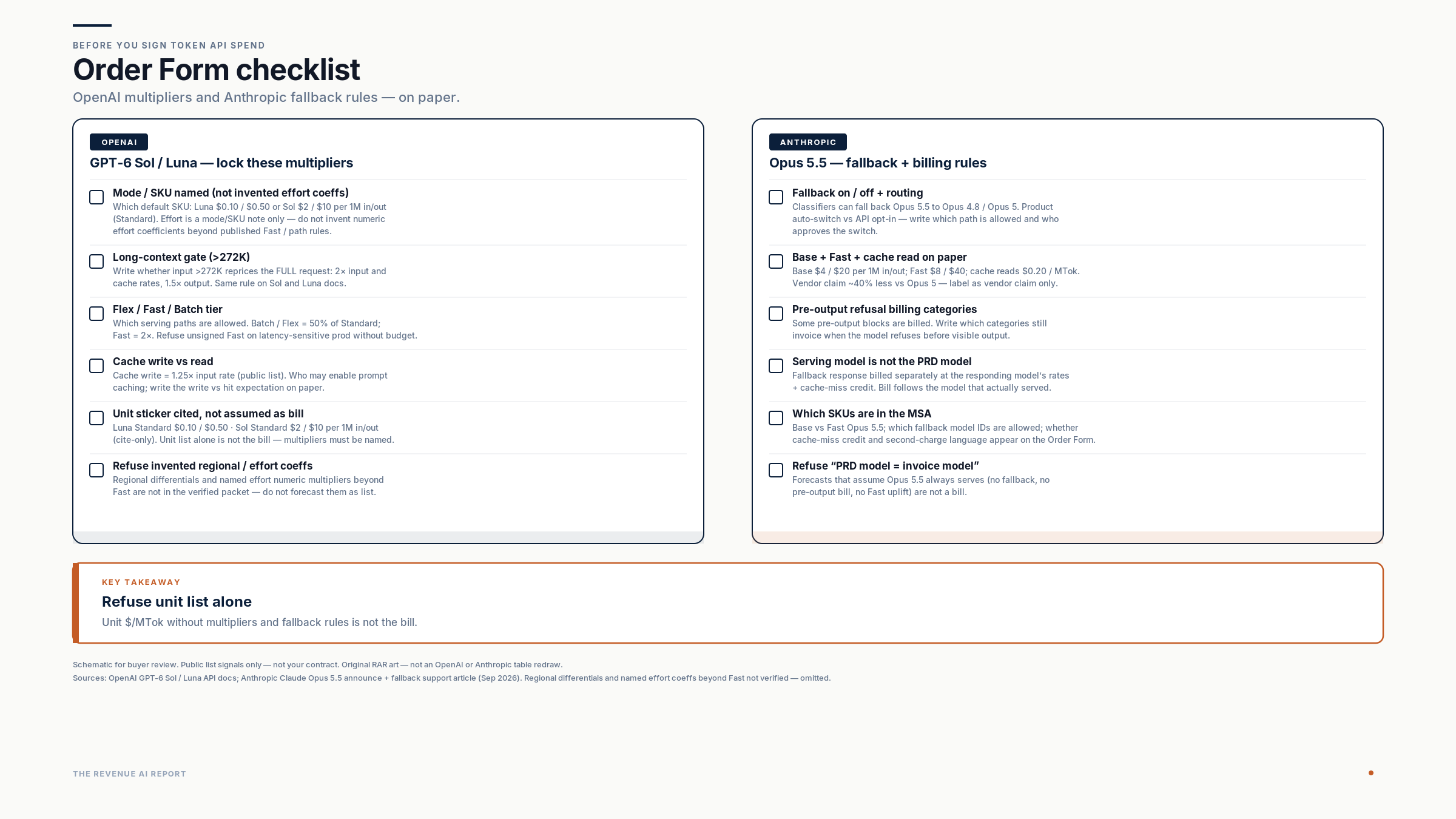
Decision rule for Director+ RevOps / Finance
- Put default model ID and allowed effort caps on the paper. Ban or gate max / xhigh without a named owner. Effort is a bill lever, not a quality toggle alone.
- Name the long-context threshold and the prompt owner. OpenAI: crossing 272K input reprices the whole request (2x input+cache, 1.5x output). Anthropic 4.6+: flat per-token across the 1M window per pricing docs. Different vendors, different surprise shapes.
- Separate Standard vs Flex vs Fast (and regional). OpenAI: Flex/Batch 50% of Standard; Fast 2x; regional +10%. Anthropic Fast mode $8/$40 on Opus 5.5. Mode mix without a clause is how unit price becomes unforeseeable.
- Forecast cache write vs cache read as separate lines. Writes are a premium (OpenAI 1.25x input; Anthropic $5 / $8). Reads are the discount (OpenAI 10% of input; Opus 5.5 $0.20). Agent loops that rewrite prefixes every turn burn the write line.
- Anthropic fallback on/off + which categories bill on pre-output refusal. API fallback is opt-in. Without fallback credit handling, refusal + retry can double-write cache. Require usage.iterations (or equivalent per-attempt) export in the meter clause where the platform exposes it. Confidence: HIGH on published rate cards and Help fallback docs; MED on Anthropic ~40% task-cost claim until buyer eval; Bedrock / Azure / Foundry may hide iterations / fallback detail.
- Chargeback keys: serving model + mode + effort, not the PRD model string. A turn that fell back to Opus 4.8 or Opus 5 is not an Opus 5.5 unit.
- Confirm contracted $ on your quote. List above is vendor-published USD API list. Your commitment, marketplace, or private offer wins. Do not invent Order Form SKU strings vendors have not published.
Quick compare
- Headline input/output: Sol $2/$10; Luna $0.10/$0.50. Opus 5.5 $4/$20. Unit price only.
- Cache read: OpenAI 10% of input ($0.20 / $0.01). Opus 5.5 $0.20 (5% of input; down 60% vs Opus 5). Hit-rate forecast.
- Cache write: OpenAI 1.25x input ($2.50 / $0.125). Opus 5.5 $5 (5m) / $8 (1h). Prefix rewrite risk.
- Long context: OpenAI over 272K input then 2x in+cache, 1.5x out, whole request. Anthropic flat standard rates across 1M (4.6+ docs). Prompt shape / owner.
- Modes: OpenAI Batch/Flex 50%; Fast 2x; regional +10%. Anthropic Fast $8/$40; Batch 50%. Mode clause.
- Effort / serving model: OpenAI none to max. Anthropic adaptive always on; classifier fallback / opt-in API fallback. Cap max without owner; chargeback on serving model.
Sources
- OpenAI, GPT-6 Sol model page: developers.openai.com/api/docs/models/gpt-6-sol
- OpenAI, GPT-6 Luna model page: developers.openai.com/api/docs/models/gpt-6-luna
- OpenAI API Pricing: developers.openai.com/api/docs/pricing
- OpenAI Developer Community, Announcing GPT-6 Sol and GPT-6 Luna (22 Sep 2026): community.openai.com announcement
- Anthropic, Introducing Claude Opus 5.5 (22 Sep 2026): anthropic.com/claude-opus-5-5
- Anthropic, Claude Opus 5.5 overview: platform.claude.com Opus 5.5
- Anthropic, Pricing (long context flat rate for 4.6+, cache, Fast mode): platform.claude.com pricing
- Claude Help Center, Why Claude switched models (Opus 5 / 5.5 fallbacks): support.claude.com
- Simon Willison, Claude Opus 5.5, GPT-6 Sol, GPT-6 Luna (22 Sep 2026; corroboration, max-effort burn): simonwillison.net
- The New Stack, OpenAI GPT-6 Sol / Luna release (corroboration): thenewstack.io
Soft CTA
If you want the next Order Form decoder and the weekly receipts before the next model price cut, subscribe
Take it to the room
The short list from this piece
Pulled from the argument above, written so you can read it out in a pipeline or board review.
Checklist diagram summarising Token Prices Fell. Which Order Form / Chargeback Lines Stop Unit Price Becoming an Unforeseeable Bill?: OpenAI, GPT-6 Sol model page; OpenAI, GPT-6 Luna model page; OpenAI API Pricing; OpenAI Developer Community, Announcing GPT-6 Sol; Anthropic, Introducing Claude Opus 5.5 (22 Sep.Frequently asked questions
- Token prices fell. Does that fix agent unit economics?
- No. List $/MTok fell. The bill still moves with effort, context band, Flex/Fast (and regional), cache write vs read, and which model served the turn.
- What OpenAI list rates matter for Sol and Luna?
- Sol $2/$10; Luna $0.10/$0.50 per 1M tokens short context. Cache read 10% of input. Cache write 1.25x input. Over 272K input: 2x input+cache and 1.5x output for the whole request. Batch/Flex 50%; Fast 2x; regional +10%.
- What Opus 5.5 list rates matter?
- $4/$20 input/output. Cache read $0.20 (down 60% vs Opus 5 $0.50). Cache write $5 (5m) / $8 (1h). Fast mode $8/$40. Anthropic ~40% lower typical task cost is a vendor claim until your eval.
- Why gate effort=max?
- Willison reported Opus 5.5 max hitting the 128K output cap on a toy SVG (~$2.56 / ~20 min) without a usable response. Max without a named owner is bill risk.
- What Order Form / chargeback lines should we require?
- Default model ID + allowed effort caps; 272K / long-context prompt owner; Standard vs Flex vs Fast (+ regional); separate cache write vs read forecasts; Anthropic fallback on/off and pre-output refusal categories; usage.iterations (or per-attempt) in the meter clause; chargeback = serving model + mode + effort.
- Do we invent SKU strings for these lines?
- No. Soft-open any unconfirmed Order Form language. Use vendor rate-card and Help language until your AE puts contracted SKUs on paper.
Subscribe
Get the next Reality Check before you sign the order form.
Keep reading
Reality Check
AI Review Time Is a Line Item. Price It and Name the Owner.
On TextQL's Argo-Bench the best AI model fully solved 34.8% of 210 data tasks. Put review time and a named owner into your AI business case.
Reality Check
Call Center Headcount Is Falling. Can You Prove AI Did It?
Revelio Labs says global call-center headcount is 5.3% below its Dec 2023 peak. Revelio: "The decline is surely multifaceted." How to test your own org.