
Othello Raised $8M for Live Call Coaching. Prove the Buyer Got a Better Conversation.
Othello raised $8M for real-time AI sales coaching under 500ms. Measure prompt to buyer response to deal result.
Jonathan Kvarfordt · Published October 14, 2026 · Last updated October 14, 2026 · 6 min read
The short answer
What's in it for you: Othello's $8M seed for live call coaching, the latency and adoption claims, and five measures that prove the buyer got a better conversation.
Decision rule
Do not buy live call coaching on latency or usage alone. Require prompt accept/ignore/correct rates, bad-prompt rate, and coached vs uncoached conversion on similar deals.
Operator action
This week: on ten coached calls, log the prompt, the rep choice, the buyer response, and the deal stage. Put accept / ignore / correct and bad-prompt rate on the enablement scorecard.
Last reviewed
On October 14, 2026, Othello announced $8 million in seed funding for real-time AI sales coaching during live calls. The company says its Hamlet model listens on the call and sends on-screen suggestions in under 500 milliseconds. (PR Newswire)
The test is whether the buyer got a clearer next step, and whether the deal moved for the right reason.
What shipped (company-stated)
Per the Oct 14 release:
- Round: $8 million seed from a16z speedrun, Owl Capital and Long Journey Ventures, with named angel participants.
- Product: A desktop overlay that starts with the call and shows live pop-ups in online meetings without joining as a participant.
- Hamlet model: Othello says live suggestions arrive in under 500 milliseconds.
- Suggestion types listed: next discovery question, missed playbook steps (MEDDPICC, Challenger), product answers, objection handling, competitor differentiation, case study to share, and when the buyer is ready to move.
- Customers (company-stated): Deployed at more than 50 large enterprises. Named examples include Microsoft, Capital One and Lyft. Industries listed include insurance, accounting, financial services, asset management, enterprise software, cybersecurity, healthcare, manufacturing and professional services.
- Adoption claim: Othello says licensed reps adopt within a week and use it on 95% or more of their calls.
The public funding announcement does not report measured lift in close rates, sales-cycle length or buyer experience.
Note on capital: Cicero, Inc. filed a Form D on August 3, 2026, for a fully sold $6.85 million offering. The October announcement does not explain how that filing relates to today's $8 million figure. Report today's announcement on its own. Do not add the two amounts.
The Proof Gap
A polished suggestion can still miss what the buyer said, or push a case study that does not fit. Speed makes that risk arrive faster.
| What the launch states | What a buyer still measures |
|---|---|
| Suggestions under 500 ms | Whether the buyer responded better after the prompt |
| 50+ enterprise deployments | Coached vs uncoached conversion by stage and segment |
| 95%+ call usage | Prompt accept, ignore, and correct rates |
| Playbook step reminders | Qualification quality and next-step commitments |
| Named logo customers | Deal outcomes tied to those accounts (not published) |
Five measures before you call it a revenue lever
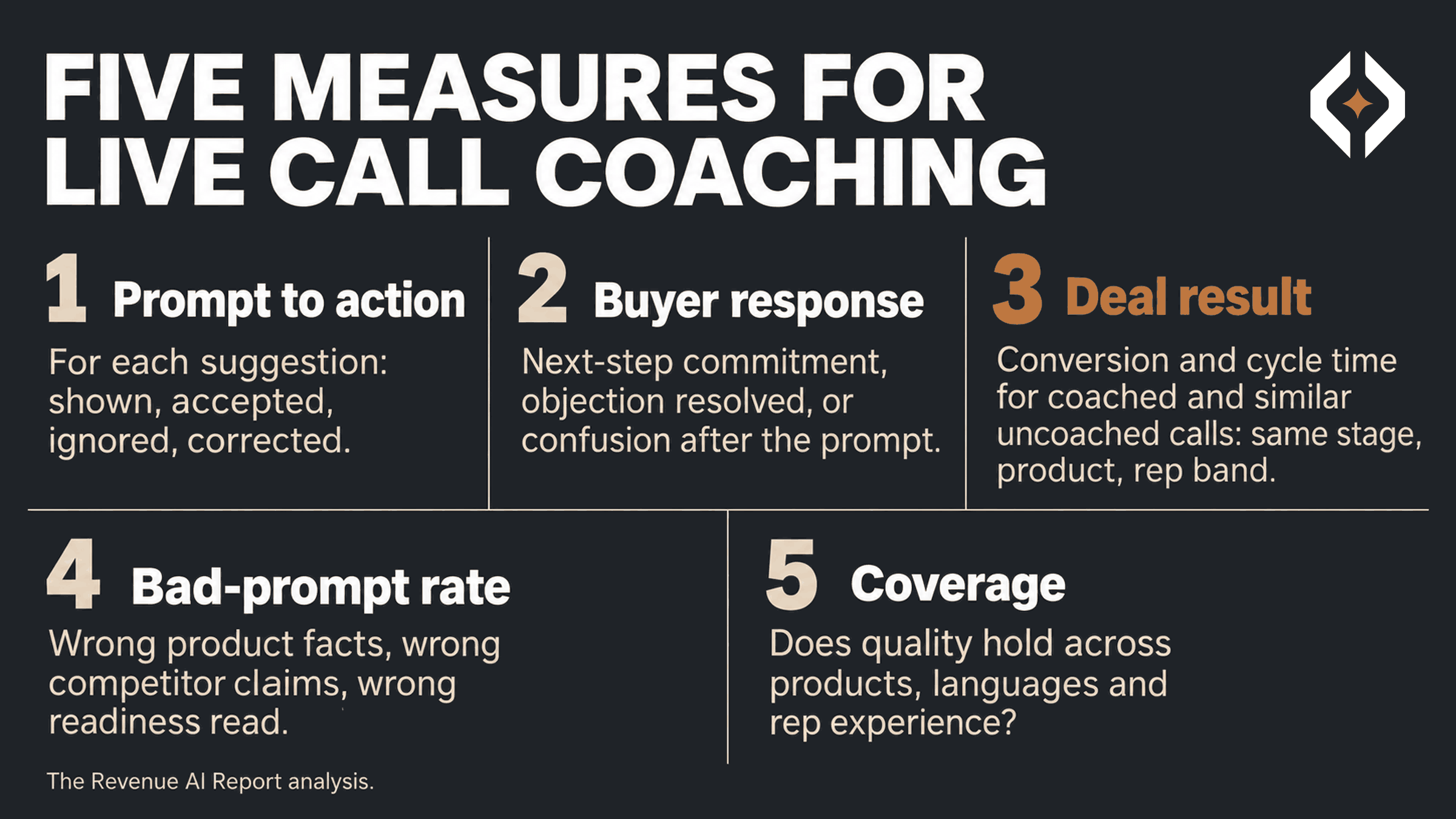
- Prompt to action. For each suggestion: shown, accepted, ignored, corrected.
- Buyer response. Next-step commitment, objection resolved, or confusion after the prompt.
- Deal result. Conversion and cycle time for coached vs similar uncoached calls (same stage, product, rep band).
- Bad-prompt rate. Wrong product facts, wrong competitor claims, wrong readiness read.
- Coverage. Does quality hold across products, languages and rep experience?
Who owns which part
- CRO / sales leaders: which call types get coaching on, and who owns the outcome scorecard.
- Enablement: which playbooks and approved proof points the model may surface.
- RevOps: how prompts and accept/reject events land in the opportunity record.
- Revenue finance: seat vs usage pricing (not disclosed in the release). Ask on the order form.
- Legal / compliance: recording, overlay consent, and regulated industries (insurance, healthcare, financial services).
What to do this week
- If you trial live coaching, log prompt, rep choice, buyer response and deal stage on ten calls.
- Put accept / ignore / correct rates and bad-prompt rate on the enablement scorecard.
- On the order form: meter unit, data retention, consent, and a stop switch for regulated call types.
Investors funded AI inside the live conversation. Your proof is still the conversation the buyer experienced.
Frequently asked questions
- What did Othello raise?
- $8 million in seed funding announced October 14, 2026, from a16z speedrun, Owl Capital and Long Journey Ventures, plus named angels.
- Does the release prove better close rates?
- No. It reports product latency, deployment count, named customers and an adoption claim. It does not publish close-rate, cycle or buyer-experience lift.
- Should I add the August Form D $6.85M to the $8M?
- No. Report the October announcement as stated. The filing relationship is not explained in the October release.
- Who is this for outside software?
- Othello lists insurance, accounting, financial services, manufacturing, healthcare and professional services among industries it serves. Measure by call and deal type, not by whether you sell software.
Keep reading
Reality Check
Forgepoint Raised $9.8M for an AI Quote Desk. Price Speed Against Margin.
Forgepoint raised $9.8M seed Oct 14 for Frank, an AI inside sales rep that turns RFQs into quotes. Run a Reversal Ledger per RFQ: speed is not margin.
Reality Check
Nous Ranks the Models, Then Sells the Router. Who Signs the Savings?
Nous ranks 14 models by score and $ per task, then sells the router. Six order-form lines and one named owner prove a router cut cost per accepted outcome.