
Frameworks by Jonathan "Coach K" Kvarfordt
By Jonathan Kvarfordt, Founder and Principal Analyst. Published October 12, 2026
First published October 12, 2026
© 2026 Jonathan Kvarfordt. All rights reserved.
This page is the dated public record of frameworks created by Jonathan "Coach K" Kvarfordt. Each entry says what the framework is, names its parts, and says how it is used.
For the full framework library, see https://www.therevenueaireport.com/frameworks.
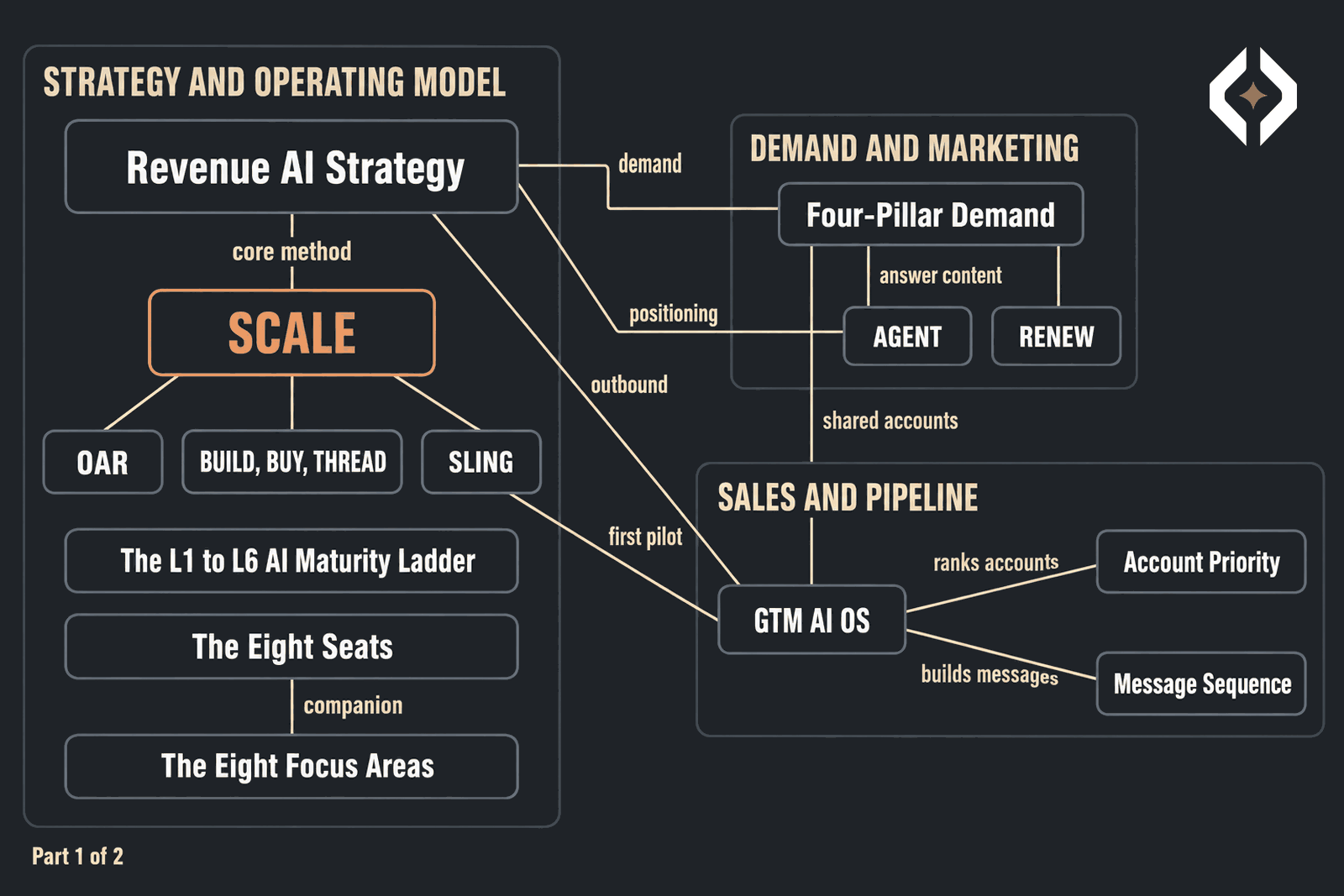
Strategy and Operating Model
Revenue AI Strategy
A full operating method for growing revenue with AI as the mechanism, starting from one business number. It links customer evidence, positioning, demand, outbound, internal AI work, behavior change and measurement through shared records and one review rhythm. It runs in eight steps:
- Define the outcome: one number, one owner, a baseline, a target and a date.
- Establish the business model and sales velocity: how the company makes money and where the number moves.
- Diagnose before prescribing: find an evidenced cause and name a competing explanation.
- Define the customer and market claim: who buys, against what, and why you.
- Choose the modules the evidence calls for: run only the parts the diagnosis supports.
- Rank the first action: pick one move with an owner, a decision date and a stop condition.
- Assemble the strategy package: the shared records in one place.
- Run and learn: every review ends in a decision, an owner and a date.
SCALE
The core method for internal AI transformation. It takes a team from a business number to a measured pilot and a verdict to expand, adjust or stop. Each step ends in one deliverable:
- Set strategic outcomes: name the business number, its drivers, the constraint and the gap type before any tool.
- Chart friction: map the workflow and find where work stalls across people, process, technology and data, with the cost of each bottleneck.
- Align capabilities: match each friction point to the right kind of fix, set the ambition level and decide how to source it.
- Launch with control: one hypothesis, a small representative team, success and stop criteria agreed in advance, guardrails and weekly updates.
- Evolve and expand: compare results to the baseline, then expand to a named scope, adjust one named part, or stop and record the learning.
OAR
Three levels of AI ambition, chosen only after the outcome, driver, constraint, fit and readiness are known. The team picks the smallest level that reaches the outcome and names it in every update.
- Optimize: AI improves a task inside the current process. The right first level for teams new to AI.
- Amplify: AI changes the workflow, ownership or decision quality inside the current operating model.
- Reinvent: a new operating model built from first principles, limited to one function at a time.
BUILD, BUY, THREAD
A sourcing rule for AI capabilities. It sorts each need by two questions: does the buyer see it, and is it infrastructure or intelligence.
- Buy: infrastructure, and buyer-facing intelligence as a platform.
- Thread: build your own motion, language, plays and evidence into the platform you bought.
- Build: internal intelligence that only you can own.
SLING
A sequencing rule for rolling out AI so it lands and lasts. It is used inside the launch step of SCALE.
- Set the foundation: fix data readiness gaps before go-live.
- Layer it in: put the capability inside the systems people already use.
- Iterate in parallel: run small bets next to one bigger bet to build confidence and data.
- Nudge, don't shove: one team at a time, and expand after the first team works.
- Ground truth every number: measure against the baseline captured before AI.
The L1 to L6 AI Maturity Ladder
A six-level model for placing one AI workflow at a time. Each level has its own benefit, failure mode and exit condition, and skipping a level is the most common cause of a reversal.
- L1 Starter: one tool, no workflow change.
- L2 Assisted: AI drafts, a human approves.
- L3 Integrated: AI is wired into the systems of record.
- L4 Orchestrated: multi-step work with a named owner, measurement and stop criteria.
- L5 Autonomous: an agent acts and humans audit the exceptions.
- L6 Rebuilt: the process itself changes.
The Eight Seats
The eight functions that own part of the revenue number. One AI deployment is read from each seat, and each seat gets its own decision.
- Sales: which accounts get human effort and what reps do with recovered time.
- Marketing: where the buyer sees you and what you give before you ask.
- RevOps and GTM engineering: the data model, the shared record and what gets automated.
- Enablement: what people are trained on and how behavior change is proven.
- Customer success: which customer patterns define the ideal customer and how retained value is proven.
- Partnerships and BD: which partners carry trust and how partner lift is separated.
- CRO, CEO and founder: an AI position that holds up in front of a board.
- Revenue finance: what the AI spend bought, in numbers that survive an audit.
The Eight Focus Areas
The eight domains of revenue work that stay as the seat count falls. It is the companion to the Eight Seats: seats are how an issue is read, areas are how work is mapped when headcount changes.
- Sales: pipeline, forecast, deal execution.
- Marketing: demand, brand, category, buyer trust.
- Revenue operations: systems, data, agent architecture, orchestration.
- Enablement: skill velocity, adoption, coaching, playbook currency.
- Customer success: retention, expansion, health, outcome delivery.
- Partnerships: ecosystem leverage, co-sell, embedded distribution.
- Executive: narrative, positioning, capital, board.
- Finance: unit economics, margin, spend efficiency, revenue quality.
Demand and Marketing
Four-Pillar Demand
The marketing system for building demand. All four pillars draw from one content engine: a single long-form source becomes many short assets, and organic results pick what paid spend amplifies.
- Surround Sound: steady visibility everywhere the ideal customer already pays attention.
- Core 100: relationships with the people who already hold the buyer's attention and trust, such as hosts, writers, analysts and community leaders.
- Customer Voice: customers telling their own story in their own words, building their own reputation and bringing the company along.
- Value Creation: useful resources the ideal customer benefits from whether or not they ever buy.
AGENT
Five checks that decide whether an answer engine will find and cite a page. Teams run it on every page meant to answer a buyer question.
- Answerable: the answer is in the first paragraph.
- Grounded: the claim rests on dated evidence.
- Easy to read: a machine can parse the page.
- Named human: a real person stands behind it.
- Trail to source: every claim links back to where it came from.
RENEW
A durability test for AI products and categories. It separates a lasting category from a feature waiting to be absorbed, and it feeds positioning decisions.
- Replace or amplify: does it replace work or make people better at it.
- Existing intent: are buyers already looking for this.
- New work: does it make new work possible.
- Economics unlocked: does it change the cost or value of the work.
- Where does the human go: what people do once it runs.
Sales and Pipeline
GTM AI OS
The operating system for targeting and outbound, built on one principle: context before automation. Every team reads and writes one shared record per account. It runs as a loop:
- KNOW: study wins, losses and retention to build an evidence-based ideal customer profile, motions and market size.
- DECIDE: rate each account and sort it into an action bucket.
- ACT: reach the right people with a message built from the account's context.
- LEARN: compare the hypothesis to the outcome, update signals and messages, and run the review rhythm.
Account Priority
A way to rank accounts for human effort. It is a ranking aid and is always reported with its four parts; it is never a purchase probability. Accounts with no buyer quote go to research before anyone sends.
- FIT: does the account suit the offer.
- PAIN: a relevant problem, in the buyer's own words.
- MOMENT: why the timing matters now.
- CONFIDENCE: how sure the team is about the account thesis.
Message Sequence
The structure for an outbound message a buyer can act on. It works in email, social messages, calls, events and ads.
- Signal: the observable trigger behind the outreach.
- Pain: the buyer's problem, in their words.
- Consequence: what the problem costs if it stays.
- Value: what changes when it is solved.
- Proof: evidence it has worked for others.
- Action: one clear next step.
Adoption and Enablement
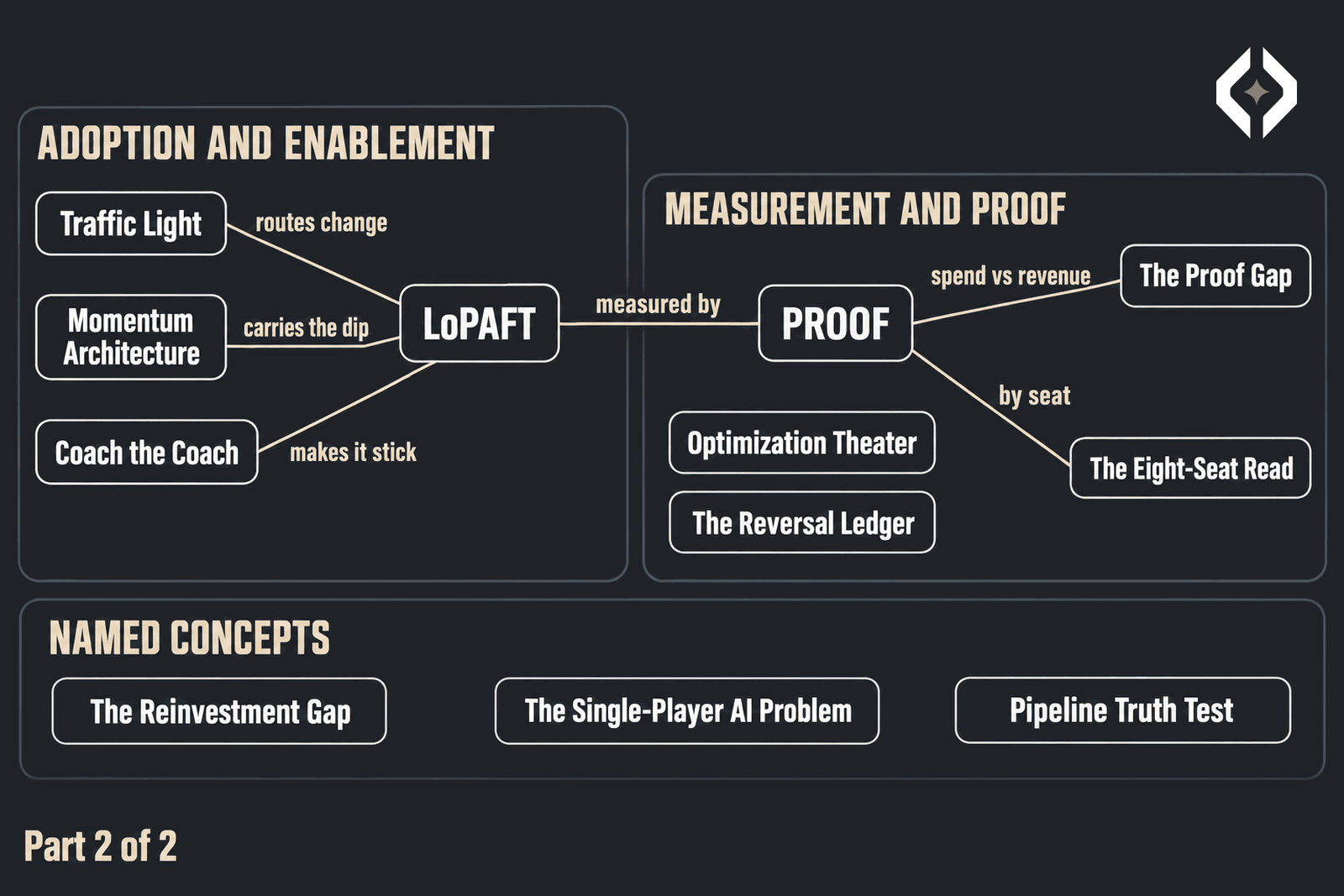
LoPAFT
A six-stage cycle and diagnostic for behavior change. It repeats as a spiral: mastery of one layer becomes the start of the next. Leaders also use it to find where a stalled rollout broke.
- Learn: knowledge transfer and the why.
- Observe: good and bad examples side by side.
- Practice: safe, low-stakes reps with no customer on the line.
- Apply: first live reps on real work, with a named owner.
- Feedback: the work measured against a written standard, with one specific adjustment and a follow-up date.
- Teach: the person explains the work to someone else in their own words.
Traffic Light
A test that sorts a change before rollout so each one gets the right amount of support.
- Green: informational. A message is enough.
- Yellow: process adjustment. Communication plus light reinforcement.
- Red: behavior change. The full LoPAFT cycle.
Momentum Architecture
The design that carries a change program through the predictable dip in weeks three to four.
- Early win: a visible result in the first weeks.
- WHY re-activation: reconnect people to the reason for the change.
- Social proof: peers showing it works.
- Executive visibility: leaders seen backing the work.
- Competing-priority protocol: a set rule for when other work pulls focus.
Coach the Coach
A method for developing managers as coaches so new behavior holds after training ends. Managers learn to observe precisely, give one specific adjustment at a time, and run spaced reinforcement.
Measurement and Proof
PROOF
Five checks for any AI initiative, used at every review to decide whether to expand, fix or stop.
- Prove where the data came from.
- Run it again and get the same result.
- Outcome tied to money.
- Owner has a name.
- Failure mode is clear.
The Proof Gap
A measure of the distance between AI spend and AI-attributable revenue in the same quarter. It tells leaders whether spend is running ahead of results and when a review of what to turn off is due.
Optimization Theater
The pattern of AI programs that report activity, such as pilots, dashboards and time saved, with no revenue result attached. Naming it lets a team spot it in a review and move the measure to revenue, retention, margin or cycle time.
The Reversal Ledger
A running, named record of AI tools that revenue teams have shut off. Each entry carries a reason code, company size band, month and sunk spend, so leaders can learn from bets that were undone before making the same one.
The Eight-Seat Read
One AI scorecard read across the Eight Seats. Each seat reports four measures:
- Dollar: what moved in money.
- Adoption: whether people use it in real work.
- Quality: whether the output holds up.
- Reversal: what was turned off or rolled back.
Named Concepts
The Reinvestment Gap
The distance between the hours AI gives back and the revenue those hours produce. When saved time is not assigned to named higher-value work, the saving fades before it reaches the number.
The Single-Player AI Problem
A real AI win that stays with one person because the workflow was never written down, owned or wired into the system of record. The gain never becomes a team result.
Pipeline Truth Test
A check of whether CRM data can support an AI agent before anyone buys one.
- Field completeness.
- Stage honesty.
- Contact freshness.
- Activity capture.
- Outcome labeling.
Rights
These frameworks, their names, and all related materials are the original work of Jonathan Kvarfordt. Any use, copy, adaptation, or teaching of them needs written permission.
To ask for permission, contact coach@therevenueaireport.com.