
The Agent Launch Is Only Half the Job
Jonathan Kvarfordt · Published · Last updated · 6 min read
Short answer: On November 10, 2026, Invoca released its Broken Funnel Report, a survey of 451 US marketing managers and above at business-to-consumer companies with 100 or more employees in five industries. Invoca, which sells call tracking, attribution, and AI agent software, commissioned the survey from research firm Gather. In the report, 44% of respondents say they have a customer-facing AI agent live in at least one channel and 27% say they are piloting one. Among the 323 respondents with an agent live or in pilot, 27% name revenue or a booked outcome as the agent's primary KPI. Invoca's release says "74% of marketers with AI agents cannot fully track an agent-handled lead from first click to conversion." For a revenue team, the question is what each agent is scored on, and whether its conversations can be traced to an outcome.
Who Invoca surveyed
Per the report's methodology, Gather fielded a 20-question guided interview from September 14 to October 5, 2026. It received 505 responses and kept 451 after quality screening. Respondents qualified at manager level or above, and the report says 60% are director or higher. They are US marketers at companies with 100 or more employees in five industries: home services (30%), healthcare including dental (28%), financial services including insurance (25%), automotive (11%), and telecom (6%). Each has direct or shared responsibility for lead conversion, paid media performance, customer engagement channels, or website and demand generation. The report gives a margin of error of plus or minus 4.6 points at 95% confidence on the clean sample.
The report counts an AI agent only if it faces customers and can hold a two-way conversation by phone, website chat, or text. Phone tree menus, notification, promotion, or nurture messages, internal tools, and chatbots that only serve canned answers did not count.
The answers are self-reported, from the US only, and were collected in one field period, September 14 to October 5, 2026. They describe marketing teams at consumer businesses in five industries, so any business-to-business reading is ours.
How teams score their agents
The report splits the primary KPI for agents into two groups, and Invoca's blog post on the survey puts that question's base at the 323 respondents with an agent live or in pilot.
- Revenue or booked outcome, 27%: conversion rate on agent conversations (11%), appointments or consultations booked (9%), and revenue attributed to agent conversations (7%). Invoca counts conversion rate inside this group.
- Other KPI, 73%: customer satisfaction score (20%), qualified leads produced (16%), volume of conversations handled (16%), share of conversations handled without a person (10%), cost per contact or cost to serve (10%), and "We don't measure it formally" (1%).
The survey asked for one primary KPI. It does not show whether teams in the 73% also track revenue as a second measure.
What teams can trace today
A separate question asked respondents with an agent, "Can your AI agent conversations do this?" The report's methodology says agent-only questions carry a base of 323, and the charts print no count. The shares answering "Yes, fully" per Invoca's report and blog:
- 27%: "Agent can see the customer's digital journey and use it"
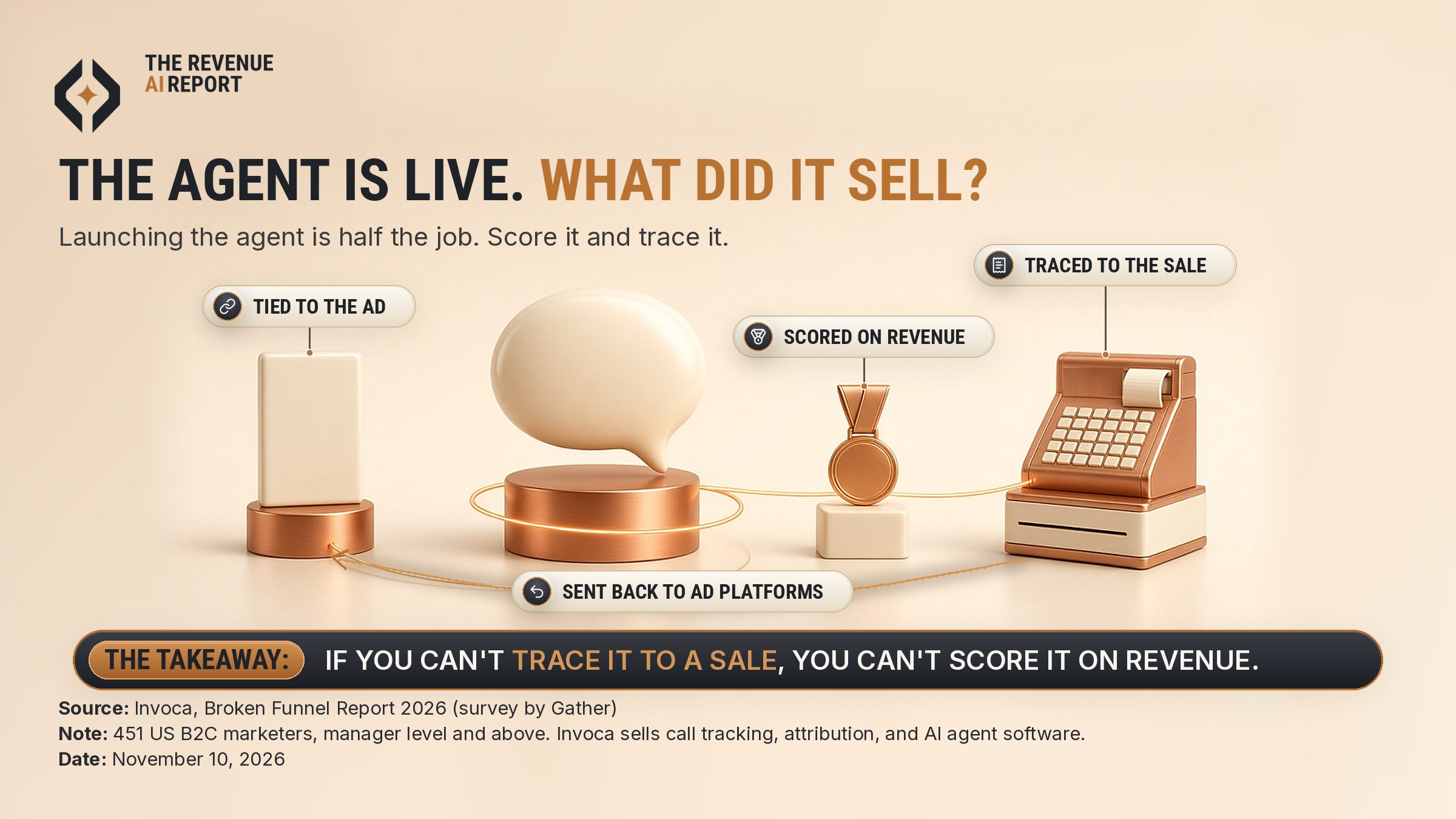
- 26%: "Conversations are tied back to the campaign, keyword, or ad that produced them"
- 26%: "A lead can be followed end to end through to conversion"
- 19%: "Outcomes can be returned to ad platforms as conversion signals"
The 74% figure in Invoca's release pairs with the end-to-end row. Invoca's blog says "Only 26% of marketers with an agent say they can track leads end-to-end" under the heading "74% can't track AI agent-handled leads from click to conversion." Invoca prints only the "Yes, fully" answers, so the other answer options and their shares are unknown. The campaign row is a separate answer that happens to share the 26% value. Invoca prints no overlap between rows, so the survey does not say how many teams have all four in place.
Where leads drop out of view
The report also lists the "Share of marketers who lose attribution, by lead destination": business locations, franchises, and dealers (56%), text or chat (46%), and phone calls (40%). It prints no base for that table. The report adds that "only 21% can both see and influence leads through conversion."
By our read, visibility looks stronger at the top of the funnel. In the report, 86% of marketers surveyed say they can tell whether a lead started its research in an AI answer engine: 46% for most leads and 40% for some. AI answer engines also lead the chart "Which entry points produce your most qualified leads" at 44%. The shares on that chart add to 232% by our arithmetic, so respondents could pick more than one entry point.
These figures are shares of respondents. Lead, conversation, and sale volumes are outside the survey.
Our read
Our read is that, for most respondents with an agent, deployment has moved ahead of measurement. The launch is the visible part of the work. A scoreboard and the data to keep it are the other half.
Our read is that the scoreboard choice and the tracking work may be linked. A team cannot run an agent on revenue if it cannot connect a conversation to a sale. The survey does not show the order in which teams made these choices, and it does not show that a revenue KPI leads to better tracking.
Our read on ad spend: automated bidding on ad platforms learns from the conversion signals advertisers send, and 19% of respondents with an agent say they can return agent outcomes fully. Whether missing signals change media results is a question this survey does not test.
Our read for teams that sell to businesses: the dealer and branch break may have a parallel at the handoff from a sales development rep to an account executive, or at a partner referral. That comparison is ours. Invoca surveyed consumer-business marketers in five industries outside software, and the business-to-business version is unmeasured here.
Moves by title
These are our suggestions, drawn from the findings above.
- CRO. Before the agent count grows, name the primary measure for each customer-facing agent and who reports it. Ask whether revenue or a booked outcome appears in that readout, and when.
- RevOps. Check whether an agent-handled lead can be traced forward to a known status (won, lost, or still open) and back to the campaign that produced it.
- Marketing. Ask whether agent outcomes go back to ad platforms as conversion signals, and whether each agent conversation carries its campaign, keyword, or ad.
- Sales and Customer Success. Map every handoff out of the agent, to a branch, dealer, partner, rep, phone line, or text thread, and name who records the outcome at each one.
Questions to settle before the next agent goes live
These are our questions, drawn from the facts above.
- What is the scoreboard. What is each customer-facing agent's primary measure, and who chose it?
- Is revenue in view at all. If the primary measure is satisfaction or volume, where does a booked outcome or sale show up?
- Can we trace a lead fully. Can an agent-handled lead be followed end to end through to conversion, and for what share of conversations?
- Do we know the source. Is each agent conversation tied to the campaign, keyword, or ad that produced it?
- Do outcomes reach the ad platforms. Are agent outcomes returned to ad platforms as conversion signals, and who owns that feed?
- Where do we lose sight. At which handoff, branch, dealer, partner, phone, or text, does the outcome stop being recorded?
Get the weekly Report: subscribe.
Hiring for revenue roles?
Post your sales, marketing, RevOps or enablement opening where revenue leaders read every week. One 30-day post is $199. Three featured posts are $299/mo.
Keep reading
Reality Check
What has to change before an AI agent can buy from your company?
OpenAI introduced ChatGPT Wallet on November 13, 2026. It lets a user's agent in ChatGPT pay a business after the user approves the purchase, and OpenAI published a Commerce Partner Playbook for the businesses on the other side. The checks land with marketing, digital, payments, and service teams. In our read, the policy call belongs to the revenue leader.
Reality Check
Notable AI Research Papers, November 2026: Nine Revenue Leaders Should Read
Nine papers from November 2026 that tested AI agents on ad rankings, workplace tasks, permissions, sales outreach and shopping choices. Each one with a link, what it found and why it lands on a revenue plan.