
Who grades a resolved outcome? Write the audit into the renewal
Jonathan Kvarfordt · Published · Last updated · 2 min read
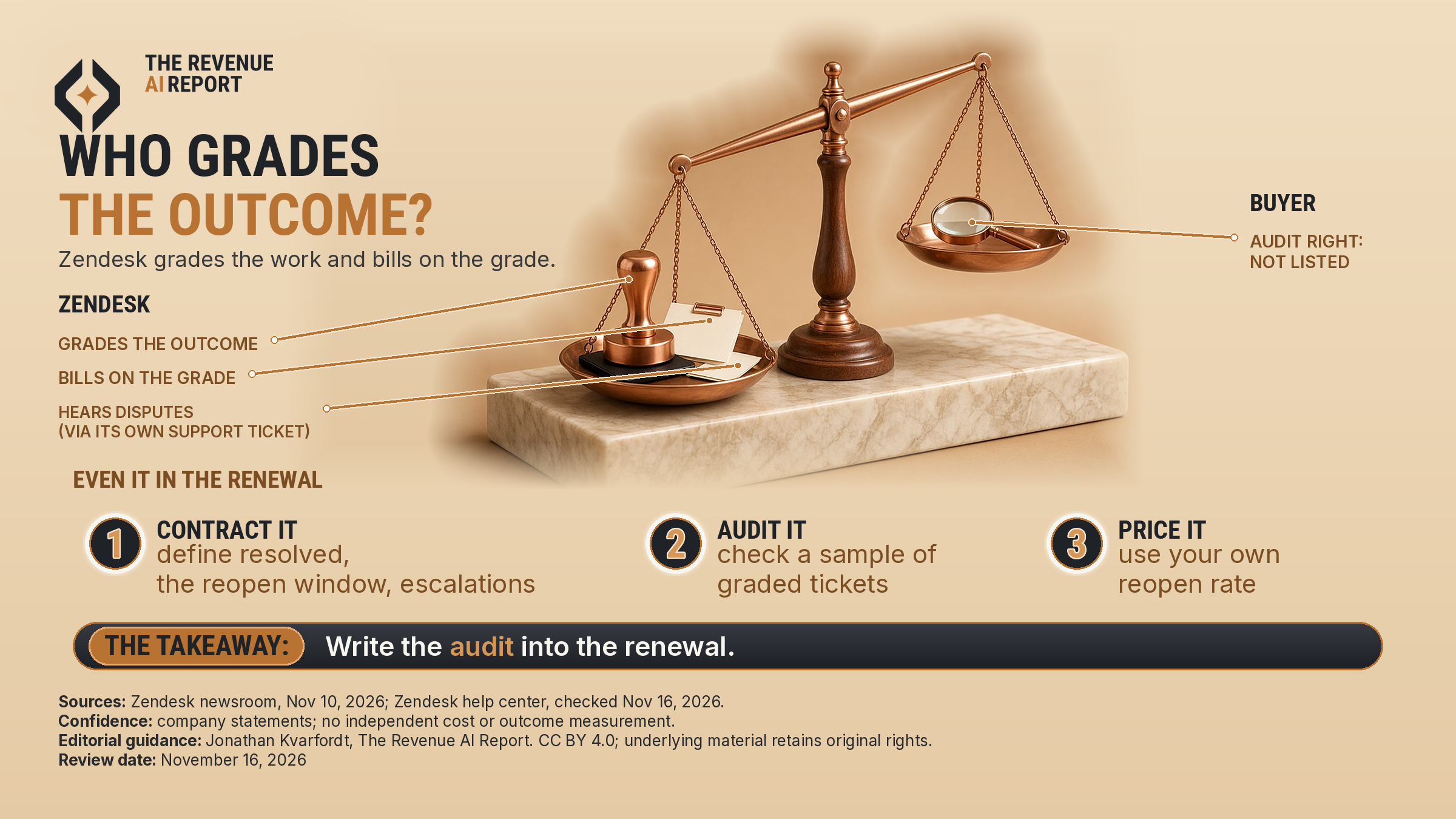
On November 10, 2026, Zendesk announced the Outcome AI Platform and Zendesk Unlimited plans. Zendesk says customers set an Outcome Budget and pay for "eligible issues resolved and business work completed." Zendesk also says it "evaluates each outcome for quality and completeness, so Zendesk customers can see what counts toward their budget." The plans bundle Zendesk AI, with features varying by tier, and come with unlimited user licenses. Zendesk's help center says the plans "are currently in an Early Access Program (EAP)." Zendesk calls this "the next evolution of the resolution-based pricing model it pioneered."
The newsroom announcement does not describe buyer audit rights for the grade. Zendesk's help center fills in part of the billing rules. Its outcome definitions page charges a resolution when "The AI Agent escalated to a human or the human took over from the agent and resolved the customer interaction," and lists "Follow up tickets once initial ticket is closed" among the ticket types it covers. Zendesk's blog says, "One issue counts once, even if it involves multiple messages, channels, or agents." To dispute an outcome charge, Zendesk says to "contact Zendesk Customer Support and file a ticket." None of these pages gives buyers audit rights for the grade. Zendesk says customers "can automate up to 84% of service requests." That is a company claim with no methodology in the announcement, which includes no buyer-issued payback figure.
Do three things before the budget is set:
- Contract it. Write in the definition of a resolved issue, the reopen window in days after a close, and how an escalation to a human is counted.
- Audit it. Pull a sample of tickets the vendor graded as resolved, have your service lead check them against your own close reasons, and put per-outcome export in the contract.
- Price it. Compare the Outcome Budget with your current per-user fees, using your own reopen rate.
A hotel guest-services desk can run the same audit. If a guest calls back two days later about the same room issue, treat that as a test of the reopen window, and record whether the vendor counted a second resolved outcome. An insurer's claims intake works the same way: when a claimant calls back about the same claim inside the window, check whether it was billed as a second resolved outcome.
The diligence work applies wherever a vendor bills per resolved outcome. Get the grade, the reopen window and the evidence into the contract before the budget is set.
Get the weekly Report: subscribe.
Hiring for revenue roles?
Post your sales, marketing, RevOps or enablement opening where revenue leaders read every week. One 30-day post is $199. Three featured posts are $299/mo.
Keep reading
Reality Check
What has to change before an AI agent can buy from your company?
OpenAI introduced ChatGPT Wallet on November 13, 2026. It lets a user's agent in ChatGPT pay a business after the user approves the purchase, and OpenAI published a Commerce Partner Playbook for the businesses on the other side. The checks land with marketing, digital, payments, and service teams. In our read, the policy call belongs to the revenue leader.
Reality Check
Notable AI Research Papers, November 2026: Nine Revenue Leaders Should Read
Nine papers from November 2026 that tested AI agents on ad rankings, workplace tasks, permissions, sales outreach and shopping choices. Each one with a link, what it found and why it lands on a revenue plan.