
What has to change before an AI agent can buy from your company?
Jonathan Kvarfordt · Published · Last updated · 6 min read
Short answer: On November 13, 2026, OpenAI introduced ChatGPT Wallet, a way for a user's agent in ChatGPT to complete a purchase on a company's website after the user approves it. OpenAI says it is rolling out in dots for ChatGPT Pro subscribers aged 18 and older in the US with eligible US-issued cards. OpenAI says businesses need no Wallet-specific integration to accept it. It also says some sites may block these purchases unintentionally, and that risk systems may flag legitimate ones, leading to declines or cancellations. A revenue team has three things to settle: who decides whether agents may buy, whether the site and payment stack let them through, and who handles the order afterward.
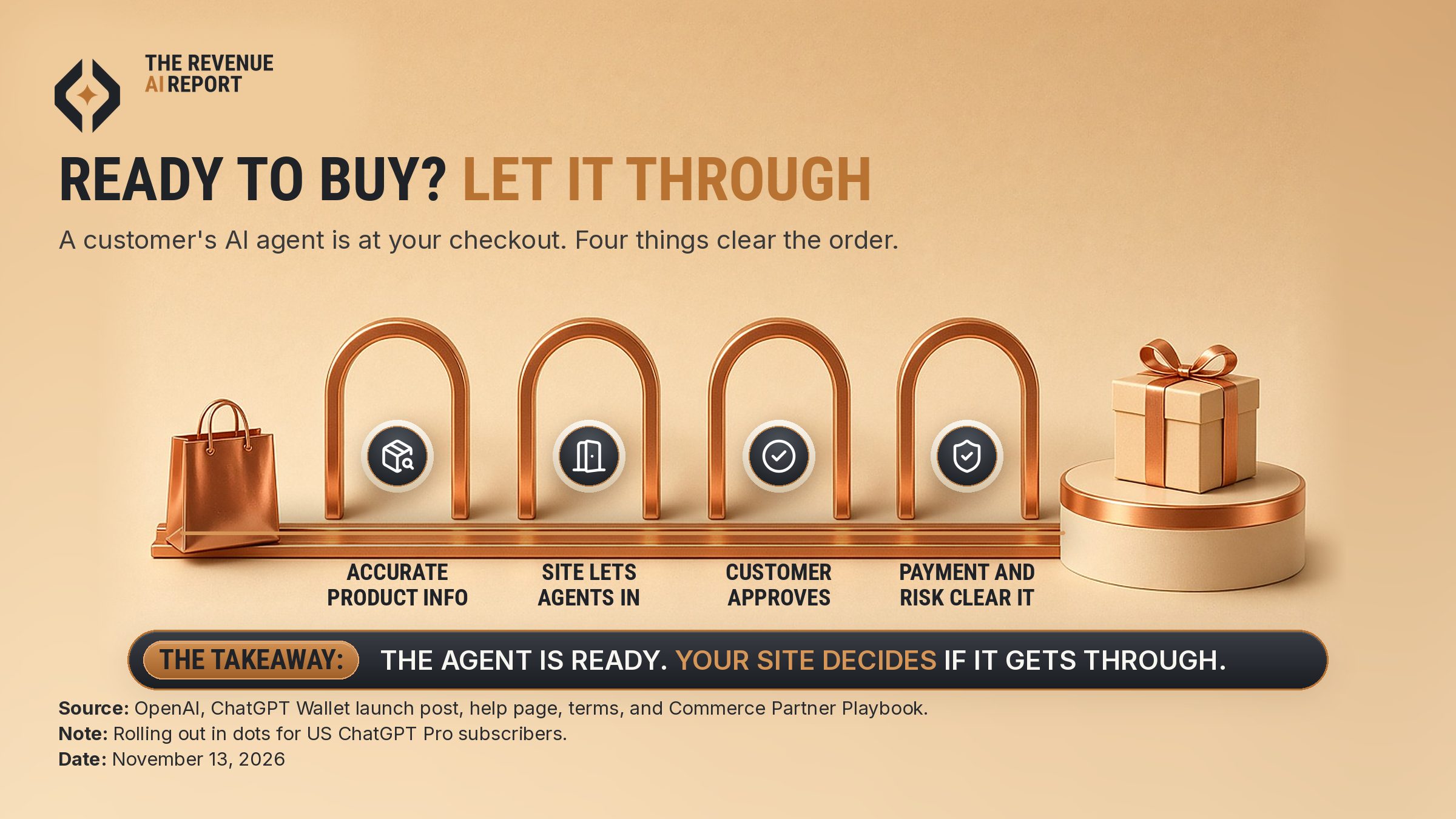
What OpenAI released
OpenAI says it built ChatGPT Wallet in partnership with American Express, Mastercard, and Visa. OpenAI's help page says Wallet works in conversations with a dot, an agent the user sets up in ChatGPT. Its example requests are finding a sweater and booking a hotel.
OpenAI says 1.2 billion people use ChatGPT each week, and that many of them use it to research products, compare options, and decide what to buy. That figure counts all weekly ChatGPT users. Wallet starts with US Pro subscribers, and OpenAI says it is starting with limited availability so it can learn from real-world use.
How a purchase works, per OpenAI
Users add a card once. OpenAI's launch post says: "Before each purchase, the user reviews the items, total, and selected card, then approves it with a security check such as Face ID or a fingerprint scan." After approval, OpenAI says the payment network provides a payment token that stands in for the card details, and the payment is charged to the selected card without ChatGPT Wallet sharing the actual card details with the business or the agent.
OpenAI's Wallet terms, effective November 12, 2026, also describe an advance path: "You must review and approve each purchase before it is submitted or grant ChatGPT the authority to approve each purchase in advance." The launch post presents pre-approval as a later step. OpenAI says it expects, over time, that users will be able to delegate purchases to their agent within set parameters, such as spending limits, purchase categories, or time periods.
OpenAI says users transact directly with businesses, which keep their customer relationships and control over pricing, fulfillment, returns, and customer service. Per OpenAI, users keep their card's existing rewards and protections for eligible disputes with businesses.
What OpenAI tells businesses to check
OpenAI's payments guide for businesses says: "ChatGPT Wallet works out of the box with existing checkout pages and payment forms. No Wallet-specific integration is required." The same guide says the business handles the order, fulfillment, customer support, and fraud decisions.
The launch post adds that "Agentic commerce is still in its early days," and that "Some sites may unintentionally block purchases through ChatGPT Wallet or other agentic payment products." OpenAI says businesses can start with the areas most relevant to their customers:
- Product information. Claim the business in ChatGPT and, once verified, update business details and upload a product feed with current pricing and availability.
- Agent access. Configure the CDN or firewall to recognize signed requests using Web Bot Auth, and confirm general site security is not blocking ChatGPT agents by accident. OpenAI says browser access does not require a plugin or a product feed.
- Payments and risk. OpenAI says Wallet's payment tokens work with existing checkout flows, and that "risk systems may still flag legitimate purchases made by agents, leading to declines or cancellations." OpenAI says it is working with fraud prevention partners including Forter, Riskified, Sardine and Signifyd, and payment service providers including Adyen, Checkout.com, and Stripe, to help their systems recognize those purchases.
- More ways to work with agents. Build a plugin so agents can check availability, manage carts, or take other actions through existing systems. Websites can also add WebMCP tools.
For risk and finance teams, the payments guide says risk systems are often tuned to detect bots, that ChatGPT's cloud browser can set off these systems by accident and cause purchases to fail, and that OpenAI is rolling out support for relaying user signals through the Forwarded HTTP header. The guide says the business receives a network token in place of the full card number, and can use the Payment Account Reference to link that token to the underlying payment account. It says Wallet can pay for a subscription if the existing checkout supports recurring billing and the customer consents. A credential from one purchase should not be reused for another: "The customer consents only to the specific transaction."
Our read
Our read is that the opening decision is a policy call, and it belongs to the CRO. If a company does not decide whether a customer's agent may complete a purchase on its site, its firewall and fraud settings decide by default. OpenAI itself says some sites may unintentionally block these purchases.
Our read is that this reaches well past software. Any company that sells through a website checkout or booking flow, in retail, travel, hospitality, or services, faces the same checks once its customers use agents to buy.
Our read on proof: this is setup and diligence work. OpenAI's launch post gives no Wallet order or revenue figures, availability is limited, and none of the OpenAI pages cited here claims that a feed, a firewall change, or a plugin raises placement or sales. With no Wallet-specific integration required, most near-term work is checks and conversations with providers the company already uses.
Moves by title
These are our suggestions, drawn from OpenAI's guidance above.
- CRO. Name one owner for the agent purchase policy, with marketing, digital, payments, and service at the table. Ask for a short readout: can an agent reach checkout today, and do legitimate agent purchases get declined?
- RevOps. Ask the payment and risk providers how they recognize agent purchases and whether they ingest the Forwarded header. Decide how orders paid through Wallet get counted, and track declines and cancellations on those orders as a separate line.
- Enablement. Brief service and sales teams. OpenAI's help page sends customers to the merchant for order status, cancellations, returns, and refunds. It also says: "Ready to check out means your approval is complete. It does not confirm that the merchant has placed your order." Teams should know how to confirm an order before a customer buys twice.
- Marketing. Check whether the business is claimed in ChatGPT and whether a product feed carries current pricing and availability. Treat it as accuracy work. OpenAI's launch post does not say it changes recommendations.
Questions to settle before an agent buys
These are our questions, drawn from the facts above.
- Who owns the policy. Who decides whether a customer's agent may complete a purchase on our site, and where is that written down?
- Are agents blocked today. Has digital checked the CDN and firewall against Web Bot Auth, or are agent purchases failing quietly?
- Will a real order clear. Have our payment and risk providers told us how they recognize agent purchases, and how many get declined or cancelled?
- How do we count it. Can finance and RevOps tell an order paid with a Wallet network token apart from other orders?
- What does service say. When a customer asks whether an agent's order went through, who answers, and with what script? OpenAI's help page says Wallet "may not be able to complete checkout at every store."
- What changes with pre-approval. If OpenAI lets users pre-approve purchases within limits, which of our checkout, fraud, and refund rules would need review?
Get the weekly Report: subscribe.
Hiring for revenue roles?
Post your sales, marketing, RevOps or enablement opening where revenue leaders read every week. One 30-day post is $199. Three featured posts are $299/mo.
Keep reading
Reality Check
The Agent Launch Is Only Half the Job
Invoca's Broken Funnel Report, released November 10, 2026, asked US consumer-business marketers how they score the AI agents that talk to their customers and whether they can trace those conversations to a sale. Most respondents with an agent name a primary measure other than revenue or a booked outcome, and few say they can fully follow an agent-handled lead to conversion. In our read, the scoreboard decision belongs to the revenue leader.
Reality Check
Notable AI Research Papers, November 2026: Nine Revenue Leaders Should Read
Nine papers from November 2026 that tested AI agents on ad rankings, workplace tasks, permissions, sales outreach and shopping choices. Each one with a link, what it found and why it lands on a revenue plan.