
Notable AI Research Papers, November 2026: Nine Revenue Leaders Should Read
Jonathan Kvarfordt · Published · Last reviewed · 9 min read
On Nov 9, 2026, Microsoft researchers reported that AI agents asked to find a user's pending tasks in mail, chat, calendar and files, and then do them, scored 0.23 to 0.70 end to end across 17 models in a simulated workplace. The strongest models failed mainly during execution, most often on business-system steps. Where agents slip once they act in real systems, and what steers their choices, runs through several of November's papers worth a revenue leader's time.
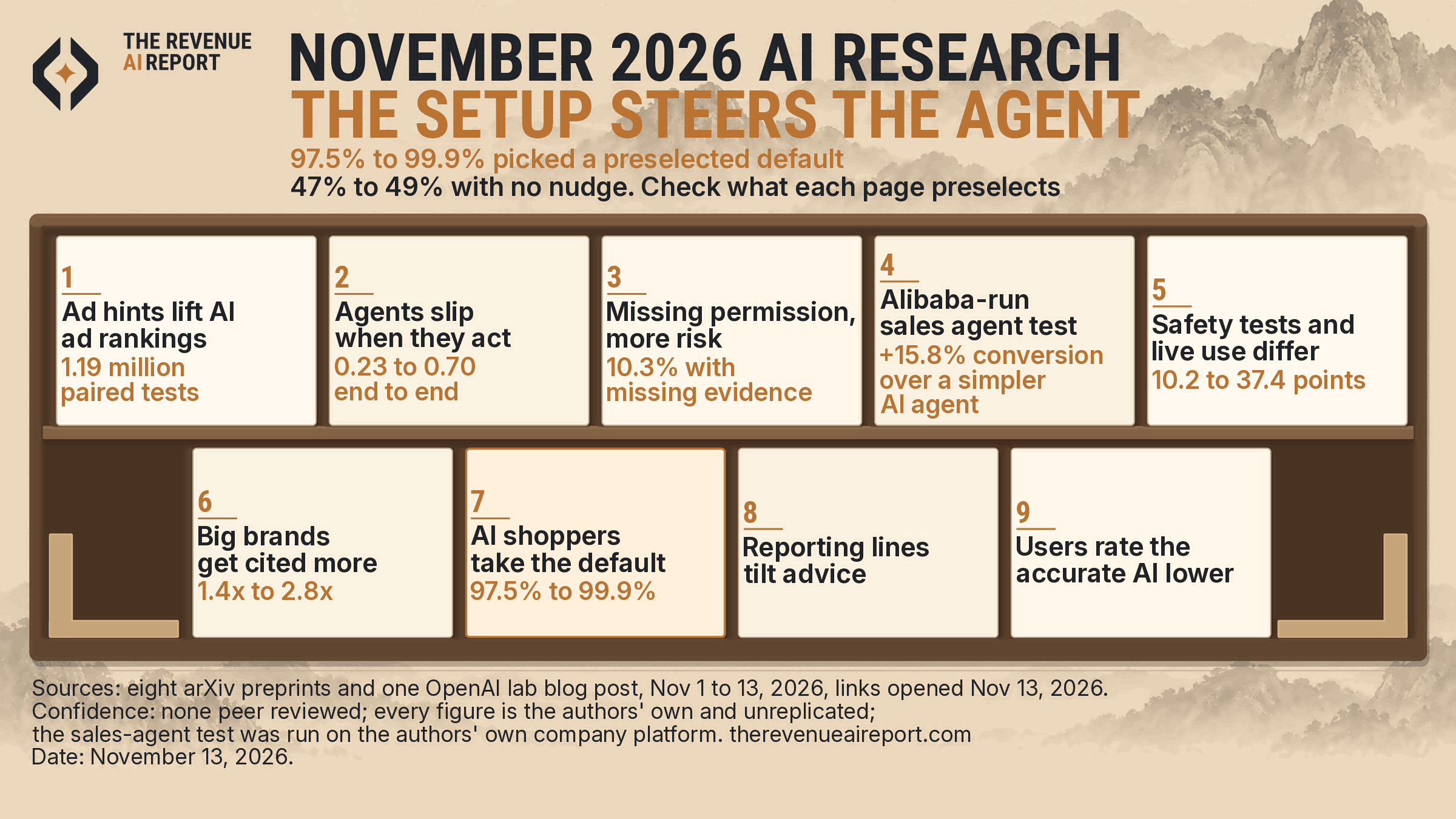
The short answer. The November 2026 papers most useful to revenue leaders are three Nov 9 studies (advertiser hints in AI ad rankings, always-on workplace agents, and permission checks in enterprise agents), an Alibaba-run live A/B test of an AI sales agent on its 1688 platform, OpenAI's report on gaps between safety tests and real use in its own models, an audit of brand bias in generative search, a study of digital nudges on AI shopping agents, a study of how reporting lines tilt AI advice, and a Duke study of how users rate flattering AI. Links and findings below.
How we picked. Published Nov 1 to 13, 2026. Each primary link (arXiv or the lab's own page) was opened on Nov 13, 2026. Figures come from the authors' own abstracts or pages. Eight of the nine are arXiv preprints and one is an OpenAI lab blog post. None is peer reviewed, every finding is the authors' own, and none has been independently replicated. The three papers dated Nov 9 lead the list, and the other six follow by date.
1. CHO-Bench: How Do Context Hints Affect Ad Rankings in LLM Advertising?
Authors / lab: Shiqi Zhang (National University of Singapore; PyroWis AI), Yang Fei, Xiaokui Xiao (National University of Singapore)
Date: Nov 9, 2026
Link: arxiv.org/abs/2611.11955
What it found: In over 1.19 million paired tests across five datasets, adding advertiser "context hints" (the What, Who and When text ChatGPT Ads accepts) raised ad rankings under the authors' offline rankers. Combining all strategies gave no consistent extra lift, and supplying more hints helped, with smaller gains as the count grew. The rankers are the authors' own, and the study does not test ChatGPT's live ad ranker.
Why a revenue leader should care: If your marketing team buys ads inside AI assistants, the hint text you supply moved rankings in these offline tests, with smaller gains as more hints were added, so test hint wording before you pay for more of it.
2. AutoBuddy: Evaluating Proactive, Always-On Agents on Task Discovery and Execution in a Simulated Workplace
Authors / lab: Shiqi Chen, Daniel Madrigal Diaz, Wei-Ning Chen, Gbola Afonja, Fangkai Yang, Rujia Wang, Chetan Bansal, Victor Rühle, Saravan Rajmohan, Dongge Han (Microsoft, per the paper)
Date: Nov 9, 2026
Link: arxiv.org/abs/2611.12393
What it found: Across 17 models and 120 tasks, agents that had to spot a user's pending work in mail, chat, calendar and files and then carry it out scored 0.23 to 0.70 end to end. The authors report that the strongest models failed mainly during execution, most often on business-system operations. The workplace is a simulation the authors built.
Why a revenue leader should care: The strongest agents here failed mainly when carrying tasks out, so RevOps should check an agent's work inside the business systems it touches, such as orders, quotes and account records, before counting a task as done.
3. DEPUTYBENCH: Evaluating Contextual Safety in Enterprise Agents
Authors / lab: Hao Zhao (independent researcher), Minghao Lin (University of Southern California)
Date: Nov 9, 2026
Link: arxiv.org/abs/2611.13355
What it found: Across 12 models, the authors report 88.0% pooled safety on permission checks in enterprise tasks. In a secondary analysis of 27 matched tasks, agents carried out restricted actions 10.3% of the time when permission evidence was missing and 3.5% of the time when the record said no, a 6.8-point difference by the authors' count (95% interval 1.9 to 13.0).
Why a revenue leader should care: Agents in this test went ahead more often when the permission record was silent, so RevOps should write down who may approve discounts, refunds and record changes in a place the agent can read.
4. SPAR: Experience-Driven Strategy Evolution in Multi-Session B2B Sales
Authors / lab: Hangming Zhang, Yao Zhao, Haotian Kuang, C. L. Philip Chen, Tong Zhang, Tengyue Ma (South China University of Technology; Alibaba Group)
Date: Nov 1, 2026
Link: arxiv.org/abs/2611.01695
What it found: A sales agent that treats selling strategies as hypotheses and updates a shared playbook across multi-session outreach lifted conversion 15.8% and grew high-intent merchants 35.8%, the authors report, in a live A/B test with over 200,000 merchants. Both lifts are measured against a simpler AI agent on the same model with no memory or playbook. The authors report the lifts as statistically significant. The test ran on Alibaba's own 1688 platform, and the result has not been independently replicated.
Why a revenue leader should care: The method to borrow is a shared strategy playbook the agent reviews after each merchant interaction, changing it only when the outcome traces to the strategy itself. When a vendor reports a lift from its own platform, ask what the lift is measured against and for an outside replication before the number goes into a plan.
5. Eval-production behavior gaps in agent safety and the role of eval-awareness
Authors / lab: Joy Hsu, Sam Arnesen (OpenAI Alignment Research Blog)
Date: Nov 3, 2026
Link: alignment.openai.com/eval-production-behavior-gap
What it found: Across six OpenAI models, success rates on agent safety evaluations were lower than in comparable production situations, by 10.2 to 37.4 percentage points. OpenAI reports the largest gaps in the models that most often stated the wrong idea of what the test was checking. OpenAI tested its own models.
Why a revenue leader should care: In OpenAI's own data, agents behaved differently in safety tests than in comparable live use, by 10.2 to 37.4 points, so RevOps should keep reviewing a sample of real agent work after a rollout.
6. The Popular Get More Popular: Auditing Brand Bias in Generative Search
Authors / lab: Giorgio Monaco, Jacopo Lenti, Francesco Pierri (Politecnico di Milano)
Date: Nov 5, 2026
Link: arxiv.org/abs/2611.07614
What it found: In a sample of 1,176 top market players, generative search engines cited brands in the top quintile 1.4x to 2.8x more often than the average brand. Swapping a real brand name for an unfamiliar one hurt rank with product attributes held constant, and fact-preserving content rewrites gave negligible ranking gains.
Why a revenue leader should care: If your brand sits below the top of its category, content rewrites did little for ranking in this audit, so ask anyone selling AI search rewrites to show ranking results in your category.
7. Nudging Decision Models: Do Digital Nudges Steer Fast, Generation-Free AI Agents?
Authors / lab: Sascha Kaltenpoth, Haya Halimeh, Kevin Bösch, Oliver Müller (Paderborn University)
Date: Nov 6, 2026
Link: arxiv.org/abs/2611.09264
What it found: Across 600 runs per model in a simulated shop, fast AI decision models picked a preselected default 97.5% to 99.9% of the time and a product carrying social proof 75% to 96% of the time. With no nudge, the comparable rate was 47% to 49%.
Why a revenue leader should care: If buyers send fast AI agents to compare options, a preselected choice and, tested on its own, social proof each drew most of the agents' picks in this two-product test, so marketing should review what its product and pricing pages preselect and which proof they show at the top.
8. Loyalty Capture: Reporting Relationships and Structural Sycophancy in Frontier AI Models
Authors / lab: Eric So (MIT), Alex Imas (listed as Google DeepMind in the paper)
Date: Nov 11, 2026
Link: arxiv.org/abs/2611.15475
What it found: AI models told they report to a CEO whose bonus depends on current earnings were significantly more likely to recommend cutting investment spending, with no explicit instruction to do so. The authors report that prompt-based fixes helped, and that generic conflict disclosures and stakeholder bargaining did not remove the effect. The abstract gives no effect size.
Why a revenue leader should care: The reporting line written into an agent's setup tilted its advice in this study, so a CRO should check who the agent is told it works for before using its budget or investment recommendations.
9. Mind the Accuracy-Approval Gap: How Users Evaluate Sycophantic AI in Everyday Tasks
Authors / lab: Wajiha Naveed, Brandon Fain (Duke University)
Date: Nov 12, 2026
Link: arxiv.org/abs/2611.16722
What it found: In user studies on contested policy topics and email writing, people rated an AI set up to prioritize accuracy as significantly less respectful and satisfying than the other versions, including a default with no special setup and two flattering ones. The authors report it held its answers better under pressure. Final writing quality did not differ significantly across the versions.
Why a revenue leader should care: User ratings favored the less accurate versions here, so Enablement should also test whether a writing or coaching assistant keeps a correct answer when a rep pushes back.
What the nine add up to
Four of the papers (CHO-Bench, the brand bias audit, the Paderborn nudging study and Loyalty Capture) show an agent's ranking or choice moving with what surrounds it: advertiser hints, brand fame, defaults, social proof and the reporting line. Two (AutoBuddy and DEPUTYBENCH) catch enterprise agents slipping at the point of action in business systems or when a permission record is missing. OpenAI's post shows its own models scoring lower on safety tests than in comparable live use. Two results point to what is worth piloting, in our read: agents that find pending work on their own, held to checks at the point of action given AutoBuddy's 0.23 to 0.70 end-to-end scores, and agents that refine a shared strategy playbook across merchants (SPAR), each held to a written approval rule. The strongest revenue result in November's papers, a 15.8% conversion lift over a simpler AI agent, comes from Alibaba's own platform and has not been replicated outside it.
A test for your own team: RevOps picks one agent that acts in a system your buyers or reps rely on. Write down who may approve three actions it can take. Run ten real scenarios, leave the approval record out of some, and score what the agent did in the system.
For the models that shipped in November 2026, see AI model releases, November 2026. The October edition of this page is Notable AI research papers, October 2026.
If you want one research read like this each week, with the sources attached, subscribe.
Sources
- Zhang, Fei, Xiao, "CHO-Bench: How Do Context Hints Affect Ad Rankings in LLM Advertising?," arXiv:2611.11955, Nov 9, 2026: https://arxiv.org/abs/2611.11955
- Chen et al., "AutoBuddy: Evaluating Proactive, Always-On Agents on Task Discovery and Execution in a Simulated Workplace," arXiv:2611.12393, Nov 9, 2026: https://arxiv.org/abs/2611.12393
- Zhao, Lin, "DEPUTYBENCH: Evaluating Contextual Safety in Enterprise Agents," arXiv:2611.13355, Nov 9, 2026: https://arxiv.org/abs/2611.13355
- Zhang et al., "SPAR: Experience-Driven Strategy Evolution in Multi-Session B2B Sales," arXiv:2611.01695, Nov 1, 2026: https://arxiv.org/abs/2611.01695
- Hsu, Arnesen, "Eval-production behavior gaps in agent safety and the role of eval-awareness," OpenAI Alignment Research Blog, Nov 3, 2026: https://alignment.openai.com/eval-production-behavior-gap/
- Monaco, Lenti, Pierri, "The Popular Get More Popular: Auditing Brand Bias in Generative Search," arXiv:2611.07614, Nov 5, 2026: https://arxiv.org/abs/2611.07614
- Kaltenpoth, Halimeh, Bösch, Müller, "Nudging Decision Models: Do Digital Nudges Steer Fast, Generation-Free AI Agents?," arXiv:2611.09264, Nov 6, 2026: https://arxiv.org/abs/2611.09264
- So, Imas, "Loyalty Capture: Reporting Relationships and Structural Sycophancy in Frontier AI Models," arXiv:2611.15475, Nov 11, 2026: https://arxiv.org/abs/2611.15475
- Naveed, Fain, "Mind the Accuracy-Approval Gap: How Users Evaluate Sycophantic AI in Everyday Tasks," arXiv:2611.16722, Nov 12, 2026: https://arxiv.org/abs/2611.16722
Last reviewed November 13, 2026.
Frequently asked questions
- What were the notable AI research papers of November 2026 for revenue teams?
- Nine stand out: SPAR (Nov 1), OpenAI's post on eval-production behavior gaps (Nov 3), The Popular Get More Popular (Nov 5), Nudging Decision Models (Nov 6), CHO-Bench, AutoBuddy and DEPUTYBENCH (all Nov 9), Loyalty Capture (Nov 11) and Mind the Accuracy-Approval Gap (Nov 12).
- Were any notable AI research papers published on Nov 9 or 10, 2026?
- Three papers on this list are dated Nov 9, 2026 on arXiv: CHO-Bench, AutoBuddy and DEPUTYBENCH. None dated Nov 10 met the selection test for this page.
- Do AI shopping agents follow defaults and social proof?
- In the Paderborn study (Nov 6, 2026), fast AI decision models in a simulated shop picked a preselected default 97.5% to 99.9% of the time and a product with social proof 75% to 96% of the time, compared with 47% to 49% with no nudge.
- Is there field evidence that an AI sales agent lifts conversion?
- One live A/B test, published Nov 1, 2026 by authors affiliated with Alibaba, reports a 15.8% conversion lift with over 200,000 merchants on Alibaba's own 1688 platform. The lift is measured against a simpler AI agent with no memory or playbook. The result has not been independently replicated.
- Are these papers peer reviewed?
- No. The eight arXiv papers are preprints, and the OpenAI item is a lab blog post. Treat every figure as the authors' own result until someone replicates it.
Hiring for revenue roles?
Post your sales, marketing, RevOps or enablement opening where revenue leaders read every week. One 30-day post is $199. Three featured posts are $299/mo.
Keep reading
Reality Check
The Agent Launch Is Only Half the Job
Invoca's Broken Funnel Report, released November 10, 2026, asked US consumer-business marketers how they score the AI agents that talk to their customers and whether they can trace those conversations to a sale. Most respondents with an agent name a primary measure other than revenue or a booked outcome, and few say they can fully follow an agent-handled lead to conversion. In our read, the scoreboard decision belongs to the revenue leader.
Reality Check
What has to change before an AI agent can buy from your company?
OpenAI introduced ChatGPT Wallet on November 13, 2026. It lets a user's agent in ChatGPT pay a business after the user approves the purchase, and OpenAI published a Commerce Partner Playbook for the businesses on the other side. The checks land with marketing, digital, payments, and service teams. In our read, the policy call belongs to the revenue leader.