
The Plan Price Held. The Cost of the Task Moved.
Strategy of Finance's AI Credit Index shows sticker prices holding while burn tables change what a task costs. Five lines for your AI order form.
Jonathan Kvarfordt · Published October 15, 2026 · Last updated October 15, 2026 · 6 min read
On October 13, 2026, Strategy of Finance published Edition 2 of its AI Credit Index. It covers 75 AI products and 293 plan tiers. The finding I care most about is easy to miss: the sticker price often held while the burn table changed what a fixed task costs.
If you own an AI credit pool or a renewal, that is the number to watch. A plan can look the same at renewal while the same piece of work costs half as much, or more, than it did when you signed.
What the Index found
All figures below come from Strategy of Finance's AI Credit Index, Edition 2, observed September 21 to October 12, 2026.
- The median bundled rate is about 1.2¢ per credit across 187 paid tiers. The middle half of plans sit between 0.4¢ and 9.5¢.
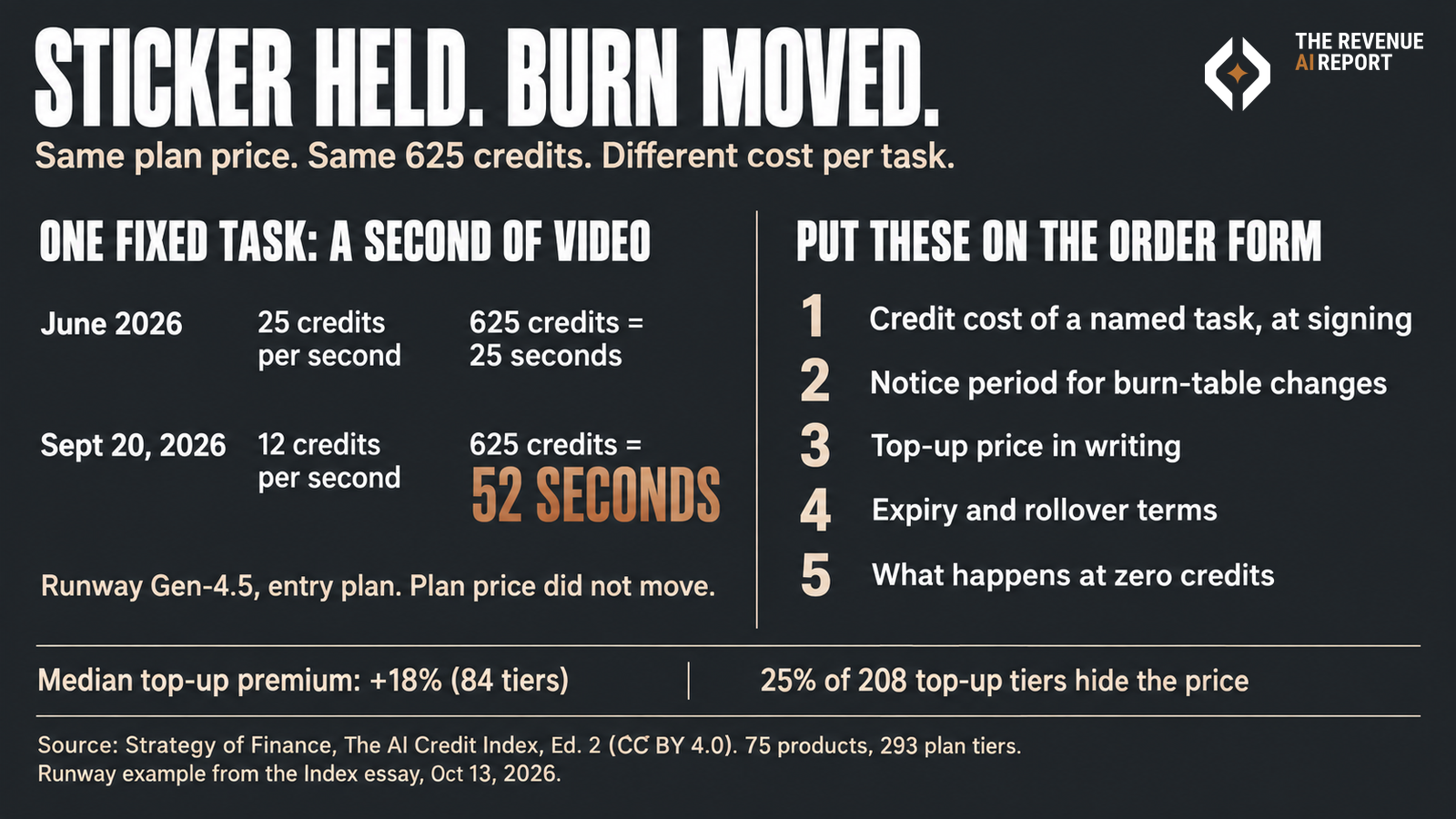
- The median top-up premium is +18%, across the 84 tiers where both prices are public.
- 25% of the 208 tiers that sell a top-up hide its price.
- In the Index's published data, included credits expire on 170 of 293 tiers, and 151 of 293 stop hard when the credits run out.
The Index says its whole-panel figures are not comparable with Edition 1, because the panel changed. I would also not compare cents per credit across products. A credit on one tool buys a very different amount of work than a credit on another.
The sticker held. The burn moved.
The clearest example is in the Index's companion essay. In June, a second of Runway Gen-4.5 video cost 25 credits. By September 20, 2026, it cost 12. The 625 credits in the entry plan bought 52 seconds of video instead of 25. The plan price did not move.
Luma did something similar with Seedance 2.0 and roughly halved the credits per second at every resolution. v0 cut its Mini token rates from $1 and $5 per million input and output tokens to $0.20 and $1.20, with plan prices held.
Those were cuts. The same channel can move the other way. The essay logs Clay, Activepieces and Make moving toward credit charges that vary with the model or with the provider's own cost. A long prompt can now cost more credits than a short one on the same plan. The bill gets more accurate and harder to predict at the same time.
A price tracker misses all of this, because the sticker did not change. The essay's buyer rule is the one I would adopt: track "the credit cost of a fixed piece of work," not the price of a credit.
Finance can see the spend now. The next question is the task.
On October 15, 2026, Ramp said it raised $1.85 billion at a $60 billion valuation, in a round led by Dragoneer. Every Ramp figure here is company-stated. Its AI Token Spend Management, launched in July, gives finance and technical teams one view of AI spend "across providers, teams, models, users, and API keys."
That changes the budget meeting. Once finance can see token spend by user and by team, the question stops being what a credit costs. It becomes what a fixed task cost this quarter, and what it produced. Spend visibility answers the first half of that question. The second half is still yours.
Ramp also claims its Router.com product cuts inference costs "up to 40%." Read that as a ceiling, not a typical result. The release quotes AngelList's controller saying Token Spend Management cut its monthly AI spend by 17.5%. That is one customer's quote, not a benchmark.
Five lines for the order form
Put these on the order form or the renewal checklist for any AI tool that bills in credits:
- Credit cost of a named fixed task, at signing. Pick two or three tasks your team actually runs, such as an enriched account record, a call summary or a 30-second video, and write down what each one costs in credits today.
- Notice period for burn-table changes. Ask for written notice before the vendor changes how many credits a task consumes, not only before a price change. I would ask for 30 days.
- Top-up price in writing. If the top-up rate only shows up inside the app, get it into the contract.
- Expiry and rollover. State when included credits expire and whether any of them roll over.
- What happens at zero. Hard stop, automatic top-up or overage, and who gets an alert before it happens.
If you used the order form in my Hermes Index piece, these lines sit next to it. That piece was about routing and who signs the savings. This one is about the meter itself, backed by an outside panel of 75 products.
Who owns which line
- RevOps or GTM engineering: picks the fixed tasks to meter and logs their credit cost each month. Choosing which tasks are worth metering is a judgment call, and it stays with people.
- Revenue finance: compares the credit cost per task quarter to quarter and flags burn-table changes against budget.
- CRO or revenue leader: decides which tasks earn more credits, based on what they produced.
- Marketing and sales leaders: report which credit-heavy tasks their teams run and what came out of them.
- Whoever signs the renewal: gets the five lines into the paper.
What to do this week
- List the AI tools your teams pay for in credits.
- For each one, pick a fixed task and record its credit cost today, with the date and a link to the vendor's burn-table page.
- Check whether the top-up price is public, and when included credits expire.
- Set a reminder 30 days before each renewal to recheck the same tasks.
This works the same way for an insurer's marketing team, a manufacturer's sales operations group or a services firm. Only the task changes.
The counter-view
Burn-table changes are not always bad news. Three of the moves the Index logged this quarter were cuts, by about half on video. If you freeze a task's credit cost in the contract, you may also freeze out a cut. Ask for notice and the right to the better rate, not a freeze.
Variable credit pricing also has a fair case. A vendor whose own cost changes with the task can average that into a flat charge or pass it through. Passing it through is more honest about cost, even if it is harder to budget.
Tracking fixed tasks also takes time. For a tool with a small bill, a check once a year may be enough. And the Index is one independent panel built from vendor pages. It is a strong record of what vendors published, not of what any single team paid.
Related
- Nous Ranks the Models, Then Sells the Router. Who Signs the Savings?
- Cheapest-Model Routing: Four Asks for Your Order Form
- G2 Puts a Number on the Distrust Tax. Price Agents Per Acceptable Outcome.
- GPT-6.1 Sol: Near-Astra Work at One-Fifth Price
- Reversal Ledger
Sources
- Strategy of Finance, The AI Credit Index, Edition 2, published Oct 13, 2026 (CC BY 4.0): strategyoffinance.com
- Rohit Agarwal, "The meter cut both ways," Strategy of Finance, Oct 13, 2026: strategyoffinance.com
- Strategy of Finance, The AI Credit Index methodology: strategyoffinance.com
- Ramp, "Ramp Reaches $60 Billion Valuation as Annualized Revenue Tops $2 Billion," PR Newswire, Oct 15, 2026 (company-stated figures): prnewswire.com
If you want the next pricing receipt broken down the same way, subscribe.
Frequently asked questions
- What is the AI Credit Index?
- An independent benchmark from Strategy of Finance that tracks credit pricing on AI products. Edition 2, published October 13, 2026, covers 75 products and 293 plan tiers observed from September 21 to October 12, 2026. It is published under a CC BY 4.0 licence.
- What is a burn table?
- The vendor's table of how many credits a given task consumes, such as credits per second of video or per AI step. It can change while the plan price and the price of a credit stay the same.
- How much more do AI credit top-ups cost?
- Per the Index, the median top-up premium is +18% across the 84 tiers where both prices are public, and 25% of the 208 tiers that sell a top-up hide its price.
- What should a buyer track instead of the price per credit?
- The credit cost of a fixed piece of work. Pick a few named tasks, record their credit cost at signing, and recheck them before each renewal.
Keep reading
Reality Check
Forgepoint Raised $9.8M for an AI Quote Desk. Price Speed Against Margin.
Forgepoint raised $9.8M seed Oct 14 for Frank, an AI inside sales rep that turns RFQs into quotes. Run a Reversal Ledger per RFQ: speed is not margin.
Reality Check
Nous Ranks the Models, Then Sells the Router. Who Signs the Savings?
Nous ranks 14 models by score and $ per task, then sells the router. Six order-form lines and one named owner prove a router cut cost per accepted outcome.