
Companies Are Pulling Back on AI. What Revenue Leaders Should Prove First
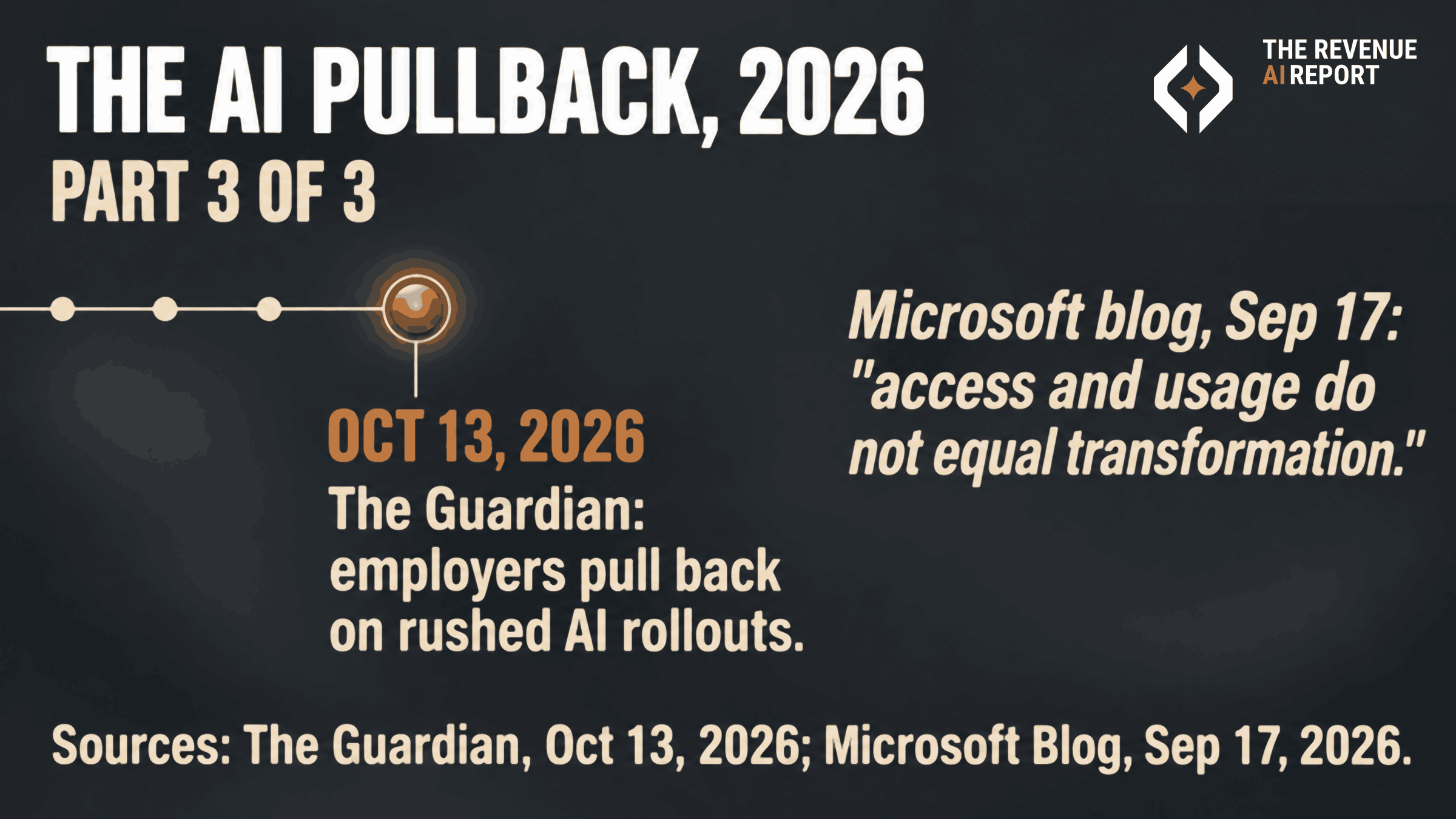
On October 13, The Guardian reported that employers who rushed AI tools into the workforce are now cleaning up errors, low-quality work, security exposure and rising costs. Meta scaled back plans to replace staff with AI agents. If your AI spend has not paid back yet, prove one outcome per workflow before you renew anything.
Jonathan Kvarfordt · Published October 15, 2026 · Last updated October 15, 2026 · 8 min read
On October 13, The Guardian reported that employers who rushed AI tools into the workforce are now cleaning up errors, low-quality work, security exposure and rising costs. Meta scaled back plans to replace staff with AI agents. If your AI spend has not paid back yet, prove one outcome per workflow before you renew anything.
What the Guardian reported
Taylor Telford's piece names the pattern plainly: "Employers are navigating a flood of errors and low-quality work that are sapping employee time, raising privacy and security risks and pushing up costs."
Three company signals stand out.
Meta. Per the Guardian, "Meta has scaled back plans to axe staff and use more AI agents after the company found employees were spending more and more time cleaning up technical and security errors, Reuters reported." A Reuters investigation published August 26, 2026 reported that Meta's Project OT explored deep headcount cuts with AI agents taking over much daily work. Meta canceled a planned second wave of cuts. Internal posts cited a rise in major technical and security incidents and more employee time spent fixing them (Ars Technica summary of the Reuters report).
Business Insider reported on September 10, 2026 that Meta is asking some individual contributors in its Applied AI division, on an opt-in basis, to move back into manager roles (Business Insider). That is one division and a voluntary ask.
Read it as a change in the role mix. When agents produce more output, someone has to check it, approve it and own the result. Meta is asking more people to take on that judgment work.
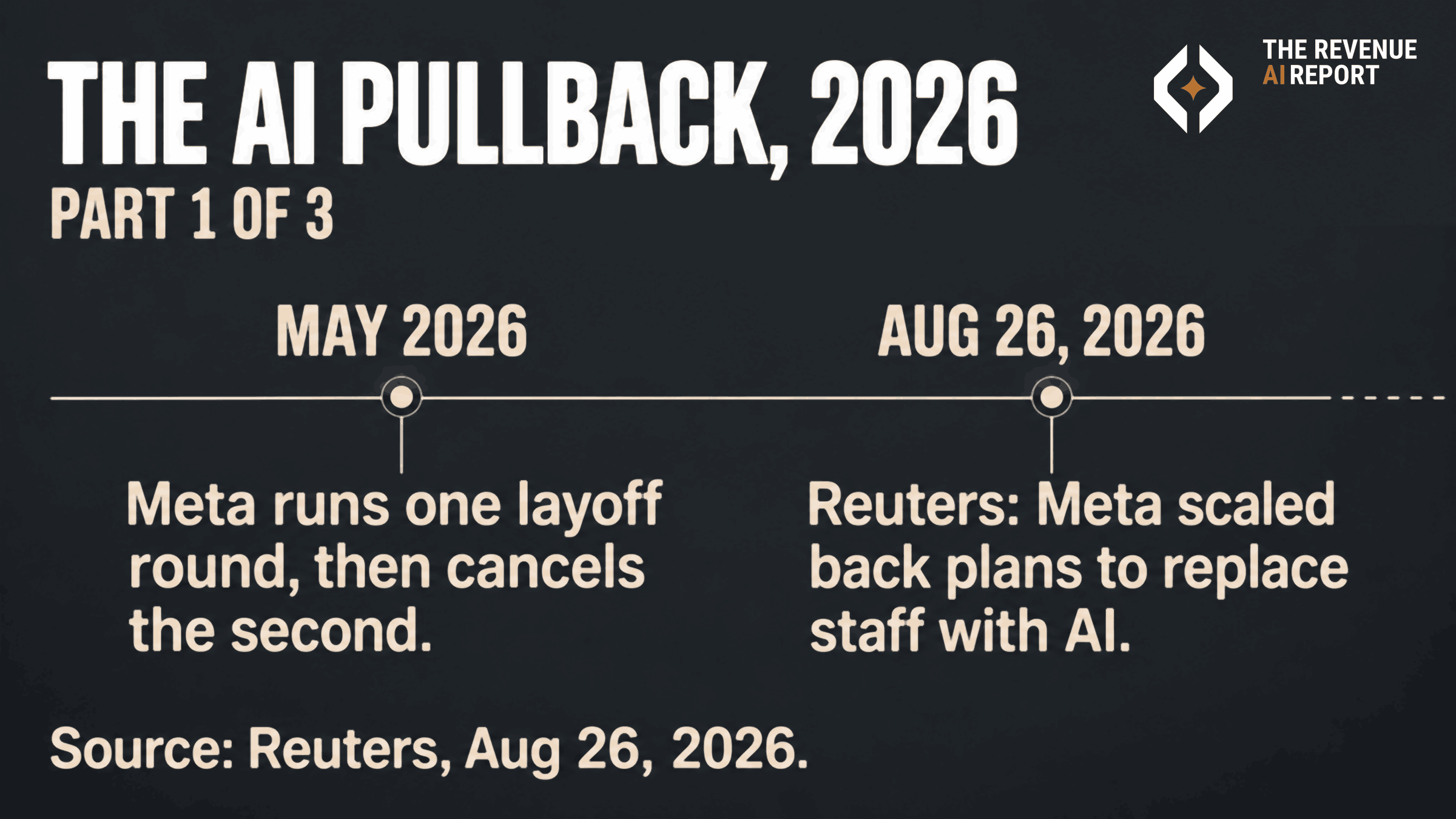
Microsoft. Kathleen Hogan, Microsoft's EVP and chief strategy and transformation officer, wrote on the Official Microsoft Blog on September 17, 2026: "We initially treated AI like a traditional technology rollout: deploy the tools, provide training, drive adoption. We learned that access and usage do not equal transformation." She also wrote that "adding agents to a broken process still leaves a broken process" and "speeding up one step just creates a longer queue at the next."
Cost controls. McKinsey manages internal AI cost by tracking per-user token use, emailing high-usage alerts, and using gateways and temporary circuit-breaker pauses, per Business Insider's interview with QuantumBlack UK leader Debasish Patnaik. He said the firm still wants consultant autonomy and is not trying to discourage AI use.
Security curbs. The Information, as reported by Reuters on September 14, 2026, said Palantir pressed Anthropic for irrevocable zero-data-retention guarantees, Nvidia limits Anthropic models to less sensitive tasks and prefers its own Nemotron models internally, and Booz Allen barred employees from using Anthropic's commercial model for proprietary cybersecurity work (CNA reprint of the Reuters report).
The numbers behind the pullback
Two surveys frame the gap. Both are checked against the original source.
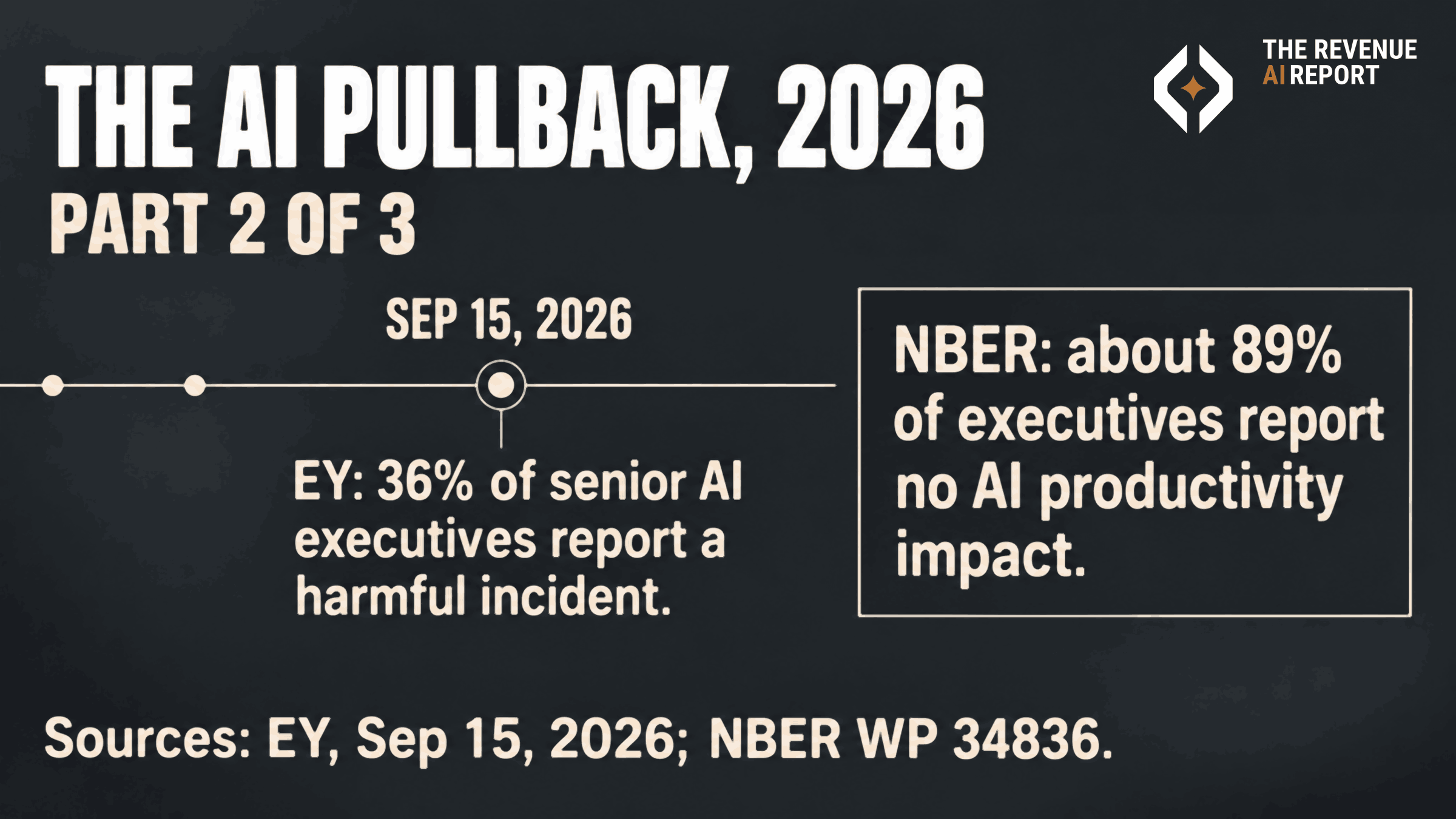
- About 89% (nine in ten) of nearly 6,000 senior executives across the US, UK, Germany and Australia reported no impact of AI on labor productivity over the past three years. Source: Yotzov et al., "Firm Data on AI," NBER Working Paper 34836, also issued as Atlanta Fed Working Paper 2026-3, fielded November 2025 to January 2026. Productivity there means sales per employee. (NBER, Atlanta Fed)
- 36% of senior AI executives said their organization had an AI incident or failure with a materially negative impact, including data loss, financial damage, operational disruption or brand damage. Source: EY US AI Risk and Governance Survey, published September 15, 2026. 202 senior AI decision-makers at publicly traded US companies with at least $1 billion in annual revenue, fielded May 28 to June 15, 2026, margin of error plus or minus 7 points. (EY)
The same pattern shows up in this week's Report coverage. In our draft on dentsu's 2026 CMO report (publishing soon), 70% of CMOs agree they have not yet seen major cost efficiencies from AI. Our draft on Accenture's $29 monthly Claude allowance, reported by 404 Media, shows a large buyer moving AI overage onto project budgets. And Ramp's new round puts AI token spend by team, model and user in front of finance. We covered that in the AI Credit Index. Those pieces make spend visible. Outcomes per dollar still sit outside most of those views.
Where this evidence stops
The Atlanta Fed paper also carries the counter-view. The same executives forecast that AI will raise productivity at their firms by 1.4% over the next three years. A minority already report positive effects. Low payback so far measures early use more than a settled ceiling on what AI can return.
The EY figure covers large public US companies only. The Meta manager move is one division and opt-in, per Business Insider. The Guardian's broader claim rests on LinkedIn posts we could not verify.
Cut, keep, prove
As a Report position, we have said it since June: "Usage is not transformation. Having a license is having a license." Hogan reached the same finding inside Microsoft. Here is how to act on it in a sales team, a hospital billing office or a freight brokerage.
Cut first. Drop seats with usage and no named task; a license that maps to "general productivity" goes. Drop tools where a human rewrites most outputs, because you pay for the tool and again for the rewrite. Drop agents allowed to act alone in systems that touch customers or money, without an approval step. The EY incident rate is the reason.
Keep. Keep workflows where faster output moves revenue timing, such as a quote out the same day or a renewal flagged a month early. Keep uses with a named owner who can switch them off. Keep reviewers. As agents scale, the review and approval roles grow. Fund them. That is the role mix Meta is moving toward.
Prove before renewal, per workflow:
- Outputs accepted without a rewrite, per month.
- Human hours per accepted output, review and rework included.
- Total cost per accepted output, licenses and tokens included.
- One business number that moved against a named baseline: cycle time, error rate, win rate or revenue touched.
- Incidents logged: wrong data sent, wrong action taken, data shared outside policy.
If line 4 is empty after a quarter, the tool goes on the cut list. Hogan's queue warning applies here. Speed in one step that piles work on the next step shows up as flat cycle time.
Pick your three largest AI line items this week. Ask each owner for these five lines by the end of the month. Renew only what can fill them.
Sources
Frequently asked questions
- Are companies abandoning AI?
- The Guardian describes cost controls, security curbs, retraining and more experienced staff. The pullback targets unchecked rollouts and agents acting without review.
- Did Meta replace managers with AI?
- Meta cut staff in May and canceled a second wave, per Reuters. Business Insider reports Meta is asking some Applied AI staff, on an opt-in basis, to move back into manager roles. The role mix is moving toward people who review and own AI output.
- What does the Atlanta Fed paper show?
- About 89% (nine in ten) of nearly 6,000 executives in four countries reported no AI impact on labor productivity over the past three years. The same executives expect a 1.4% productivity gain over the next three.
- What should a revenue leader measure first?
- Cost per accepted output and one business number that moved against a baseline. Payback shows up in accepted outputs and a moved baseline. Add usage counts only as context.
- How common are AI incidents?
- In EY's September 2026 survey of 202 senior AI executives at US public companies with $1 billion or more in revenue, 36% reported an AI incident with materially negative impact.
Keep reading
Reality Check
Forgepoint Raised $9.8M for an AI Quote Desk. Price Speed Against Margin.
Forgepoint raised $9.8M seed Oct 14 for Frank, an AI inside sales rep that turns RFQs into quotes. Run a Reversal Ledger per RFQ: speed is not margin.
Reality Check
Nous Ranks the Models, Then Sells the Router. Who Signs the Savings?
Nous ranks 14 models by score and $ per task, then sells the router. Six order-form lines and one named owner prove a router cut cost per accepted outcome.