
Which AI Surfaces Actually Cite Us on Commercial-Intent Prompts, and Why Is One Blended AI Visibility Score the Wrong Instrument for That Decision?
Foundation x AirOps measured citation share across six AI surfaces. One blended AI visibility score averages those systems into a vanity number. Track citation rate and citation share per surface. Soft subscribe only.
Jonathan Kvarfordt · Published September 25, 2026 · 9 min read
The short answer
Which AI surfaces actually cite us on commercial-intent prompts, and why is one blended "AI visibility" score the wrong instrument for that decision?
Decision rule
Kill the single blended AI visibility score as a board metric. Track citation rate and citation share per surface. Buy visibility tools only if they break out ChatGPT vs Google AI vs Gemini. Refuse one-score OKRs.
Evidence
- Foundation x AirOps State of B2B AI Discovery 2026 lab page: six-surface citation mix, social ~7% vs <=0.3%, ~27x gap, Gemini 71.63% product, G2 ~25-33% on five surfaces, ChatGPT community 9.26%, Claude 2.67%
- Required disclose: Foundation Marketing Services commercial relationship with AirOps; citation = answer visibility, not traffic/conversion
Operator action
This week: pick the surface your buyers use, run a recurring commercial-intent prompt set on that surface, and refuse any vendor that only sells one blended AI visibility score.
Last reviewed
Which AI surfaces actually cite us on commercial-intent prompts, and why is one blended "AI visibility" score the wrong instrument for that decision?
Your board deck has one "AI visibility" number. Your buyers ask ChatGPT. Those are different instruments. Foundation x AirOps measured citation share by surface. The blended score fails the measurement job.
The argument
How this benchmark breaks down
A map of the sections ahead, in the order the case is made. The sourced charts are in the research library.
Contents diagram for Which AI Surfaces Actually Cite Us on Commercial-Intent Prompts, and Why Is One Blended AI Visibility Score the Wrong Instrument for That Decision?, listing the sections: AI visibility score vs citation share, B2B AI discovery surface-specific citations, ChatGPT vs Google AI Overview citations, Gemini product domain citation share.Disclosure (read first): This report was produced by Foundation Marketing Services in collaboration with AirOps; Foundation has a commercial relationship with AirOps. Numbers below are theirs; we score the buyer decision, not the vendor.
What the study publishes
Scope (Foundation x AirOps, confidence: study page). Commercial-intent B2B software prompts from Jun 22 to Jul 24, 2026 across six AI surfaces: ChatGPT, Claude, Gemini, Perplexity, Google AI Overview, and Google AI Mode. AirOps logged roughly 380,000 AI answers. Foundation classified about three million citation events across 81 B2B software categories. Source: Foundation lab
Benchmark
Which AI Surfaces Actually Cite Us on Commercial-Intent Prompts, and Why Is One Blended AI Visibility Score the Wrong Instrument for That Decision?
Source-cited charts live in the research library.
Which AI Surfaces Actually Cite Us on Commercial-Intent Prompts, and Why Is One Blended AI Visibility Score the Wrong Instrument for That Decision?. Diagram showing Evidence, Analysis, Decision, Outcome.Citation definition (required). A citation event is one domain appearing as a source in one AI answer. It measures AI-answer visibility, not traffic and not conversion.
Two retrieval systems. Google AI Overview and Google AI Mode build from Google's live search index. ChatGPT, Claude, Gemini, and Perplexity run as standalone assistants with their own retrieval and training data. Product domains lead on every surface. The split shows up in reviews, communities, social, and media.
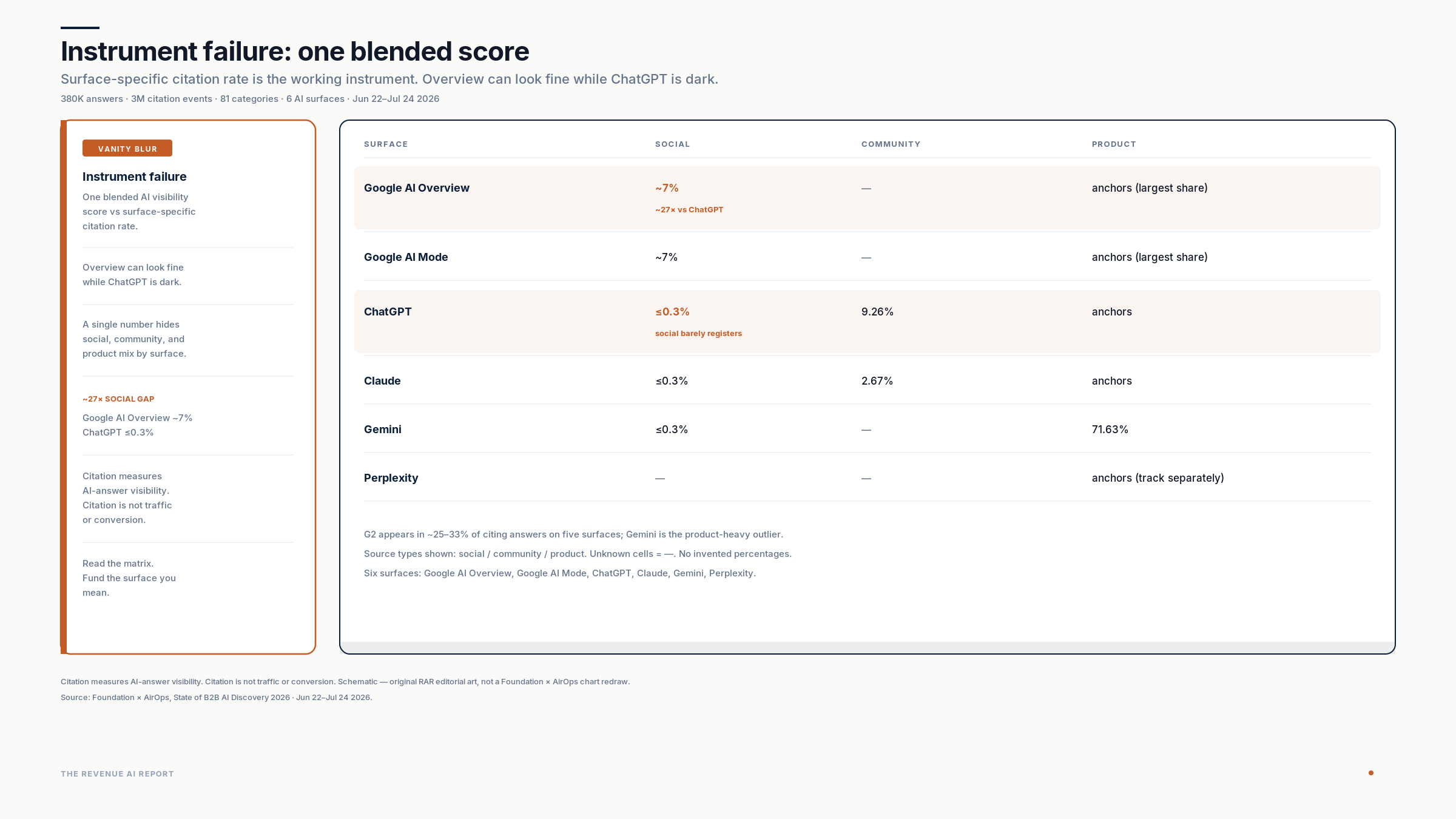
Social gap (~27x). About 7% of citations on Google's two AI surfaces go to social domains (YouTube, LinkedIn). On ChatGPT, Gemini, and Claude, social's share is 0.3% or lower. The report calls that roughly a 27x gap between AI Overview and ChatGPT. (confidence: study page)
Community fork. ChatGPT community citation share is 9.26%, driven almost entirely by Reddit. Claude community sits at 2.67%. (confidence: study page)
Gemini is vendor-heavy. Gemini sends 71.63% of its citations to product domains. No single third-party domain appears in even 14% of Gemini's answers. (confidence: study page)
G2 on five surfaces. G2 appears in about a quarter to a third (~25-33%) of citing answers on the other five surfaces. Gemini is the outlier. (confidence: study page)
Category swings the mix. Across six representative categories in the study, reviews' citation share swings 3.3x (7.64% managed databases to 25.07% recruiting/ATS). Community share swings 2.5x (5.5% SEO platforms to 13.89% EDR/XDR). (confidence: study page)
Comparison / listicle URLs (soft-tag). Some secondary coverage cites "84 of 100 most-cited URLs" as comparison/listicle pages. That figure was not verified on the public lab page we fetched for this decoder. Treat it as soft until confirmed in the full report PDF. Do not put it in a board slide as proven.
AirOps cross-vertical 68.4% (separate study). AirOps' own May-June 2026 cross-vertical analysis puts B2B software brand-and-product citation share at 68.4%. That uses a different taxonomy. It is not interchangeable with the six-surface Foundation x AirOps mix. Tag it AirOps proprietary when you quote it. (confidence: study page, labeled separate)
Prior Foundation x AirOps 57M work is a different method. Do not mix those method counts with the ~380K / ~3M figures above.
Proof Gap: blended score vs surface-specific citation
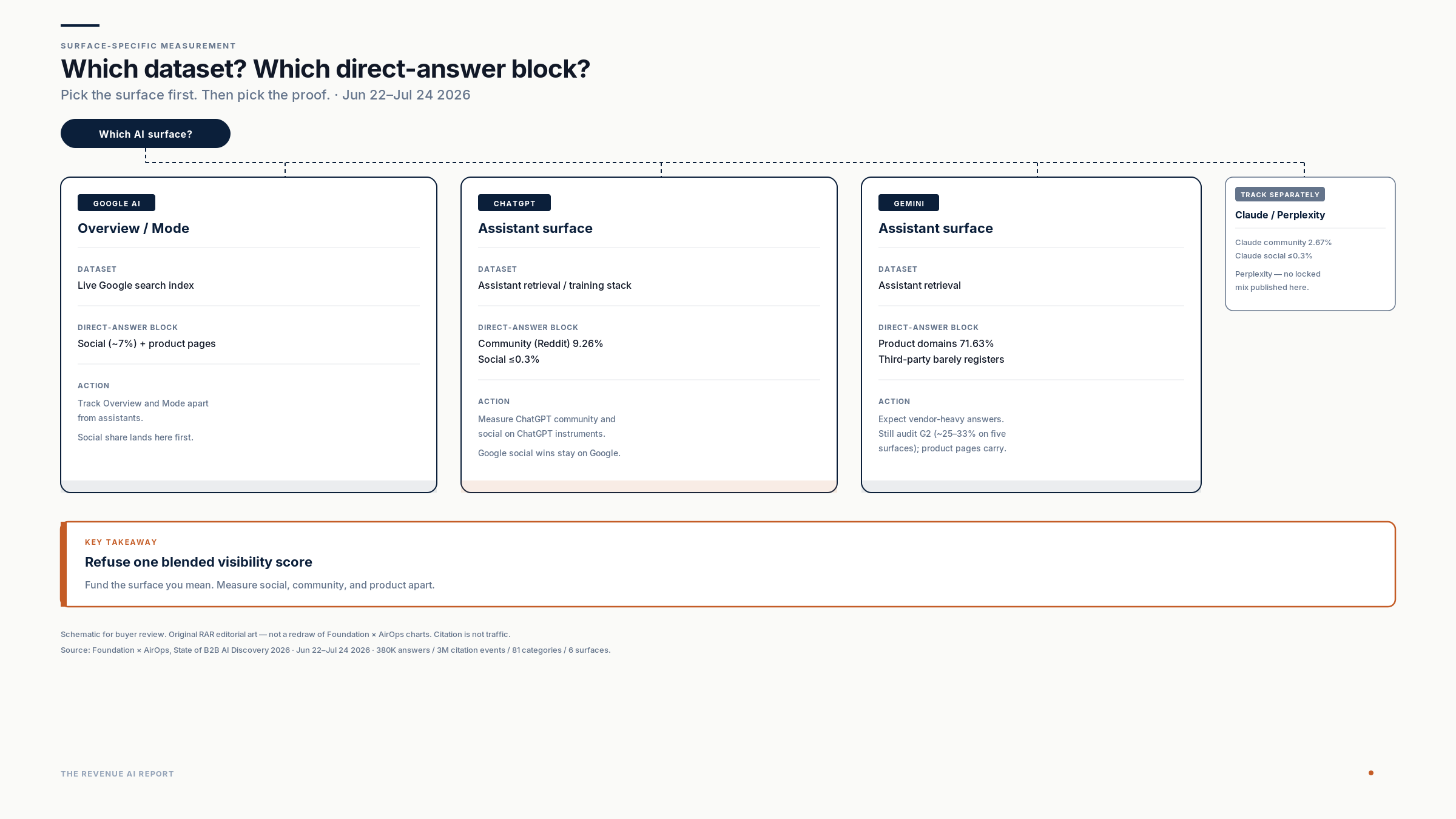
The Proof Gap here is instrument failure. Teams buy or report a single AI visibility score. The study shows surfaces diverge on social, community, and third-party share. A healthy Google AI Overview number can hide a ChatGPT hole. A ChatGPT win can hide a Gemini miss. Citation rate and citation share must be tracked per surface. Anything else is spend without proof on the surface buyers use.
Decision rule for Director+ teams (RevOps, enablement, revenue systems)
- Kill the single blended AI visibility score as a board metric. Track citation rate and citation share per surface across the six named surfaces.
- Match the dataset to the surface. Google AI Overview / AI Mode need a live-index view. ChatGPT needs community weight. Gemini needs a product-domain view.
- Treat G2 like owned media on five surfaces. ~25-33% of citing answers outside Gemini. Operate the profile.
- Fund the contested share with category context. Reviews and community swing hard by category (3.3x / 2.5x in the study's six-category cut). Copying another category's playbook funds the wrong channel.
- Prompt set = how buyers ask. Recurring commercial-intent prompts per surface. Turn off one-time blended audits.
- Buy visibility tools only if they break out by surface. If the vendor cannot show ChatGPT vs Google AI vs Gemini separately, you are buying the Proof Gap.
- Do not convert citation share into traffic or pipeline in the deck. Visibility only. Prove traffic and conversion with your own analytics.
Eight-Seat Read (lite): one decision each
- CMO / demand: Kill the single blended AI visibility dashboard this quarter?
- Content / AEO: Fund product and comparison pages before the next editorial sprint?
- RevOps: Which of the six surfaces do buyers in our category actually use?
- Product marketing: Treat G2 as owned media?
- Community / social: Fund Reddit or YouTube only if category and surface data say so?
- CRO: Refuse board slides that show one AI visibility number?
Turn off: one-score OKRs; category-agnostic playbooks; one-time audits instead of recurring prompt sets.
Vendor claim score
/5: "Track with continuous prompt tooling / one platform sees all six." Surface-split measurement is the useful claim. An AirOps (or any vendor) sales pitch that collapses six surfaces into one score is not. Do not pick their chart as proof of purchase. Demand per-surface citation rate and citation share on your category prompts.
Why we might be wrong
- The study window is about five weeks (Jun 22-Jul 24 2026). Mixes can move.
- Google AI Overview does not trigger for every query, so its answer volume differs structurally from the standalone assistants.
- Commercial co-authors (Foundation Marketing Services and AirOps). Read numbers as published methodology; score the buyer decision yourself.
- Citation share is not pipeline. A surface win can still fail conversion.
Sources
- Foundation x AirOps, The State of B2B AI Discovery 2026: Foundation lab. Study window Jun 22-Jul 24 2026; ~380K AI answers; ~3M citation events; 81 B2B software categories; six surfaces (ChatGPT, Claude, Gemini, Perplexity, Google AI Overview, Google AI Mode).
- Disclosure: This report was produced by Foundation Marketing Services in collaboration with AirOps; Foundation has a commercial relationship with AirOps. A citation measures AI-answer visibility, not traffic or conversion.
Soft CTA
If you want the next AEO decoder and the weekly receipts before you buy another visibility score, subscribe
Take it to the room
The short list from this piece
Pulled from the argument above, written so you can read it out in a pipeline or board review.
Checklist diagram summarising Which AI Surfaces Actually Cite Us on Commercial-Intent Prompts, and Why Is One Blended AI Visibility Score the Wrong Instrument for That Decision?: Foundation x AirOps, The State of B2B AI Discovery; Disclosure:.Frequently asked questions
- Which AI surfaces actually cite us?
- You only know if you measure citation share on each of the six: ChatGPT, Claude, Gemini, Perplexity, Google AI Overview, Google AI Mode. Foundation x AirOps show the mixes diverge (social ~7% on Google AI vs <=0.3% on ChatGPT/Gemini/Claude; Gemini 71.63% product; ChatGPT community 9.26%).
- Why is one blended AI visibility score the wrong instrument?
- It averages two retrieval systems and six source mixes into one vanity number. A healthy Overview score can hide a ChatGPT hole (and reverse). That is the Proof Gap: spend without proof on the surface buyers use.
- What dataset should we run per surface?
- Per surface, not blended. Google AI: live-index with social/community visible. ChatGPT: community-aware (Reddit-heavy). Gemini: product-domain heavy; third-party share alone under-reads. Claude community is lower (2.67%) than ChatGPT. Always split all six.
- Does a citation mean traffic or conversion?
- No. The report defines a citation as a domain appearing as a source in one AI answer. Visibility only.
- Why does G2 keep showing up?
- On five of six surfaces, G2 appears in roughly a quarter to a third of citing answers. Gemini is the exception where no third-party domain clears even 14% of answers.
- Is the AirOps 68.4% brand-and-product figure part of the six-surface study?
- No. Separate AirOps proprietary cross-vertical analysis (May-June 2026), different taxonomy. Do not swap it into the six-surface mix.
- Is this an AirOps sales piece?
- The report was produced by Foundation Marketing Services in collaboration with AirOps; Foundation has a commercial relationship with AirOps. Numbers are theirs. We score the buyer decision: refuse tools that only sell one blended score.
Subscribe
Get the next benchmark, with the sample size attached.
Keep reading
Benchmark
Landbase GTMBench Put GTM-3 Omni Ahead. Blind-Test Your Own ICP Before You Buy
Treat vendor precision as a question generator. Buy only after a blind ICP test, judged by someone who does not sell the tool, tracked accepted rows to held meetings to pipeline to cost.
Benchmark
The AI Adoption Curve for Revenue Teams: L1 to L6, and Where Most Teams Stall
Six levels from one tool with no workflow change to a rebuilt process. Each level has a failure mode and an exit criterion. Most revenue teams are at L2 and reporting L4.