
Self-Ranking Best-Of Pages in AI Overviews. Prove the Recommendation Before You Renew
Treat a citation as visibility only. Renew listicle and paid-mention spend only when recommendation share is measured on the named surface, on your prompt panel.
Jonathan Kvarfordt · Published October 8, 2026 · 8 min read
The short answer
We paid for best-X listicles and AI brand mentions. How do we prove they won the AI recommendation, separate from a citation that can send the buyer to a competitor?
Decision rule
Treat a citation as visibility only. Renew listicle and paid-mention spend only when recommendation share is measured on the named surface, on your prompt panel.
Evidence
- AI Overviews cited 38% fewer vendor self-ranking listicles, Sep vs Jun 2026, on 100 B2B software queries [Verified primary].
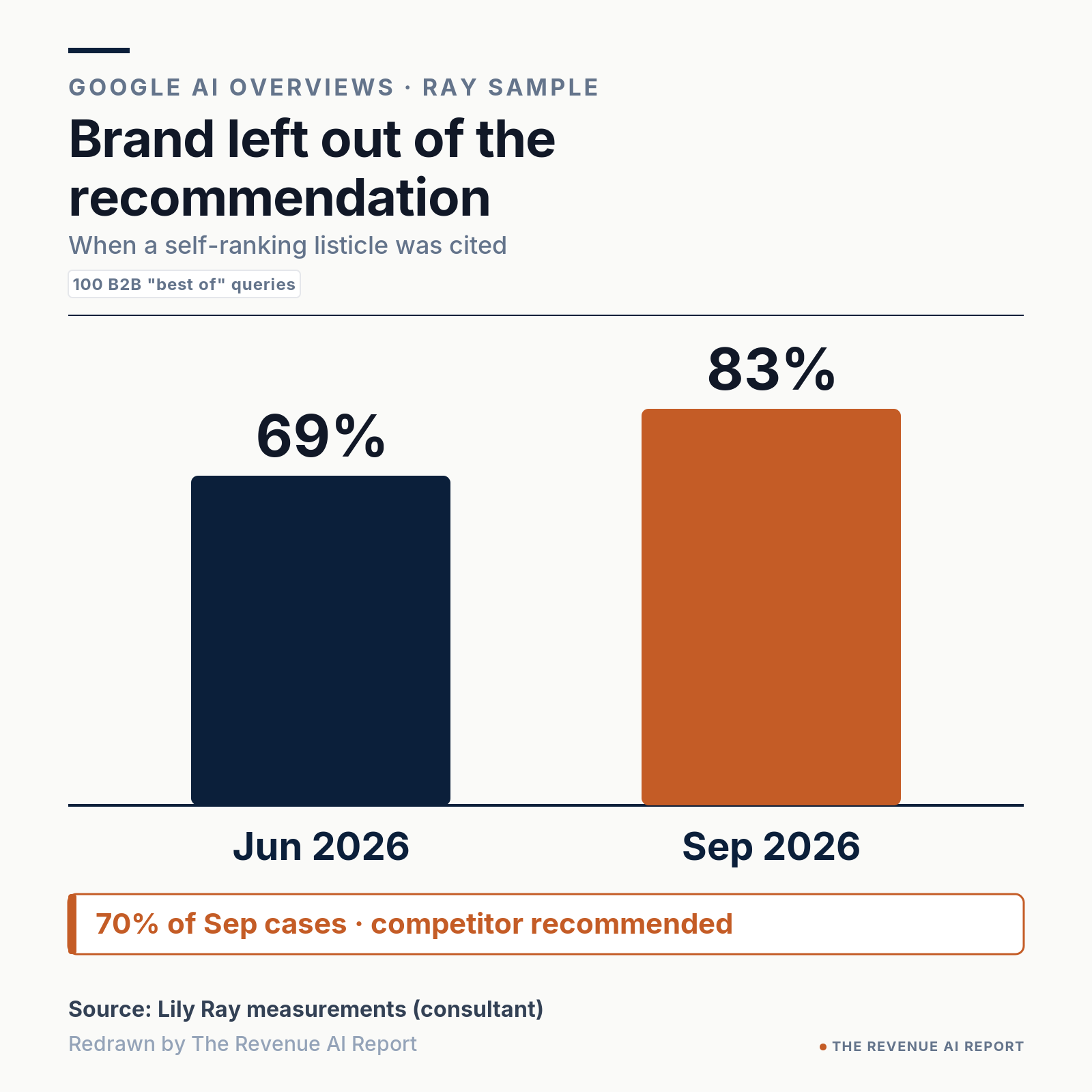
- Publishing brand left out of the recommendation 83% in Sep (69% in Jun); listicle helped a competitor in 70% of cases [Verified primary].
Operator action
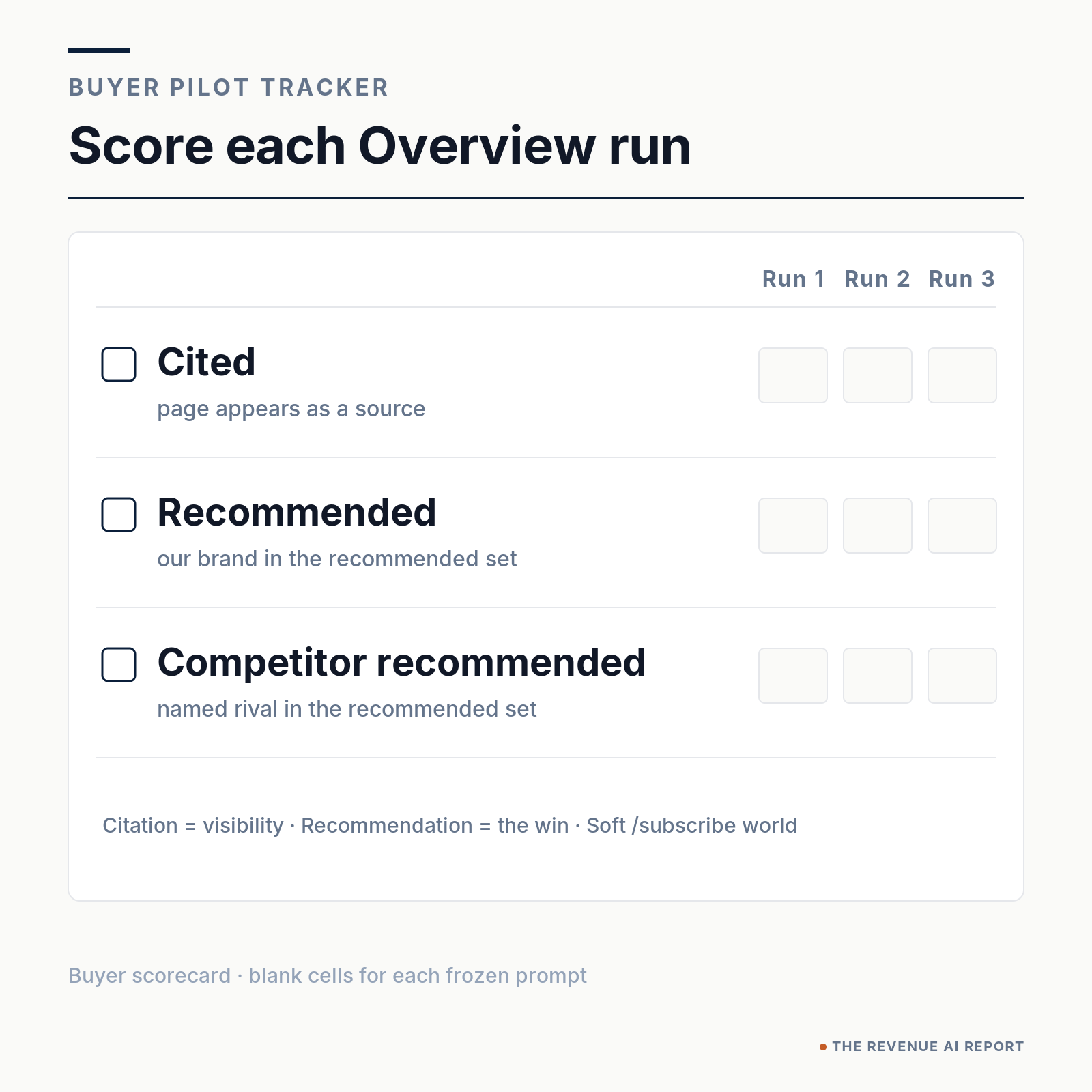
Freeze a commercial-intent prompt panel. For each run, score three lines: cited, recommended, competitor recommended. Refuse renewals that report citation alone.
Last reviewed
Sources
- Lily Ray, Prediction: the next massive Google update is around the corner, Oct 4, 2026. https://lilyraynyc.substack.com/p/prediction-the-next-massive-google. Consultant essay; self-ranking listicle figures are Ray's own measurements on Google AI Overviews.
- PPC Land, Google AI Overviews cut self-ranking listicle citations 38%, Lily Ray finds, Oct 5, 2026. https://ppc.land/google-ai-overviews-cut-self-ranking-listicle-citations-38-lily-ray-finds/. Secondary write-up of Ray; also reports Scrunch and Kevin Indig figures that point in different directions.
- Google Search Central, Guidance on using generative AI content (updated Oct 1, 2026). https://developers.google.com/search/docs/fundamentals/using-gen-ai-content. Manual fact-check language verified on the live docs page.
- Google Search Central, Creating helpful, reliable, people-first content (main-content / effort / fabricated-creator language reported Oct 2, 2026). Reported via Ray and PPC Land coverage; documented policy context, not a ranking-change notice.
- Google spam policies apply to AI Overviews and AI Mode (May 15, 2026 clarification), per Ray and PPC Land.
- The Revenue AI Report, Sep 25, 2026: Which AI Surfaces Actually Cite Us on Commercial-Intent Prompts.
- The Revenue AI Report, Oct 6, 2026: Ask the Same AI the Same Question Twice.
The argument
How this benchmark breaks down
A map of the sections ahead, in the order the case is made. The sourced charts are in the research library.
Contents diagram for Self-Ranking Best-Of Pages in AI Overviews. Prove the Recommendation Before You Renew, listing the sections: Sources, The short answer, What Ray measured, The Proof Gap: citation without recommendation proof, Conflicting datasets (read before you renew), Policy context (timing only).Confidence tags: [Verified primary] = checked against Ray's Substack essay (Oct 4, 2026) and/or Google's live AI-content docs. [Reported] = from PPC Land or other secondary coverage of Scrunch / Kevin Indig / spam-window timing. [RAR analysis] = buyer framing we add for Director+ teams to test.
The short answer
You paid for a "best X" listicle or an AI brand mention. The vendor screenshot shows your page cited in a Google AI Overview. That is one check. The second check is whether the Overview recommended you.
Benchmark
Self-Ranking Best-Of Pages in AI Overviews. Prove the Recommendation Before You Renew
Source-cited charts live in the research library.
Self-Ranking Best-Of Pages in AI Overviews. Prove the Recommendation Before You Renew. Diagram showing Evidence, Analysis, Decision, Outcome.Lily Ray measured 100 "best B2B software" queries on Google AI Overviews, comparing September 2026 to June. AI Overviews cited 38% fewer vendor self-ranking listicles. When those pages still appeared, the brand that ranked itself #1 was left out of the recommendation 83% of the time (69% in June). In 70% of cases, the listicle helped a competitor get recommended [Verified primary].
Decision rule: Treat a citation as visibility only. Renew listicle and paid-mention spend only when recommendation share is measured on the named surface, on your prompt panel.
Operator action this week: Freeze a commercial-intent prompt panel. For each run, score three lines: cited, recommended, competitor recommended. Refuse renewals that report citation alone.
What Ray measured
Scope and figures from Ray's Oct 4 essay [Verified primary]:
- Queries: 100 "best B2B software" queries
- Surface: Google AI Overviews only
- Windows: September 2026 vs June 2026
- Citation volume: AI Overviews cite 38% fewer vendor self-ranking ("best of") listicles than in June
- Publishing brand left out of recommendation: 83% in September, up from 69% in June
- Competitor helped: in 70% of cases, the listicle helped a competitor get recommended while the publishing brand was left out
Ray's charts live on her Substack and in the PPC Land write-up. Link those primaries in the board pack. Do not treat a RAR redraw of the percentages as Ray's original art.
Paid-mention market ranges Ray inventories [Verified primary]:
- Per-placement listicle spots often priced around $135–$250, by host Domain Rating / Domain Authority
- Packages such as 5 AI brand mentions for $1,500
- Some placements sell dofollow links; agency playbooks note one-off paid placements of $100–$200 when outreach fails
Google's link spam policy still treats money-for-links as a violation unless marked `rel="sponsored"` or `rel="nofollow"`. Google's generative-AI features guide says seeking inauthentic mentions "isn't as helpful as it might seem." Spam policies have covered attempts to manipulate generative AI responses in Search since the May 15, 2026 clarification [Verified primary / Reported].
The Proof Gap: citation without recommendation proof
The Proof Gap here is instrument failure on a paid placement. Teams buy self-ranking pages and paid mentions to win AI recommendations. Vendors deliver a citation screenshot. Ray's sample shows citation and recommendation often diverge on the same Overview: the page appears as a source; the publishing brand is left out of who gets recommended; a competitor can take that slot.
Our Sep 25 surface-split piece already treated citation as visibility, not traffic. Our Oct 6 KACI piece showed one run is one sample. This piece adds a third line on the same surface: was your brand the one recommended?
Required caveats on Ray's numbers [RAR analysis]:
- Ray is a consultant with a commercial stake in audit and recovery work
- One AI surface (Google AI Overviews), one vertical slice (B2B software "best of" queries), n = 100
- Method for classifying "recommendation" vs "citation" is not fully disclosed
- None of the competing datasets below has been independently audited
Conflicting datasets (read before you renew)
Other public cuts point in different directions. PPC Land reports both alongside Ray [Reported]:
- Lily Ray (Sep 2026): Measured 100 B2B "best of" queries on Google AI Overviews. Headline: brand left out 83%; competitor helped 70%; citations down 38% vs Jun. Tension with Ray: reference dataset.
- Scrunch (mid-2026): Measured ~10,000 URLs across 7 assistants. Headline: cited self-ranking page lifted author recommendation ~4% → ~7%; competitor recommended in 24.3% of answers citing such a page. Tension with Ray: same tactic family; different surfaces, window, and rates.
- Kevin Indig (Aug 24, 2026): Measured 5.32M organic result rows. Headline: 62% of vendor-authored list pages gained estimated organic traffic since January (median +38%). Tension with Ray: organic traffic, not AI Overview recommendation.
Can 24.3% and 70% both be true? Possibly. Scrunch measured seven assistants over a mid-2026 window; Ray measured Google AI Overviews alone, three months later. Neither study is independently audited. Kevin Indig's 62% is an organic-traffic share, not a citation or recommendation rate. Do not swap it into an AI Overview slide.
Policy context (timing only)
Google rewrote its generative-AI content guidance on Oct 1, 2026. The live docs now say it is "critical" to manually fact-check and review all AI-generated content before publishing, including titles, meta descriptions, structured data, and alt text [Verified primary]. Helpful-content docs gained main-content / effort / fabricated-creator language around Oct 2, per Ray and PPC Land [Reported]. Spam policies have covered AI Overviews and AI Mode since May 15, 2026 [Reported].
Google ran four spam updates in 2026 (March, June, August, September). The September cycle began Sep 24 with a window of up to two weeks; PPC Land notes that window can run to Oct 8 [Reported]. Documentation edits are signals Ray reads as pre-update warnings. Google has named no ranking update tied to the October edits. Treat them as policy context, not as proof that any single listicle will lose tomorrow.
Order Form and pilot lines
Paste these into the listicle, paid-mention, or AEO placement contract. Fill the blanks with your vendor. [RAR analysis]
- Surfaces named: "Vendor reports each surface on its own line: Google AI Overview, Google AI Mode, ChatGPT, Claude, Gemini, Perplexity, or the subset we name."
- Three-line score per prompt: "For each frozen prompt, vendor reports cited (yes/no), our brand recommended (yes/no), and competitor recommended (named brands)."
- Recommendation definition: "Recommended means [named entity / product] appears in the Overview's recommended or shortlisted set as defined in the pilot annex. Citation alone does not count as a win."
- Prompt panel frozen: "Prompt panel is versioned. Any change to wording, count, or language resets the baseline."
- Run count and band: "Each prompt runs [N] times per period. Citation and recommendation deltas count only above the baseline variance band for [X] consecutive periods."
- Paid-mention disclosure: "Any paid placement is labeled for the buyer with host URL, fee, link-rel attributes, and disclosure status. Undisclosed paid mentions are out of scope for renewal credit."
- Citation, recommendation, traffic, pipeline on separate lines: "Vendor makes no claim converting citation into recommendation, traffic, or pipeline."
- Raw export: "Buyer receives per-run answer text, cited URLs, recommended entities, and timestamps on request."
- Stop rule: "Pilot ends on [date] or after [N] periods. Named owner can unwind placements that fail the recommendation line."
Eight-Seat Read: one decision each
Director to C-suite revenue leaders.
- CMO / marketing: Drop board slides that treat an AI Overview citation as a recommendation win.
- Demand gen / content: Fund the next self-ranking or paid-mention package only after the three-line score holds on your panel.
- RevOps: Own the frozen prompt panel and the cited / recommended / competitor-recommended log.
- Product marketing: Separate "we appear as a source" from "we are the brand recommended" in every AEO review.
- Finance / procurement: Approve renewals on recommendation share plus your own referral traffic and pipeline. Citation screenshots alone do not qualify.
- Legal / compliance: Require disclosure status and link-rel attributes on every paid placement before payment clears.
- Sales enablement: Train reps that a competitor can win the recommendation from a page that cites your category.
- CEO / strategy: Ask one question on every listicle renewal: on which surface, and how often, were we recommended?
Why we might be wrong
- Ray's 83% / 70% / 38% figures may not hold on your category prompts or outside Google AI Overviews.
- Scrunch's lift (~4% → ~7%) and 24.3% competitor rate may better describe multi-assistant behavior on your panel.
- Kevin Indig's organic gains for vendor list pages may continue even when Overview recommendation rates stay weak.
- A well-built third-party listicle (independent author, real testing) may recommend the publishing brand more often than vendor self-ranking pages.
- Google's October documentation edits may not produce a near-term ranking change aimed at this tactic.
- Paid mentions with proper disclosure and nofollow/sponsored links may survive even if dofollow schemes do not.
- Recommendation classification is underspecified in public write-ups. Your annex definition may score the same Overview differently.
If you want the next AEO decoder when a citation screenshot is sold as a recommendation win, subscribe.
Take it to the room
The short list from this piece
Pulled from the argument above, written so you can read it out in a pipeline or board review.
Checklist diagram summarising Self-Ranking Best-Of Pages in AI Overviews. Prove the Recommendation Before You Renew: Ray's 83% / 70% / 38% figures may not hold on your; Scrunch's lift (~4% → ~7%) and 24.3% competitor; Kevin Indig's organic gains for vendor list pages; A well-built third-party listicle (independent; Google's October documentation edits may not.Frequently asked questions
- What did Lily Ray find on self-ranking listicles?
- On 100 "best B2B software" queries, Google AI Overviews cited 38% fewer vendor self-ranking listicles in September than in June. The brand that ranked itself #1 was left out of the recommendation 83% of the time (69% in June). In 70% of cases the listicle helped a competitor get recommended [Verified primary].
- Does a citation in an AI Overview mean we won the recommendation?
- No. Ray's sample shows the Overview can cite the page and still leave the publishing brand out of who gets recommended. Score cited, recommended, and competitor recommended as three lines [RAR analysis].
- How much do paid AI brand mentions cost in Ray's inventory?
- Per-placement spots often around $135–$250; example packages include 5 AI brand mentions for $1,500 [Verified primary]. Treat those as market examples Ray listed, not as RAR pricing research.
- Why do Scrunch and Ray disagree?
- Different surfaces, windows, and samples. Scrunch (~10k URLs, 7 assistants) reports author recommendation lift ~4% → ~7% and competitor recommended in 24.3%. Ray measured Google AI Overviews alone later in 2026. Neither is independently audited [Reported].
- Does Kevin Indig's 62% mean self-ranking pages still work?
- It means 62% of vendor-authored list pages gained estimated organic traffic since January in his study. That is organic traffic, not AI Overview recommendation share. Keep the metrics on separate lines [Reported].
- What should we put on the Order Form?
- Named surfaces, a frozen prompt panel, three-line scoring (cited / recommended / competitor recommended), a recommendation definition, run count and variance band, paid-mention disclosure, and a stop rule [RAR analysis].
- Is this a prediction that Google will demote all self-ranking pages?
- No. Ray predicts a larger update aimed at scaled AI content, fake authors, and AI-facing self-promotion. Google has not named such an update. Use her measurement for buying proof; treat the forecast as her opinion [Verified primary].
Subscribe
Get the next benchmark, with the sample size attached.
Keep reading
Benchmark
Which AI Surfaces Actually Cite Us on Commercial-Intent Prompts, and Why Is One Blended AI Visibility Score the Wrong Instrument for That Decision?
Foundation x AirOps measured citation share across six AI surfaces. One blended AI visibility score averages those systems into a vanity number. Track citation rate and citation share per surface. Soft subscribe only.
Benchmark
The AI Adoption Curve for Revenue Teams: L1 to L6, and Where Most Teams Stall
Six levels from one tool with no workflow change to a rebuilt process. Each level has a failure mode and an exit criterion. Most revenue teams are at L2 and reporting L4.