
Landbase GTMBench Put GTM-3 Omni Ahead. Blind-Test Your Own ICP Before You Buy
Treat vendor precision as a question generator. Buy only after a blind ICP test, judged by someone who does not sell the tool, tracked accepted rows to held meetings to pipeline to cost.
Jonathan Kvarfordt · Published October 6, 2026 · 8 min read
The short answer
Landbase published a vendor-run GTMBench putting GTM-3 Omni ahead of Clay, Apollo, and ZoomInfo. How do we judge that against our own ICP before we buy?
Decision rule
Treat vendor precision as a question generator. Buy only after a blind ICP test, judged by someone who does not sell the tool, tracked accepted rows → held meetings → pipeline → cost.
Evidence
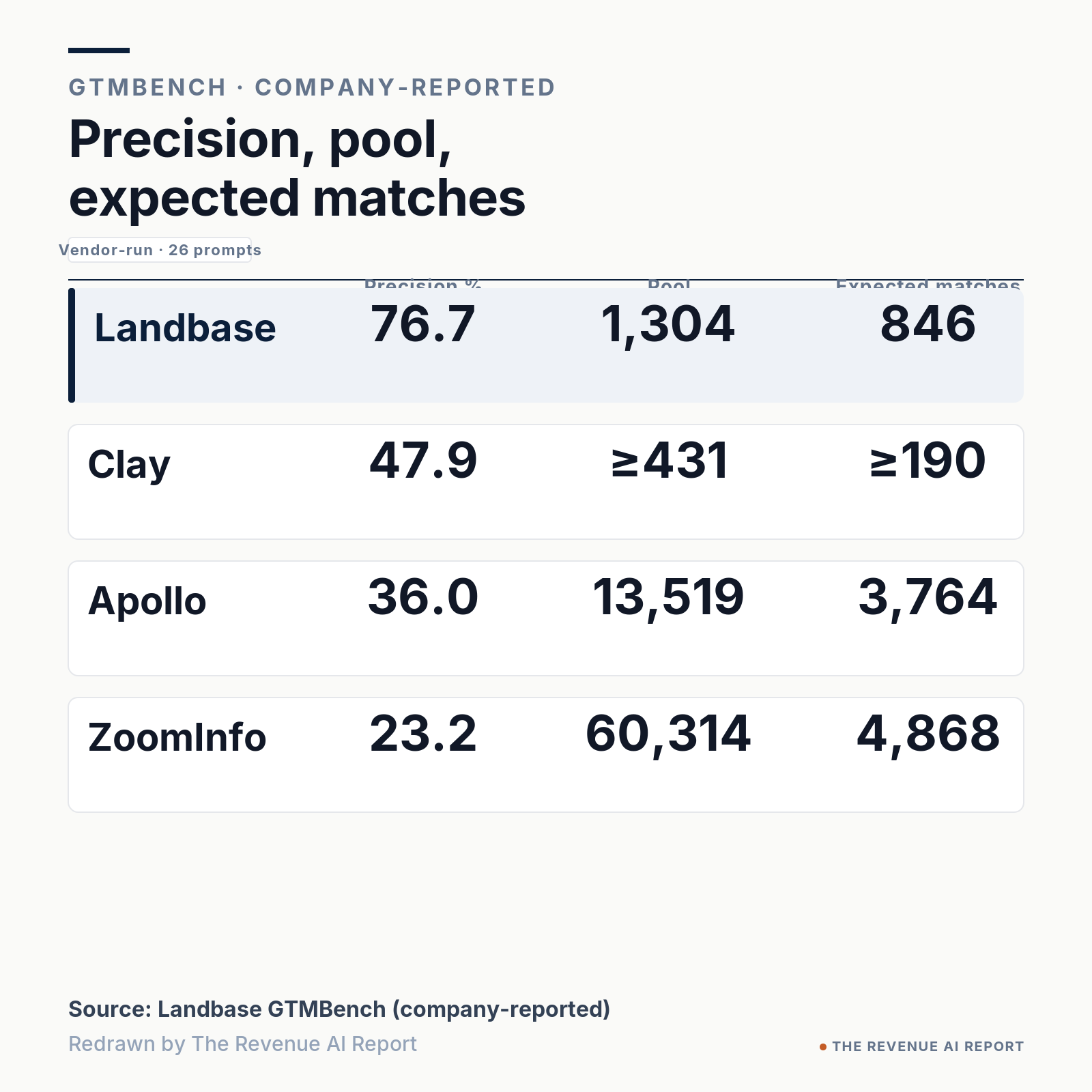
- GTM-3 Omni 76.7% precision; Clay 47.9%; Apollo 36.0%; ZoomInfo 23.2% across 26 prompts [Verified primary].
- Landbase reports winning 18 of 26 prompts [Verified primary].
Operator action
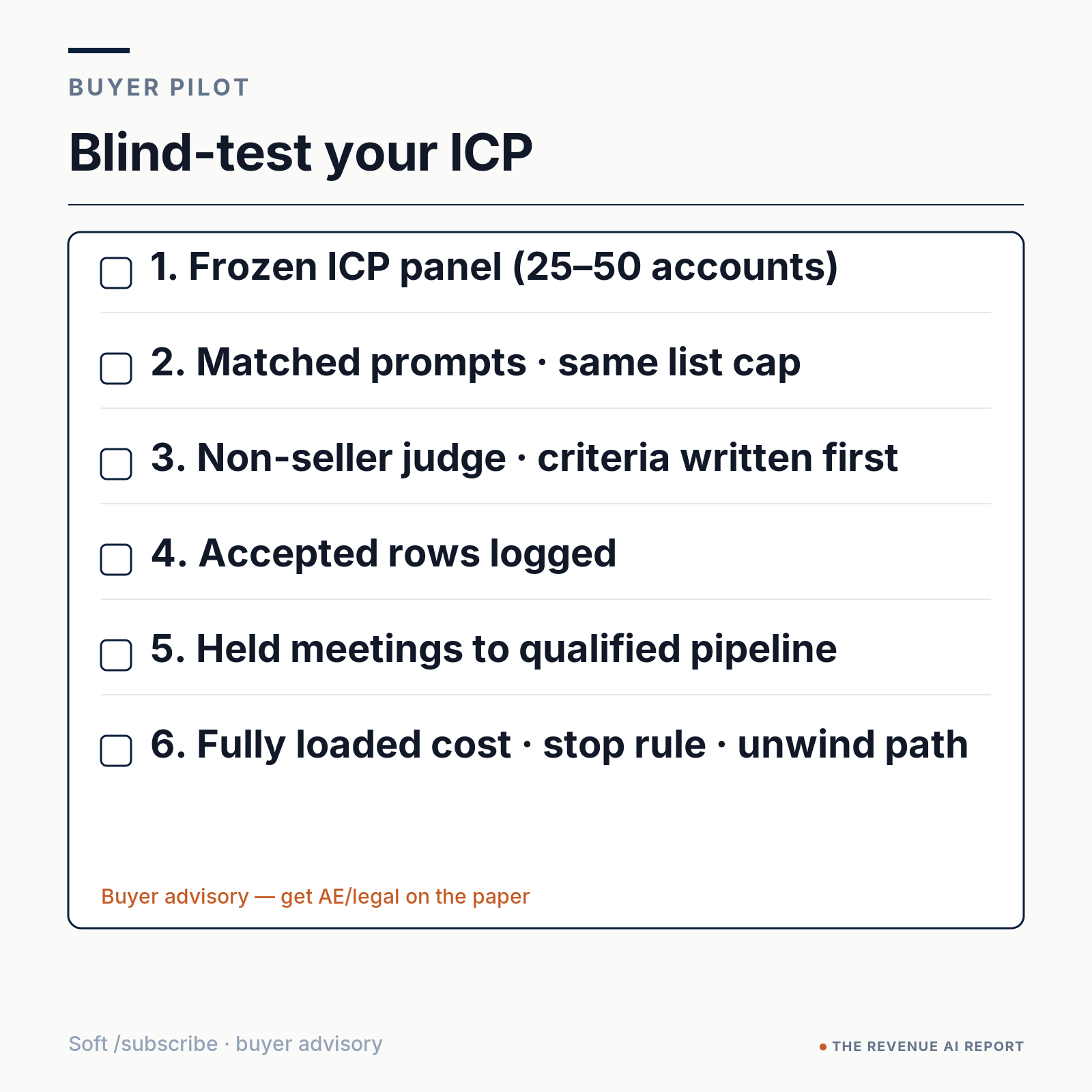
Pick 25 to 50 accounts your best rep would pursue. Freeze the criteria. Run every vendor under the same prompts. Have a non-seller score the rows. Log accepted rows, held meetings, pipeline, and cost.
Last reviewed
Sources
- Landbase, The 2026 GTMBench: https://www.landbase.com/gtmbench (read Oct 6, 2026). Company-published benchmark, methods, and embedded results table. All scores and setup details below attributed to Landbase.
- Landbase, Why We Built GTMBench, Oct 1, 2026: https://www.landbase.com/blog/why-we-built-gtmbench. Company explanation of prompts, tooling, timing, and scoring.
- The Revenue AI Report, Reversal Ledger: https://www.therevenueaireport.com/reversal-ledger. Public page lists 15 documented cases (JSON-LD `numberOfItems`: 15).
The argument
How this benchmark breaks down
A map of the sections ahead, in the order the case is made. The sourced charts are in the research library.
Contents diagram for Landbase GTMBench Put GTM-3 Omni Ahead. Blind-Test Your Own ICP Before You Buy, listing the sections: Sources, The short answer, What Landbase published, The Proof Gap: company-reported scores on an uneven setup, Order Form and pilot lines for your ICP, Eight-Seat Read: one decision each.Confidence tags: [Verified primary] = checked against landbase.com/gtmbench page source (static prose and embedded JS results table) on Oct 6, 2026. [Company-reported] = Landbase method claims on that page or companion blog. [RAR analysis] = buyer framing we add for Director+ teams to test.
The short answer
Landbase published a vendor-run prospecting benchmark that scores its GTM-3 Omni agent at 76.7% precision across 26 prompts, ahead of Clay (47.9%), Apollo (36.0%), and ZoomInfo (23.2%) [Verified primary]. Landbase also reports winning 18 of those 26 prompts [Verified primary]. Those figures sharpen a buying conversation. Your ICP stays unanswered.
Benchmark
Landbase GTMBench Put GTM-3 Omni Ahead. Blind-Test Your Own ICP Before You Buy
Source-cited charts live in the research library.
Landbase GTMBench Put GTM-3 Omni Ahead. Blind-Test Your Own ICP Before You Buy. Diagram showing Evidence, Analysis, Decision, Outcome.Decision rule: Treat vendor precision as a question generator. Buy only after a blind ICP test, judged by someone who does not sell the tool, tracked accepted rows → held meetings → pipeline → cost.
Operator action this week: Pick 25 to 50 accounts your best rep would pursue. Freeze the criteria. Run every vendor under the same prompts. Have a non-seller score the rows. Log accepted rows, held meetings, pipeline, and cost.
What Landbase published
GTMBench gave Landbase, Clay, Apollo, and ZoomInfo the same 26 list-building prompts. Lists were capped (1,000 rows; 200 for ZoomInfo person prompts). Returned rows were re-scraped from LinkedIn and scored by one AI judge against criteria generated once per prompt [Company-reported].
Headline scores from the published results table [Verified primary]:
- Landbase: Precision 76.7%; First-100 76.1%; Pool size 1,304; Expected matches 846; Time to list 134s; Prompts won 18.
- Clay: Precision 47.9%; First-100 40.6%; Pool size ≥431; Expected matches ≥190; Time to list 17s; Prompts won 4.
- Apollo: Precision 36.0%; First-100 29.2%; Pool size 13,519; Expected matches 3,764; Time to list 20s; Prompts won 1.
- ZoomInfo: Precision 23.2%; First-100 18.3%; Pool size 60,314; Expected matches 4,868; Time to list 20s; Prompts won 0.
Landbase says the 26 prompts were fixed before any system ran, drawn from more than 50,000 prompts on its platform [Company-reported]. Competitors' filters were written by a fresh Claude Code session given only each vendor's public API documentation and field reference, with no corrective turns. Landbase ran its own agent [Verified primary].
The Proof Gap: company-reported scores on an uneven setup
The benchmark was designed and run by Landbase's AI Lab. Results are company-reported. Buyers can inspect the published method and prompt-level data. Inspection alone does not make the test independent of the seller.
The setup measures what a new coding agent can do from public docs on the first attempt for Clay, Apollo, and ZoomInfo, and Landbase running its own agent. Those are different operating conditions.
Precision is also only one job. ZoomInfo's geometric-mean pool of 60,314 companies per prompt and 4,868 expected matches sit far above Landbase's 1,304 pool and 846 expected matches [Verified primary]. A larger pool can still yield more workable accounts when precision is lower. Time-to-list runs the other way: Landbase averages 134 seconds; Clay, Apollo, and ZoomInfo sit at 17 to 20 seconds [Verified primary]. Precision, reach, and speed answer separate questions.
Order Form and pilot lines for your ICP
Paste these into the prospecting pilot plan or Order Form schedule. Fill the blanks with each vendor. [RAR analysis]
- Frozen ICP panel: "Buyer supplies [25–50] named accounts and written criteria before any vendor runs."
- Matched prompts: "Every vendor receives the same prompt set, list cap, and return format."
- Blind judge: "Rows are scored by [named role] who does not sell the product. Pass/fail criteria written before scoring starts."
- Accepted-row definition: "A row counts only when every stated criterion holds against fresh reference data."
- Funnel metrics: "Report accepted rows, seller-accepted rows, reachable contacts, conversations started, held meetings, and qualified pipeline as separate lines."
- Fully loaded cost: "Time, credits, data fees, and manual cleanup recorded for each vendor path."
- Setup parity: "Either every vendor is run by an experienced operator, or every vendor is run by the same agent recipe. Mixed setups are labeled as such."
- Stop rule: "Pilot ends when [N] held meetings or [date] hits. Named owner can unwind the workflow if quality drops."
Eight-Seat Read: one decision each
Director to C-suite revenue leaders.
- CRO / VP Sales: Do not greenlight a prospecting switch on a vendor precision slide alone.
- VP Demand Gen: Fund the blind ICP panel before the bake-off deck goes to leadership.
- RevOps: Own the frozen prompts, the accepted-row definition, and the cost log.
- Sales Ops: Track seller-accepted rows and wasted touches separately from vendor precision.
- Enablement: Train reps on the pass/fail criteria used in the blind score before the pilot starts.
- Finance / Procurement: Require fully loaded cost on the Order Form, including credits and cleanup hours.
- Marketing Ops / Product marketing: Keep coverage and precision claims on separate lines in any board pack.
- CEO / strategy: Ask one question in every prospecting review: what happened on our ICP, from accepted rows to held meetings?
Why we might be wrong
- Landbase's precision advantage may hold on your ICP. The Proof Gap is independence and setup parity.
- An experienced Clay, Apollo, or ZoomInfo operator with corrective turns may close the Claude Code first-pass gap.
- Markets that need broad coverage may correctly prefer ZoomInfo's larger pool even at lower precision.
- Time-to-list matters when seller time is scarce. 134 seconds can be cheap if bad rows burn hours.
- The AI judge is a model-plus-tools workflow. A human SDR panel could score the same rows differently.
- Prompts drawn from Landbase's own platform may favor agent-style derived criteria over catalog filters.
- Reversal Ledger has 15 cases; that is a case count, not a failure rate. Use it to put a stop rule and unwind path on the pilot.
Soft close
If you want the next Order Form decoder when a vendor publishes its own bake-off, subscribe.
Take it to the room
The short list from this piece
Pulled from the argument above, written so you can read it out in a pipeline or board review.
Checklist diagram summarising Landbase GTMBench Put GTM-3 Omni Ahead. Blind-Test Your Own ICP Before You Buy: Landbase's precision advantage may hold on your ICP; An experienced Clay, Apollo, or ZoomInfo operator; Markets that need broad coverage may correctly; Time-to-list matters when seller time is scarce; The AI judge is a model-plus-tools workflow.Frequently asked questions
- What does Landbase's GTMBench claim?
- Across 26 fixed natural-language prompts, Landbase reports 76.7% average precision for GTM-3 Omni, 47.9% for Clay, 36.0% for Apollo, and 23.2% for ZoomInfo, with Landbase winning 18 of 26 prompts [Verified primary].
- Is GTMBench an independent benchmark?
- No. Landbase designed and ran it. Scores are company-reported. The published method is inspectable; the test remains vendor-run [Company-reported].
- How were Clay, Apollo, and ZoomInfo driven?
- Landbase says each competitor was driven by a fresh Claude Code session using that vendor's public API docs and field reference, with no corrective turns. Landbase ran its own agent [Verified primary].
- What should buyers measure beyond vendor precision?
- A blind ICP test: accepted rows, seller acceptance, held meetings, qualified pipeline, and fully loaded cost, judged by someone who does not sell the tool [RAR analysis].
- What do the pool and time-to-list numbers show?
- ZoomInfo's published pool is 60,314 with 4,868 expected matches; Landbase's are 1,304 and 846. Landbase time-to-list averages 134 seconds; Clay, Apollo, and ZoomInfo sit at 17 to 20 seconds [Verified primary].
- How does the Reversal Ledger fit?
- Reversal Ledger has 15 cases; that is a case count, not a failure rate. Use it as a prompt to name a stop rule and unwind path on the pilot.
Subscribe
Get the next benchmark, with the sample size attached.
Keep reading
Benchmark
Which AI Surfaces Actually Cite Us on Commercial-Intent Prompts, and Why Is One Blended AI Visibility Score the Wrong Instrument for That Decision?
Foundation x AirOps measured citation share across six AI surfaces. One blended AI visibility score averages those systems into a vanity number. Track citation rate and citation share per surface. Soft subscribe only.
Benchmark
The AI Adoption Curve for Revenue Teams: L1 to L6, and Where Most Teams Stall
Six levels from one tool with no workflow change to a rebuilt process. Each level has a failure mode and an exit criterion. Most revenue teams are at L2 and reporting L4.