
Claude's $200 Plan Carries About 5× the Seat Value of ChatGPT Pro 200. Which Allowance Lines Go on the Order Form?
SemiAnalysis, Oct 5 2026: on the mid-tier daily-driver models (Claude Opus 5.5 vs GPT-6.1 Sol), Anthropic's $200/month plan gives about 5× the API-equivalent value of OpenAI's $200 plan. OpenAI halved its $200 plan value last week and added a $500 tier. Anthropic raised Opus allowances ~20% on Max and ~50% on Pro. A user maxing Opus 5.5 runs the plan at a modeled -369% gross margin, so allowances will keep moving. Measure workload, price seats on allowance, and write floors, change notice, and grandfathering into the Order Form. Route heavy agent users to metered API.
Jonathan Kvarfordt · Published October 5, 2026 · Last reviewed October 6, 2026 · 7 min read
The short answer
When Claude's $200 plan carries about 5× the API-equivalent value of ChatGPT Pro 200 on the daily-driver models, which allowance lines must go on the Order Form before we buy AI seats?
Decision rule
Price every seat on its allowance for your workload. Same $200, different vendor and model, about 5× apart. No seat deal without an allowance floor, change notice, and grandfather term on paper.
Evidence
- newsletter.semianalysis.com/p/anthropic-subscriptions-offer-5x (Oct 5 2026, Megalaa, Kan, Patel): Opus 5.5 vs GPT-6.1 Sol ~5× API-equivalent value on $200 plans; OpenAI $200 plan exhausted after $2,897 of GPT-6 Astra; Anthropic $200 plan 50% left after $2,485 of Fable 5.1; OpenAI halved $200 plan value and added $500 tier; Sol limits flat after 6.1 cache-read cut (value ~-30%); Anthropic Opus limits +~20% Max, +~50% Pro after Opus 5.5 price cut; -369% / 6% Opus margins at 100% / 20% utilization; subscriptions ~10% of Anthropic revenue, over 40% of inference compute, ~$36M lower revenue per MW. Modeled estimates.
- help.openai.com/en/articles/9793128-about-chatgpt-pro-tiers (retrieved 2026-10-05): eligible Pro 200 subscribers keep the previous allowance through Oct 29 2026, then move to the lower allowance at $200/month.
Operator action
This week: pull model mix and token shape per user, convert each candidate plan to API-equivalent value on that workload, and send the AE an Order Form redline with allowance floor, change notice, grandfather term, and a metered-API path for heavy agent users.
Last reviewed
Two $200 seats. One carries about five times the work. Most order forms treat them as the same line.
SemiAnalysis limit-tested every major AI subscription and published the results on Oct 5 2026 (SemiAnalysis). If you buy AI seats for a revenue team, read this before your next renewal. The allowance you buy today will not hold still.
The argument
How this reality check breaks down
A map of the sections ahead, in the order the case is made. The sourced charts are in the research library.
Contents diagram for Claude's $200 Plan Carries About 5× the Seat Value of ChatGPT Pro 200. Which Allowance Lines Go on the Order Form?, listing the sections: What SemiAnalysis measured, The gap, What moved last week, Heavy users run the vendor at a loss, Order Form checklist, Keep the meters apart.What SemiAnalysis measured
They ran experiments that isolate one token type at a time (input, cache write, cache read, output), watched how far each plan's usage meter moved, and converted that to API-equivalent dollars for an agentic workload based on their own September usage (SemiAnalysis). Their example: use 1% of a $200 plan's monthly limit and you used $2 of value.
Their rule for reading any plan: value only makes sense as the full (plan, model, workload) tuple. One plan can be worth very different amounts depending on which model your team runs and how.
Reality Check
Claude's $200 Plan Carries About 5× the Seat Value of ChatGPT Pro 200. Which Allowance Lines Go on the Order Form?
Source-cited charts live in the research library.
Claude's $200 Plan Carries About 5× the Seat Value of ChatGPT Pro 200. Which Allowance Lines Go on the Order Form?. Diagram showing Evidence, Analysis, Decision, Outcome.The gap
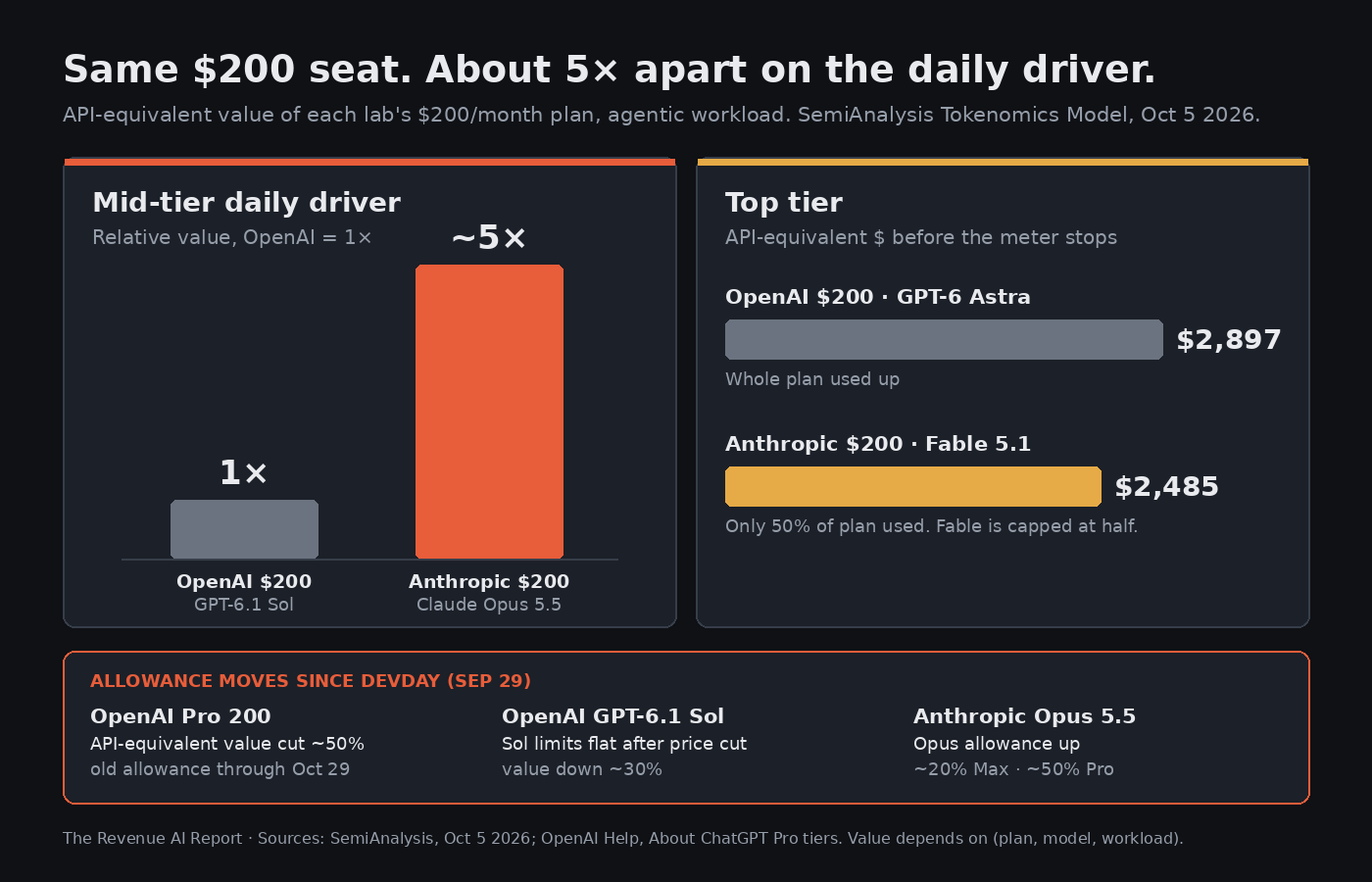
- Daily driver: about 5×. On Claude Opus 5.5 vs GPT-6.1 Sol, the mid-tier models both labs market as the daily driver, Anthropic's $200 plan offers ~5× the API-equivalent value of OpenAI's $200 plan "across the board" (SemiAnalysis). Sol is cheaper per token, and the gap still holds on raw token counts.
- Top tier: close. OpenAI's $200 plan is used up after $2,897 of GPT-6 Astra. Anthropic's $200 plan still has 50% left after $2,485 of Fable 5.1, because Fable can only use half the limit (SemiAnalysis).
- Per dollar: after last week's cut, OpenAI's Pro 100, 200, and 500 give the same tokens per dollar on every model. Anthropic already gave every tier the same per-dollar value (SemiAnalysis).
What moved last week
- OpenAI halved its $200 plan. SemiAnalysis tracking confirmed a ~50% cut in API-equivalent value and a new $500 tier. The $500 plan gives 21% more Astra than the old $200 plan (SemiAnalysis).
- Grandfather window. Pro 200 subscribers active any time from Sep 22 through 10 a.m. PT Sep 29 2026 keep the previous allowance through Oct 29 2026, then move to the lower allowance at the same $200 (OpenAI Help).
- Sol price cut, flat limits. GPT-6.1 Sol cut cache reads 50%, and OpenAI left Sol token limits on the $200 plan unchanged. API-equivalent value fell ~30% (SemiAnalysis).
- Anthropic raised Opus limits. With the Opus 5.5 price cut (input and output -20%, cache reads -60% vs Opus 5), Anthropic raised Opus token limits ~20% on Max and ~50% on Pro. SemiAnalysis says that did not fully offset the API price cut (SemiAnalysis).
The cut mechanics are covered in Pro 200 usage cut and Pro 500 Ultrafast. This piece is about what each seat is worth after the dust settles.
Heavy users run the vendor at a loss
SemiAnalysis models a Claude plan at 92% API gross margin. A user who maxes out Opus 5.5 runs it at -369% gross margin. At a more realistic 20% utilization it is about 6%. The same math on Fable 5.1 gives 1% maxed and 80% at 20% (SemiAnalysis).
Subscriptions are about 10% of Anthropic revenue but can take over 40% of its inference compute, lowering blended revenue per megawatt by ~$36M, per SemiAnalysis estimates (SemiAnalysis).
Your heaviest agent users are the vendor's most expensive customers. That is where allowances get trimmed next. SemiAnalysis also caught one provider running an “extremely tiny” A/B test with ~20% lower limits on one of three identical accounts. Limits can change without an announcement.
Order Form checklist
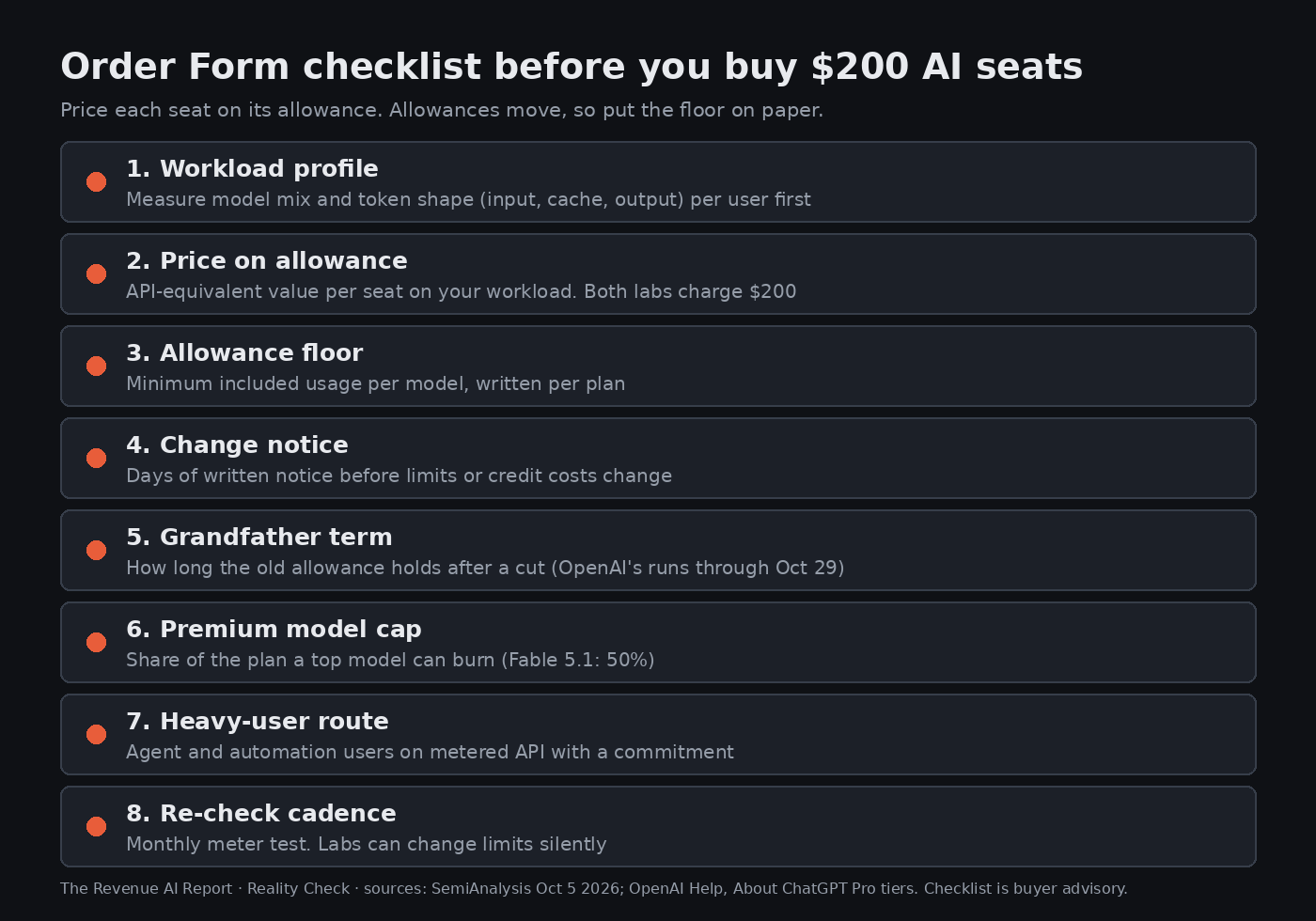
- Workload profile. Pull model mix and token shape (input, cache, output) per user for two to four weeks before you buy seats.
- Price on allowance. Convert each plan to API-equivalent value on your workload. Two $200 seats can sit about 5× apart.
- Allowance floor. Minimum included usage per model, per plan, written on the form.
- Change notice. Days of written notice before limits or credit costs drop, with a credit or exit if they do.
- Grandfather term. How long the current allowance holds after a cut. OpenAI's runs through Oct 29.
- Premium-model cap. The share of the plan the top model can use. Fable 5.1 stops at 50%.
- Heavy-user route. Agent and automation users who max the seat move to metered API with a commitment. Commitment terms: Anthropic commitment cliff vs OpenAI grace.
- Monthly re-test. Run a light meter check or get usage data from the vendor every month.
Keep the meters apart
- Seat allowance (this piece): what a $200 subscription carries, per model and workload.
- Pro 200 cut and Pro 500: the DevDay decoder.
- API serving tiers: Astra Ultrafast at 6× Standard list is a per-token API line. See Astra Ultrafast at 6×.
- API commitments: Anthropic commitment cliff vs OpenAI grace.
Soft opens
- All SemiAnalysis figures are modeled estimates from its limit tests. Full tables sit in its paid Tokenomics Model. Confirm on your own account.
- SemiAnalysis uses ~5× in the head-to-head and ~4× in a later note on OpenAI's lack of a five-hour limit. We use about 5× from the head-to-head.
- Dollar values for Opus 5.5 and Sol are not in the public section. We use the ratio only.
- The comparison covers individual plans. Team and Enterprise seat allowances can differ. Get yours in writing.
Sources
- SemiAnalysis, Anthropic Subscriptions Offer 5x+ More Value Than OpenAI (Oct 5 2026): newsletter.semianalysis.com
- OpenAI Help, About ChatGPT Pro tiers (retrieved 2026-10-05): help.openai.com
- AI Weekly recap (Oct 5 2026): aiweekly.co
- Anthropic Help, What is the Enterprise plan? (retrieved 2026-10-06): support.claude.com
- Anthropic Help, How am I billed for my Enterprise plan? (retrieved 2026-10-06): support.claude.com
New Order Form decoders land in the weekly issue first. Subscribe.
Take it to the room
The short list from this piece
Pulled from the argument above, written so you can read it out in a pipeline or board review.
Checklist diagram summarising Claude's $200 Plan Carries About 5× the Seat Value of ChatGPT Pro 200. Which Allowance Lines Go on the Order Form?: SemiAnalysis, Anthropic Subscriptions Offer 5x+; OpenAI Help, About ChatGPT Pro tiers (retrieved; AI Weekly recap (Oct 5 2026): aiweekly.co; Anthropic Help, What is the Enterprise plan?; Anthropic Help, How am I billed for my Enterprise.Frequently asked questions
- Is Claude's $200 plan really worth 5× ChatGPT Pro 200?
- On the mid-tier daily-driver models, yes, per SemiAnalysis (Oct 5 2026): Claude Opus 5.5 on Anthropic's $200 plan gives about 5× the API-equivalent value of GPT-6.1 Sol on OpenAI's $200 plan, on an agentic workload. At the top tier the plans are close.
- What is API-equivalent value?
- What the tokens a plan allows would cost at API list prices. SemiAnalysis measures how far each plan's usage meter moves per token type and converts that to dollars for a set workload.
- What changed on OpenAI's $200 plan?
- SemiAnalysis confirmed OpenAI halved the API-equivalent value of the $200 plan and added a $500 tier. Per OpenAI Help, eligible existing Pro 200 subscribers keep the previous allowance through Oct 29 2026.
- Did Anthropic raise limits?
- Yes. With the Opus 5.5 price cut, Anthropic raised Opus token limits about 20% on Max plans and about 50% on Pro, per SemiAnalysis. That did not fully offset the API price cut.
- Why will allowances keep moving?
- SemiAnalysis models a user maxing Opus 5.5 at -369% gross margin for the vendor, and about 6% at 20% utilization. Subscriptions are ~10% of Anthropic revenue but over 40% of its inference compute. Vendors trim where the loss sits.
- What should go on the Order Form?
- Workload profile, allowance per model, allowance floor, change-notice period, grandfather term, premium-model cap, a metered-API route for heavy agent users, and a monthly re-test. The checklist is buyer advisory.
- Do Claude Enterprise Standard and Premium seats keep their usage allowance after renewal?
- No. Anthropic says Standard/Premium and Chat-only seats are no longer available for new contracts and transition to the single Enterprise seat at the next renewal. That seat is US$20 per seat per month billed annually and includes no token allowance. All usage in Chat, Claude Code, and Cowork bills at standard API rates. See Anthropic Help Center articles "What is the Enterprise plan?" (https://support.claude.com/en/articles/9797531) and "How am I billed for my Enterprise plan?" (https://support.claude.com/en/articles/11526368).
Subscribe
Get the next Reality Check before you sign the order form.
Keep reading
Reality Check
AI Review Time Is a Line Item. Price It and Name the Owner.
On TextQL's Argo-Bench the best AI model fully solved 34.8% of 210 data tasks. Put review time and a named owner into your AI business case.
Reality Check
Call Center Headcount Is Falling. Can You Prove AI Did It?
Revelio Labs says global call-center headcount is 5.3% below its Dec 2023 peak. Revelio: "The decline is surely multifaceted." How to test your own org.