
OpenAI Now Prices a Lead-Routing Decision at About $0.0001. What Does Your Vendor Charge per AI Action?
On Oct 6 2026 OpenAI opened the Decisions API in public beta. It returns a probability, a pick from a fixed list, or a score, and it bills input tokens only: $0.10 per million on gpt-6-luna, with no output or cache charges. A 1,000-token lead record costs about $0.0001 to route. A million of them cost about $100. A standard Agentforce action lists at $0.10. Make vendors split model cost from platform fee on every AI step that only classifies, and write the beta price risk into the Order Form.
Jonathan Kvarfordt · Published October 7, 2026 · 6 min read
The short answer
OpenAI's new Decisions API prices a classification call at input tokens only. What should we change in vendor contracts that charge per AI action for lead routing, scoring, and tagging?
Decision rule
No per-action AI price on a routing, scoring, or tagging step until the vendor shows the model cost under it and what the rest of the price buys.
Evidence
- OpenAI API changelog (Oct 6 2026): "Released the Decisions API in beta with gpt-6-luna. Turn text and images into typed answers 10x faster than the Responses API."
- OpenAI Decisions guide (retrieved Oct 7 2026): public beta, GA expected in the coming weeks; question types predicate, choice, score; "With gpt-6-luna, input costs $0.10 per 1M tokens. You pay only for input tokens: there are no cache-read, cache-write, or output-token charges." Regional processing premiums and long-context input multipliers apply. Images must be inline base64. ZDR and HIPAA for eligible customers; data residency in the US and Europe.
- OpenAI API pricing page (retrieved Oct 7 2026): gpt-6-luna on standard processing is $0.10 input and $0.50 output per million tokens on requests outside /v1/decisions.
- Salesforce Agentforce pricing page (retrieved Oct 7 2026): Flex Credits $500 per 100,000 credits; its usage example prices one action at 20 Flex Credits, US$0.10.
- CellCog (Oct 6 2026): TypeSafe's Jev decision model lists $0.042 per million input tokens, text only; neither vendor has published head-to-head accuracy.
Operator action
This week: list every vendor AI step that only routes, scores, or tags. Get the per-action or per-credit price, the monthly volume, and the average input size for each. Send each vendor one question: what is the model cost under this step, and what does the rest of the price buy?
Last reviewed
One hundredth of a cent. That is what OpenAI now charges for the model to route a 1,000-token lead.
OpenAI opened the Decisions API in public beta on Oct 6 2026 (OpenAI changelog). You send a record and a question. It sends back a probability, a pick from your list, or a score. It runs only on gpt-6-luna and bills input tokens only: $0.10 per million, with no output, cache-read, or cache-write charges (Decisions guide).
The argument
How this reality check breaks down
A map of the sections ahead, in the order the case is made. The sourced charts are in the research library.
Contents diagram for OpenAI Now Prices a Lead-Routing Decision at About $0.0001. What Does Your Vendor Charge per AI Action?, listing the sections: What OpenAI shipped, The math a buyer should run, Where this shows up in a revenue stack, Order Form lines for vendor AI actions, Who owns which line, Soft opens.Most of the AI in a revenue stack does exactly this kind of job. Route the lead. Score the fit. Tag the reply. Flag the risk. Many vendors bill those steps per action or per credit. You now have a public floor for the model cost under them.
What OpenAI shipped
- Endpoint: POST /v1/decisions, public beta. OpenAI expects general availability "in the coming weeks."
- Three answer types: predicate (probability a condition is true), choice (one option from a fixed set, with probabilities and confidence), score (position on ordered levels).
- Price: $0.10 per million input tokens on gpt-6-luna. Output, cache reads, and cache writes cost nothing.
- Still billed extra: regional processing premiums and long-context input multipliers.
- Speed: OpenAI says about 10x faster than the Responses API. That is a vendor claim with no published test setup.
- Data: Zero Data Retention and HIPAA for eligible customers. Processing in the US and Europe.
- Inputs: text and images. Images must be inline base64; hosted image URLs and file IDs are not accepted.
Reality Check
OpenAI Now Prices a Lead-Routing Decision at About $0.0001. What Does Your Vendor Charge per AI Action?
Source-cited charts live in the research library.
OpenAI Now Prices a Lead-Routing Decision at About $0.0001. What Does Your Vendor Charge per AI Action?. Diagram showing Evidence, Analysis, Decision, Outcome.The math a buyer should run
A lead record with enrichment fields and the question runs about 1,000 input tokens. At $0.10 per million, that is $0.0001 per decision. A million decisions a month is about $100 in model cost. The same model on the Responses API also bills output at $0.50 per million (OpenAI pricing), so a 50-token answer adds about $25 per million calls.
Now the vendor side. Salesforce lists Flex Credits at $500 per 100,000 and prices one Agentforce action at 20 credits, or $0.10 (Agentforce pricing). A million standard actions is $100,000 at list.
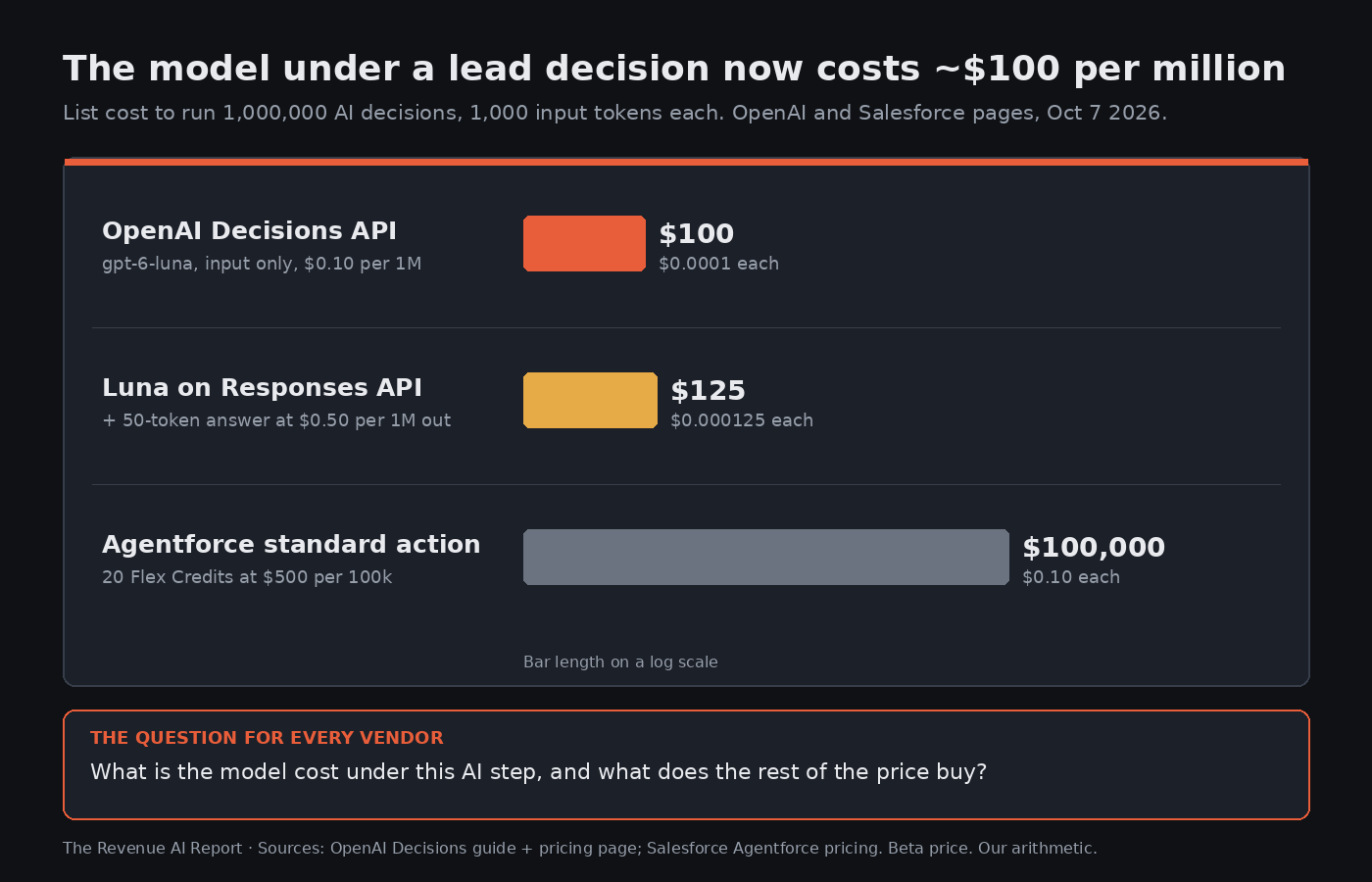
An Agentforce action does more than a bare classification. It runs inside your CRM with data access, permissions, guardrails, and an audit trail. That work is worth something. The point is narrower: when the AI step is a yes or no, a pick-one, or a score, the model is now a rounding error. Whatever you pay above about $0.0001 per decision is platform, margin, and risk. Know how much of each you are buying.
The same logic applies to any tool that sells AI on credits: enrichment, sales engagement, support, intent. It is the question behind who audits the agent meter and the Flex Credits vs conversation breakeven.
Where this shows up in a revenue stack
- Inbound lead routing: which segment, region, or owner gets the lead.
- ICP fit score: score the account against your tiers before a rep touches it.
- Reply triage: positive, objection, out of office, unsubscribe, wrong person.
- Call and meeting disposition: next step booked, yes or no; competitor named, yes or no.
- Renewal risk flag: score account notes and tickets against a churn rubric.
- Outbound compliance check: does this email make a claim legal has banned.
Order Form lines for vendor AI actions
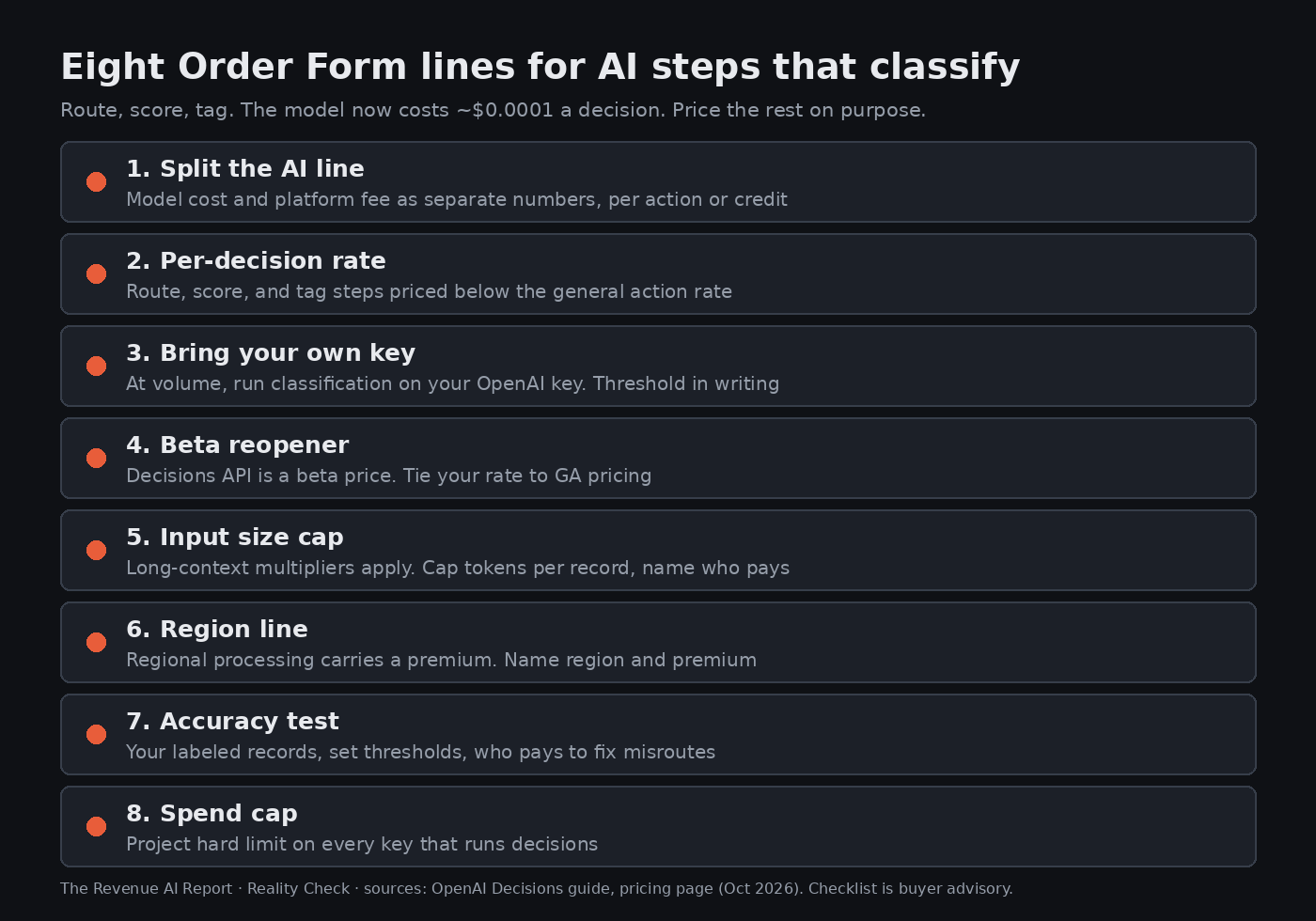
- Split the AI line. For each AI step, model cost and platform fee as separate numbers, per action or per credit.
- Per-decision rate. Steps that only route, score, or tag get their own rate, below the general action rate.
- Bring your own key. At volume, the vendor runs classification on your OpenAI key and you pay OpenAI direct. Put the volume threshold in writing.
- Beta reopener. The Decisions API price is a beta price. If a vendor builds on it, tie your rate to the GA price and get a reopener if GA lands lower.
- Input size cap. Long-context multipliers apply. Cap tokens per record and name who pays when a record runs long.
- Region line. Regional processing carries a premium. Name the region and the premium on the order form.
- Accuracy test. A labeled set of your own records, the thresholds, and who pays to fix misroutes.
- Spend cap. A project hard limit on any key that runs decisions. Same controls as the Grow tier checklist. Partner-app allowance burn has its own lines in the SIWC and Marketplace Order Form.
Who owns which line
- Procurement: the split AI line, per-decision rate, bring-your-own-key threshold, and beta reopener.
- RevOps and GTM engineering: input size, region, the labeled test set, and thresholds.
- Revenue Finance: the spend cap and chargeback by key.
Soft opens
- This is a beta price. OpenAI has not said whether GA pricing will match it.
- The 1,000-token record and 50-token answer are our assumptions. Your records may run shorter or longer.
- The 10x speed claim comes from OpenAI with no published test setup. Measure your own latency.
- Agentforce list prices exclude discounts, pre-commit terms, and per-user editions with pooled credits. Your contract rate may differ.
- A rival decision model, TypeSafe's Jev, lists $0.042 per million input tokens, text only, per CellCog. Neither vendor has published head-to-head accuracy.
Sources
- OpenAI, API changelog, Oct 6 2026 entry: developers.openai.com/api/docs/changelog
- OpenAI, Decisions guide, pricing and availability (retrieved Oct 7 2026): developers.openai.com/api/docs/guides/decisions
- OpenAI, API pricing (retrieved Oct 7 2026): developers.openai.com/api/docs/pricing
- OpenAI Developer Community, Decisions API public beta announcement (Oct 6 2026): community.openai.com
- Salesforce, Agentforce pricing and usage example (retrieved Oct 7 2026): salesforce.com/agentforce/pricing
- CellCog, OpenAI Decisions API: Price, Question Types, vs Jev (Oct 6 2026): cellcog.ai
New Order Form decoders land in the weekly issue first. Subscribe.
Take it to the room
The short list from this piece
Pulled from the argument above, written so you can read it out in a pipeline or board review.
Checklist diagram summarising OpenAI Now Prices a Lead-Routing Decision at About $0.0001. What Does Your Vendor Charge per AI Action?: OpenAI, API changelog, Oct 6 2026 entry; OpenAI, Decisions guide, pricing and availability; OpenAI, API pricing (retrieved Oct 7 2026); OpenAI Developer Community, Decisions API public; Salesforce, Agentforce pricing and usage example.Frequently asked questions
- What is OpenAI's Decisions API?
- A beta endpoint, POST /v1/decisions, released Oct 6 2026. It runs on gpt-6-luna and returns typed answers: a probability that a condition is true, a choice from a fixed set, or a score against ordered levels. It accepts text and images.
- How much does the Decisions API cost?
- $0.10 per million input tokens on gpt-6-luna. There are no output, cache-read, or cache-write charges. Regional processing premiums and long-context input multipliers still apply.
- What does one lead-routing decision cost?
- At about 1,000 input tokens per record, about $0.0001. A million decisions a month is about $100 in model cost before any regional or long-context premium.
- How does that compare with a per-action AI price?
- Salesforce lists a standard Agentforce action at 20 Flex Credits, or $0.10, so a million actions is $100,000 at list. An Agentforce action includes platform work beyond the model, so ask the vendor to show the model cost and what the rest of the price buys.
- Is the Decisions API price final?
- It is a public beta price. OpenAI expects general availability in the coming weeks and has not said whether the GA price will match. Write a reopener into any contract that depends on it.
- What should go on the Order Form for vendor AI steps that classify?
- Model cost and platform fee as separate lines, a per-decision rate for route, score, and tag steps, a bring-your-own-key threshold, a beta reopener, an input size cap, the processing region and premium, an accuracy test on your labeled data, and a spend cap.
Subscribe
Get the next Reality Check before you sign the order form.
Keep reading
Reality Check
AI Review Time Is a Line Item. Price It and Name the Owner.
On TextQL's Argo-Bench the best AI model fully solved 34.8% of 210 data tasks. Put review time and a named owner into your AI business case.
Reality Check
Call Center Headcount Is Falling. Can You Prove AI Did It?
Revelio Labs says global call-center headcount is 5.3% below its Dec 2023 peak. Revelio: "The decline is surely multifaceted." How to test your own org.