
Claude Sonnet 5.5 Keeps the Same $2/$10 Sticker as Sonnet 5, Claims Up to 30% Lower Cost per Task, and Is the First Sonnet with Cyber/frontier_llm Fallback to Sonnet 5 (API Fallback Opt-In; Apps Default On)
Sonnet 5.5 list $/MTok is flat vs Sonnet 5 ($2/$10; cache read $0.20; cache write $2.50/5m and $4/1h; Batch $1/$5). Tag vendor "up to 30% less per task" UNPROVEN. Chargeback on tokens/task, cache, Batch, serving model after fallback, and refusal category. Apps auto-switch default ON; API fallback opt-in. Name owners before volume agents hit claude-sonnet-5-5.
Jonathan Kvarfordt · Published September 29, 2026 · 8 min read
The short answer
Sonnet 5.5 sticker is flat - which Order Form / chargeback lines prove the bill fell ~30%, and who owns cyber/frontier fallback (serving model + refusal category) before we point volume agents at claude-sonnet-5-5?
Decision rule
Refuse unsigned fallback ownership. Confirm flat sticker on the paper, tag vendor 30% UNPROVEN, map effort/cache/Batch/serving-model/refusal meters, name apps auto-switch and API fallback owners, and fill the accepted-outcome blank or flag Proof Gap.
Evidence
- anthropic.com/claude-sonnet-5-5 (28 Sep 2026): flat $2/$10 vs Sonnet 5; up to 30% less per task / 30%+ faster testing claims; first Sonnet with cyber safeguards; claude-sonnet-5-5 on API + AWS + Google Cloud + Azure
- platform.claude.com/docs/en/about-claude/pricing: Sonnet 5.5 $2/$10; cache read $0.20; cache write $2.50 (5m) / $4 (1h); Batch $1/$5
- platform.claude.com/docs/en/models/sonnet-5-5/whats-new-sonnet-5-5: effort default High on Claude API; levels recalibrated; cyber+frontier_llm default-route to Sonnet 5; bio/reasoning_extraction/general_harms no default retry; availability IDs
- support.claude.com/en/articles/17161993-why-claude-switched-models-in-your-conversation-with-sonnet-5-5: apps auto-switch default ON; API not default; fallback billed at Sonnet 5 + cache-miss credit; pre-output billing by classifier
- platform.claude.com/docs/en/build-with-claude/refusals-and-fallback: stop_reason refusal; category billing table; fallbacks default beta; iterations receipt; Bedrock/Foundry client-side only
Operator action
Today: lock flat sticker lines on the OF/runbook, tag vendor 30% UNPROVEN, name apps auto-switch + API fallback owners, wire chargeback on serving model + refusal category, re-sweep effort after recalibration, and fill the accepted-outcome blank before pointing volume agents at claude-sonnet-5-5.
Last reviewed
Claude Sonnet 5.5 keeps the same $2/$10 sticker as Sonnet 5, claims up to 30% lower cost per task, and is the first Sonnet with cyber/frontier_llm fallback to Sonnet 5 (API fallback opt-in; apps default on)
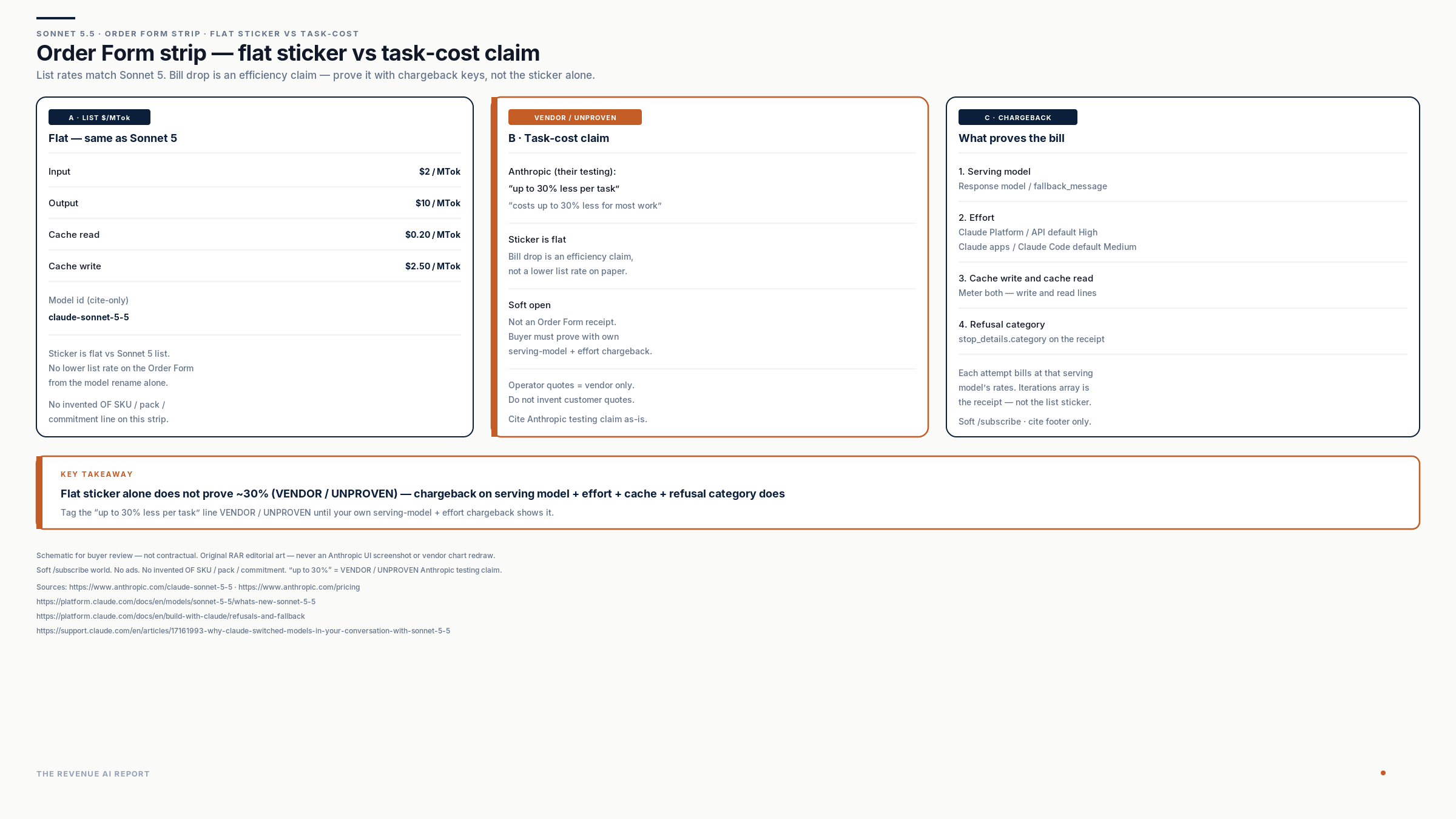
Claude Sonnet 5.5 list dollars are flat vs Sonnet 5: $2 / MTok input, $10 / MTok output. Cache read $0.20 / MTok. Cache write $2.50 / MTok (5-minute) / $4 / MTok (1-hour). Batch $1 / $5. Model id: `claude-sonnet-5-5` (Anthropic Sonnet 5.5, 28 Sep 2026; Claude Platform pricing).
The argument
How this reality check breaks down
A map of the sections ahead, in the order the case is made. The sourced charts are in the research library.
Contents diagram for Claude Sonnet 5.5 Keeps the Same $2/$10 Sticker as Sonnet 5, Claims Up to 30% Lower Cost per Task, and Is the First Sonnet with Cyber/frontier_llm Fallback to Sonnet 5 (API Fallback Opt-In; Apps Default On), listing the sections: Claude Sonnet 5.5 Order Form flat sticker, Sonnet 5.5 $2 $10 same as Sonnet 5, Up to 30% less per task VENDOR UNPROVEN, Cyber frontier_llm fallback Sonnet 5.Anthropic tags "up to 30% less per task" and "30%+ faster" as testing claims. Tag those VENDOR / UNPROVEN until your buyer eval reproduces them. Flat sticker means a bill drop is an efficiency claim, not a lower list rate. Do not put "30%" on the Order Form as receipt math. Sibling decoder on unit vs bill after a token cut: GPT-6 / Opus 5.5 token-cut Order Form.
Chargeback lines that prove the bill moved
Reality Check
Claude Sonnet 5.5 Keeps the Same $2/$10 Sticker as Sonnet 5, Claims Up to 30% Lower Cost per Task, and Is the First Sonnet with Cyber/frontier_llm Fallback to Sonnet 5 (API Fallback Opt-In; Apps Default On)
Source-cited charts live in the research library.
Claude Sonnet 5.5 Keeps the Same $2/$10 Sticker as Sonnet 5, Claims Up to 30% Lower Cost per Task, and Is the First Sonnet with Cyber/frontier_llm Fallback to Sonnet 5 (API Fallback Opt-In; Apps Default On). Diagram showing Evidence, Analysis, Decision, Outcome.Pull these meters. They move the invoice when the sticker does not:
- Tokens / task. Effort default on the Claude API is High. Claude apps / Claude Code default Medium. Effort levels are recalibrated vs Sonnet 5. Re-sweep; do not carry the old setting over (What's new in Sonnet 5.5).
- Cache write vs cache read. Write is 1.25x / 2x base input (5m / 1h). Read is 0.1x. Miss ratio on fallback paths matters.
- Batch vs real-time. Batch is 50% of list ($1 / $5). Real-time stays at $2 / $10.
- Serving model after fallback. Response `model` + `usage.iterations` (incl. `fallback_message`) name who actually ran.
- Pre-output refusal category. `stop_details.category` drives whether a pre-output refusal is billed (Refusals and fallback).
First Sonnet with cyber safeguards
Sonnet 5.5 is the first Sonnet shipped with cyber safeguards and fallbacks like Anthropic's most capable models (launch; Help Center).
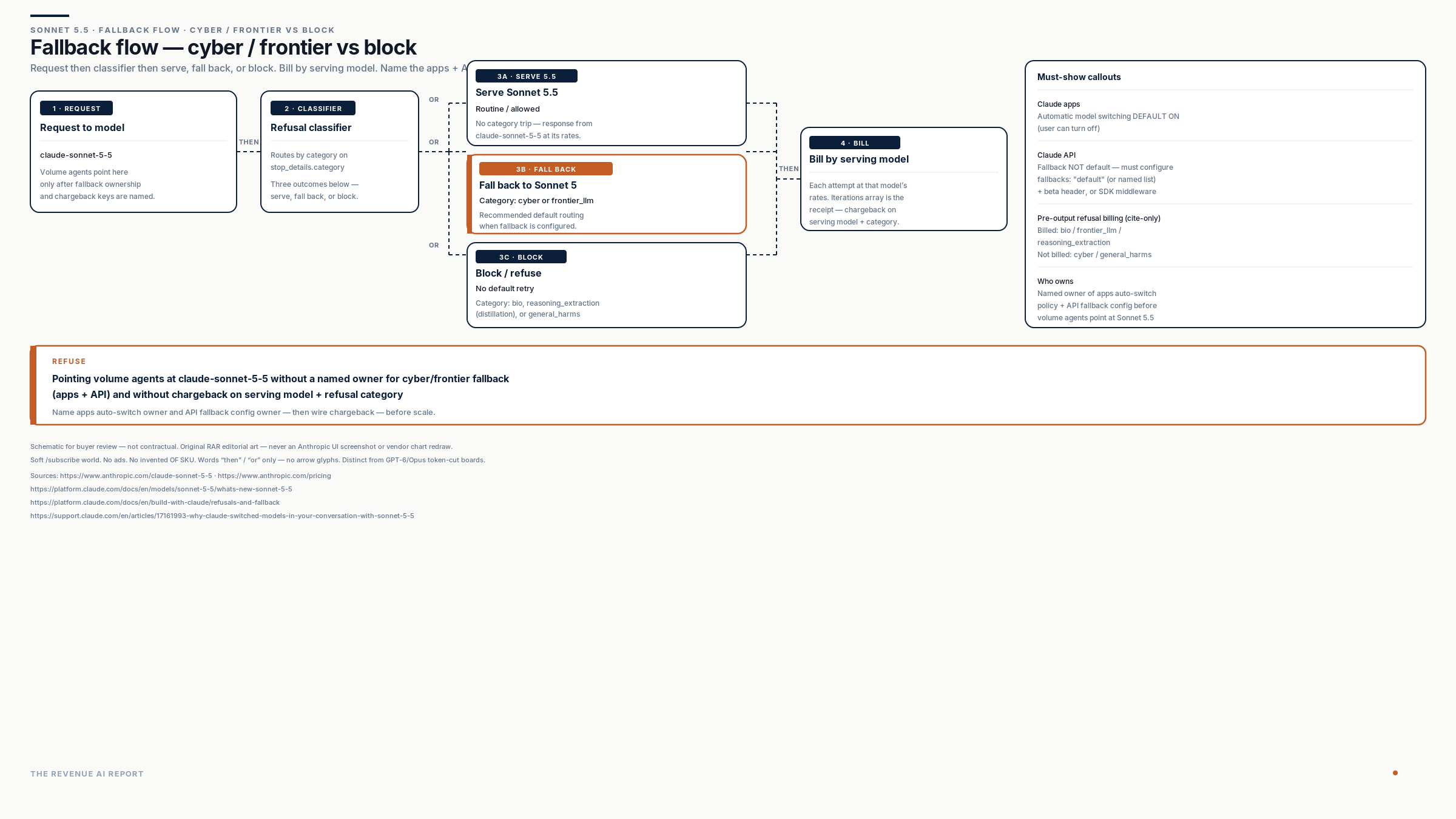
Classifier path (cite-only):
- Request hits `claude-sonnet-5-5`, then classifier.
- Serve Sonnet 5.5 on routine / allowed.
- Fall back to Sonnet 5 when category is `cyber` or `frontier_llm` (recommended default routing on API with `fallbacks: "default"`).
- Block / refuse (no Sonnet 5 fallback) when category is `bio`, `reasoning_extraction` (distillation), or `general_harms`.
Apps vs API ownership (name it before volume)
Claude apps (web, Mobile, Desktop, Claude Code, and related surfaces): automatic model switching is DEFAULT ON. User / admin can turn it off in Settings → Capabilities (Claude Code: Config → MODEL & OUTPUT). After a switch, the chat stays on Sonnet 5 until someone picks Sonnet 5.5 again (Help Center).
Claude API: fallback is NOT default. You must configure `fallbacks: "default"` (or a named list) plus the `server-side-fallback-2026-07-01` beta header, or use SDK middleware / manual retry with fallback credit. Until configured, the API returns HTTP 200 with `stop_reason: "refusal"` and empty content. Server-side `fallbacks` is Claude API beta only; Bedrock / Google Cloud / Microsoft Foundry need client-side fallback (SDK middleware or your retry) (Refusals and fallback).
Name the owner of (1) apps auto-switch policy and (2) API fallback config before pointing volume agents at `claude-sonnet-5-5`.
Billing: serving model + refusal category, not the PRD string
- Each attempt bills at the rates of the model that ran it. Fallback to Sonnet 5 bills at Sonnet 5 rates. Anthropic provides a cache-miss credit on the fallback path so you do not pay to re-cache the conversation twice.
- Pre-output refusal billing by category (as of Sep 2026 docs): billed for `bio`, `frontier_llm`, `reasoning_extraction`. Not billed for `cyber`, `general_harms` (or null category). Mid-stream refusals bill input + streamed output.
- Chargeback receipt = serving model (`model` / `fallback_message` in `usage.iterations`) + refusal category (`stop_details.category`). The PRD string `claude-sonnet-5-5` alone is not the bill line.
Soft opens (do not invent)
- Slack / Zendesk / Atlassian early-tester quotes on the launch page = vendor only. Not your Order Form proof.
- Bedrock / Azure / Foundry may hide fallback detail relative to first-party Claude API. Soft-open exact cloud invoice fields for serving model / refusal category.
- No invented Order Form SKU / pack / commitment for "30% task savings."
Availability
`claude-sonnet-5-5` on Claude API; `anthropic.claude-sonnet-5-5` on Amazon Bedrock; `claude-sonnet-5-5` on Google Cloud and Microsoft Foundry (What's new).
Order Form / chargeback checklist
- List sticker: $2 / $10; cache read $0.20; cache write $2.50 (5m) / $4 (1h); Batch $1 / $5. Flat vs Sonnet 5.
- Vendor "up to 30%" tagged VENDOR / UNPROVEN. Not OF math.
- Effort default map: API High vs apps Medium; re-sweep after recalibration.
- Cache write vs read and Batch vs real-time on the chargeback sheet.
- Serving model after fallback (iterations / response model) named as a meter.
- Refusal category billing rules on the paper (bio / frontier_llm / reasoning_extraction billed pre-output; cyber / general_harms not).
- Apps auto-switch owner (default ON) and API fallback config owner (not default).
- Accepted-outcome blank. If missing, flag Proof Gap.
Proof Gap
- Flat sticker ≠ lower bill by itself.
- Vendor efficiency ("up to 30%") ≠ accepted outcome.
- Meter moves with effort, cache, Batch, serving model, and refusal category - not the press "30%."
- Unit ≠ bill without those chargeback lines and named fallback owners.
Who reviews which line (Eight-Seat lite)
- RevOps / Finance: list vs task-cost claim; chargeback keys; Batch vs real-time; accepted-outcome blank.
- GTM eng / platform: API `fallbacks` / SDK middleware; effort defaults; cache policy; Bedrock / Foundry client-side path.
- Enablement: train apps auto-switch notices; gate volume agents until API fallback is configured.
- Security / compliance: cyber + frontier_llm fallback to Sonnet 5; bio / distillation / general_harms block; named policy owner for auto-switch OFF cases.
Sources
- Anthropic, Introducing Claude Sonnet 5.5 (28 Sep 2026): anthropic.com/claude-sonnet-5-5
- Claude Platform docs, Pricing: platform.claude.com/docs/en/about-claude/pricing
- Claude Platform docs, What's new in Claude Sonnet 5.5: platform.claude.com/docs/en/models/sonnet-5-5/whats-new-sonnet-5-5
- Claude Help Center, Why Claude switched models in your conversation with Sonnet 5.5: support.claude.com/en/articles/17161993-why-claude-switched-models-in-your-conversation-with-sonnet-5-5
- Claude Platform docs, Refusals and fallback: platform.claude.com/docs/en/build-with-claude/refusals-and-fallback
- Anthropic pricing hub: anthropic.com/pricing
Soft CTA
If you want the next Order Form decoder before the next flat-sticker efficiency claim, subscribe
Take it to the room
The short list from this piece
Pulled from the argument above, written so you can read it out in a pipeline or board review.
Checklist diagram summarising Claude Sonnet 5.5 Keeps the Same $2/$10 Sticker as Sonnet 5, Claims Up to 30% Lower Cost per Task, and Is the First Sonnet with Cyber/frontier_llm Fallback to Sonnet 5 (API Fallback Opt-In; Apps Default On): Anthropic, Introducing Claude Sonnet 5.5 (28 Sep; Claude Platform docs, Pricing; Claude Platform docs, What's new in Claude Sonnet; Claude Help Center, Why Claude switched models in; Claude Platform docs, Refusals and fallback.Frequently asked questions
- Is Sonnet 5.5 cheaper on the list sticker than Sonnet 5?
- No. Same $2 / $10 in/out. Cache and Batch match Sonnet 5. Any "up to 30% less per task" is a vendor efficiency claim until your eval proves it.
- Which lines prove the bill fell ~30%?
- Tokens/task (effort), cache write vs read, Batch vs real-time, serving model after fallback, and pre-output refusal category. Not the press headline.
- Who owns cyber / frontier fallback?
- Name the apps auto-switch owner (default ON) and the API fallback-config owner (opt-in). Chargeback on serving model + refusal category.
- What happens on the API if we never configure fallbacks?
- HTTP 200 with stop_reason: "refusal". No automatic Sonnet 5 retry until you set fallbacks / SDK middleware / manual retry.
- Which refusal categories fall back to Sonnet 5 vs block?
- Default routing retries cyber and frontier_llm on Sonnet 5. bio, reasoning_extraction, and general_harms stand as refusals (no default Sonnet 5 retry).
- Are pre-output refusals always free?
- No. Docs bill pre-output refusals for bio, frontier_llm, and reasoning_extraction. cyber and general_harms pre-output are not billed. Mid-stream always bills streamed tokens.
- What must be on the Order Form / runbook today?
- Flat sticker lines; VENDOR/UNPROVEN tag on 30%; effort/cache/Batch/serving-model/refusal meters; apps + API fallback owners; accepted-outcome blank. Soft-open invented SKUs and cloud-hidden fallback fields.
Subscribe
Get the next Reality Check before you sign the order form.
Keep reading
Reality Check
AI Review Time Is a Line Item. Price It and Name the Owner.
On TextQL's Argo-Bench the best AI model fully solved 34.8% of 210 data tasks. Put review time and a named owner into your AI business case.
Reality Check
Call Center Headcount Is Falling. Can You Prove AI Did It?
Revelio Labs says global call-center headcount is 5.3% below its Dec 2023 peak. Revelio: "The decline is surely multifaceted." How to test your own org.