
What the AI-in-Revenue Discourse Is Actually Saying, September 2026
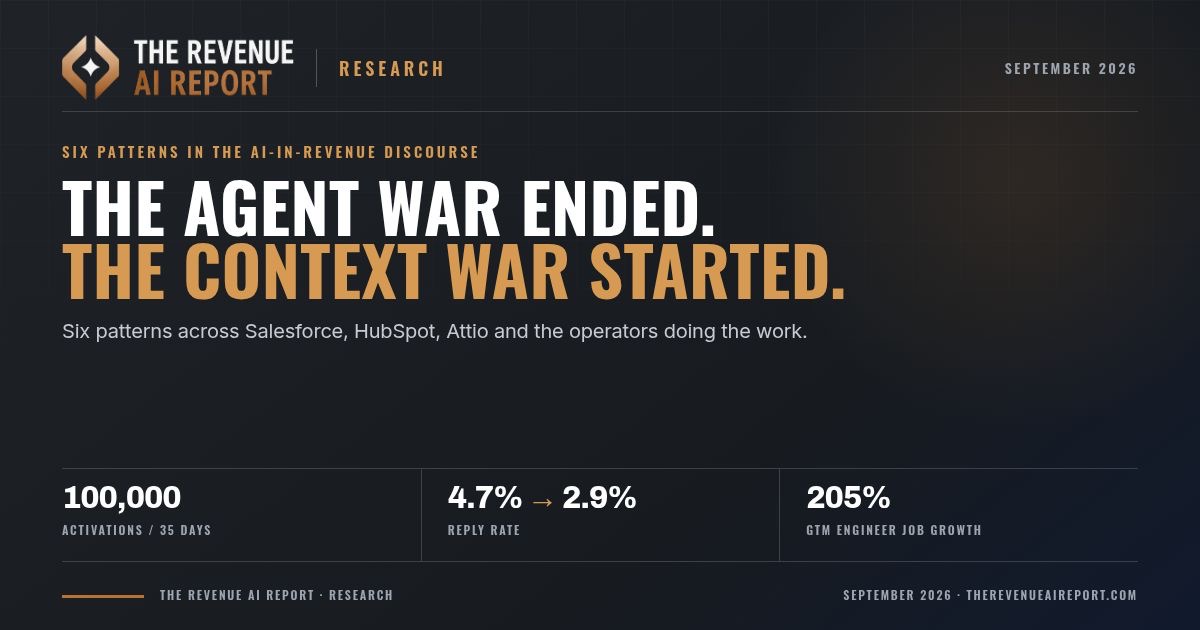
Six cross-vendor patterns beneath the launches, pricing changes, practitioner complaints and hiring data, and the question almost nobody is asking.
The short answer
What does the research show about What the AI-in-Revenue Discourse Is Actually Saying, September 2026?
Evidence
- Salesforce reported 100,000 Coworker activations in 35 days, with inherited permissions and no migration.
- Reported 11x customer churn reached 70-80% within three months, against a three-month break clause inside 12-month contracts.
- GTM Engineer postings grew 205% year over year, with more than 3,000 open roles reported as of March 2026.
Supporting pages
- What Is AIforce, and How Does It Relate to Agentforce, Claudeforce, and Slackforce? analysis
- Nobody Owns AI in Your Revenue Org, and It Shows analysis
- Dictionary plain-language definitions
The news is not the story. The pattern is the story.
In the same week, Salesforce, HubSpot and Attio each described a different product using nearly the same strategic idea: own the governed context beneath the agent. At the same time, revenue operators were talking about messy data, damaged sending domains, hidden oversight costs and agents that look good in a demo but fail in the operating system around them.
Read one source and this looks like a launch cycle. Read across vendors, practitioners, pricing, hiring and reversals, and it looks like a market changing its story. The agent itself is becoming less differentiated. The context, controls and human operator around it are becoming the product.
This scan separates what the market is saying from what it is avoiding. It is a pattern analysis, not a representative survey. Individual claims are linked to their sources, and the named reversal set in The Reversal Ledger should not be read as a base rate for all deployments.
Activation
100,000
The Revenue AI Report · September 2026
Survival
70-80%
The Revenue AI Report · September 2026
Volume
1,150 → 7,400
The Revenue AI Report · September 2026
Yield
4.7% → 2.9%
The Revenue AI Report · September 2026
Ownership
205%
The Revenue AI Report · September 2026
Figure 4. The discourse rewards starts, scale and activity. The numbers underneath it point to survival, yield and ownership.
Figure 2a. Outbound volume per rep per month, before and after AI adoption
Volume rose about 6.4x. The bar axis starts at zero.
Period
- Before AI adoption1,150emails per rep per month
- After AI adoption7,400emails per rep per month
About 1 in 6 emails never reaches an inbox
What this does not say
This does not show that volume caused the yield decline at any single company.
- Publisher
- Salesmotion data as reported by Draftship
- Sample and method
- Reported before and after categories for outbound volume per rep per month.
- Field dates
- Not published by the source.
Before and after are the categories reported by the source. No calendar dates were published.
Volume rose about 6.4x. The bar axis starts at zero.
| Period | Value (emails per rep per month) | Note |
|---|---|---|
| Before AI adoption | 1150 | |
| After AI adoption | 7400 | About 1 in 6 emails never reaches an inbox |
Source: Salesmotion data as reported by Draftship. Reported before and after categories for outbound volume per rep per month. Confidence: Medium.
Caveat: Before and after are the categories reported by the source. No calendar dates were published.
What this does not say: This does not show that volume caused the yield decline at any single company.
1. The agent war ended. The context war started.
The CRM war is turning into a context war. Major vendors are positioning themselves as the governed layer every agent runs on, not merely the maker of one agent.
Within one week, three vendors arrived at the same destination from different directions.
- Salesforce introduced AIforce as an interface layer that carries Salesforce data, workflows, permissions and business logic into Claude, Slack and other places where people work. The strategic asset is not a standalone agent. It is the governed plumbing beneath many agents.Salesforce announcement·Additional launch analysis
- HubSpot's Fall '26 Spotlight centered on a self-updating Smart CRM, Context Home and a Growth Context layer. Context Home makes the shift explicit: HubSpot now scores the completeness of the context its own AI will use.CMSWire·MarTech
- Attio describes itself as "the CRM for agentic revenue" and makes Universal Context the foundation: emails, calls, product and billing signals captured into a live system.Attio·Attio changelog
September 15-16, 2026
Salesforce
AIforce / Coworker
Governed interface layer
Salesforce data, workflows, permissions and business logic move into the tools where people work.
September 15-16, 2026
HubSpot
Smart CRM / Context Home / Growth Context
Self-updating context layer
The CRM captures and scores the context its agents use.
September 15-16, 2026
Attio
CRM for agentic revenue / Universal Context
Live context layer
Email, calls, product and billing signals feed the operating record.
The governed context layer
Who grades the context?
Within one week, three vendors shifted the center of competition from the agent to the context beneath it. Sources: Salesforce announcement, CMSWire, MarTech, Attio and the Attio changelog, linked above. The shared September 15-16 window is displayed because the scan does not support a more precise individual date.
What we think
The agent wars ended this week. The context wars started, and the referee works for one of the teams.
The unanswered question is not whether the context is complete. It is who grades it. When a CRM uses AI to update the record, scores the record's completeness, and then feeds that record back to its own agents, the buyer is inside a self-referential loop. There is no outside auditor.
"Universal context" also turns portability into the strategic issue vendors would rather not discuss. The more emails, calls, product events, permissions and business logic live in one context layer, the more expensive the exit. Buyers should ask for context export, lineage and independent quality checks before they ask which model is underneath the agent.
The AI vendor map on this site can make the shift visible: which products are becoming context layers, which are becoming features on someone else's layer, and which are likely to be paved over.
2. "One click to activate" is the pitch because deployment is the graveyard.
The category has quietly admitted that activation friction kills revenue AI. Every major launch now sells time-to-first-value. Almost none reports time-to-kill.
Salesforce led with friction: Coworker inherits existing permissions, requires no migration, and reached 100,000 activations in 35 days. HubSpot led with "self-updating" and a 28-day free trial. Attio promised a system that is live from day one.
That positioning follows the failure pattern already visible in AI SDRs. Reported 11x customer churn reached 70-80% within three months, with a three-month break clause in 12-month contracts operating like a trial. A ZoomInfo test reportedly did not proceed because it performed "significantly worse than our SDR." Artisan's LinkedIn presence disappeared amid data-broker compliance questions.
- Salesforce: 100,000 Coworker activations in 35 days, with inherited permissions and no migration.Salesforce
- HubSpot: self-updating CRM and a 28-day trial reduce the work required to reach a first result.MarTech
- Attio: "live from day one" moves the promise from capability to setup speed.Attio
- The AI SDR post-mortem shows how easy starts can turn into fast exits.Death to Cold Emails·Draftship
What we think
Activation is a click. Deployment is an operating condition.
A hundred thousand activations tell us that the button worked. They do not tell us whether the workflow produced useful output, whether anyone owned exceptions, whether the economics held, or whether the deployment was still alive on day 90. The industry's favorite measure is time-to-value. Its missing twin is time-to-kill.
The Reversal Ledger exists because kill reasons do not care how easy the first click was. Bad data, no owner, weak economics and no rollback plan survive every onboarding improvement. Define the conditions that would stop the deployment before you buy, then build the exit path.
3. Volume won the reply-count war and is losing the real one.
AI outbound can increase total replies while reducing reply yield, inbox placement and trust. The software captures the activity. The customer keeps the damaged asset.
The public math makes the trade visible. After AI adoption, outbound volume rose from roughly 1,150 to 7,400 emails per rep per month. Reply rates fell from 4.7% to 2.9%. Raw replies still increased from 54 to 215 per month. About one in six emails never reached an inbox.
This is why both sides can claim victory. A vendor can point to more replies. The operator can point to lower yield, worse deliverability and a market that increasingly recognizes generic AI outreach on sight.
- Salesmotion data reported by Draftship shows volume rising from about 1,150 to 7,400 emails per rep per month while reply rate falls from 4.7% to 2.9%; raw replies rise from 54 to 215.Draftship
- Practitioners in r/sales describe the products as "spam cannons with better UI" and point to prospects replying with prompt-injection jokes rather than buying intent.r/sales
- Google, Yahoo and Microsoft now enforce hard deliverability gates including DMARC alignment, complaint rates under 0.3%, a practical target of 0.1%, bounce rates under 2%, and one-click unsubscribe.SpamCipher
What we think
The AI SDR did not fail. It succeeded at exactly what it was built to do, which was to send more email, and that turned out to be the failure.
Domain reputation is now a balance-sheet item, but almost nobody accounts for it that way. AI outbound spends an asset the vendor does not own. The buyer absorbs the replacement cost when a domain is burned, while the vendor reports activity and replies.
The procurement question should be blunt: what is the half-life of a sending domain on this platform, and who pays when it is damaged? A serious benchmark should track volume, reply yield, inbox placement, complaint rate and domain health together. Reporting only total replies hides the transfer of risk.
4. The boring layer ate the ROI.
The revenue AI that sticks is doing data cleaning, deduplication, enrichment, routing and matching. The market created a new job title to own the work the demo skips.
The clearest practitioner signal in this scan came from r/revops. Asked who was using AI for RevOps beyond drafting, operators repeatedly pointed upstream: data quality, record matching, deduplication, enrichment standards and routing. One GTM engineer described compressing QBR preparation from two to three weeks to 30 minutes by connecting CRM, warehouse, product, call and ticket data.
The labor market is confirming the same pattern. GTM Engineer postings grew 205% year over year, with more than 3,000 open roles as of March 2026 and an inflection point in December 2025. Salesforce, HubSpot and Gong are among the companies hiring the title.
- Independent RevOps practitioners converge on upstream data work as the durable use case and warn that "agentic" systems fail when the underlying data remains messy.r/revops
- GTM Engineer postings grew 205% year over year, with more than 3,000 open roles reported as of March 2026.GTM Engineer Pulse
- The pattern matches the failure stories in the Reversal Ledger: the agent gets the headline, while data, ownership and operating design decide whether it lives.
Visible agent layer
Draft · Recommend · Act
Control layer
Permissions · QA · Escalation · Rollback
Messy inputs become confident errors.
Boring layer
Clean · Deduplicate · Enrich · Match · Route
Source layer
CRM · Warehouse · Product · Calls · Tickets
Owner across every layer: GTM Engineer / RevOps
The agent is the visible layer. Data quality, controls and ownership determine whether it survives production. Sources: r/revops practitioner discussion and GTM Engineer Pulse, linked above.
What we think
Every vendor sells the robot. The corpses in the Ledger mostly died of plumbing. The market already voted: it created a job title to do the work the demos skip.
This is the strongest pattern in the scan because three independent signal types point to the same layer: practitioner reports, hiring demand and killed deployments. The hard part is not generating an answer. It is maintaining clean inputs, resolving identity, routing exceptions, preserving permissions and assigning an owner when the answer is wrong.
Most companies still do not have a budget line or a clear owner for that layer. Vendors avoid saying "fix your data first" because it slows the sale. Buyers should treat the GTM Engineer boom as an admission that the hidden implementation layer is real enough to require a salary.
5. Outcome-based pricing is an admission of guilt, and the start of a measurement fight.
Agents broke the logic of seat pricing. Outcome pricing makes the vendor sound accountable, but the vendor still defines, measures and bills the outcome.
HubSpot lost more than half its value during the period covered by this scan, cut AI agent prices and shifted toward "pay when the agent works." Analysts read the move against weak end-market readiness for broad agent adoption. At the same time, Gartner's warning about "agent washing" and its prediction that 40% of agentic AI projects will be cancelled by 2027 kept circulating, with governance, ownership and ROI, not model capability, named as the problems.
- HubSpot's repricing and investor reaction show the pressure to connect agent charges to visible output.The Boston Globe·Lynton
- Gartner said only about 130 of thousands of vendors making agentic claims were credible and forecast that more than 40% of agentic AI projects would be cancelled by the end of 2027.Gartner·Forbes
- HFS Research is one of the few sources pushing telemetry and audit requirements into the discussion.HFS Research
What we think
Outcome-based pricing sounds like the vendor taking the risk. Read the definition of "outcome" first. The vendor wrote it, measures it and bills it. The risk did not move. It got renamed.
A resolved ticket can be closed too early. A qualified lead can be scored by the system selling the lead. A completed task can create cleanup work outside the meter. The argument moves from price per seat to the definition, attribution and auditability of the result.
Revenue teams should require outcome definitions in the contract, exportable run logs, exception counts and a dispute path. The pricing model is also a useful confidence signal. Tracking which tools move from seats to usage to outcomes will show where vendors are willing to underwrite performance, and where they are merely changing the unit on the invoice.
6. Nobody got replaced. The human moved upstream and got more expensive.
Every "replace the SDR" story keeps a human in the system. The work moves from execution to supervision, integration and accountability.
SaaStr's six-month experiment with five agents produced measurable results, but it also required a RevOps rebuild and 15-20 hours of human oversight each week. Practitioners describe the useful model as an exoskeleton, not a robot. Salesforce practitioners keep returning to the same unresolved question: if an agent makes a mistake, who is responsible?
- The SaaStr experiment required 15-20 hours per week of human oversight plus RevOps work.Death to Cold Emails
- The practitioner shorthand is direct: do not replace the SDR with a robot; give the SDR an exoskeleton.r/SaaSSales
- Salesforce practitioners are debating accountability, review load and whether constant supervision creates real time savings.r/salesforce
What we think
The original pitch was "remove a rep." The delivered system is "keep the rep, add a scarce operator, and supervise the machine." That can still be a good investment. It is not labor elimination.
Oversight belongs inside the ROI model. So do integration work, exception handling, QA, compliance review and the cost of a bad send. Fifteen to 20 hours a week of senior attention is not a rounding error. It is part of the product's true price.
Accountability is not an abstract ethics debate. It is org design. Every production agent needs one named owner with authority to stop it, a review cadence, escalation rules and a rollback plan. If nobody owns the mistake, the deployment is one bad action away from a kill decision.
7. The missing layer is survival data.
Everyone is arguing about whether agents work.
Vendors answer with activation and activity. Practitioners answer with one company's experience. Analysts answer with surveys and forecasts. Each view contains useful evidence. None answers the question that matters after the launch: what remains alive after day 90, and what do the survivors have in common?
Vendors are unlikely to publish a clean survival curve because churn is part of the answer. Practitioners cannot see across companies. Analysts usually sample opinions, plans or self-reported outcomes rather than killed deployments with documented reasons.
As far as this scan found, the Reversal Ledger is the missing layer in the public record: a cross-company collection of killed deployments and the stated reasons they were reversed. It is a collected case set, not a representative sample, so it cannot produce a market-wide failure rate. It can do something the launch data cannot: show recurring fingerprints in the corpses.
"Everyone else is arguing about whether AI works in revenue. We are counting what happens when it does not, and the pattern in the corpses predicts which of this week's launches are already dead."
The useful unit of analysis is not the launch. It is the deployment lifecycle:
- 1. ActivationDid the team turn it on?
- 2. AdoptionDid the intended users keep using it?
- 3. OperationDid the data, controls and owner hold up under real work?
- 4. OutcomeDid it create a result that survives independent measurement?
- 5. SurvivalWas it still alive at day 90, and why?
- 6. ReversalIf it died, what triggered the kill and how expensive was the exit?
That is the measurement stack the market is missing. Activation without survival is a vanity metric. Outcome without an audit trail is vendor-defined. ROI without oversight and exit cost is incomplete.
8. What to watch next month
Use the next launch cycle to test these patterns rather than repeat the announcements.
Context portability
Do Salesforce, HubSpot or Attio publish export, lineage or independent quality controls for the context their agents consume?
Survival reporting
Does any vendor pair activation with 30-, 60- or 90-day retention and production use?
Domain economics
Do AI outbound tools report inbox placement and domain-health costs alongside reply volume?
Ownership
Does GTM Engineer hiring continue to rise, and do companies give the role authority over production agents?
Outcome audits
Do outcome-priced products expose definitions, run logs, exceptions and dispute rights?
Human cost
Do ROI calculators begin to include supervision, QA, integration and rollback work?
If those measures stay absent, the absence is evidence. The market will still be selling the start while operators pay for the middle and discover the end.
Method and limits
This pattern scan compares vendor announcements and product positioning with practitioner discussions, pricing and market commentary, hiring data and documented reversal cases. Sources include Salesforce, HubSpot and Attio launch materials and coverage; Reddit discussions in sales, RevOps, SaaS sales and Salesforce communities; practitioner analyses; hiring-market data; and analyst or business press coverage.
This is a directional discourse scan, not a census, survey or representative sample. Reddit threads are anecdotal. Vendor claims describe their own products. Hiring counts depend on the source's collection method. The Reversal Ledger is a collected set of reported cases and cannot establish a base rate for all AI deployments. Numbers on this page remain attributed to their original sources so readers can inspect the evidence and its limits.
License: CC BY 4.0. You may share and adapt this work with attribution. Individual source material remains subject to its original publisher's terms.
Also in the record
Figures that sit alongside these charts.
- Salesforce reported 100,000 Coworker activations in 35 days, with inherited permissions and no migration.
- Reported 11x customer churn reached 70-80% within three months, against a three-month break clause inside 12-month contracts.
- GTM Engineer postings grew 205% year over year, with more than 3,000 open roles reported as of March 2026.
- Gartner forecast that more than 40% of agentic AI projects would be cancelled by the end of 2027, naming governance, ownership and ROI rather than model capability.
- SaaStr's five-agent experiment still required 15-20 hours of human oversight each week plus a RevOps rebuild.
Questions this page answers
What the data says, in plain language.
- What does the research show about What the AI-in-Revenue Discourse Is Actually Saying, September 2026?
- Six cross-vendor patterns beneath the launches, pricing changes, practitioner complaints and hiring data, and the question almost nobody is asking. The news is not the story. The pattern is the story.
- What does the figure "Figure 2a. Outbound volume per rep per month, before and after AI adoption" show?
- Volume rose about 6.4x. The bar axis starts at zero. Source: Salesmotion data as reported by Draftship. Reported before and after categories for outbound volume per rep per month. Confidence: Medium. Caveat: Before and after are the categories reported by the source. No calendar dates were published.
- What does the figure "Figure 2b. Reply rate over the same before and after periods" show?
- Reply rate fell 1.8 percentage points while raw replies rose from 54 to 215 per month. Source: Salesmotion data as reported by Draftship. Reply rate reported for the same before and after categories as the volume figure. Confidence: Medium. Caveat: A falling rate with rising raw replies is why vendor and operator accounts of the same program disagree.
- What else sits alongside these figures?
- Salesforce reported 100,000 Coworker activations in 35 days, with inherited permissions and no migration. Reported 11x customer churn reached 70-80% within three months, against a three-month break clause inside 12-month contracts. GTM Engineer postings grew 205% year over year, with more than 3,000 open roles reported as of March 2026. Gartner forecast that more than 40% of agentic AI projects would be cancelled by the end of 2027, naming governance, ownership and ROI rather than model capability.
- Where does this data come from?
- Every figure is reproduced from a named publisher: Salesforce, Salesforce Break, CMSWire, MarTech, Attio, Attio changelog. Sample, field date, and confidence are shown on each chart. Sources marked as vendor research are labelled on the page.
- What could not be confirmed?
- A survival curve for revenue AI deployments. No vendor, analyst or practitioner source in this scan published 30-, 60- or 90-day retention for activated agents. A market-wide failure rate. The Reversal Ledger is a collected case set of reported reversals and cannot establish a base rate for all AI deployments. Inbox placement and domain-health reporting from AI outbound vendors. The deliverability gates are published by the mailbox providers, not by the tools sending into them.
Cite this page
Permanent URL and suggested citation.
https://www.therevenueaireport.com/research/discourse-patterns-september-2026
Kvarfordt, Jonathan. "What the AI-in-Revenue Discourse Is Actually Saying, September 2026." The Revenue AI Report, Research Library. https://www.therevenueaireport.com/research/discourse-patterns-september-2026
Figures on this page are reproduced from the publishers listed below. Cite the original publisher for the underlying data, and this page for the compilation and framing.
Sources
Every publisher used on this page.
If a metric, model term, or method on this page is unfamiliar, every one of them is defined in The AI and Revenue Dictionary. Sample size, field date, and confidence tags are explained there too.
SalesforceVendor research
AIforce and Coworker announcement, including the 100,000 activations in 35 days figure.
https://www.salesforce.com/news/stories/aiforce-announcement/Salesforce Break
Independent launch analysis of AIforce, Slackforce, Claudeforce and Agentforce Coworker.
https://salesforcebreak.com/2026/09/17/aiforce-slackforce-claudeforce-agentforce-coworker/CMSWire
Coverage of HubSpot's Breeze assistant and self-updating CRM.
https://www.cmswire.com/customer-experience/hubspot-debuts-breeze-assistant-selfupdating-crm/MarTech
Coverage of HubSpot rebuilding its platform around AI agents, including the 28-day trial.
https://martech.org/hubspot-rebuilds-its-platform-around-ai-agents/AttioVendor research
Product positioning as the CRM for agentic revenue, with Universal Context.
https://attio.com/Attio changelogVendor research
Shipping record used to check the positioning against released functionality.
https://attio.com/changelogDeath to Cold Emails
AI SDR post-mortem, including the SaaStr experiment oversight hours and reported churn.
https://deathtocoldemails.com/ai-sdr-post-mortem/Draftship
Analysis carrying the Salesmotion volume and reply-rate figures.
https://draftship.io/blog/do-ai-sdrs-work-2026r/sales
Practitioner discussion of AI outbound quality. Anecdotal, not a sample.
https://www.reddit.com/r/sales/comments/1t63m4o/SpamCipher
Summary of 2026 deliverability gates at Google, Yahoo and Microsoft.
https://spamcipher.com/blog/cold-email-compliance-2026r/revops
Practitioner discussion of AI use in RevOps beyond drafting. Anecdotal, not a sample.
https://www.reddit.com/r/revops/comments/1s5l63o/GTM Engineer Pulse
Job-market data on GTM Engineer postings, including 205% year-over-year growth.
https://gtmepulse.com/insights/job-market-2026/The Boston Globe
Coverage of HubSpot's valuation and AI agent pricing changes.
https://www.bostonglobe.com/2026/05/08/business/hubspot-stock-price-ai-agents/Lynton
Commentary on the software repricing cycle referenced in the pricing section.
https://www.lyntonweb.com/library/saaspocalypse-overGartner
Agent washing warning and the forecast on cancelled agentic AI projects.
https://www.gartner.com/en/newsroom/press-releases/2025-06-25Forbes
Coverage restating the Gartner forecast and vendor credibility count.
https://www.forbes.com/sites/robertszczerba/2026/07/07/HFS Research
Argument for telemetry and audit requirements in agentic claims.
https://www.hfsresearch.com/research/stop-falling-agentic-washing/r/SaaSSales
Practitioner framing of the exoskeleton model. Anecdotal, not a sample.
https://www.reddit.com/r/SaaSSales/comments/1op7y6b/r/salesforce
Practitioner debate on agent accountability and review load. Anecdotal, not a sample.
https://www.reddit.com/r/salesforce/comments/1uead0u/
Could not confirm
What we looked for and did not find.
Claims found during research and not charted
- A survival curve for revenue AI deployments. No vendor, analyst or practitioner source in this scan published 30-, 60- or 90-day retention for activated agents.
- A market-wide failure rate. The Reversal Ledger is a collected case set of reported reversals and cannot establish a base rate for all AI deployments.
- Inbox placement and domain-health reporting from AI outbound vendors. The deliverability gates are published by the mailbox providers, not by the tools sending into them.
Read the analysis
Issues built on this theme.
Research on this site is the evidence layer. These essays take the numbers above and apply them to real decisions, so you can see how the data reads in practice.
- What Is AIforce, and How Does It Relate to Agentforce, Claudeforce, and Slackforce?
AIforce is Salesforce's live interface layer that brings CRM data, workflows, logic, and permissions to any AI interface. It sits on top of Data 360, Customer 360, and Agentforce. Claudeforce, Slackforce, and Agentforce Coworker are the first three surfaces. Open beta for Claudeforce is not GA; the product page is stale versus the Sep 15 announcement.
- Nobody Owns AI in Your Revenue Org, and It Shows
AI in GTM sits between RevOps, IT, enablement, and whichever leader moved first. Ambiguous ownership is why capability stalls at the pilot line. Here is an ownership model that actually holds.
- Seats, Consumption, or Outcomes: How to Negotiate AI Pricing You Can Forecast
AI vendors are moving off per-seat pricing and onto models that make your spend a variable you cannot forecast. Here is how each model actually behaves at scale, and the terms to fight for.
How to cite this research
Written by Jonathan Kvarfordt, Founder and Principal Analyst, The Revenue AI Report. Published under CC BY 4.0.
APA
Kvarfordt, J. (2026). What the AI-in-Revenue Discourse Is Actually Saying, September 2026. The Revenue AI Report. Retrieved from https://www.therevenueaireport.com/research/discourse-patterns-september-2026
MLA
Kvarfordt, Jonathan. "What the AI-in-Revenue Discourse Is Actually Saying, September 2026." The Revenue AI Report, 31 Aug. 2026, www.therevenueaireport.com/research/discourse-patterns-september-2026.
BibTeX
@misc{kvarfordt2026discoursepatternsseptember2026,
  author = {Kvarfordt, Jonathan},
  title = {What the AI-in-Revenue Discourse Is Actually Saying, September 2026},
  year = {2026},
  publisher = {The Revenue AI Report},
  url = {https://www.therevenueaireport.com/research/discourse-patterns-september-2026}
}Next theme
The Manual TaxEnterprise AI is stalling because leaders bought tools without subtracting work. The receipts on the pilot-to-P&L gap, the executive-worker split, and why enablement becomes the change management owner.
Subscribe