
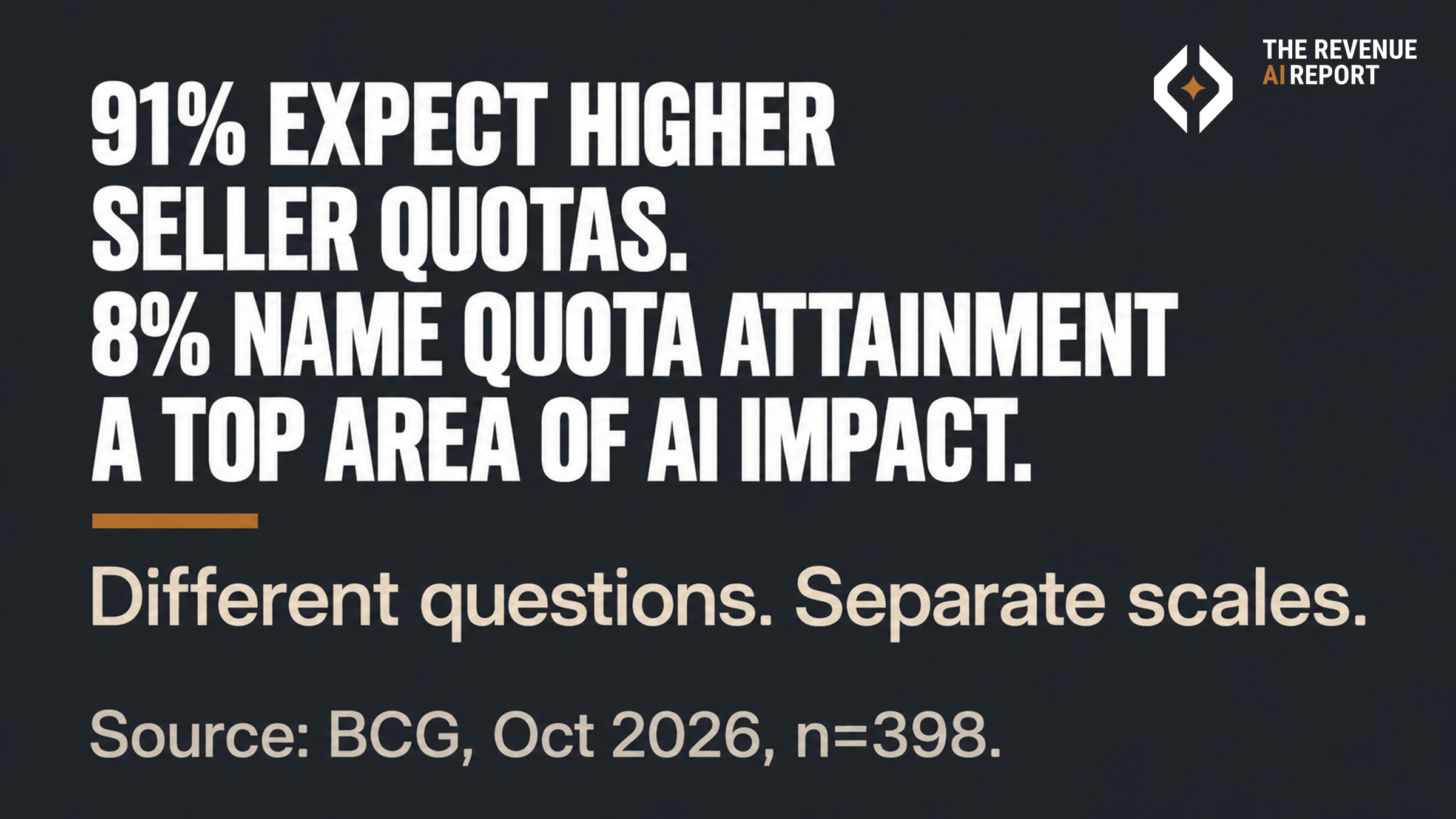
91% Expect Higher Seller Quotas. 8% Name Quota Attainment a Top Area of AI Impact.
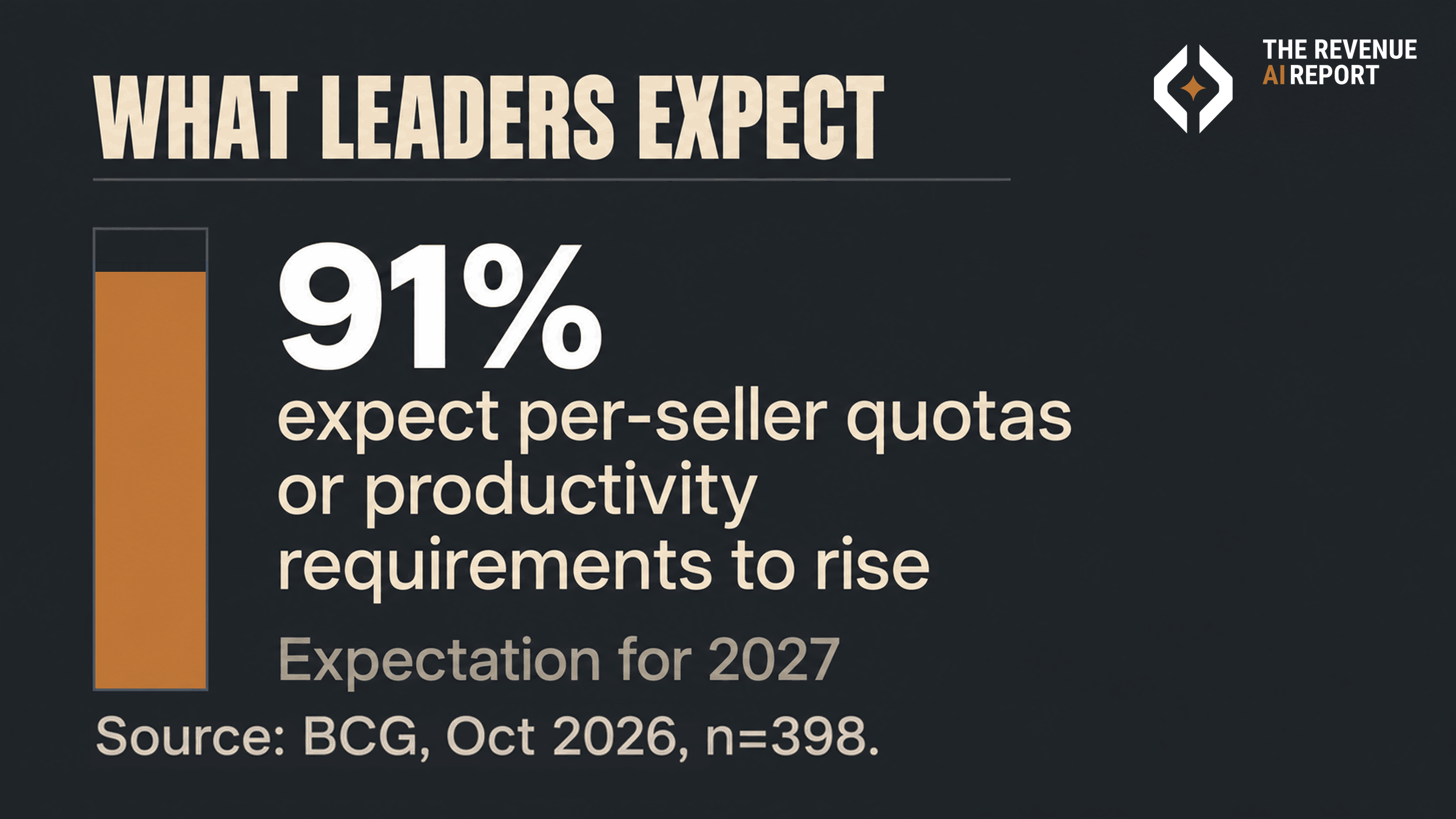
In BCG's survey of 398 revenue leaders, published Oct 19, 91% expect per-seller quotas or productivity requirements to rise. Before you approve an AI-based uplift, give each plan line a metric, a baseline, an owner and a check date.
Jonathan Kvarfordt · Published October 19, 2026 · Last updated October 19, 2026 · 8 min read
In BCG's survey of 398 revenue leaders, published Oct 19, 91% expect per-seller quotas or productivity requirements to rise. Before you approve an AI-based uplift, give each plan line a metric, a baseline, an owner and a check date.
While 2027 sales plans are being set, many of them raise what each seller must deliver, on the assumption that AI makes each seller more productive. If that assumption is wrong, the gap shows up as missed quota by the middle of 2027.
BCG published the numbers on October 19, 2026. In its survey of 398 CROs, sales leaders, chief commercial officers and RevOps leaders, 91% "expect quotas or productivity requirements per seller to rise." On the outcome side, "only 13% report win rates as a top area of measurable AI impact, and only 8% report higher quota attainment."
Those are two different measures. The 91% is what leaders expect for 2027. The 8% is the share of leaders who name higher quota attainment as a top area of measurable AI impact. Nearly every leader expects more output per seller, and few put quota attainment at the top of their AI results list.
Below is a ledger for closing that gap before you sign the plan.
What BCG found
Adoption is wide. "Ninety percent of the leaders we surveyed report meaningful AI use in sales workflows." The earliest returns are operational: 33% report reduced administrative workloads and 18% report better forecast accuracy.
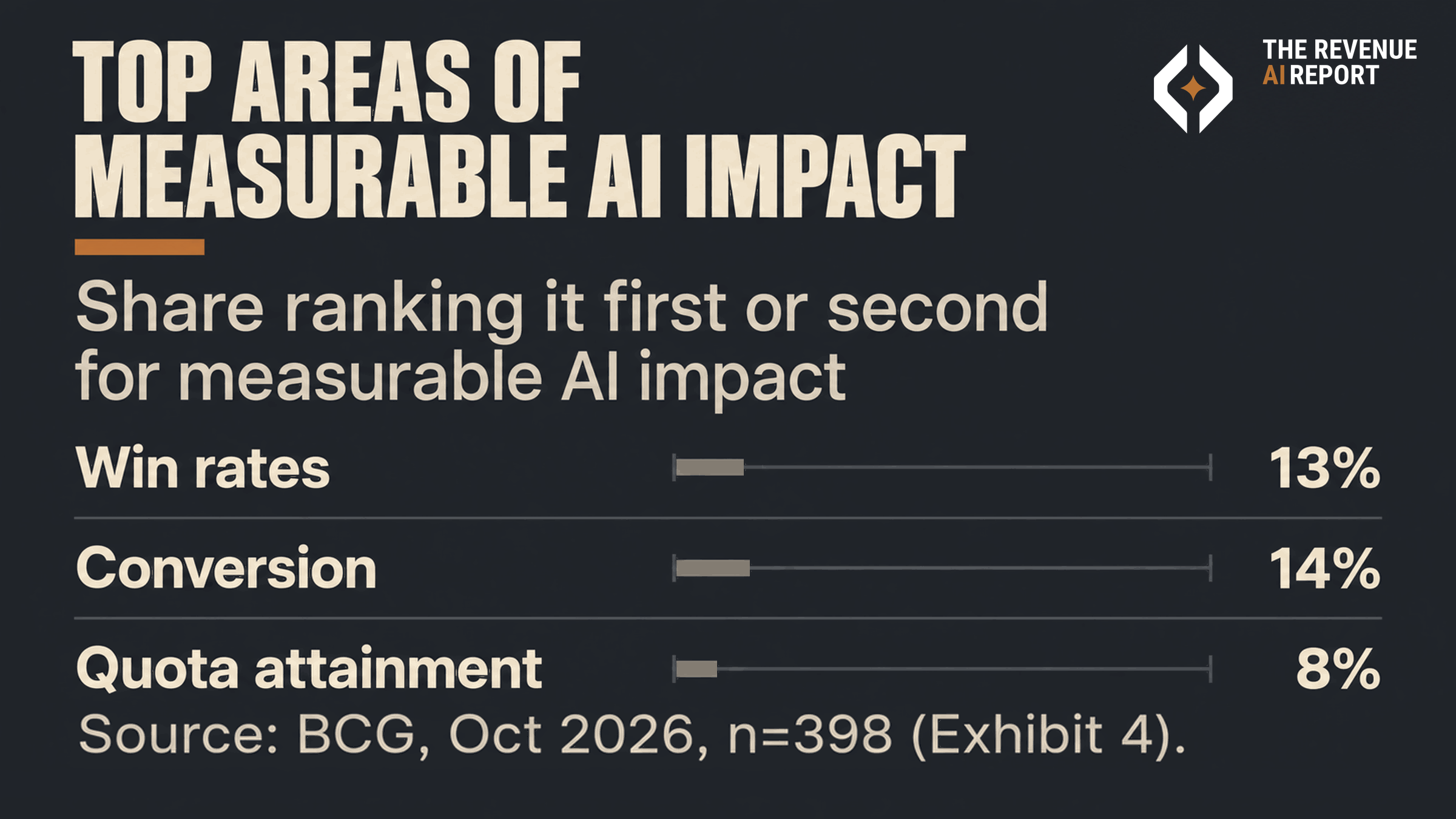
Selling outcomes trail. 13% rank win rates, 14% rank improved conversion and 8% rank higher quota attainment first or second among areas of measurable AI impact (BCG, Exhibit 4). The most-cited areas were efficiency ones: per BCG's press release, 33% of respondents ranked administrative workload and 22% ranked seller time saved among their top two areas of measurable AI impact. BCG says AI returns have been weighted toward "increasing seller productivity and coverage (51%)." "Only 32% point to accelerating earlier proof-of-value activities," while 51% say buyers expect more customized proof of value, including evidence of ROI, before they purchase.
Two more lines shape the ledger.
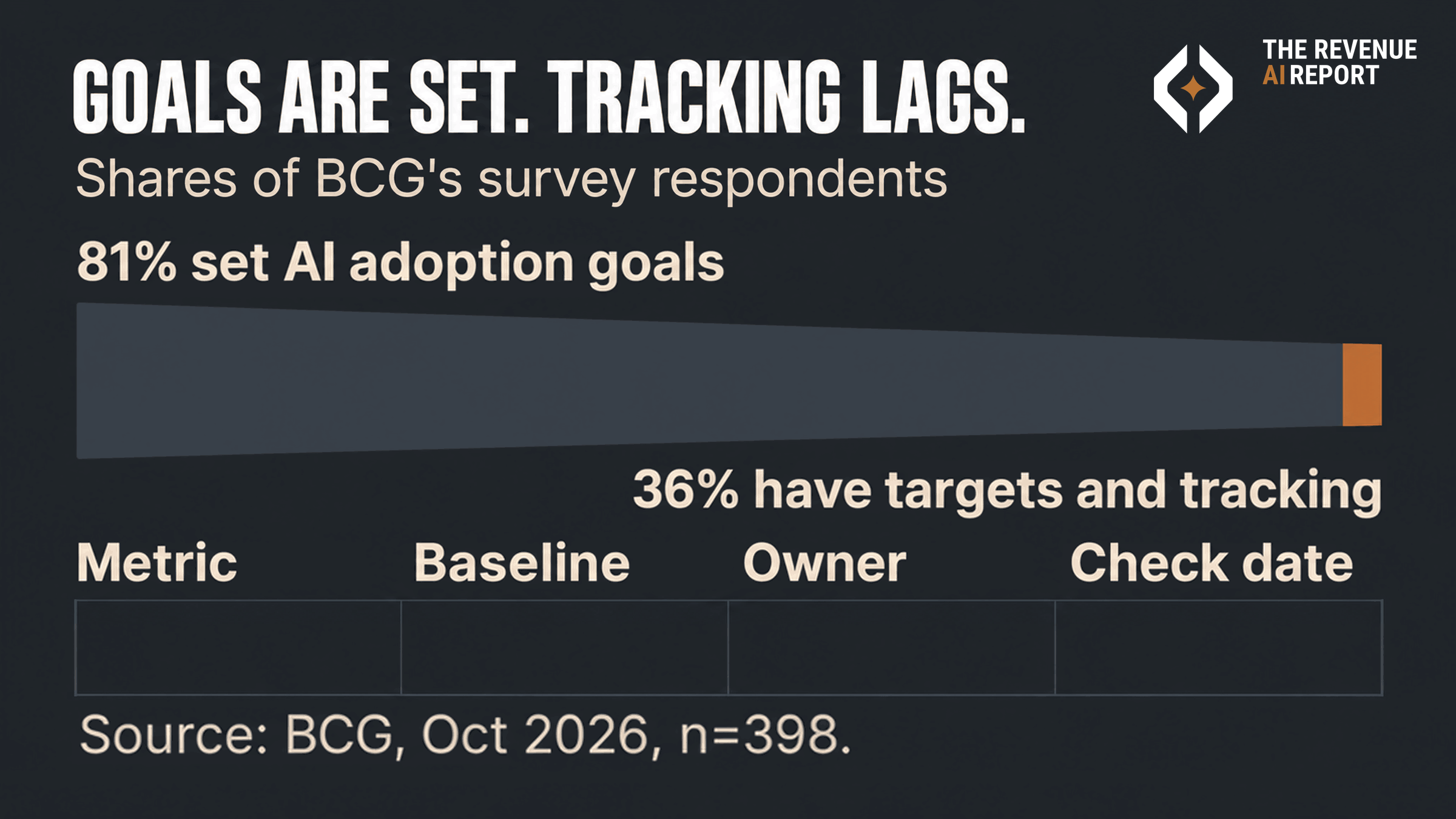
First, measurement. "81% of respondents established AI adoption goals, but only 36% have targets and tracking in place."
Second, growth. More AI-advanced organizations, which BCG defines as those with more autonomous agents deployed, are "more likely to be growing revenue at double-digit rates (69% versus 42%)." That is a correlation. The survey does not show which way the link runs. One possible reason runs the other way: faster-growing companies have more money to spend on AI.
BCG surveyed large companies, the answers are self-reported, and the page gives no fieldwork dates. The ledger below works at any company size, from a small regional distributor to a national carrier.
A view from outside BCG
Executives' own estimates of AI productivity gains can run ahead of what shows up in revenue. A March 2026 NBER working paper (not peer-reviewed) surveyed nearly 750 corporate executives, mostly CFOs at US firms, and found "perceived productivity gains are larger than measured productivity gains, likely reflecting a delay in revenue realizations." The same paper finds AI productivity gains positive and expected to strengthen in 2026.
Read the same way, self-reported shares like the 13% and 8% could run high, or measured results could simply arrive later. Either way, a quota built on what leaders perceive is a bet on a number nobody has measured yet. Your CRM can measure it.
The quota-assumption ledger
BCG's own description of leading organizations sets the rule: "Before approving increases in headcount, budgets, or quotas, leading organizations assess whether AI is sufficiently embedded in sales workflows to support higher expectations in terms of expansion, cross-selling, and upselling."
Turn that into a ledger. List every 2027 plan line that leans on AI. For each line, write down the metric that has to move first, its baseline today, the person who tracks it, and the date it gets checked.
| Plan line that leans on AI | Metric that moves first | Baseline to record now | Who tracks it | Check date |
|---|---|---|---|---|
| Quota uplift per seller | Win rate on qualified opportunities | Trailing four quarters, by segment, from your CRM | RevOps lead | End of Q1 2027, then end of Q2 |
| Higher coverage ratio (more accounts per seller) | Stage-to-stage conversion on the added accounts | Current conversion by stage for the same account tier | VP or Director of Sales | 60 days after the coverage change |
| Hires avoided or delayed | Proof-of-value cycle time (first meeting to signed business case) | Median days for deals closed in the last 12 months | RevOps lead with Finance | End of Q1 2027 |
| Ramp time cut for new sellers | Days to first closed deal | Median for the last two hiring cohorts | Enablement lead | 90 days after each cohort starts |
| Seller hours freed by AI | Customer-facing hours per seller per week | Current calendar and activity data | Sales managers, reported to RevOps | Monthly from January 2027 |
Do not approve an uplift until its metric is tracked. If the metric has no baseline today, the plan line stays at its pre-AI level until one exists.
A clean way to hold that line is to split each quota into two parts. The base quota assumes no AI gain. The AI uplift goes into the plan as a separate, named amount that takes effect only after the metric moves past its baseline on the check date. Finance sees both numbers, and sellers know which part of their quota depends on proof.
Run it before plans lock
- List every 2027 plan line where AI is part of the math: quota, coverage, headcount, ramp.
- Pull the baseline for each metric from your CRM this week. If you cannot pull it, write "no baseline" in the ledger.
- Name one owner per row, by title.
- Put the check dates in the planning calendar next to the quarterly business reviews.
- Split each affected quota into base and AI uplift.
- Agree in writing what happens if the metric does not move: the uplift stays off and the plan line holds at base.
For Enablement leads: BCG found 81% set AI adoption goals, and only 36% have targets and tracking. Turn each adoption goal into a tracked target tied to one ledger row.
For Directors of Sales: bring the ledger to your VP or CRO before plans lock. A filled-in ledger gives them something specific to approve, which is easier to sign than a slide titled "AI efficiencies."
What this looks like in practice
These are composites built to show the moves. Neither is a reported case.
An industrial parts distributor plans a higher quota per seller because AI now drafts quotes and logs calls. Its RevOps lead finds win rates were never baselined by segment. The CRO approves the base quota now and books the uplift as contingent on a win-rate check at the end of the first quarter.
A regional healthcare services group that sells lab and imaging contracts to clinics plans to cover more clinic accounts per sales rep without new hires. Its VP of Sales records current conversion from proposal to signed contract for that clinic tier and sets a 60-day check. The hiring plan holds its open roles in reserve and releases them if conversion on the added accounts falls below baseline.
The role mix shifts
BCG says the survey suggests CROs "are not primarily planning to use AI to shrink their sales organizations." The work shifts instead. The CROs BCG interviewed described using the hours AI frees up to increase customer-facing time, and advanced organizations are 22 percentage points more likely to hire AI-specialized roles. The ledger tracks whether those freed hours turn into wins. For the comp side of that shift, see quota and comp design after AI. For choosing the metric itself, see pick the AI payback metric before launch.
The decision for this planning cycle is a signature. Do not sign an AI-based quota uplift until its row in the ledger has a baseline, an owner and a check date.
Sources
The BCG page was captured on October 19, 2026. Every figure here appears in the page text of that capture; the definition of the impact figures (share ranking an area first or second) is from BCG's Exhibit 4. The 22% for seller time saved is from BCG's press release, also captured October 19, 2026.
- BCG, "The 2027 Revenue Agenda: Moving the AI Focus from Productivity to Proof of Value," Federico Fabbri, Marina Nekrasova, Tarandeep Singh and Nacho Hafner, October 19, 2026. Survey of 398 CROs, sales leaders, chief commercial officers and RevOps leaders at large companies across 23 countries: bcg.com
- BCG, "Chief Revenue Officers Entering 2027 with a 'Do More with More' AI Agenda," press release, October 19, 2026: bcg.com
- NBER Working Paper 34984, "Artificial Intelligence, Productivity, and the Workforce: Evidence from Corporate Executives," Salomé Baslandze, Zachary Edwards, John Graham, Ty McClure, Brent H. Meyer, Michael Sparks, Sonya R. Waddell and Daniel Weitz, March 2026. NBER working paper, not peer-reviewed: nber.org
Frequently asked questions
- What share of revenue leaders expect quotas to rise in 2027?
- In BCG's survey of 398 revenue leaders at large companies, published October 2026, 91% expect quotas or productivity requirements per seller to rise. The survey is self-reported and the page gives no fieldwork dates.
- What does the 8% figure in the BCG survey measure?
- The 8% is the share of leaders who name higher quota attainment as a top area of measurable AI impact. The 13% for win rates and the 14% for conversion use the same framing. Leaders may see other effects they did not rank at the top.
- Are AI-advanced companies growing revenue faster?
- BCG found AI-advanced organizations more likely to be growing revenue at double-digit rates, 69% versus 42%. That is a correlation. The survey does not show which way the link runs, and other factors could explain it.
- What goes in a quota-assumption ledger?
- One row per 2027 plan line that leans on AI, such as quota uplift, coverage ratio or hires avoided. Each row names the metric that has to move first, its baseline today, the owner who tracks it in your CRM, and the date it gets checked.
- Who should own the ledger?
- RevOps usually tracks win rate, conversion and cycle time. Enablement owns adoption targets and ramp. A VP or Director of Sales brings the filled-in ledger to the CRO before plans lock, and the CRO approves each uplift only once its metric is tracked.
Hiring for revenue roles?
Post your sales, marketing, RevOps or enablement opening where revenue leaders read every week. One 30-day post is $199. Three featured posts are $299/mo.
Keep reading
Benchmark
Ask the Same AI the Same Question Twice. How Many Runs Before a Citation Shift Counts as Proof?
Require a run count plus a variance band before any vendor citation-share delta counts as a result.
Benchmark
Landbase GTMBench Put GTM-3 Omni Ahead. Blind-Test Your Own ICP Before You Buy
Treat vendor precision as a question generator. Buy only after a blind ICP test, judged by someone who does not sell the tool, tracked accepted rows to held meetings to pipeline to cost.