
Google Halved Nano Banana Image Prices at 1K and 2K. Input Now Costs 3x. What Does an Ad Variant Cost Now?
Google shipped Nano Banana 2.1 on Oct 6 2026 and cut the image-output rate from $60 to $30 per million tokens. A 2K image drops from $0.101 to $0.0504. A 4K image drops only 25%, after Google revised its 4K token count on launch day. Input went from $0.50 to $1.50 per million tokens, and text and thinking output from $3 to $7.50. Here is what a batch of ad variants really costs, and the Order Form lines.
Jonathan Kvarfordt · Published October 8, 2026 · 6 min read
The short answer
Google says Nano Banana 2.1 cuts image prices about in half. What does a batch of AI ad variants cost after the change, and what should marketing and RevOps put on the Order Form?
Decision rule
Move bulk 1K and 2K ad variants to Nano Banana 2.1 on Batch with thinking set low. Price 4K work on your own token counts before you migrate it.
Evidence
- Google, Gemini Developer API pricing (last updated Oct 7 2026): Nano Banana 2.1 Standard input $1.50 per million tokens (text/image/video), output $7.50 (text and thinking) and $30 (images), equal to $0.0336 per 1K image, $0.0504 per 2K image, $0.113 per 4K image. Batch: $0.75 input, $3.75 text and thinking, $15 images, equal to $0.0168, $0.0252, $0.0567. Image tokens: 1,120 at 1K, 1,680 at 2K, 3,780 at 4K. No free tier.
- Same page, Nano Banana 2 (Gemini 3.1 Flash Image): input $0.50, text and thinking $3, images $60 per million tokens, equal to $0.067 per 1K, $0.101 per 2K, $0.151 per 4K image (2,520 tokens at 4K). Batch $0.034, $0.050, $0.076.
- Google, Gemini API release notes (Oct 6 2026): Nano Banana 2.1 (gemini-nano-banana-2.1) generally available. gemini-3.1-flash-image deprecated, no shutdown date announced.
- Kingy AI (updated Oct 6 2026, 9:25 p.m. PDT): Google's revised pricing page lists 3,780 output tokens for a 4K image, replacing the launch-day figure of 2,520. A previously listed Oct 29 shutdown date for Nano Banana 2 was removed. Thinking levels minimal, medium, high, default medium. Flex and Priority unsupported.
- Grounding with Google Web and Image Search: 5,000 free search requests a month shared across Gemini 3.x models, then $14 per 1,000. One request may run more than one search.
Operator action
This week: pull token counts for 100 of your real image requests, split into input, thinking, and image. Re-price them at 2.1 rates. Move anything that can wait to Batch, set thinking to minimal on bulk variants, and ask every creative vendor that resells Google image models whether the cut reaches your credit price.
Last reviewed
Google halved the image meter. Then it raised the other two.
On Oct 6 2026 Google made Nano Banana 2.1 generally available in the Gemini API and deprecated Nano Banana 2 (Gemini API release notes). The pricing page cuts image output from $60 to $30 per million tokens. The same page raises input from $0.50 to $1.50 per million tokens and text and thinking output from $3 to $7.50 (Gemini API pricing).
The argument
How this reality check breaks down
A map of the sections ahead, in the order the case is made. The sourced charts are in the research library.
Contents diagram for Google Halved Nano Banana Image Prices at 1K and 2K. Input Now Costs 3x. What Does an Ad Variant Cost Now?, listing the sections: The rate card, The 4K price moved on launch day, What an ad variant costs, Where this hits GTM, Nano Banana 2 is on the clock, with no date, Order Form lines for Nano Banana 2.1.If your team generates ad variants, event creative, or one-to-one account images through Google's models, the headline is half price. Your bill depends on how much text, reference material, and thinking rides along with each image.
The rate card
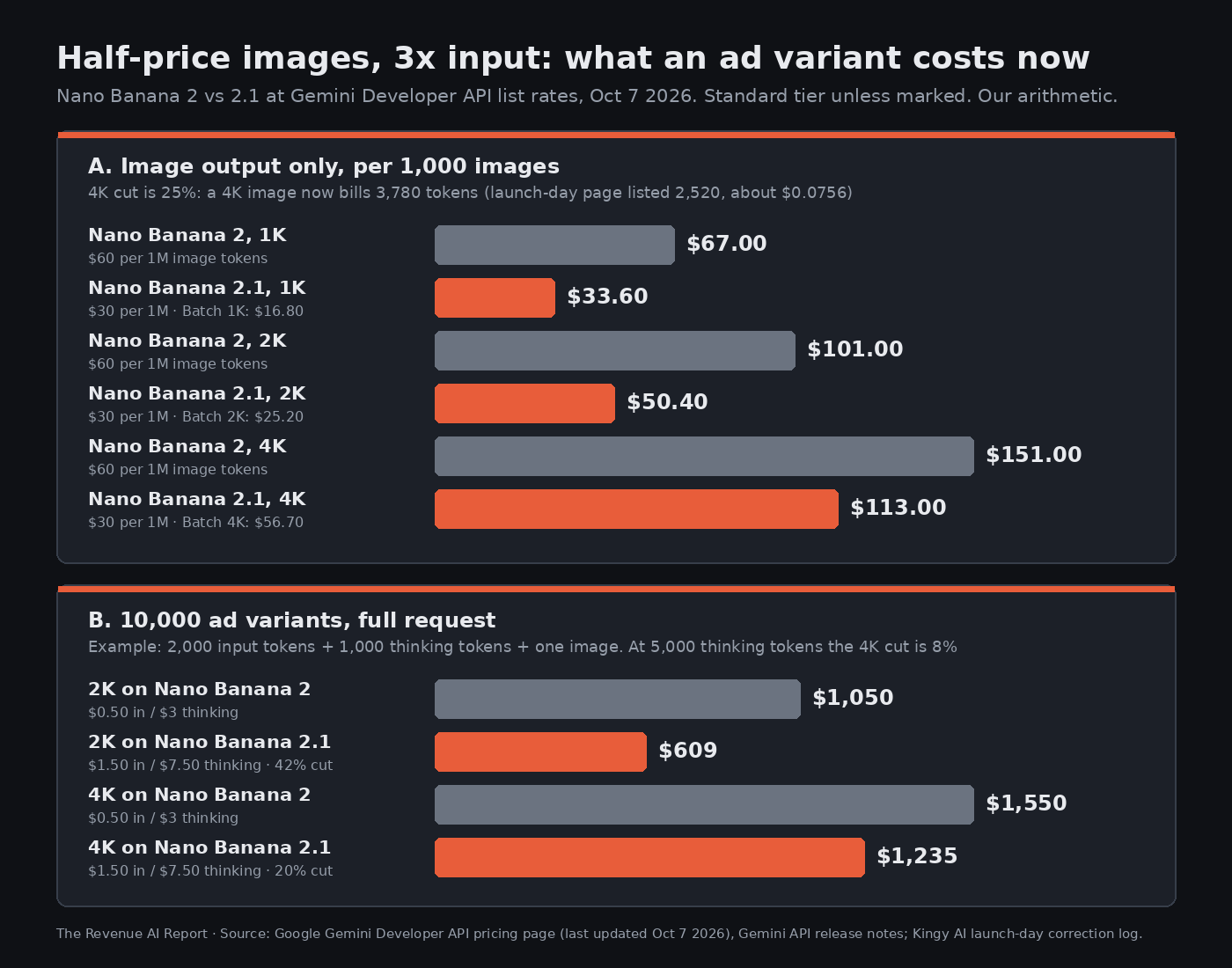
- Image output. Nano Banana 2.1: $0.0336 at 1K, $0.0504 at 2K, $0.113 at 4K. Nano Banana 2: $0.067, $0.101, $0.151 (Gemini API pricing).
- Input. $1.50 per million tokens for text, image, and video on 2.1. Nano Banana 2 lists $0.50. That is 3x.
- Text and thinking output. $7.50 per million tokens on 2.1. Nano Banana 2 lists $3. That is 2.5x.
- Batch. Half of every 2.1 rate: $0.0168 at 1K, $0.0252 at 2K, $0.0567 at 4K.
- Free tier. None for 2.1 on the Developer API.
- Grounding. 5,000 free search requests a month, shared across Gemini 3.x models, then $14 per 1,000. Google says one request may run more than one search.
Reality Check
Google Halved Nano Banana Image Prices at 1K and 2K. Input Now Costs 3x. What Does an Ad Variant Cost Now?
Source-cited charts live in the research library.
Google Halved Nano Banana Image Prices at 1K and 2K. Input Now Costs 3x. What Does an Ad Variant Cost Now?. Diagram showing Evidence, Analysis, Decision, Outcome.The 4K price moved on launch day
Google bills an image by its token count. At 1K a 2.1 image is 1,120 tokens. At 2K it is 1,680. At 4K the pricing page now says 3,780 tokens, or $0.113 (Gemini API pricing).
That 4K number changed after launch. Kingy AI logged the correction at 9:25 p.m. PDT on Oct 6: the launch-day page listed 2,520 tokens for a 4K image, and the revised page lists 3,780 (Kingy AI). At $30 per million, 2,520 tokens is about $0.0756. That figure was still going around after launch (Scoy). The real 4K cut is 25%.
One more 4K wrinkle. Nano Banana 2 on Batch lists $0.076 at 4K. Nano Banana 2.1 on Standard lists $0.113. If you already run 4K on Batch, moving to 2.1 Standard raises your image line by about half. Move to 2.1 Batch at $0.0567 instead.
What an ad variant costs
Take one ad variant. 2,000 input tokens for the brief, brand rules, and copy. 1,000 thinking tokens. One image out. Reference images and earlier edit turns add input tokens on top, at the new $1.50 rate.
- 2K on Nano Banana 2. $0.001 input + $0.003 thinking + $0.101 image = $0.105. $1,050 per 10,000 variants.
- 2K on Nano Banana 2.1. $0.003 + $0.0075 + $0.0504 = $0.0609. $609 per 10,000. A 42% cut.
- 4K on Nano Banana 2. $0.001 + $0.003 + $0.151 = $0.155. $1,550 per 10,000.
- 4K on Nano Banana 2.1. $0.003 + $0.0075 + $0.113 = $0.1235. $1,235 per 10,000. A 20% cut.
Now let the model think harder. At 5,000 thinking tokens per variant the 2K cut drops to 22% and the 4K cut drops to 8%. Ignore input, and about 8,400 thinking tokens per 4K image wipes out the saving. At 2K it takes about 11,200.
Google's model spec lists three thinking levels, minimal, medium, and high, with medium as the default (Kingy AI; model page). Google has not published typical thinking token counts per image. Read them off your own responses before you set a budget.
Same lesson as our GPT-6 and Opus 5.5 token cut decoder: the unit price fell, and the bill depends on the units you burn. For another meter with fine print under a cheap headline, see Claude Haiku 5.5's 100K token cliff.
Where this hits GTM
- Paid social and display variants. High volume, usually 1K or 2K. The cut is real here. Put it on Batch and set thinking to minimal.
- One-to-one account creative. Each image carries account context and reference images. Input at 3x eats into the saving. Measure input tokens per request.
- Event and print assets at 4K. The smallest cut, and the line that moved on launch day. Price on your own requests.
- Creative tools you already pay for. If a tool you pay for runs Google image models behind its own credits, a cut in Google's rate does not change your contract. Ask.
Nano Banana 2 is on the clock, with no date
Google deprecated gemini-3.1-flash-image on Oct 6 and says no shutdown date is announced (Gemini API release notes). Kingy AI reports an Oct 29 shutdown date was listed and then removed (Kingy AI). Plan the move now. Ask for a notice period before you depend on either model.
Google also offers project-level and billing-account spend caps in AI Studio (Gemini API release notes). Set one on the creative project before a bulk run. Our OpenAI usage tiers decoder covers why the cap needs a named owner.
Order Form lines for Nano Banana 2.1
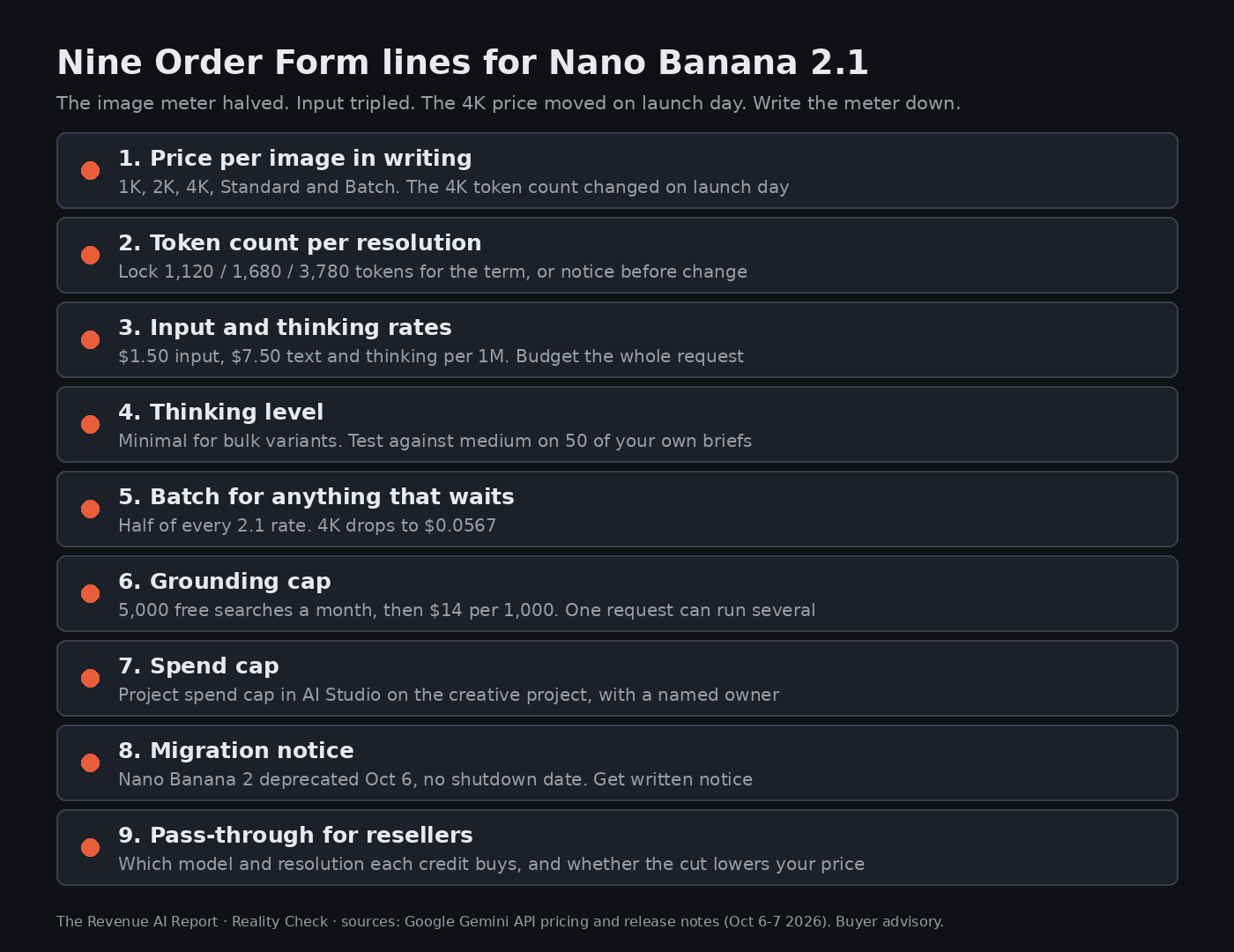
- Price per image in writing. By resolution: 1K, 2K, 4K, Standard and Batch. The token rate alone moved the 4K price on launch day.
- Token count per resolution. Lock 1,120, 1,680, and 3,780 tokens for the term, or get notice before any change.
- Input and thinking rates. $1.50 input and $7.50 text and thinking per million tokens. Budget the whole request.
- Thinking level. Set minimal for bulk variants. Test quality against medium on 50 of your own briefs.
- Batch for anything that waits. Half price on every 2.1 rate. 4K drops to $0.0567.
- Grounding cap. 5,000 free searches a month, then $14 per 1,000. One request can run several. Turn it off where you do not need it.
- Spend cap. A project spend cap in AI Studio on the creative project, with a named owner.
- Migration notice. Nano Banana 2 is deprecated with no shutdown date. Ask for written notice before shutdown.
- Pass-through for resellers. If a creative tool runs on Google image models, get in writing which model and resolution each credit buys, and whether the rate cut lowers your price.
Who owns which line
- Procurement: price per image in writing, token counts per resolution, migration notice, reseller pass-through.
- Marketing ops and creative ops: thinking level, Batch routing, and the 50-brief quality test.
- GTM engineering: token logging per request, grounding settings, and the 4K re-price.
- Revenue Finance: the spend cap and the monthly creative budget.
Soft opens
- All prices are Gemini Developer API list. Google says Gemini Enterprise Agent Platform prices may differ.
- The request shape above is an example. Google has not published typical input or thinking token counts per image.
- Quality claims on the model card are vendor-run. Test on your own briefs and brand assets.
- Google's pricing page changed once on launch day. Check it again before you sign.
Sources
- Google, Gemini Developer API pricing (last updated Oct 7 2026): ai.google.dev/gemini-api/docs/pricing
- Google, Gemini API release notes (Oct 6 2026): ai.google.dev/gemini-api/docs/changelog
- Google, Gemini Nano Banana 2.1 model page: ai.google.dev
- Kingy AI, Nano Banana 2.1: Specs, Pricing and Benchmarks (updated Oct 7 2026): kingy.ai
- Scoy, AI News Roundup for October 7 (Oct 7 2026): scoy.ai
New Order Form decoders land in the weekly issue first. Subscribe.
Take it to the room
The short list from this piece
Pulled from the argument above, written so you can read it out in a pipeline or board review.
Checklist diagram summarising Google Halved Nano Banana Image Prices at 1K and 2K. Input Now Costs 3x. What Does an Ad Variant Cost Now?: Google, Gemini Developer API pricing (last updated; Google, Gemini API release notes (Oct 6 2026); Google, Gemini Nano Banana 2.1 model page; Kingy AI, Nano Banana 2.1: Specs, Pricing and; Scoy, AI News Roundup for October 7 (Oct 7 2026).Frequently asked questions
- How much does Nano Banana 2.1 cost per image?
- On the Gemini Developer API, $0.0336 at 1K, $0.0504 at 2K, and $0.113 at 4K on Standard. Batch is half: $0.0168, $0.0252, and $0.0567. Input and thinking tokens bill on top.
- Is Nano Banana 2.1 half the price of Nano Banana 2?
- For image output at 1K and 2K, yes. At 4K the cut is 25%, from $0.151 to $0.113. Input rose from $0.50 to $1.50 per million tokens and text and thinking output from $3 to $7.50, so the full request saves less.
- Why did the 4K price change after launch?
- Google bills images by token count. The launch-day page listed 2,520 tokens for a 4K image, about $0.0756. The revised page lists 3,780 tokens, or $0.113.
- What does an AI ad variant cost on Nano Banana 2.1?
- With 2,000 input tokens and 1,000 thinking tokens, a 2K variant costs about $0.061 and a 4K variant about $0.124 at list. That is $609 and $1,235 per 10,000 variants, against $1,050 and $1,550 on Nano Banana 2.
- When does Nano Banana 2 shut down?
- Google deprecated it on Oct 6 2026 and says no shutdown date is announced. Ask for written notice before you depend on it.
- What should go on the Order Form?
- Price per image by resolution, a locked token count per resolution, the input and thinking rates, a thinking-level setting, Batch for work that can wait, a grounding cap, a spend cap, a migration notice period, and pass-through terms for creative tools that resell the model.
Subscribe
Get the next Reality Check before you sign the order form.
Keep reading
Reality Check
AI Review Time Is a Line Item. Price It and Name the Owner.
On TextQL's Argo-Bench the best AI model fully solved 34.8% of 210 data tasks. Put review time and a named owner into your AI business case.
Reality Check
Call Center Headcount Is Falling. Can You Prove AI Did It?
Revelio Labs says global call-center headcount is 5.3% below its Dec 2023 peak. Revelio: "The decline is surely multifaceted." How to test your own org.