
AI Visibility Scores Need a Denominator. AI Knows Us Printed One.
In a vendor self-study dated 16 October 2026, AI Knows Us reported 420 of 420 India readings usable on ChatGPT and Gemini. Four checks to ask of any AI visibility tracker before renewal.
Jonathan Kvarfordt · Published October 17, 2026 · Last updated October 17, 2026 · 5 min read
Marketing leaders now pay for tools that report how often AI assistants cite their company. The dashboards show a percentage. Few show how many questions were asked, how many answers came back usable, which assistants were tested, or what counted as a hit. Without those, a visibility score cannot be checked, and a renewal decision rests on trust.
On 16 October 2026, AI Knows Us published a study that leads with the missing number. Below I walk through what it reported, where it stops, and a four-row check for any tracker you pay for. It is a companion to my earlier piece on rerun overlap in AI citation trackers.
What the study reported
All figures below are from AI Knows Us's own study. It is a vendor self-study, covering ChatGPT and Gemini only.
- In a vendor self-study dated 16 October 2026, AI Knows Us put 210 Indian buying questions to ChatGPT and to Gemini: 420 readings attempted, 420 usable.
- Across three markets in the same run: 1,260 of 1,260 readings usable, 20,143 citations, 4,947 distinct domains.
- AI Knows Us reports 82.0% of those citations went to vendor or agency own sites and 0.7% to review directories.
- Its 15 October run used 597 of 612 attempted readings, and all 15 losses sat in one market and engine cell.
- AI Knows Us cited itself in 2 of 210 ChatGPT India readings and 0 of 210 Gemini India readings.
- The study counts citations only (one domain per reading, deduped), on ChatGPT and Gemini only. It did not score mentions or recommendations.
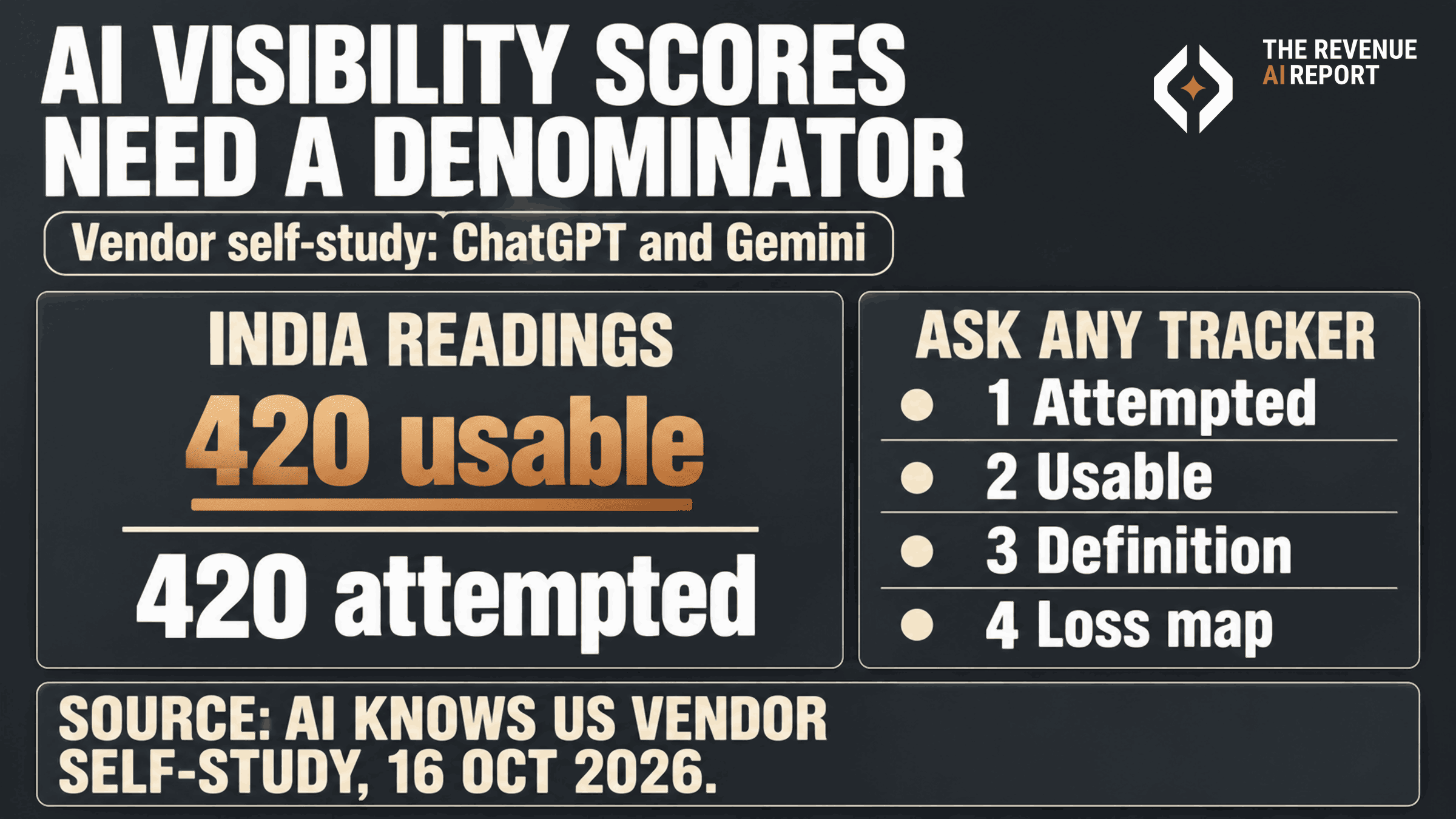
Why usable over attempted comes first
A rate is a count over a count. If a tracker says your brand appears in 12% of AI answers, the next question is: 12% of what? Some readings fail. The assistant times out, refuses, or returns nothing parseable. If a tool drops those quietly, the denominator shrinks and the rate moves without anything changing in the market.
The 15 October run shows why the split helps. Fifteen readings were lost, and all of them sat in one market and engine cell. A blended score would have hidden that, while a per-cell count shows exactly where the gap sits.
Small samples also swing. At 210 readings, my math puts one reading at about half a percentage point, so a move from 2 to 3 citations looks like a jump on a chart and comes down to one answer.
Cited, mentioned and recommended are three different counts
Being cited means the assistant linked or attributed a source domain. Being mentioned means your name appeared in the answer text. Being recommended means the assistant told the buyer to pick you. A tracker can score high on one and low on the others.
AI Knows Us counted citations only. Its numbers say nothing about how often ChatGPT or Gemini named or recommended any company. Read the 82.0% figure the same way. It describes where citations pointed and has no bearing on which company the assistant favored.
The counter-view and caveats
- It is a vendor self-study. AI Knows Us sells in this category and ran the test on itself. Treat it as one vendor's measurement.
- The 82.0% and 0.7% shares cannot be recomputed. The page gives no raw counts behind them.
- Two engines only. Nothing in the study reads on Google AI Overviews, Perplexity or Claude. Buyers in your market may use those more.
- No industry cuts. The study does not break results down by trade, so a manufacturer and a bank cannot read their own category from it.
- A clean denominator does not make the questions representative. Someone chose those 210 questions. Ask how.
Examples across industries
The check works for any company tracking AI answers, in any sector.
- A regional hospital system asks which sites assistants cite for "best cardiac care near me." Ask for usable counts per engine.
- An industrial equipment maker tracks questions about forklift fleet leasing. Ask whether the tool scored citations or recommendations.
- A credit union tracks mortgage questions in three states. Ask for the loss map by state and engine.
- A law firm tracks practice-area questions. Ask how many questions were attempted per area before reading any percentage.
The four-row check before you renew a tracker
Ask your vendor to fill this in for the last reporting period. If a row comes back blank, note that in the renewal file.
- Attempted. Questions times engines times markets, as a number.
- Usable. Readings that returned a parseable answer, per engine and market.
- Definition. Whether the tool scored citation, mention or recommendation, and how it dedupes.
- Loss map. Where failed readings sat, by engine and market cell.
Pair it with the rerun overlap check from our KACI piece. If a tracker can show its denominator and its rerun stability, it has earned a renewal conversation. If it can't, I'd set a cut date.
What this does to the team
AI answers add a new channel to measure, and measurement work shifts the role mix. Someone in marketing ops or RevOps now owns the question set, audits the denominators, and explains the numbers to the CRO. That role sits beside the content team. Budget for it when you budget for the tool.
Sources
- AI Knows Us, "AI search visibility in India, measured: 420 readings of ChatGPT and Gemini on 16 October," updated 16 October 2026: https://www.aiknowsus.com/blog/ai-search-visibility-in-india-measured-420-readings-of-chatgpt-and-gemini-on-16-october
- The Revenue AI Report, AI citation rerun overlap (KACI): https://www.therevenueaireport.com/blog/ai-citation-rerun-overlap-aeo-tracker-proof-kaci
Frequently asked questions
- What did the AI Knows Us study measure?
- In a vendor self-study dated 16 October 2026, AI Knows Us put 210 Indian buying questions to ChatGPT and to Gemini: 420 readings attempted, 420 usable. It counted citations only.
- Which AI assistants did it cover?
- ChatGPT and Gemini only. It did not test Google AI Overviews, Perplexity or Claude.
- Does being cited mean being recommended?
- No. A citation means the assistant attributed a source domain. The study did not score mentions or recommendations.
- Can the 82.0% vendor-site share be checked?
- Not from the published page. AI Knows Us reports 82.0% of citations went to vendor or agency own sites and 0.7% to review directories, but gives no raw counts behind those shares.
- What should I ask my AI visibility tracker?
- Ask for attempted readings, usable readings per engine and market, the definition of a hit (citation, mention or recommendation), and a loss map showing where failed readings sat.
Keep reading
Reality Check
The dashboard was green. The answer was wrong.
Most teams judge an AI assistant by whether it is up and fast. Those checks confirm the tool responded and leave the accuracy of the answer untested. AWS recently published a clear example of the gap, from its own sales tools.
Reality Check
Before You Buy More AI Seats, Ask Non-Users Why
Gallup found 44% of US workers who don't use AI say it can't help their work, and 16% say they lack access. Name the task per role and back it with managers before buying more seats.