
Liquid d1-ultra Bills Decisions on Input Only. Name the Questions on the Meter.
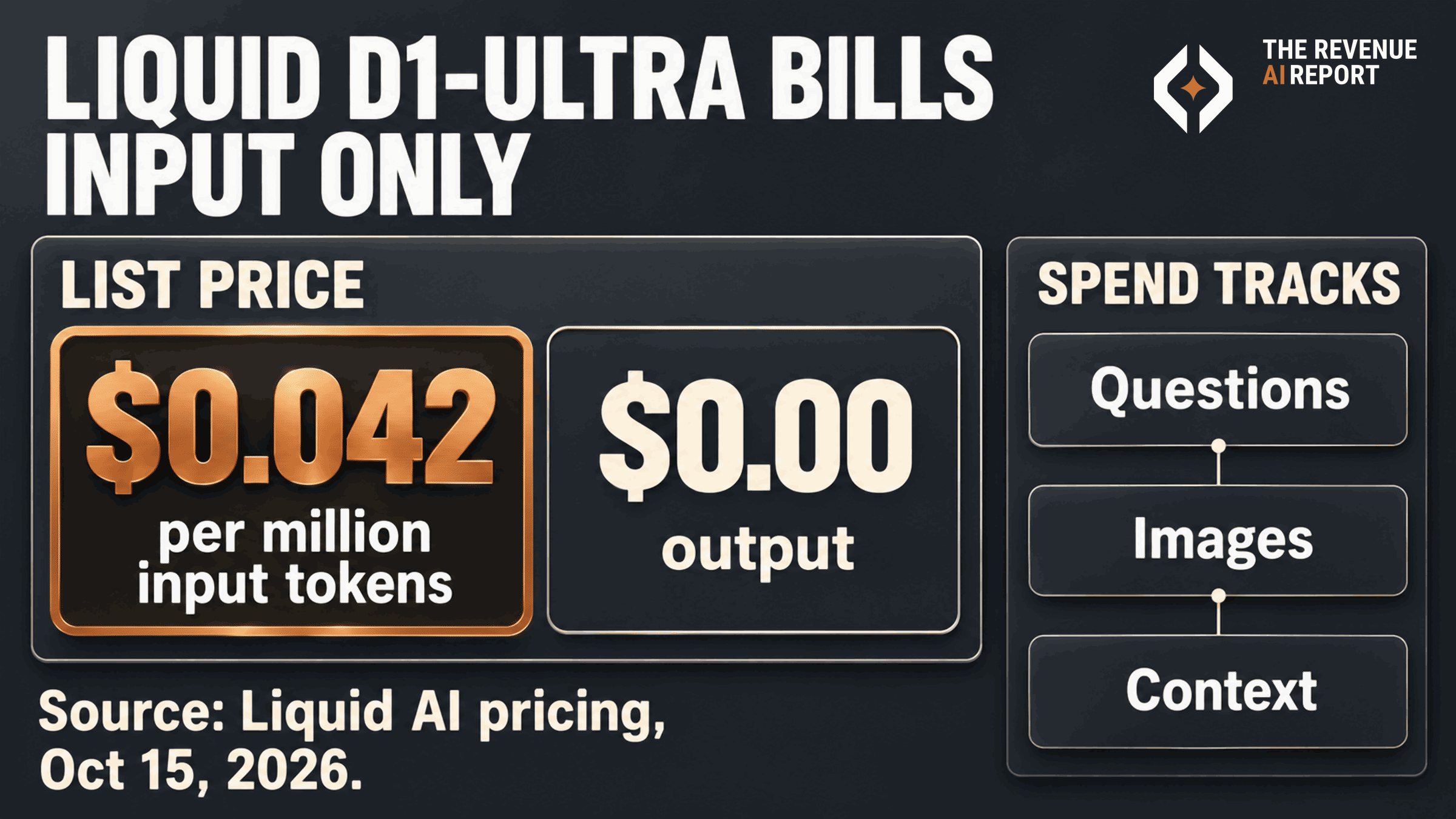
Liquid AI released d1-ultra on Oct 15, 2026 at $0.042 per million input tokens and $0.00 output, billed per question. A six-line order form for revenue teams before decision calls go on routing and triage.
Jonathan Kvarfordt · Published October 17, 2026 · Last updated October 17, 2026 · 5 min read
Revenue teams are wiring small AI models into ticket routing, lead triage and agent approvals. Each of those calls is a decision, and each decision now has its own line on an invoice. Most teams cannot say which questions are allowed to run up that line, or what result pays for it.
On Oct 15, 2026, Liquid AI released d1-ultra, a decision model listed at $0.042 per million input tokens and $0.00 output. The sticker price is small, and the meter counts every question, every image and every token of context you send. Below I cover what Liquid published and give a six-line order form to fill in before the first call ships.
What Liquid published on Oct 15
From Liquid AI's blog and pricing page:
- Liquid AI released d1-ultra on Oct 15, 2026, listed at $0.042 per million input tokens and $0.00 output.
- The sibling hosted model, d1, lists at $0.02 per million input tokens, $0.00 output.
- Liquid bills each question as its own prompt, including its text and all images. A 1024x1024 image counts as 1,536 input tokens.
- Liquid says d1-ultra reads the input in one forward pass and returns probabilities without generating any tokens. That is why the output line reads zero.
- Liquid's docs list OpenRouter and Vercel AI Gateway, alongside the Liquid API.
On quality, d1-ultra scores 65.2 on Artificial Analysis's Decision Index, top of 13 decision models; next is Jev 1.13 at 57.5.
How the meter adds up
A decision model answers a narrow question. Should this ticket go to billing or to support? Is this inbound lead a fit for field sales? May this agent call the refund tool? Liquid's docs name the same kinds of uses: ticket routing, triage, guardrails, tool-call approval and model routing.
Because each question is billed as its own prompt, three questions about one ticket cost three prompts. The ticket text gets counted three times. Attach a photo of a damaged shipment and the image tokens get counted with every question too.
My math, from Liquid's list price: one 1024x1024 image is 1,536 input tokens. A million single-image questions is about 1.5 billion tokens, or roughly $64.51 at $0.042 per million, before any text. That is cheap per call. The bill climbs fast once a workflow asks five questions per item, sends four photos per question, and runs on every inbound record across several regions.
With the output line fixed at zero, spend tracks three things: question count, image count and context length.
Examples across industries
The test is the same in any business. Name the question, count how often it runs, and name the outcome it serves.
- An insurer routes claims photos to the right adjuster queue. One question per claim, one image. Easy to cap.
- A freight broker triages inbound load requests by lane and urgency. Text only, high volume. Price it per thousand requests.
- A hospital supply team flags purchase requests that need a second approval. A guardrail question that can be counted and audited.
- A retail bank approves which internal agent may open a dispute case. A tool-approval question with a named owner.
- A manufacturer's distributor portal scores warranty claims with three photos each. Image tokens dominate here. Set an image policy first.
The counter-view and caveats
The case for moving fast is real. An input-only meter is easier to forecast than a chat model whose output length varies, and the d1 sibling roughly halves the per-token rate for questions that do not need the larger model. Liquid's new orgs also get $2 in free credit to test before signing anything.
Three caveats belong in the same memo.
First, check the benchmark lead at the source. Artificial Analysis's published data shows a 7.75 point lead over Jev 1.13. Quote the index figures in your board deck.
Second, the Decision Index is new. Artificial Analysis's changelog shows v1.0 launched on Oct 13, 2026. A three-day-old benchmark ranks models on its own test set, so I'd still run d1-ultra on a sample of your own tickets before trusting the ranking.
Third, the model returns a probability, and someone has to set the threshold where the model acts and where a person reviews. That threshold drives your error cost more than the token price does.
The order form: six lines before the first decision call
Fill this in per workflow. A question type missing any line stays off the meter.
- Default model. d1 for every workspace. d1-ultra only where a test on your own records shows it earns the higher rate.
- Question allowlist. Name each question type allowed to call the model, and how many questions run per record.
- Image policy. Which workflows may send images, how many per question, and at what resolution. Images are billed with every question.
- Spend owner. One named owner per workspace, with a monthly cap and an alert.
- Threshold owner. The person who sets the probability cutoff for auto-action versus human review, and reviews misroutes weekly.
- Keep/cut date. Tie each question type to an accepted outcome: a resolved ticket, a lead accepted by sales, a correct approval. Cut any question type that cannot show one by the review date.
RevOps or GTM engineering owns lines 1 to 5. Revenue finance signs line 6.
What this does to the team
Decision models take the first sort off people's desks. The work that remains moves toward judgment: setting thresholds, reviewing edge cases, and owning the spend. The people on the triage desk spend more of their time reviewing what the model routed. Plan the role mix around the people who tune and audit those decisions.
Sources
- Liquid AI, "d1-ultra" blog post, Oct 15, 2026: https://www.liquid.ai/blog/d1-ultra
- Liquid AI, Pricing (accessed Oct 16, 2026): https://www.liquid.ai/pricing
- Liquid AI, Decision models documentation (accessed Oct 16, 2026): https://docs.liquid.ai/lfm/models/decision-models
- Artificial Analysis, Decision Index (accessed Oct 16, 2026): https://artificialanalysis.ai/evaluations/artificial-analysis-decision-index
- Artificial Analysis, Changelog: https://artificialanalysis.ai/changelog
Frequently asked questions
- What does Liquid d1-ultra cost?
- Liquid AI lists d1-ultra at $0.042 per million input tokens and $0.00 output. The sibling d1 model lists at $0.02 per million input tokens, $0.00 output.
- Why is the output price zero?
- Liquid says d1-ultra reads the input in one forward pass and returns probabilities without generating any tokens. There is no output to bill.
- How are images billed?
- Liquid bills each question as its own prompt, including its text and all images. A 1024x1024 image counts as 1,536 input tokens, and it is counted again for each question that includes it.
- How does d1-ultra rank on benchmarks?
- d1-ultra scores 65.2 on Artificial Analysis's Decision Index, top of 13 decision models; next is Jev 1.13 at 57.5. The index launched as v1.0 on Oct 13, 2026.
- Where can I access d1-ultra?
- Liquid's docs list OpenRouter and Vercel AI Gateway, alongside the Liquid API.
Keep reading
Reality Check
The dashboard was green. The answer was wrong.
Most teams judge an AI assistant by whether it is up and fast. Those checks confirm the tool responded and leave the accuracy of the answer untested. AWS recently published a clear example of the gap, from its own sales tools.
Reality Check
Before You Buy More AI Seats, Ask Non-Users Why
Gallup found 44% of US workers who don't use AI say it can't help their work, and 16% say they lack access. Name the task per role and back it with managers before buying more seats.