
Ultramarine 1 Flash and the $0.13 Task: Price Your Own Task List First
Paper Instruments reports Ultramarine 1 Flash at 59.3 for $0.13 per task on its internal PI Knowledge Work suite. What revenue leaders should verify before a cost-per-task number goes into a forecast.
Jonathan Kvarfordt · Published October 17, 2026 · Last updated October 17, 2026 · 5 min read
Revenue leaders are being asked to buy AI agents for knowledge work: account research, proposal drafts, contract summaries, board prep. Vendors sell seats, credits and tokens. Finance wants to know what one finished piece of work costs. Those are different numbers, and most budgets mix them up.
On Oct 14, 2026, Paper Instruments published a number shaped like the one finance asks for. On its internal PI Knowledge Work suite, Paper Instruments reports Ultramarine 1 Flash at 59.3 for $0.13 per task. Below I cover what the company published, where the claim stops, and a six-line order form to fill in before a cost-per-task figure enters your forecast.
What Paper Instruments published
From the Paper Instruments blog, product page and docs:
- On its internal PI Knowledge Work suite, Paper Instruments reports Ultramarine 1 Flash at 59.3 for $0.13 per task (Oct 14, 2026).
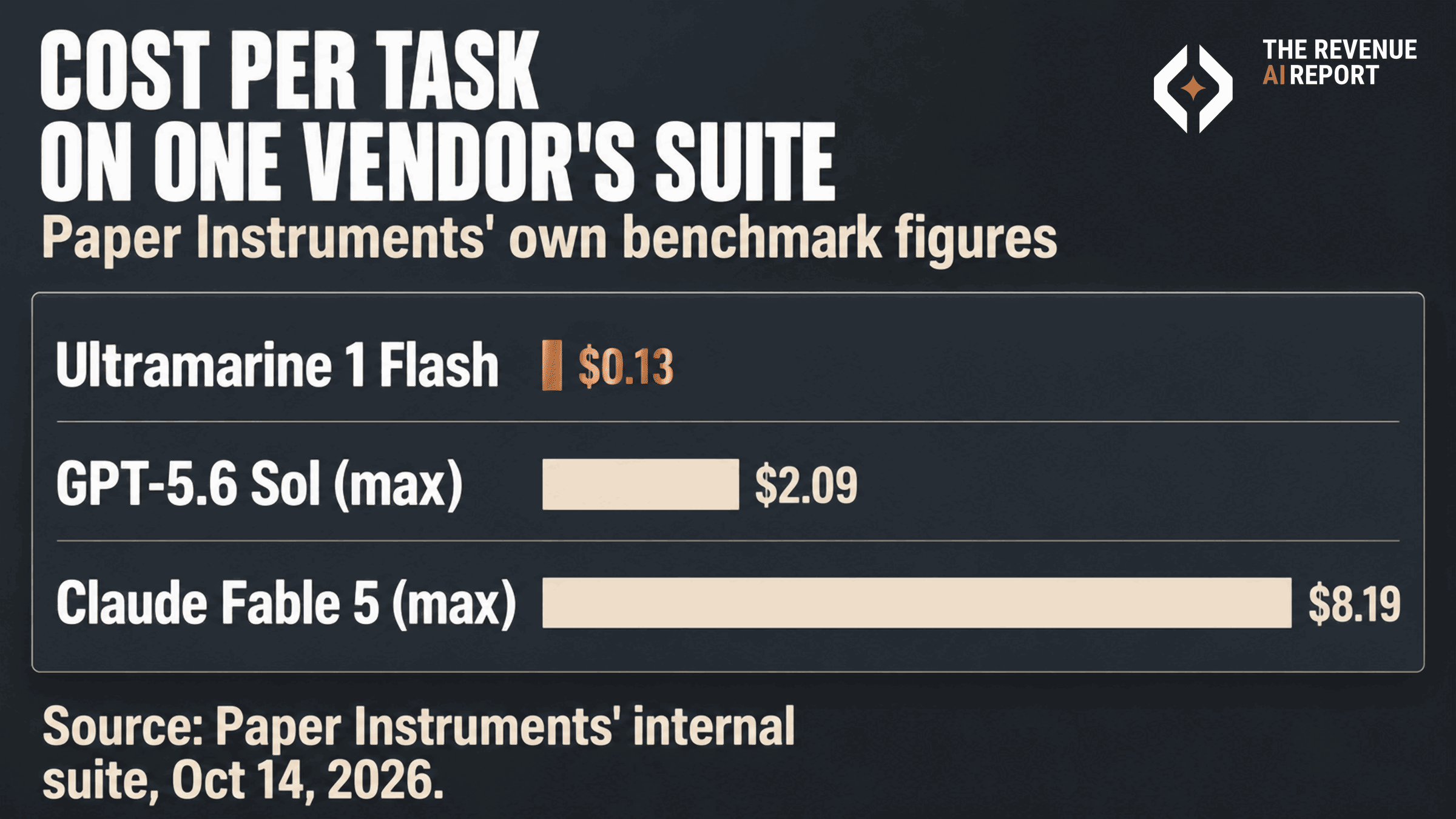
- On the same internal suite, Paper Instruments reports Claude Fable 5 (max) at 57.8 for $8.19 per task and GPT-5.6 Sol (max) at 55.1 for $2.09 per task. The company says it priced each run at each developer's official API pricing as of October 2026.
- Paper Instruments puts Claude Opus 5.5 (max) at $6.96 and GPT-6 Sol (max) at $1.26 per task, each within three points of Ultramarine.
- Ultramarine API list price: $0.15 per million input tokens, $0.03 cached, $0.50 output.
- Model weights are listed as "coming soon."
The $8.19, $2.09, $6.96 and $1.26 figures are Paper Instruments' own per-task results on its own suite. Each developer publishes its list prices separately, per million tokens. For reference, OpenAI lists GPT-5.6 Sol at $4 input and $20 output per million tokens, a promotional rate that runs at least through Nov 21, 2026.
Paper Instruments also says Ultramarine is about 60x cheaper than Claude Fable 5. On its own suite, $8.19 divided by $0.13 works out to 63x by my math.
Why cost per task is the number finance needs
A token price tells you what the meter charges, and a task price tells you what a finished result costs. A model with a low token price can still cost more per task if it writes long drafts, retries often, or fails the rubric and needs a second run.
The useful part of this release is that it names a unit finance can plan against. That unit still belongs to Paper Instruments' task list, its rubric and its harness.
The counter-view and caveats
Read the table as a vendor benchmark, run by the vendor, on a suite the vendor built.
- The per-task method cannot be checked from outside. Paper Instruments states its pricing rule but publishes no per-task token counts, so nobody can recompute $0.13 or $8.19 from public data.
- The suite is internal. Its tasks may look nothing like yours. A contract summary for a law firm and a quote review for an equipment dealer are both knowledge work, and they can score very differently.
- Top scores still sit near 60. On Paper Instruments' own numbers, the best models land in the high 50s and low 60s. Some share of output will need human rework, and rework has a cost the table does not show.
- Weights are "coming soon." Teams that plan to self-host should wait for the release before budgeting around it.
Treat $0.13 as the vendor's number until you rerun it on your own work.
Examples across industries
Run the test on tasks your team already does and can grade.
- A commercial insurer drafts renewal summaries for brokers. Grade against the underwriter's checklist.
- A medical device maker prepares account briefs before hospital value-analysis meetings. Grade on accuracy of contract terms.
- A logistics firm answers RFP questionnaires. Grade on the share of answers sales accepts without edits.
- A wealth management firm builds quarterly client review packs. Grade on compliance sign-off on the first pass.
- A staffing agency writes candidate submittals. Grade on client acceptance rate.
Each example gives you an accepted deliverable to count. That count is the denominator for your own cost per task.
The order form: six lines before a cost-per-task number enters the forecast
- Task suite. Name 20 to 50 real tasks from your own work, with inputs and expected outputs. Test on these.
- Rubric owner. One person who defines what "accepted" means for each task and grades blind across models.
- Formula. Cost per accepted deliverable equals total model spend plus human rework time, divided by deliverables accepted. Log tokens per task so you can recompute it.
- Baseline date. Record the list prices and promotional end dates in effect on the test date. Rerun when they change.
- Keep/cut threshold. Set the cost per accepted deliverable and acceptance rate a model must hit to stay in production.
- Chargeback owner. Name who carries the spend by workspace or team, and who signs the quarterly review.
RevOps or GTM engineering owns lines 1 to 4. Revenue finance owns lines 5 and 6.
What this does to the team
Cheaper first drafts shift the role mix toward judgment work: grading, editing and sign-off. The rubric owner and the person who reads the spend log both become real jobs. Plan for both before the agent goes live, and staff the review step as carefully as the drafting step.
Sources
- Paper Instruments, "Ultramarine" blog post, Oct 14, 2026: https://www.paperinstruments.com/blog/ultramarine
- Paper Instruments, Ultramarine product page (accessed Oct 16, 2026): https://www.paperinstruments.com/ultramarine
- Paper Instruments, Ultramarine docs (accessed Oct 16, 2026): https://docs.paperinstruments.com/docs/ultramarine
- OpenAI, API pricing (accessed Oct 16, 2026): https://developers.openai.com/api/docs/pricing
- Anthropic, Pricing (accessed Oct 16, 2026): https://www.anthropic.com/pricing
Frequently asked questions
- What did Paper Instruments report for Ultramarine 1 Flash?
- On its internal PI Knowledge Work suite, Paper Instruments reports Ultramarine 1 Flash at 59.3 for $0.13 per task, published Oct 14, 2026.
- Are the peer per-task costs list prices?
- No. The $8.19, $2.09, $6.96 and $1.26 per-task figures are Paper Instruments' own results on its internal suite. List prices are published per million tokens on each developer's pricing page.
- What is the Ultramarine API price?
- Paper Instruments lists $0.15 per million input tokens, $0.03 cached and $0.50 output on the Ultramarine API.
- Is Ultramarine 60x cheaper than Claude Fable 5?
- Paper Instruments says about 60x on its internal suite. Dividing its $8.19 figure by $0.13 gives 63x by my math. Neither figure can be recomputed from outside because no per-task token counts are published.
- Are the Ultramarine weights open?
- Not yet. Paper Instruments lists model weights as "coming soon."
Keep reading
Reality Check
The dashboard was green. The answer was wrong.
Most teams judge an AI assistant by whether it is up and fast. Those checks confirm the tool responded and leave the accuracy of the answer untested. AWS recently published a clear example of the gap, from its own sales tools.
Reality Check
Before You Buy More AI Seats, Ask Non-Users Why
Gallup found 44% of US workers who don't use AI say it can't help their work, and 16% say they lack access. Name the task per role and back it with managers before buying more seats.