
The dashboard was green. The answer was wrong.
Most teams judge an AI assistant by whether it is up and fast. Those checks confirm the tool responded and leave the accuracy of the answer untested. AWS recently published a clear example of the gap, from its own sales tools.
Jonathan Kvarfordt · Published October 17, 2026 · Last updated October 17, 2026 · 4 min read
Most teams judge an AI assistant by whether it is up and fast. Those checks confirm the tool responded and leave the accuracy of the answer untested. AWS recently published a clear example of the gap, from its own sales tools.
What AWS found
AWS runs an internal set of AI agents that let its sellers and sales leaders ask business questions in plain English. One of them, the Customer Insights Agent, builds a view of each customer. On Oct 16, AWS described what its team found when it tested that agent before launch:
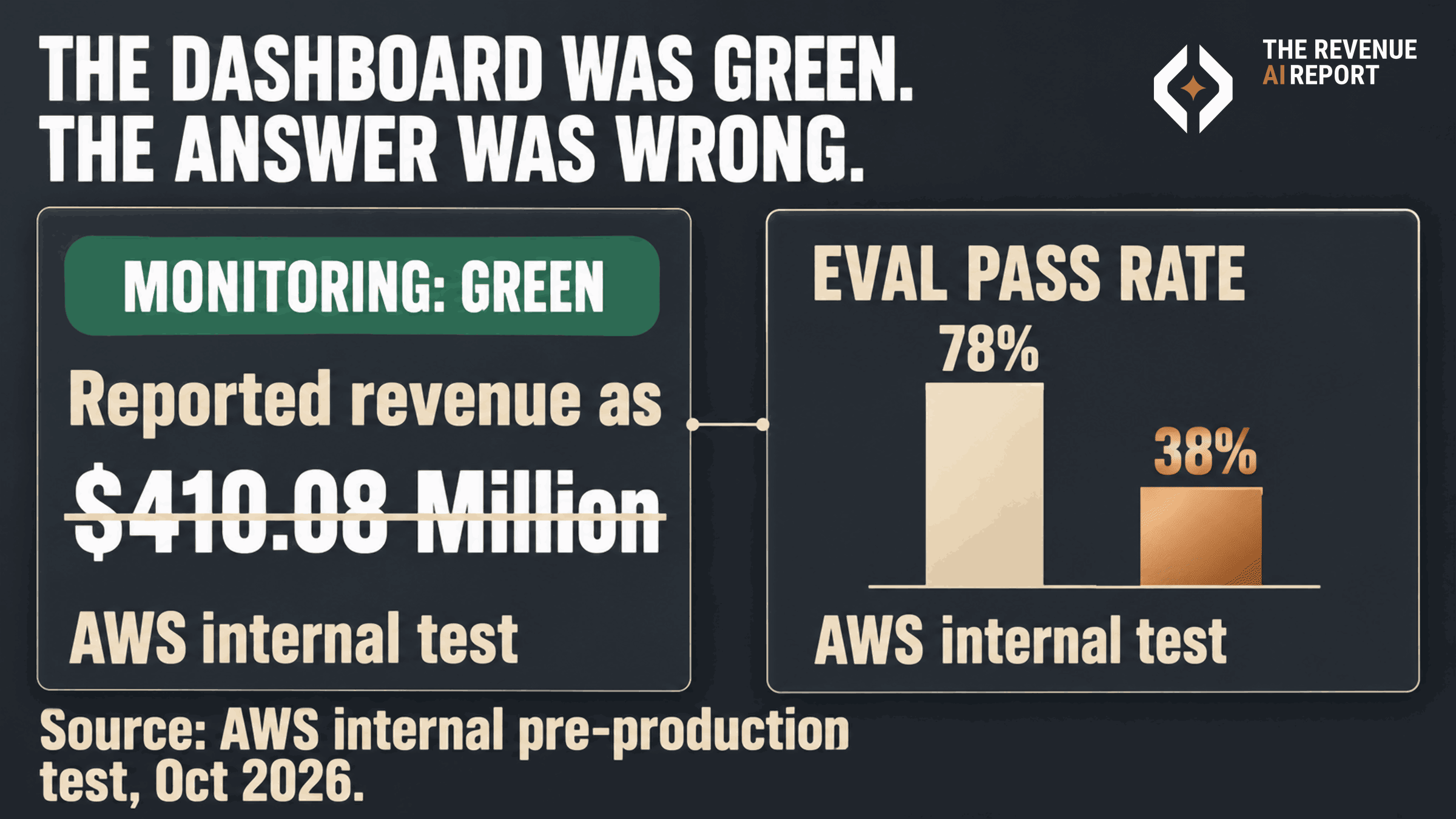
- It reported $410.08 of a customer's three-month revenue on a service as "$410.08 Million."
- It labeled Sales Revenue as Sales Revenue excluding Adjustments.
- It offered an annual recurring revenue estimate that appeared nowhere in the data.
- It presented its own calculations as sourced facts.
Through those runs, monitoring stayed green. In AWS's words, it "told us the system had responded, not whether the answer was right."
AWS caught these errors before launch. The post describes a near miss and reports no customer incident. AWS also spells out the cost had it shipped: a seller who repeats an inflated figure can lose credibility with the customer.
Why this matters outside software
Any team that puts an AI assistant between its people and its numbers faces the same risk. An insurance agent quoting a policy total, a distributor checking a key account's quarter, and a hotel group's sales lead preparing for a renewal all trust the figure on the screen. An uptime chart gives none of them a way to check it.
Quality moves after launch
AWS says the data behind these agents refreshes every week, with no release needed for answers to change. It also describes a pre-production test where a data change, a tool change and a paired prompt update were meant to ship together but landed apart. During that mismatch, the evaluation pass rate fell from 78% to 38%.
AWS also describes a case from production. After an upstream schema change, the agent started citing data from the wrong time window, and in AWS's words "the first signal came through a seller inquiry rather than an automated alert." A seller caught it first. AWS does not report any customer impact from the error.
So an answer that passed before launch needs checking again after each weekly refresh.
What to ask before an AI answer reaches a seller
- Does each answer name the right account, metric, time period and source?
- Can the tool show whether a number came from the data or was calculated?
- Who re-tests after a change to the data, the prompts or the tools?
- Is each tool tested on its own, with the handoffs between tools tested as well?
- Do quality checks keep running in production, and who gets alerted when they fail?
- What result earns this tool the right to stay in the workflow?
AWS's own error list is a useful starting checklist: wrong metric, wrong time period, wrong customer, invented figures, wrong currency or unit, and unrequested calculations.
If your team only uses an off-the-shelf assistant, start here. Before a number from an AI assistant goes into an account plan or a forecast, check the account, the metric, the period and where the figure came from.
The role mix
This shifts the role mix toward judgment work and the people who own answer quality. RevOps and enablement teams define what a correct answer looks like, keep the test questions current, and review failures. Sellers keep the judgment call on what goes in front of a customer.
The counter-view
This is one company's account of its own internal system, published on AWS's own blog alongside AWS products. The errors were found before launch, which is the process working as designed. Several figures in the post's dashboard images are marked illustrative. I'd treat the 78% to 38% drop as one pre-production test, and the list of errors as one agent's findings.
Source
AWS Machine Learning Blog, "Building trust in AI agents: A production-ready evaluation framework with Amazon Bedrock AgentCore," Oct 16, 2026: <https://aws.amazon.com/blogs/machine-learning/building-trust-in-ai-agents-a-production-ready-evaluation-framework-with-amazon-bedrock-agentcore/>
Frequently asked questions
- What went wrong with the AWS sales agent?
- In a pre-launch test, it reported $410.08 of a customer's three-month revenue as "$410.08 Million," mislabeled a revenue metric, offered an annual recurring revenue estimate not in the data, and presented its own calculations as sourced facts.
- Did these errors reach customers?
- AWS says its team caught them before launch. The post reports no customer incident.
- Why did monitoring stay green?
- AWS says monitoring confirmed that the system had responded and did not check whether the answer was right.
- How much did quality drop in the mismatch test?
- In one pre-production test, the evaluation pass rate fell from 78% to 38% while a data change, a tool change and a prompt update were out of sync.
- What should revenue leaders check?
- Check the account, metric, time period and source of each answer, whether a number was calculated or sourced, and whether quality checks run after every data, prompt or tool change.
Keep reading
Reality Check
ChatGPT Ads Added Measurement. Price the Spend You Can't Measure Yet.
ChatGPT Ads added measurement partners, a redesigned Conversions page and visual ad tests while advertisers report mixed results. A six-line order form for B2B pipeline spend you can't measure yet.
Reality Check
Before You Buy More AI Seats, Ask Non-Users Why
Gallup found 44% of US workers who don't use AI say it can't help their work, and 16% say they lack access. Name the task per role and back it with managers before buying more seats.