
Before You Buy More AI Seats, Ask Non-Users Why
Gallup found 44% of US workers who don't use AI say it can't help their work, and 16% say they lack access. Name the task per role and back it with managers before buying more seats.
Jonathan Kvarfordt · Published October 17, 2026 · Last updated October 17, 2026 · 7 min read
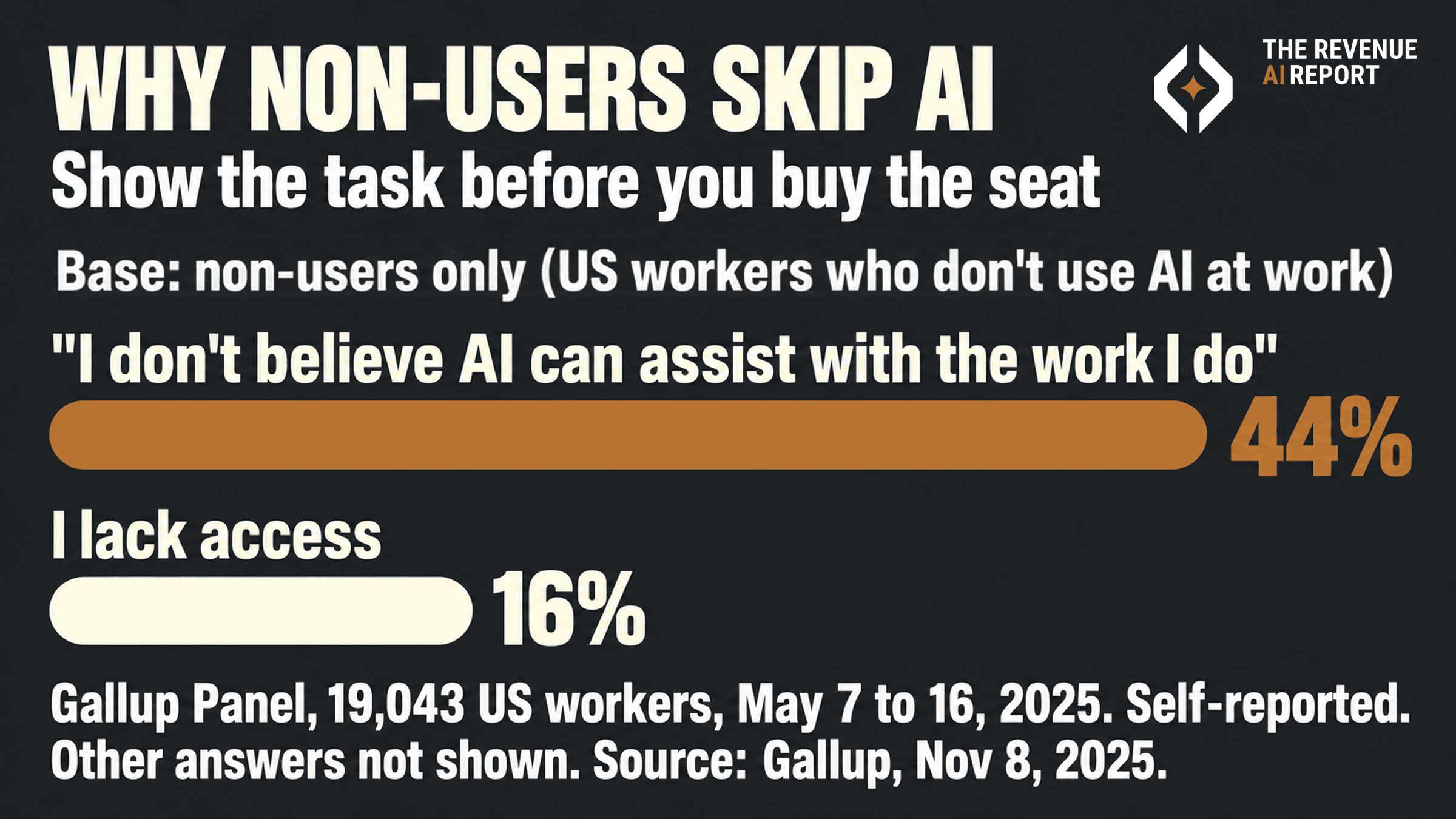
Among US workers who don't use AI at work, 44% say AI can't help with the work they do. 16% say they lack access.
Gallup asked US workers who don't use AI at work for their main reason. 44% said AI can't help with the work they do. 16% said they lack access.
That matters for anyone about to buy more AI licenses. A seat is one paid user account. When use runs low, the usual fix on the table is more seats, a different tool or another training session. Before you spend on any of those, ask the people who don't use it why. Here is what Gallup heard.
What the non-users said
Gallup surveyed 19,043 US workers through the Gallup Panel from May 7 to 16, 2025, and published the results on November 8, 2025. Gallup asked people who do not use AI at work for their main reason. The base for these two figures is non-users only (Gallup, Nov 2025).
- 44% said the main reason is "I don't believe AI can assist with the work I do."
- 16% said they lack access.
The fieldwork is more than a year old, and use has grown since. Gallup's newer panel (22,573 employed US adults, May 6 to 20, 2026, published July 20, 2026) found 52% of US workers use AI in their role, 30% use it frequently (a few times a week or more) and 15% use it daily (Gallup, Jul 2026). In the same survey, 47% say their organization has integrated AI tools, and 20% don't know.
Read together: about half of US workers still don't use AI in their role, and when the non-users explained themselves, relevance came up far more often than access. A seat solves access, and a person who can't see where AI fits in Tuesday's work will still leave it unopened.
Managers are the strongest lever in the data
Gallup also measured manager support. In organizations integrating AI, 78% of employees who strongly agree their manager supports AI use are frequent users, against 44% of those who don't strongly agree. Only 36% strongly agree their manager actively supports their team's AI use (Gallup, published July 27, 2026, updated September 30, 2026, Q2 2026 panel of 22,573; Gallup). That is a correlation, and teams that already use AI may also rate their managers higher.
Two more surveys point at the same gap between the people who plan the rollout and the people asked to use it.
- Wharton Human-AI Research and GBK Collective (1,416 US respondents at firms with 1,000+ employees, July 9 to 29, 2026): 78% of managers and above say employees get adequate AI training. Only 56% of entry and mid-level employees agree (Wharton/GBK, Oct 2026).
- BCG (11,749 workers, 14 markets, June 3, 2026): a clear strategy lifts self-reported business impact by 25 points, and better tools alone by about 5 points. 66% of frontline regular users get limited or no guidance on what to do with the time they save (BCG).
How you pitch it may matter
A Stanford HAI field study (Karunakaran, Raveendhran, Kim, October 7, 2026) followed two divisions of one law firm for about two years. One division pitched an AI tool to its paralegals as job enrichment and backed the pitch with support. The other pitched it as a way to draft faster. Paralegals in the enrichment division used the tool 58% more and experimented with it 70% more (Stanford HAI).
It is one field study at one law firm. The pitch and the support changed together, so the study cannot say which one did the work. It is consistent with what the Gallup non-users said about relevance.
Read it as a role-mix question
Each role's work is a set of tasks. When AI takes some of them, the person moves toward the tasks that need judgment: checking, deciding, talking to the customer. In Gallup's survey, 44% of non-users said AI can't assist with the work they do. Gallup did not ask how they reached that view, so the useful test is a short list per role, built with the people in that role, showing which tasks would move and what the freed time is for.
How to train people on those tasks is a separate question. LOPAFT in Action covers it. This post stops at the step before training: finding the task and getting a manager behind it.
Where this evidence stops
The Gallup non-user figures date from May 2025, and the base is non-users, so they say nothing about why users drop off. Every figure here is self-reported, and none of them shows cause. Stanford's study covers one firm. The counter-view deserves room. Some teams truly lack access or a usable tool, and for them more seats are the right answer. And a California Management Review Insight (October 2, 2026), a practitioner essay that is not peer reviewed, reports that 93% of employees with AI training use the tools against 57% without, which argues training drives use (CMR). The same essay's follow-up found training barely shifted time saved, which leaves the productivity case open.
What to change before you buy more seats
1. Ask the non-users one question
Survey the people with idle seats: "What is the main reason you don't use AI at work?" Include Gallup's leading answer, "I don't believe AI can assist with the work I do," and a lack-of-access option. If relevance dominates, hold the seat purchase.
2. Name two tasks per role
With two or three people from each role, list the tasks AI could draft or prepare today, and pick two. Write down what the person checks before the output goes anywhere, and what they do with the time freed.
3. Put the manager on the hook
Each manager demonstrates one of the two tasks in a team meeting, using their own work. Then ask the Gallup-style question in your next pulse survey: does your manager actively support your team's AI use?
4. Rate training from the receiving end
Ask entry and mid-level staff whether the AI training they got was adequate, and compare it with what their managers say.
Two composite examples outside software
These are composites built to show the steps. Neither is a reported case.
An independent insurance agency. Half the service team never opens the AI tool. Asked why, most say it can't help with policy service. The agency manager sits with two account managers and names two tasks: drafting the renewal summary a producer reviews, and turning a carrier's endorsement notice into a plain-language client email. The manager shows both on a real account in the Monday meeting. The agency buys no new seats that quarter.
A field services company. Dispatchers have AI access and use it for nothing. The operations manager picks two dispatcher tasks: drafting the end-of-shift handover note and summarizing a technician's job notes for the customer. Dispatchers check every summary for parts and prices before it goes out, and spend the freed time calling customers whose jobs slipped. The manager asks the support question in the next monthly pulse.
What to do this week
Pull the list of seats with no use in the last 30 days. Send those people the one-question survey. Book a 30-minute session per role to name two tasks. Decide on any new seats after the answers come back.
Related
Sources
- Gallup, manager support and employee AI adoption, Nov 8, 2025. Gallup Panel, 19,043 US workers, May 7 to 16, 2025: gallup.com
- Gallup, organizational AI adoption, Jul 20, 2026. Gallup Panel, 22,573 employed US adults, May 6 to 20, 2026, margin of error ±0.9 points: gallup.com
- Gallup, AI and workplace productivity, Jul 27, 2026, updated Sep 30, 2026: gallup.com
- Stanford HAI (Karunakaran, Raveendhran, Kim), "Want Employees to Embrace AI? Stop Selling It as a Productivity Tool," Oct 7, 2026: hai.stanford.edu
- Wharton Human-AI Research and GBK Collective, "The Adaptive Advantage: Who's Winning With AI and How," Oct 2026: knowledge.wharton.upenn.edu
- BCG, "AI at Work 2026," Jun 3, 2026. 11,749 workers, 14 markets: bcg.com
- California Management Review Insight, "Why AI Training Is Driving Adoption but Not Sustainable Productivity," Oct 2, 2026 (practitioner essay, not peer reviewed): cmr.berkeley.edu
Frequently asked questions
- Why don't employees use the AI tools their company bought?
- In Gallup's survey of US workers (fielded May 2025, published Nov 2025), 44% of non-users said the main reason is "I don't believe AI can assist with the work I do." Only 16% said they lack access. The base is non-users.
- What share of US workers use AI at work?
- Gallup's May 2026 panel found 52% of US workers use AI in their role, 30% use it frequently and 15% use it daily.
- Does manager support change AI use?
- Gallup found 78% of employees who strongly agree their manager supports AI use are frequent users, against 44% of those who don't strongly agree. Only 36% strongly agree their manager actively supports their team's AI use. The link is a correlation.
- Does it matter how AI is pitched to employees?
- A Stanford HAI field study at one law firm found paralegals used AI 58% more and experimented 70% more when it was pitched as job enrichment with support. The pitch and the support changed together, so the study cannot separate them.
- Should we buy more AI seats to raise adoption?
- Ask non-users why first. If most say AI can't help their work, name two tasks per role and get managers to back them before buying seats. If most say they lack access, more seats may be the right call.
Keep reading
Reality Check
ChatGPT Ads Added Measurement. Price the Spend You Can't Measure Yet.
ChatGPT Ads added measurement partners, a redesigned Conversions page and visual ad tests while advertisers report mixed results. A six-line order form for B2B pipeline spend you can't measure yet.
Reality Check
The dashboard was green. The answer was wrong.
Most teams judge an AI assistant by whether it is up and fast. Those checks confirm the tool responded and leave the accuracy of the answer untested. AWS recently published a clear example of the gap, from its own sales tools.