
Where AI Models Stand, November 2026: Who Leads and Why
Jonathan Kvarfordt · Published · 11 min read
The short answer
What is the best AI model in November 2026?
Last reviewed
Can I compare these scores with October's? No. Artificial Analysis changed its index twice since our October edition, so October scores (v4.3) and November scores (v5.0.1) use different tests and cannot be compared point for point.
Anthropic released Claude Fable 5.2 on Nov 9, 2026, and Artificial Analysis lists it at 65, the top score on its independent board. Google made Gemini 4 Carbon generally available on its API on Nov 10 and released Gemini 4 Hydrogen on Nov 12. Carbon and Gemini 4 Argon share the top of LMArena's human-vote ranking. Vals AI's index also puts Fable 5.2 at the top, at 71.31% as of Nov 11, 2026. (Vals AI)
The argument
How this reality check breaks down
A map of the sections ahead, in the order the case is made. The sourced charts are in the research library.
Contents diagram for Where AI Models Stand, November 2026: Who Leads and Why, listing the sections: What shipped from Oct 12 to Nov 13, What independent testers found, Where every major lab stands, The counter-view: read launch charts with care, What this means if you buy or run AI for revenue, Bottom line.
- Prices change on Dec 1: Gemini 4 Carbon and Argon cost $2 input and $10 output per million tokens through Nov 30, 2026, then $4 and $20. (Google)
- No tester-published safety result yet: No outside tester has published its own safety result for any model announced between Oct 12 and Nov 13, 2026, in our search of UK AISI, NIST CAISI, METR and Apollo Research pages and the labs' own cards. Anthropic's Claude Fable 5.2 card reports outside testing by UK AISI, NIST and METR, run on Claude Mythos 5.2.
- Lowest cost near the top: Among models scoring 55 or higher on the Artificial Analysis index, GPT-6.1 Sol (max) has the lowest listed cost per index task at $1.27 (our read of Artificial Analysis's rows, Nov 13, 2026). (Artificial Analysis)
What shipped from Oct 12 to Nov 13
Reality Check
Where AI Models Stand, November 2026: Who Leads and Why
Source-cited charts live in the research library.
Where AI Models Stand, November 2026: Who Leads and Why. Diagram showing Evidence, Analysis, Decision, Outcome.- Anthropic, Nov 9: Claude Fable 5.2, which Anthropic says is "built for demanding reasoning and long-horizon agentic work," at $8 input and $40 output per million tokens. Claude Fable 5.1 was $10 and $50, a 20% lower list price by our arithmetic. Claude Mythos 5.2 offers the same capabilities to organizations Anthropic verifies. (Anthropic release notes, pricing)
- Google, Oct 13 to Nov 12: Gemini 4 Argon went generally available on Oct 13. Gemini 4 Carbon, announced Oct 28, went generally available on the API on Nov 10. Both are $2 and $10 per million tokens through Nov 30, then $4 and $20, and neither is on the free tier. Gemini 4 Hydrogen went generally available on Nov 12 at a flat $1.50 and $7.50. (Google AI Studio changelog, pricing)
- OpenAI, Oct 26: GPT-6.1 Terra, which OpenAI calls "a fast, efficient model for visual reasoning, precise computer use, and clear, natural writing," at $1 and $5. (OpenAI API changelog, pricing)
- Meta, Oct 12 to Nov 9: Muse Wonder and Muse Wonder Full (Oct 12; Wonder Full has no public API), Muse Spark Open (Oct 15, open weights through third-party hosts) and Muse Ember (Nov 9) at $0.10 and $0.50 for prompts up to 200,000 tokens. (Meta pricing, Muse Ember)
- Open-weights labs: Moonshot's Kimi K3.1 Pro (Oct 24), DeepSeek V4.1 Flash 1017 (Oct 17, pricing unchanged), Mistral Large 4 open weights (Oct 29, at $0.70 and $2.10), Tencent Hy4 (Nov 3, per Artificial Analysis) and Thinking Machines' Inkling 2 Small (Nov 5, weights pending per Artificial Analysis). (Kimi, DeepSeek, Mistral, Artificial Analysis changelog)
Correction, Nov 13, 2026: The Oct 12 version of our October edition said Gemini 4 Argon was limited to Google's Fairwind Program with no public date. Google made Argon generally available on Oct 13, 2026, on the paid Gemini API, and the October page was updated to say so. Gemini 4 Carbon's API went generally available on Nov 10, 2026. (Google AI Studio changelog)
What independent testers found
Artificial Analysis lists Claude Fable 5.2 (max) at 65, with its xhigh and high settings at 62. It also flags the max setting as "particularly expensive" and "very verbose": 275 million output tokens to run the index, where the median is 77.3 million. (Artificial Analysis)
Gemini 4 Hydrogen scores 54 at xhigh and 51 at high on Artificial Analysis. It enters LMArena at #15 with a preliminary 1490. (Artificial Analysis, LMArena)
Artificial Analysis says Muse Ember (max) matches Claude Haiku 5.5 (max) at 36 "at a third of the Cost per Task": $0.14 for Ember and $0.41 for Haiku 5.5. (Artificial Analysis)
Where every major lab stands
Scores below are the Artificial Analysis Intelligence Index v5.0.1 and LMArena's text ranking, both independent, read Nov 13, 2026. Cost per index task is Artificial Analysis's weighted average cost to run its own index tasks, a benchmark-run cost. Confidence and the outside safety test use the definitions under the table.
| Lab | Model (setting) | AA index v5.0.1 | LMArena text | AA cost per index task | API price per 1M tokens (in / out) | Outside safety test | Confidence |
|---|---|---|---|---|---|---|---|
| Anthropic | Claude Fable 5.2 (max) | 65 | Not listed | $26.54 | $8 / $40 | Present, lab-reported (UK AISI, NIST, METR; tests name Mythos 5.2) | High |
| Gemini 4 Carbon (high) | 60 | #1, 1526±10, preliminary | $5.48 | $2 / $10 through Nov 30; $4 / $20 from Dec 1 | Partial: outside red-teaming of misuse safeguards only (Gray Swan, Trajectory Labs) | Medium | |
| Anthropic | Claude Opus 5.5 (max) | 59 | #4, 1507±6 (high setting) | $10.04 | $4 / $20 | Present, lab-reported and tester-published (US CAISI; METR, Sep 22) | High |
| OpenAI | GPT-6 Astra (max) | 57 | #42, 1474±6 | $6.24 | $10 / $50 | Present, tester-published (UK AISI, Sep 28; Apollo, Sep 3) | High |
| OpenAI | GPT-6.1 Sol (max) | 55 | #30, 1481±6 | $1.27 | $2 / $10 | 0 (missing) | High |
| Gemini 4 Hydrogen (xhigh / high) | 54 / 51 | #15, 1490±9, preliminary | $3.16 / $1.87 | $1.50 / $7.50 | 0 (missing: Google says its safety report "will be available in the coming days") | Medium | |
| OpenAI | GPT-6.1 Terra (max) | 51 | Not listed | $0.96 | $1 / $5 | 0 (missing) | High |
| Gemini 4 Argon (high) | 50 | #2, 1522±5 | $4.97 | $2 / $10 through Nov 30; $4 / $20 from Dec 1 | Present, tester-published (Apollo Research, Oct 13) | High | |
| Meta | Muse Wonder Full (max) | 50 | Not listed | Not listed (no public API) | No API | 0 (missing) | Medium |
| Moonshot | Kimi K3.1 Pro | 46 | #24, 1485±10 | $3.68 | CNY 13 / 68 (Moonshot); $2 / $10 as listed by Artificial Analysis and LMArena, third-party only | 0 (missing) | Medium |
| Meta | Muse Wonder (max) | 44 | #3, 1511±6 | $6.95 | $4 / $20 | 0 (missing) | High |
| Meta | Muse Ember (max) | 36 | Not listed | $0.14 | $0.10 / $0.50 up to 200K; $0.30 / $1.50 over 200K | 0 (missing) | High |
| SpaceXAI | Grok 4.7 (xhigh) | 35 | #92, 1443±5 | $7.77 | $2 / $6 | 0 (missing) | High |
| DeepSeek | DeepSeek V4.1 Flash 1017 (max) | 33 | Not listed under this name | $0.60 | $0.30 / $1.20 peak; off-peak half | 0 (missing) | High |
| Mistral | Mistral Large 4 (high) | 26 | #134, 1420±8 | $2.06 | $0.70 / $2.10 | 0 (missing) | High |
| Meta | Muse Spark Open (xhigh) | 25 | Not listed | $2.02 | Open weights; third-party hosts | 0 (missing) | Medium |
Also on the board, partly checked at our read: Tencent Hy4 (35), Qwen3.8 Max (34), Inkling 2 Small (31), MiMo-V2.6-Pro (30) and Nemotron 3.5 Super VL (14).
Under our rule, Artificial Analysis scores less than a point apart and LMArena rows with overlapping rank spreads count as ties. On Artificial Analysis that covers Carbon and Opus 5.5 (60.03 and 59.11), GPT-6.1 Sol with Claude Sonnet 5.5 (54.61 and 54.54) and with Hydrogen xhigh (53.92), Argon with Hydrogen high, Terra and Muse Wonder Full (50.41 with 50.79, 51.33 and 50.08), and Muse Ember with Grok 4.7 (36.02 and 35.49). On LMArena, Carbon and Argon (1 to 3), Muse Wonder (1 to 8) and Claude Opus 5.5 (3 to 10) have overlapping rank spreads.
How we grade. Confidence: High means an independent Artificial Analysis score read Nov 13 plus an official price read Nov 13 plus a non-preliminary LMArena or Vals row. Medium means an independent score with a preliminary rating, a missing cost, or a price only from a third party. Low means only lab-reported scores, or no independent board. Tie: on Artificial Analysis, equal rounded scores or an unrounded gap under 1.0 point; on LMArena, overlapping rank spreads. Independent safety test: a safety evaluation of that model run by an organization other than the lab, documented in the lab's system or model card or by the tester itself; a third-party benchmark run by the lab does not count; missing scores 0 and stays on the table.

The counter-view: read launch charts with care
Lab launch pages report tests the lab chose, run on the lab's own setup. Where a lab and Artificial Analysis report the same named test, the numbers differ.
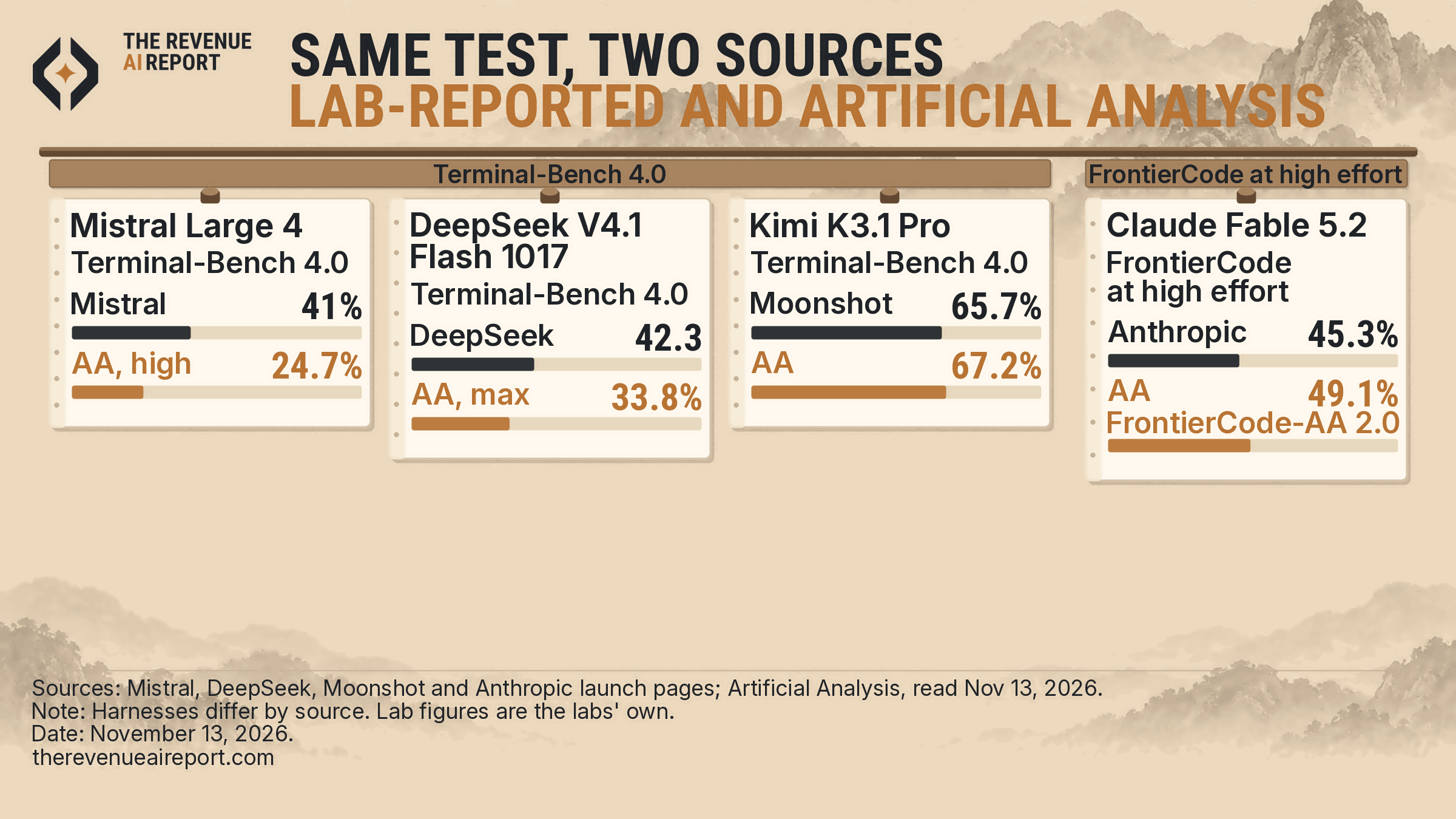
| Model | Test | Lab-reported | Artificial Analysis |
|---|---|---|---|
| Mistral Large 4 | Terminal-Bench 4.0 | 41% (Mistral) | 24.7% (high) |
| DeepSeek V4.1 Flash 1017 | Terminal-Bench 4.0 | 42.3 (DeepSeek) | 33.8% (max) |
| Kimi K3.1 Pro | Terminal-Bench 4.0 | 65.7% (Moonshot) | 67.2% |
| Claude Fable 5.2 | FrontierCode at high effort | 45.3% (Anthropic) | 49.1% on FrontierCode-AA 2.0 |
Sources: Mistral, DeepSeek, Kimi, Anthropic, Artificial Analysis. Harnesses differ by source.
Two of the four score lower on the Artificial Analysis run and two score higher. Read a lab chart as the lab's chosen tests on the lab's own setup, and check the same test on an independent board before it goes into a plan.
The independent board has its own limits. The Artificial Analysis index is a blend of nine evaluations, and it changed twice between Oct 27 and Nov 3. A gap under one point at the top is a tie under our rule, so test the top models on your own workload.
Few rows carry an outside safety test. By our count, 11 of the 16 rows in the table score 0 for an outside safety test, as do all five partly checked models. Gemini 4 Hydrogen's safety report was still pending at our read.
What this means if you buy or run AI for revenue
Price Carbon and Argon at the Dec 1 rate. Both go from $2 and $10 to $4 and $20 per million tokens on Dec 1, 2026.
For a CRO's hardest analysis, price the setting you will run. Anthropic says Claude Fable 5.2 is built for "demanding reasoning and long-horizon agentic work." It holds the top independent score at 65, at $26.54 per Artificial Analysis index task on its max setting. Its high setting scores 62 at $9.08. Gemini 4 Carbon (60) and Claude Opus 5.5 (59) are tied a step below.
For RevOps volume work, start from cost per task. GPT-6.1 Sol scores 55 at $1.27 a task. GPT-6.1 Terra scores 51 at $0.96. Muse Ember scores 36 at $0.14, and at 3.2 minutes it has the shortest Artificial Analysis time per task among the models in our table. Meta pitches Ember "for repeatable coding and agentic tasks at scale." Run account research, call summaries or record cleanup on two of them and compare edits needed and cost. If you are piloting agents that run many small tasks a day, start with cost per task.
For fact-heavy briefs, check the hallucination rate. Artificial Analysis lists Gemini 4 Argon at 4.3% and Hydrogen (xhigh) 8.5%. GPT-6.1 Terra is at 34.5% and Kimi K3.1 Pro at 37.3%. Give any model your own sources for market and account research.
For Enablement writing people will read, look at human votes. LMArena's voters put Gemini 4 Carbon and Argon at the top, both with a rank spread of 1 to 3, and Muse Wonder's spread of 1 to 8 overlaps them. Muse Wonder Full has no public API, so it cannot go into a plan.
Ask for the safety test. Ask any vendor which outside group tested the model underneath and where the result is published.
Test on your own work. Pick three real tasks, such as a renewal brief, a pipeline review summary and a campaign brief from messy notes. Run two or three models side by side and score accuracy, edits needed and cost.
Bottom line
Anthropic holds the top independent score with Claude Fable 5.2. Google's Carbon and Argon share the top of the human-vote board, at an intro price that doubles Dec 1. OpenAI's GPT-6.1 Sol has the lowest listed cost per task among models at 55 or higher. No outside tester has published its own safety result for any model announced in the window. Let your costs and your own tests drive the choice.
Want this kind of read every week, with the receipts? Subscribe to The Revenue AI Report.
For the research side of November 2026, see Notable AI research papers, November 2026. The October edition of this page is Where AI Models Stand, October 2026.
Sources
- Artificial Analysis, Intelligence Index v5.0.1 leaderboard and model pages, read Nov 13, 2026: https://artificialanalysis.ai/leaderboards/models
- Artificial Analysis changelog (v5.0 Oct 27; v5.0.1 Nov 3), read Nov 13, 2026: https://artificialanalysis.ai/changelog
- LMArena text leaderboard, page dated Nov 11, 2026: https://lmarena.ai/leaderboard/text
- Vals AI, Vals Index, updated Nov 11, 2026: https://www.vals.ai/benchmarks/vals_index
- Anthropic release notes and pricing, read Nov 13, 2026: https://platform.claude.com/docs/en/release-notes/overview and https://platform.claude.com/docs/en/about-claude/pricing
- Anthropic, Claude Fable 5.2 and Mythos 5.2, and system card, Nov 9, 2026: https://www.anthropic.com/claude-fable-and-mythos-5-2
- Google AI Studio changelog and pricing, read Nov 13, 2026: https://aistudio.google.com/docs/changelog and https://aistudio.google.com/docs/pricing
- Google DeepMind, Gemini 4 Hydrogen model card and Gemini 4 Carbon Safety & Security Report, November 2026: https://deepmind.google/models/model-cards/
- OpenAI API changelog and pricing, read Nov 13, 2026: https://developers.openai.com/api/docs/changelog and https://developers.openai.com/api/docs/pricing
- OpenAI, GPT-6.1 Terra system card addendum: https://deploymentsafety.openai.com/gpt-6-1-terra
- Meta pricing and Muse Ember post, Nov 9, 2026: https://dev.meta.ai/docs/pricing-rate-limits and https://research.meta.ai/blog/muse-ember
- Moonshot, Kimi K3.1 Pro, Oct 24, 2026: https://www.kimi.com/news/kimi-k3-1-pro
- DeepSeek API updates and pricing: https://api-docs.deepseek.com/updates
- Mistral, Mistral Large 4 open weights, Oct 29, 2026: https://mistral.ai/news/mistral-large-4-oss/
- SpaceXAI models and news: https://docs.x.ai/developers/models and https://x.ai/news
- Alibaba Cloud Model Studio pricing: https://www.alibabacloud.com/help/en/model-studio/model-pricing
- UK AISI blog, METR, Apollo Research and NIST CAISI pages, read Nov 13, 2026: https://www.aisi.gov.uk/blog, https://metr.org/research/, https://www.apolloresearch.ai/research, https://www.nist.gov/caisi
Take it to the room
The short list from this piece
Pulled from the argument above, written so you can read it out in a pipeline or board review.
Checklist diagram summarising Where AI Models Stand, November 2026: Who Leads and Why: Artificial Analysis, Intelligence Index v5.0.1; Artificial Analysis changelog (v5.0 Oct 27; v5.0.1; LMArena text leaderboard, page dated Nov 11, 2026; Vals AI, Vals Index, updated Nov 11, 2026; Anthropic release notes and pricing, read Nov 13.Last reviewed November 13, 2026.
Frequently asked questions
- What is the best AI model in November 2026?
- Claude Fable 5.2 (max) leads the Artificial Analysis Intelligence Index v5.0.1 at 65 (read Nov 13, 2026). Gemini 4 Carbon and Gemini 4 Argon share the top of LMArena's human-vote text ranking, both with a rank spread of 1 to 3 (page dated Nov 11, 2026).
- Can I compare November and October AI model scores?
- No. October used Artificial Analysis Intelligence Index v4.3 and November uses v5.0.1, which has different tests. A model can score differently on the two pages without having changed.
- Which near-frontier AI model is cheapest to run?
- Among models scoring 55 or higher on the Artificial Analysis index, GPT-6.1 Sol (max) has the lowest listed cost per index task at $1.27 (our read of Artificial Analysis's rows, Nov 13, 2026).
- Have outside testers checked these models for safety?
- Partly. Anthropic's Claude Fable 5.2 card reports outside testing by UK AISI, NIST and METR, run on Claude Mythos 5.2, and Google's Gemini 4 Carbon report names outside red-teaming of its misuse safeguards. In our search, no outside tester has published its own result for a model announced Oct 12 to Nov 13, 2026. Gemini 4 Hydrogen's full safety report was still pending at our read, and 11 of the 16 table rows score 0 for an independent safety test.
- Do Gemini 4 Carbon and Argon prices change?
- Yes. Google lists both at $2 input and $10 output per million tokens through Nov 30, 2026, and $4 and $20 from Dec 1, 2026.
Hiring for revenue roles?
Post your sales, marketing, RevOps or enablement opening where revenue leaders read every week. One 30-day post is $199. Three featured posts are $299/mo.
Subscribe
Get the next Reality Check before you sign the order form.
Keep reading
Reality Check
The Agent Launch Is Only Half the Job
Invoca's Broken Funnel Report, released November 10, 2026, asked US consumer-business marketers how they score the AI agents that talk to their customers and whether they can trace those conversations to a sale. Most respondents with an agent name a primary measure other than revenue or a booked outcome, and few say they can fully follow an agent-handled lead to conversion. In our read, the scoreboard decision belongs to the revenue leader.
Reality Check
What has to change before an AI agent can buy from your company?
OpenAI introduced ChatGPT Wallet on November 13, 2026. It lets a user's agent in ChatGPT pay a business after the user approves the purchase, and OpenAI published a Commerce Partner Playbook for the businesses on the other side. The checks land with marketing, digital, payments, and service teams. In our read, the policy call belongs to the revenue leader.