
Pay for an AI Product When It Beats General-Purpose AI on the Full Job
Run the core task through general-purpose AI and the vendor with the same inputs. Pay for stability, control, and execution. Order Form lines inside.
Jonathan Kvarfordt · Published October 13, 2026 · Last updated October 13, 2026 · 6 min read
At its September 29, 2026 DevDay, OpenAI announced a Marketplace where eligible enterprise customers can apply part of their existing OpenAI commitment toward approved partner software, starting with 32 partners. Every AI renewal now carries a question: what does this product do that the assistant we already license can't?
Vendors should answer that before the buyer asks. Buyers should run the test before they sign. The test is simple. Give both the same job and the same information, then count everything it takes to get a usable result.
The budget is already moving
Platforms are starting to sell partner software through the AI budget itself (OpenAI DevDay recap, Sep 29, 2026). We covered the contract mechanics in OpenAI Marketplace Commitment: Order Form Chargeback.
That makes the comparison concrete. When the partner product and the general-purpose assistant draw on the same budget line, Finance will ask what each dollar buys.
Run the head-to-head
Pick the core task the customer pays for. Run it through the vendor product and through the general-purpose AI the team already licenses. Give both the same permitted data. Score four things:
- Setup. Hours to first usable output, including connectors and permissions.
- Accuracy. Correct outputs on a fixed set of real, redacted cases.
- Review. Minutes a person spends checking and fixing each output.
- Upkeep. Effort to keep it working when fields, rules, or models change.
Take a call summary. The full job: spot the commitment, check it against the contract, assign an owner, and confirm it happened. A product that reliably runs that whole chain has a strong case for its price.
Where a product earns its price
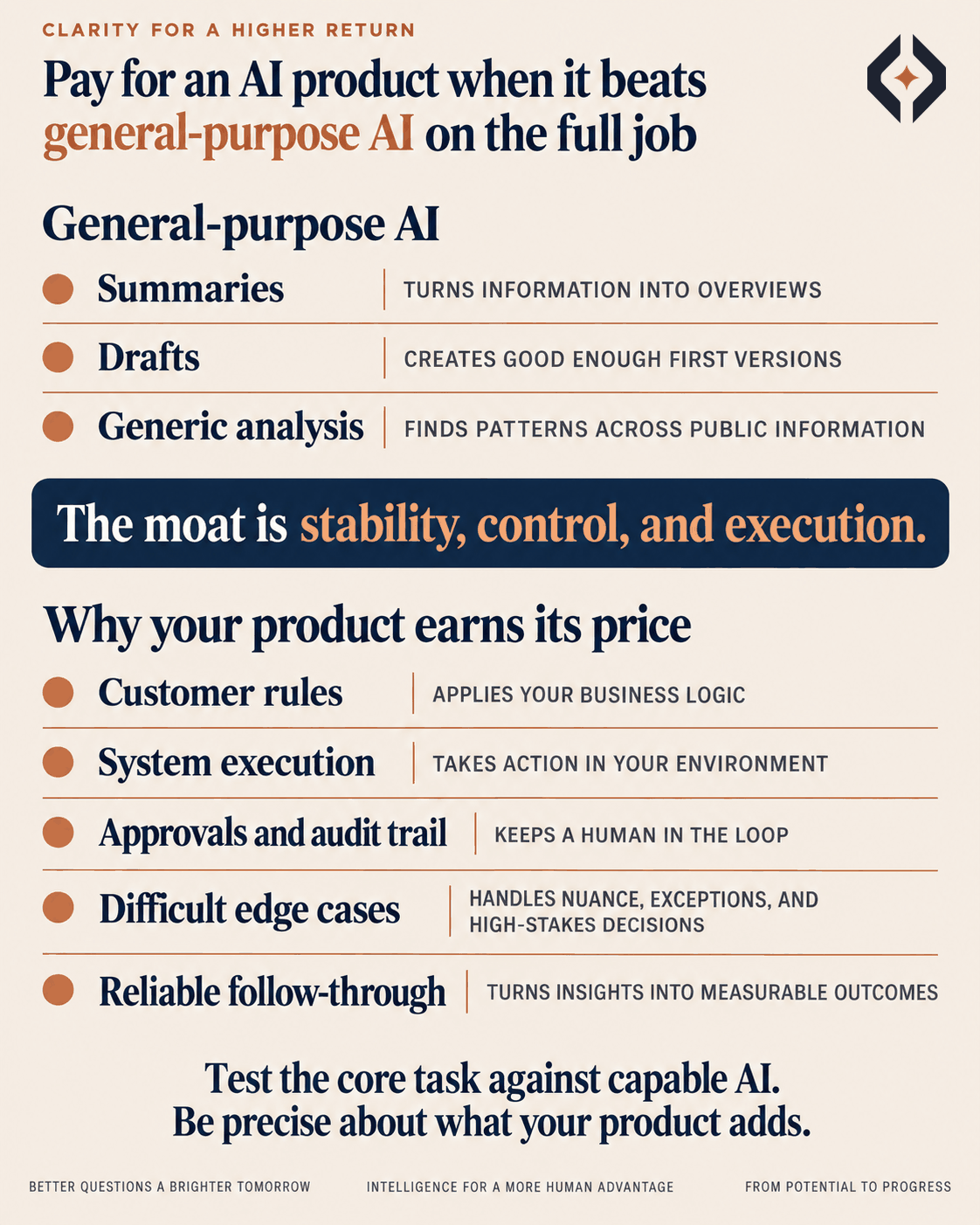
The moat is stability, control, and execution. In practice that means five things:
- Customer rules. It applies the buyer's own business logic the same way every time.
- System execution. It takes the next step inside the CRM, billing, or ticketing system.
- Approvals and audit trail. It keeps a human on risky actions and records who approved what.
- Difficult edge cases. It handles missing data, exceptions, and high-stakes calls predictably.
- Reliable follow-through. It closes the loop and reports what happened.
Benchmark evidence supports the first point. In TextQL's Argo-Bench, a data-agent benchmark on a simulated food-delivery business, one task asked agents to cut $9.6 million from a courier bonus budget. One strong model built a careful plan that lost $86,281. A simple uniform cut would have saved $0.40 million. Another model worked out what the bonuses were for and saved $3.09 million of an attainable $3.12 million. When the prompt stated the purpose of the bonuses and that a holdout test existed, the mean score across all model settings rose from 18.5 to 61.7 (Argo-Bench, arXiv:2610.02122, Section 3.2). A short statement of business context lifted the average score by more than 40 points. That context is what a good product encodes.
The Proof Gap
What a vendor's "purpose-built AI" claim shows: positioning, and usually a strong demo on clean data.
What a buyer still needs:
- Side-by-side results against the general-purpose AI already licensed, on the same inputs.
- Behavior when information is missing, a connection fails, or a request exceeds the system's authority.
- Proof that the buyer's rules are stored, readable, and exportable.
- End-to-end completion rates, including the write-back step.
Vendors: show the failure cases on purpose. Buyers trust a system they have watched stop and ask for help.
Order Form lines
Buyer advisory. Fill the brackets and take them to your AE and legal.
- Head-to-head in the pilot. "During the pilot, Buyer runs [N] redacted cases through the Service and through Buyer's licensed general-purpose AI with the same permitted inputs. Results logged for accuracy, review minutes, and setup hours."
- Failure demonstration. "Before go-live, Vendor demonstrates Service behavior on missing data, a failed connector, and a request outside its approved authority."
- Rules export. "Business rules Buyer configures in the Service are exportable in readable form at any time and at termination."
- End-to-end reporting. "Vendor reports the monthly share of [workflow] runs completed through write-back to [system], with failure reasons."
- Renewal re-test. "[60] days before renewal, Buyer may rerun the head-to-head. If the Service's advantage on [metric] falls below [X], the parties renegotiate scope or price."
- Channel terms. "If purchased through an AI platform marketplace, the Order Form names which agreement governs data, support, and termination."
Eight-Seat Read
- CEO: Ask each AI vendor for one slide: the job your product finishes that the assistant we license leaves undone.
- CFO: Treat overlap with licensed general-purpose AI as a pricing lever at renewal.
- CRO: Fund products that act inside the deal process.
- CMO: If you sell software, position on rules, execution, and control. Prove it with a side-by-side your buyer can rerun.
- RevOps: Run the head-to-head. Keep the case set fixed so results compare across vendors and renewals.
- Sales leader: Count rep minutes per finished task in each tool, from first click to logged outcome.
- CS leader: Watch follow-through: commitments captured, owned, and closed. That is where products earn renewals.
- Enablement: Train on the full workflow in the chosen tool, including where it stops and asks.
Why we might be wrong
- General-purpose AI is improving fast and adding connectors. The gap you measure today may close by renewal.
- A team that builds on general-purpose AI owns the upkeep: prompts, rules, connectors, and testing. That hidden cost can make the vendor cheaper.
- Head-to-heads on 20 or 50 cases are small samples. Edge cases that matter may never appear.
- The Argo-Bench example comes from a vendor-built, simulated business. Real business context is messier and harder to encode.
- Some products win on distribution, compliance sign-off, or support quality, which a task test will miss.
Frequently asked questions
- Why buy specialized AI software if the team already has ChatGPT or Claude?
- Buy it when it completes the full job more reliably: applying your rules, acting inside your systems, keeping approvals and an audit trail, and handling exceptions. Test that on your own cases.
- How do you compare an AI vendor with general-purpose AI?
- Run the same task with the same permitted data through both. Score setup hours, accuracy on a fixed case set, review minutes per output, and upkeep effort.
- What makes an AI product defensible?
- Stability, control, and execution: consistent business rules, actions in customer systems, approvals and audit trails, edge-case handling, and follow-through.
- What is the OpenAI Marketplace?
- Announced at DevDay on September 29, 2026, it lets eligible enterprise customers apply part of an existing OpenAI commitment toward approved partner software, starting with 32 partners.
- What should an AI renewal contract include?
- A head-to-head re-test right, a failure demonstration, rules export, end-to-end completion reporting, and clear governing terms if bought through a marketplace.
Hiring for revenue roles?
Post your sales, marketing, RevOps or enablement opening where revenue leaders read every week. One 30-day post is $199. Three featured posts are $299/mo.
If you want the next head-to-head before your renewal window opens, subscribe at /subscribe.
Sources
- OpenAI, "DevDay 2026 recap," Sep 29, 2026. https://openai.com/index/devday-2026-recap/
- Tomitsuka et al., "Argo-Bench: Evaluating Data Agents on Enterprise-Scale Workflows," arXiv:2610.02122, TextQL, Section 3.2 "Wrong objective." https://arxiv.org/abs/2610.02122
Keep reading
Playbook
Salesforce's AI Agents Reached Its Unanswered Leads. Build a Ledger for Yours.
Salesforce says agents that make first contact with leads it could not reach in time helped generate more than $88 million in revenue. Here is a five-field ledger to track your own lead-response agent.
Benchmark
91% Expect Higher Seller Quotas. 8% Name Quota Attainment a Top Area of AI Impact.
In BCG's survey of 398 revenue leaders, published Oct 19, 91% expect per-seller quotas or productivity requirements to rise. Before you approve an AI-based uplift, give each plan line a metric, a baseline, an owner and a check date.