
Meta's Oct 30 Ad Terms Make You Review Every AI-Made Ad. Name Who Signs Off.
Meta's Oct 30 terms make you review every ad its automation helps build. Name one approver, keep a per-campaign change record, and finish a 12-day checklist.
Jonathan Kvarfordt · Published October 19, 2026 · Last updated October 19, 2026 · 8 min read
Meta's Oct 30 terms make you review every ad its automation helps build. Name one approver, keep a per-campaign change record, and finish a 12-day checklist.
Meta's Ad Creative AI tools already create new media for your ads. On October 6, Meta said it is "beginning to test" assistant features that will "soon" let advertisers "plan and create a campaign, generate creative imagery and text, update targeting, or change a budget conversationally." On October 30, 2026, Meta's updated Self-Serve Ad Terms take effect, and they keep your company "solely responsible" for every ad, now "including for reviewing, approving or removing them, even when you use our automated features."
Two questions land on the marketing leader. Who on your team approves an ad or a budget change that a machine made? And where is the record that shows what the machine changed, who said yes, and what happened to spend and pipeline afterward?
Both are below, plus a 12-day checklist that runs from October 19 through October 30. Read it with your counsel; this is not legal advice.
Meta's terms quoted here were captured October 18, 2026.
What you agree to on October 30
Meta asks for no signature. Continued business use already counts as acceptance under today's terms, and the October 30 Commercial Terms keep that rule: "If you do not agree to the updated terms, you may stop all access or use of our Products for business or commercial purposes."
Three changes reach the people who run paid media:
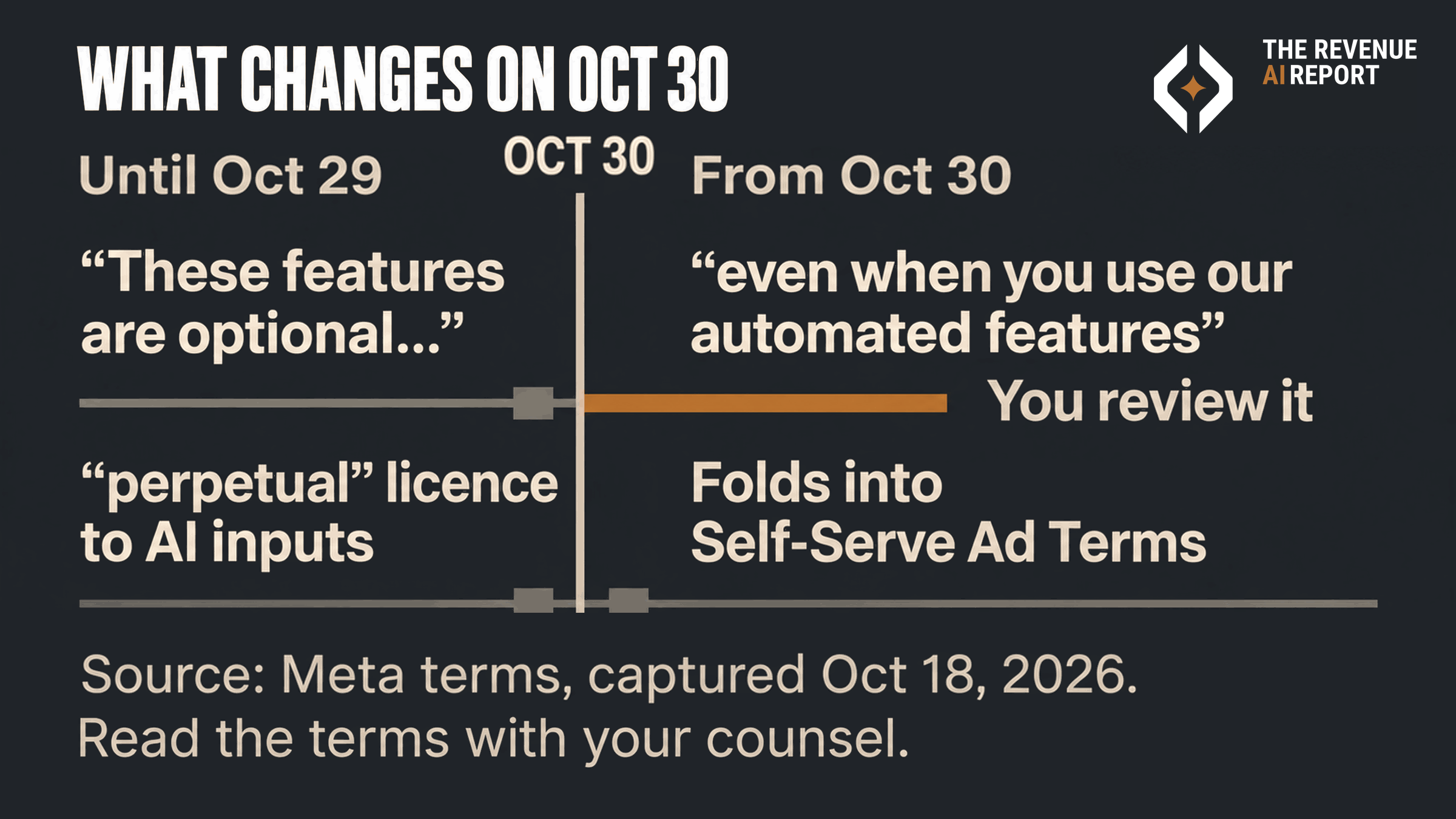
- You review automated ads. The duty covers order, creative, targeting and placements, "even when you use our automated features to assist with the formatting, generation, or selection of your Ad Creative and Orders."
- The "optional" line is gone. Today's Self-Serve Ad Terms say of Meta's automated campaign features: "These features are optional..." The October 30 version drops it.
- AI creative rules move into the Self-Serve Ad Terms, which will "incorporate the Ad Creative Generative AI Terms," per Meta's banner on that page. The Self-Serve text now carries this rule from the Generative AI terms: "You must not alter or remove any watermark or content-authenticating metadata generated by AI in connection with Ad Creative."
The input licence changes too. Today's Ad Creative Generative AI Terms grant Meta "a perpetual, worldwide, non-exclusive, fully paid and royalty-free license to use any Input" and add: "This license survives termination." Those terms fold into the Self-Serve Ad Terms on October 30, and neither October 30 preview uses the word "perpetual." The Commercial Terms, today and from October 30, cover content through the Terms of Service: "As described in 'The permissions you give us' section in our Terms, you grant us a license to content."
One existing clause deserves a look now. Meta's Commercial Terms, today and from October 30, extend the content licence to "Content you or someone on your behalf (such as your agency that places an ad for you...)" makes available. An agency placing ads warrants it has "the authority to and will bind the advertiser" to Meta's terms.
Why the sign-off moves to a named person
Meta says of its assistant tests: "Previews, approvals, and controls let you decide what to hand off and what to own." In practice that approval is a click, and under the October 30 terms your company owns it. If nobody is named to make it, it falls to whoever happens to be logged in to Ads Manager that afternoon.
This shifts the role mix on the marketing team. The media buyer's time moves toward judgment work: approving, rejecting and recording what the automation proposes. Someone senior owns that call, the way someone owns compliance review today. More on that split in who owns an agent's mistake.
These are composites built to show the moves. Neither is a reported case.
A farm equipment manufacturer runs Meta campaigns that send leads to its dealers. When it turns on Meta's generated text variations, its Director of Marketing approves every AI variation, because an ad promising a spec or price the company would never write still runs under its name.
A regional bank runs mortgage and deposit campaigns on Meta through an agency. Its VP of Marketing finds no clause in the agency contract on who approves AI-made creative or who logs automated budget moves. She adds both before October 30 and asks for the agency's change log weekly.
The per-campaign change record
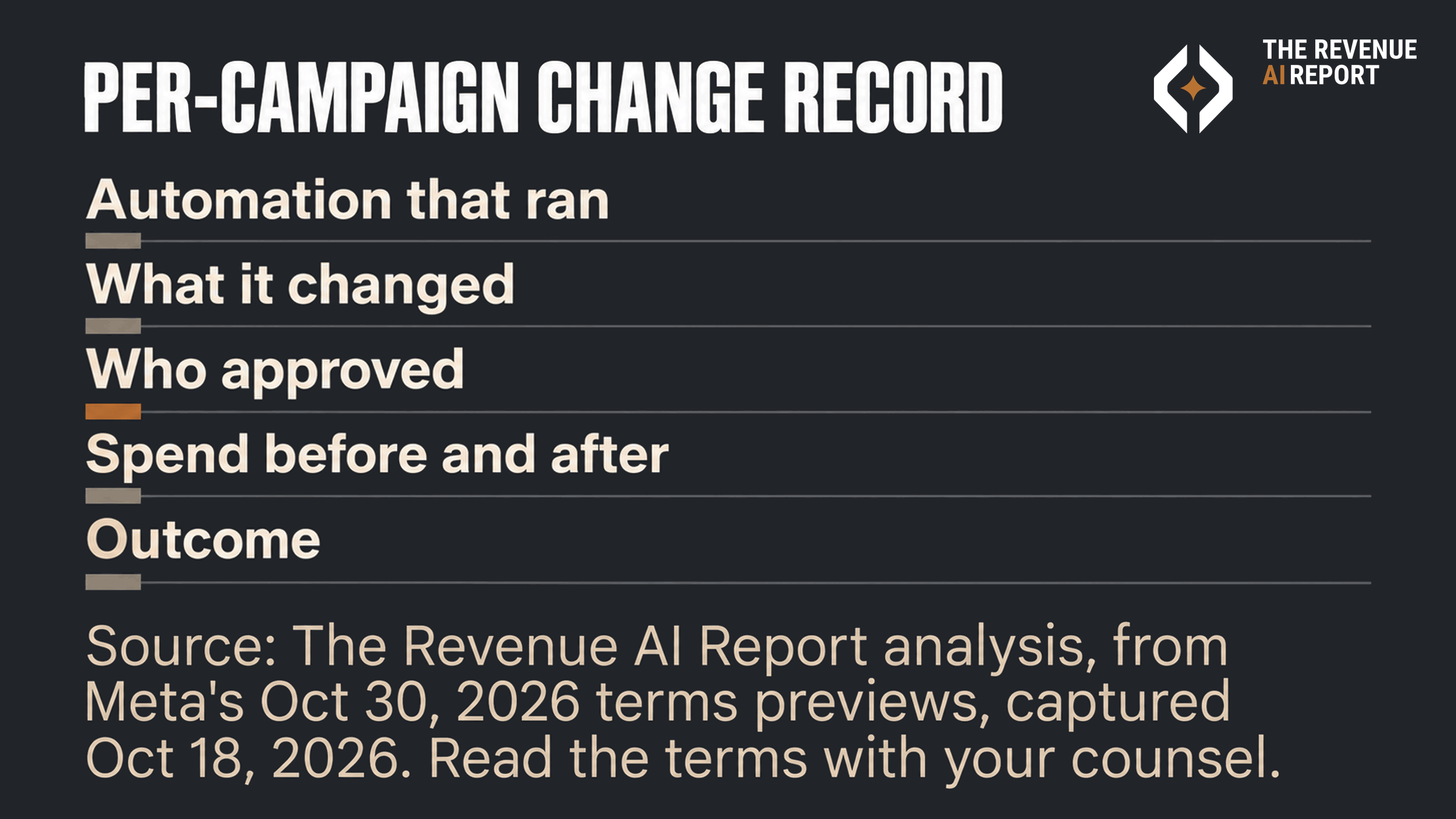
Keep one row per automated change, per campaign. A shared sheet is fine. Use these five fields:
| Field | What to write |
|---|---|
| Automation that ran | The Meta feature or assistant action, by name |
| What it changed | Creative, copy, audience, budget or placement, with the old and new value |
| Who approved | One named person, with the date |
| Spend before and after | From Ads Manager, for the same window on each side |
| Outcome | Leads, booked calls, applications or pipeline, from your own systems |
The last two fields serve RevOps and the CRO. When Meta's automation moves budget, your pipeline report shows the result with no note of the cause. Log each automated budget change with the date, campaign and amount. RevOps can then line spend shifts up with pipeline by campaign and week, and tell an automated reallocation from a planned one.
If a change goes wrong, this record is your undo list. Our rollback plan for agents uses the same idea.
The 12-day checklist, October 19 to October 30
Each step names the marketing owner who does it.
If you are reading this after a step's date, do the missed steps first, in order, before October 30.
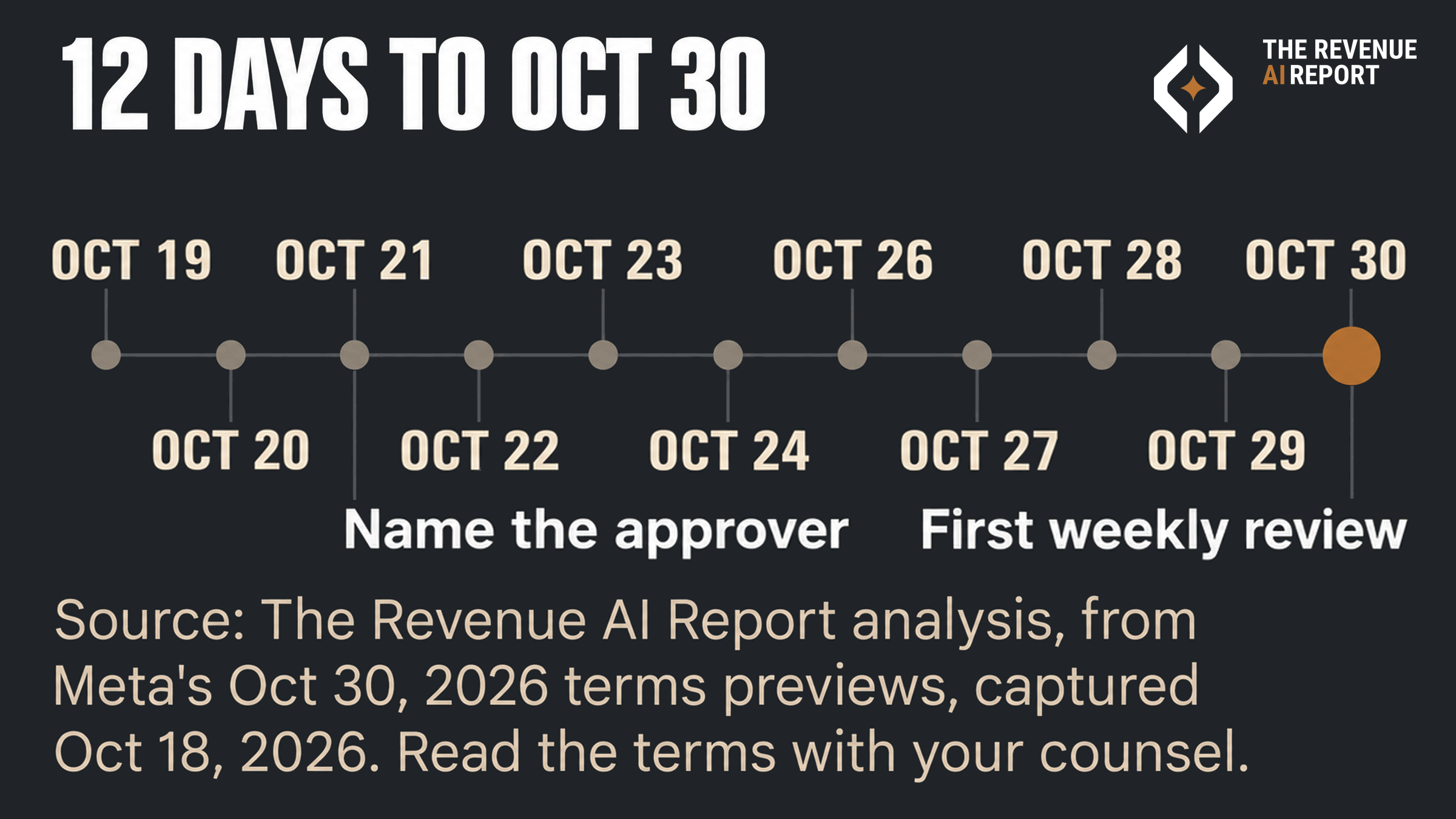
- Oct 19. The CMO sends the current and October 30 terms to counsel and saves dated copies of both.
- Oct 20. The Director of Marketing lists every live Meta campaign and the automated features running on each.
- Oct 21. The VP of Marketing names one approver for AI-generated creative and automated budget changes, plus a backup, per brand or ad account.
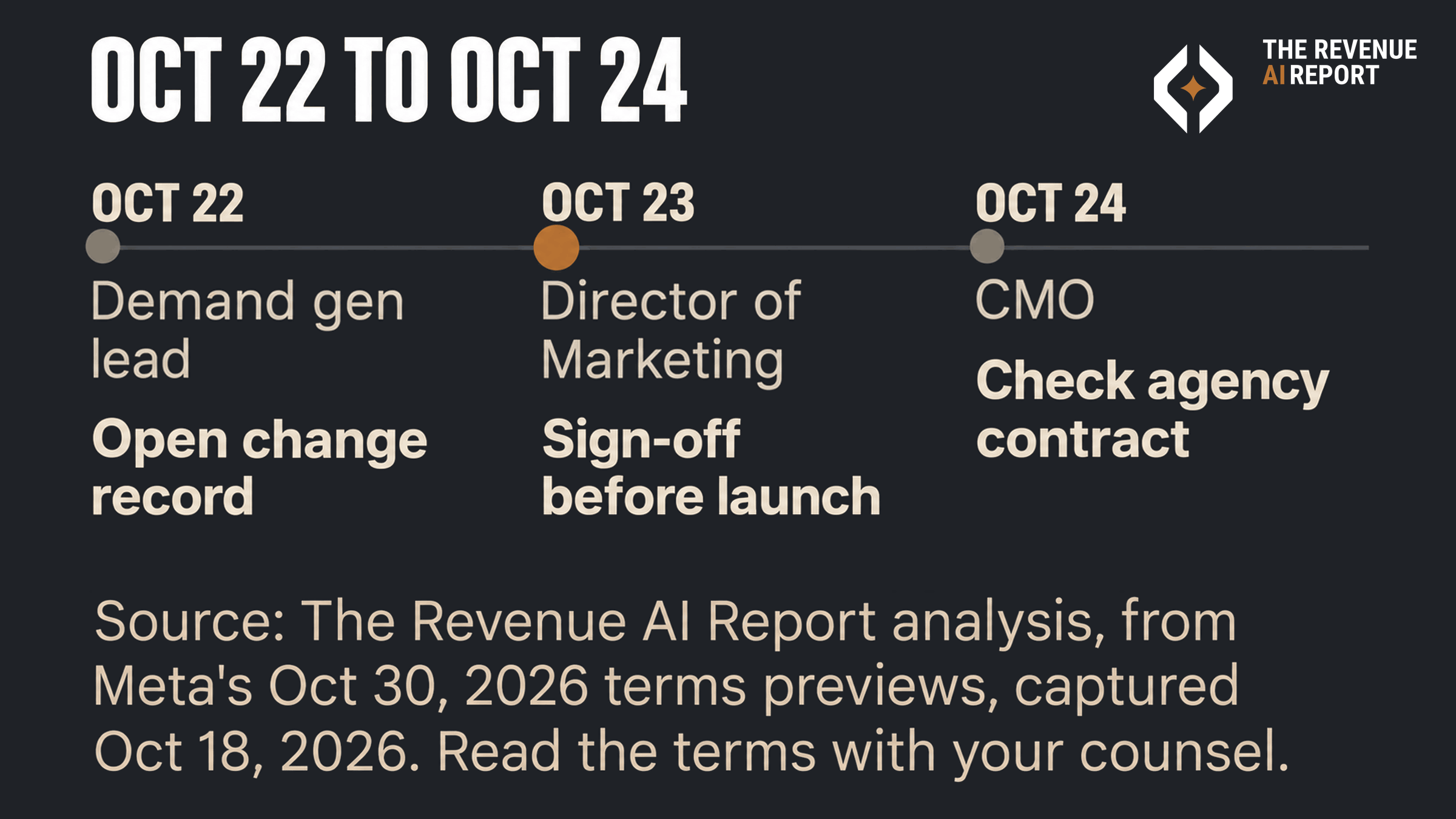
- Oct 22. The demand gen lead opens the change record above and backfills the recent automated changes the team can still trace.
- Oct 23. The Director of Marketing sets the rule in writing: no AI-made ad and no automated budget change goes live without the named approver's sign-off.
- Oct 24. The CMO checks the agency contract: who approves AI-made creative, who warrants rights to the content, and whether the agency may bind your company to Meta's terms.
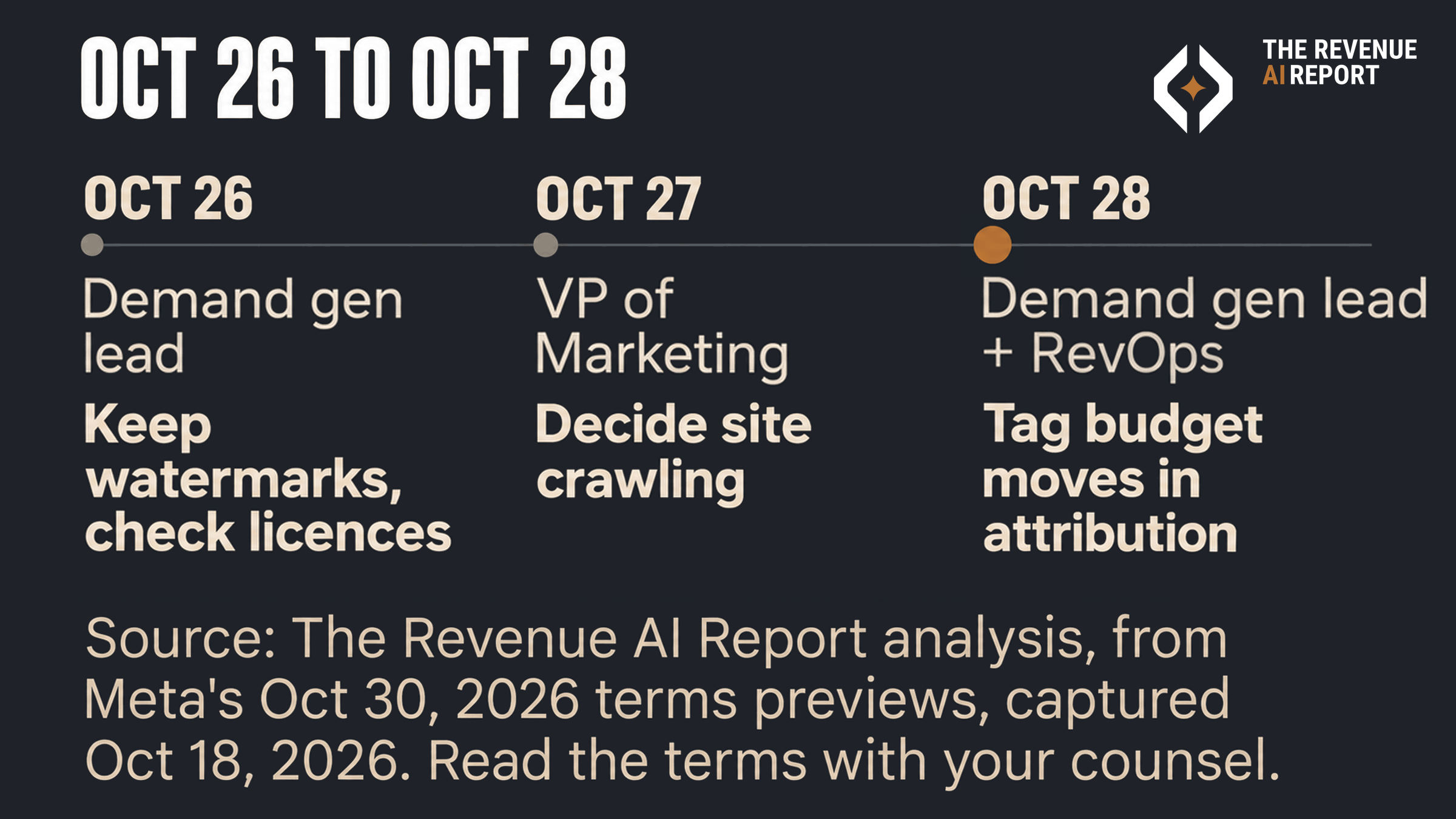
- Oct 26. The demand gen lead confirms AI watermarks and content-credential metadata stay on every export, and that licences for footage, music and avatars cover use on Meta.
- Oct 27. The VP of Marketing makes a site-crawl decision for the company domain with the web owner and counsel. Both English editions of the Commercial Terms preview let Meta crawl sites "associated with your products or services." As of October 19, both editions tie crawled content to "provide, develop, improve, research, and maintain advertising and business products." Neither edition uses the word "train." On October 18 the UK English edition still said "research, train and maintain the integrity of" Meta's products, so check the live text the day you decide. Matt Topic, an attorney at Loevy & Loevy, gave Nieman Lab his view: "I think 'develop' is broad enough to include 'train.'" Meta spokesperson Daniel Roberts told The Verge "content owners can use robots.txt to signal their preferences." No preview text we captured mentions robots.txt.
- Oct 28. The demand gen lead sends the change record to RevOps and agrees how automated budget changes get tagged in pipeline attribution, by date and campaign.
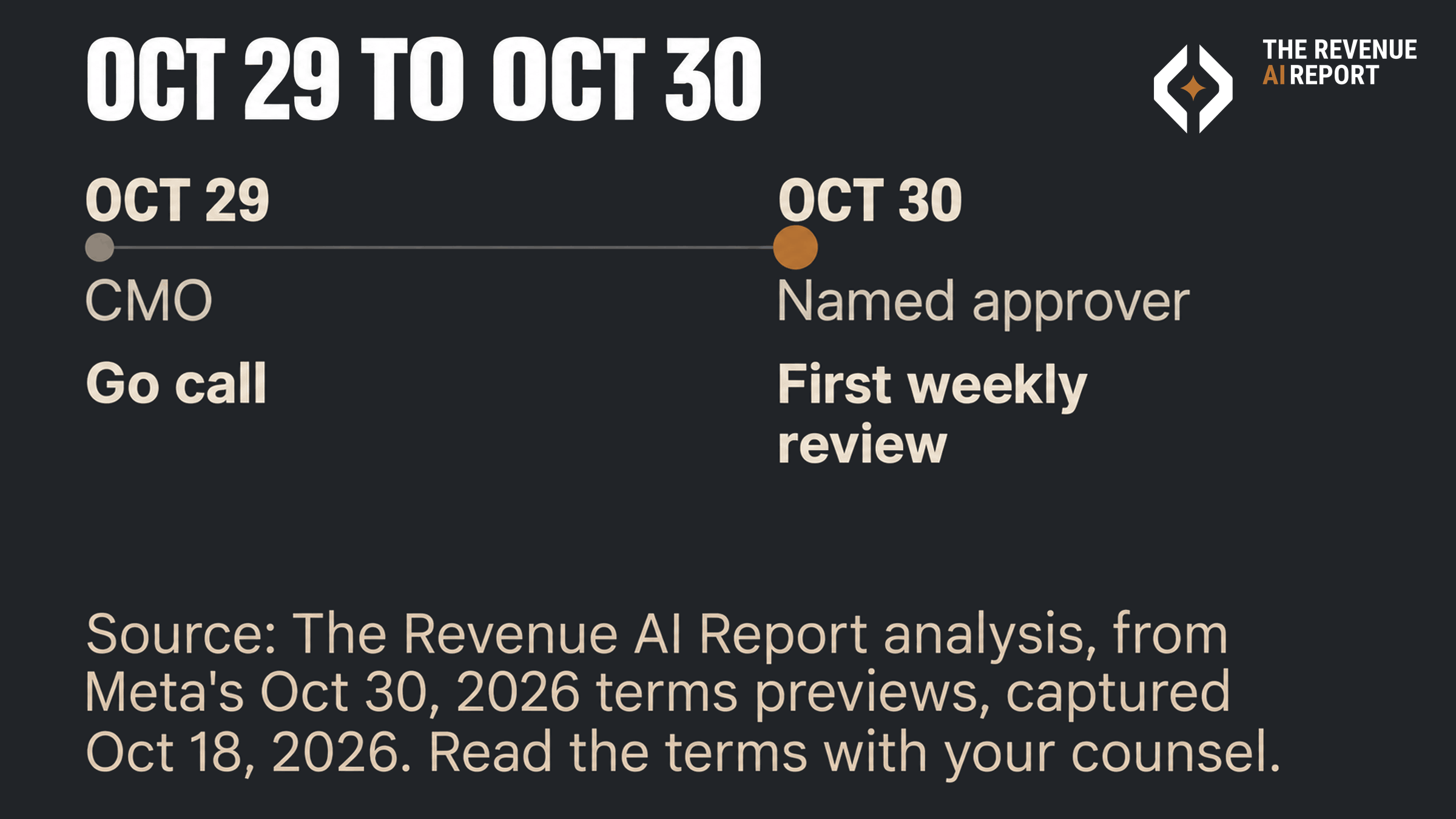
- Oct 29. The CMO makes the go call: keep running on October 30 with the approver, the record and the agency terms in place, or pause business use while counsel finishes.
- Oct 30. The named approver runs the first weekly review of the change record. The terms take effect today.
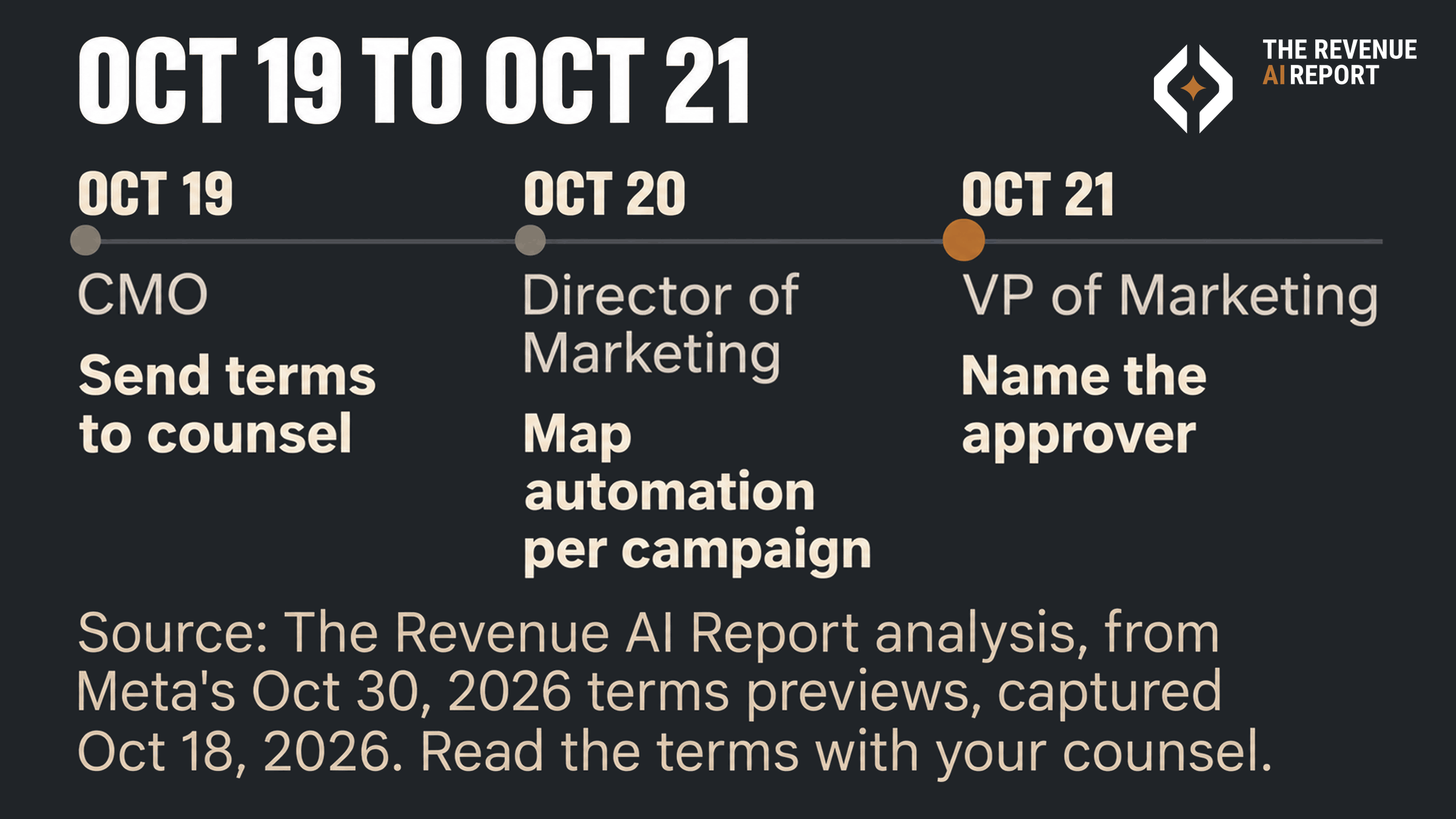
The decision for this week is a name. Put one person's name next to "approves AI-made ads and budget changes" by October 21, as step 3 asks, and the rest of the list has an owner.
Sources
Meta's terms were captured on October 18, 2026. The crawl clause was rechecked in both US English and UK English on October 19, 2026.
- Meta, "Meta Commercial Terms" preview, effective October 30, 2026: facebook.com
- Meta, "Self-Serve Ad Terms" preview, effective October 30, 2026: facebook.com
- Meta, "Ad Creative Generative AI Terms": facebook.com
- Meta for Business, "Advertising Week New York 2026: New AI Capabilities to Guide Campaigns and Reach Customers," October 6, 2026: facebook.com
- Nieman Lab, "Legal experts warn Meta's new terms still grant broad scraping permissions, despite language changes," Andrew Deck and Hanaa' Tameez, October 17, 2026: niemanlab.org
- The Verge, "Meta's new terms may allow it to train AI on news sites for free," Emma Roth, October 16, 2026: theverge.com
- The Verge, "Meta removes language that may have allowed it to scrape news sites," Terrence O'Brien, October 17, 2026: theverge.com
Frequently asked questions
- When do Meta's new ad terms take effect?
- October 30, 2026. Meta asks for no signature. Continued business use counts as acceptance, as it already does today, and the terms name stopping business use as the alternative.
- Am I responsible for ads Meta's automation creates?
- Yes. The October 30 Self-Serve Ad Terms make the advertiser responsible for reviewing, approving or removing ads, even when Meta's automated features helped make them. Name one approver and keep a record of each automated change.
- What should a per-campaign change record include?
- Five fields: which Meta automation ran, what it changed, who approved it, spend before and after, and the outcome in leads or pipeline. RevOps uses the date and campaign fields to match automated budget moves to pipeline.
- Does Meta train its AI on my company website?
- On October 19, 2026, both the US English and UK English previews tied crawled content to advertising and business products, and neither used the word "train." The UK English preview still listed "train" on October 18. Decide your site-crawl setting with your web owner and counsel.
- What should I check in my agency contract?
- Who approves AI-made creative, who warrants rights to the content, and whether the agency may bind your company to Meta's terms. Meta's terms already extend the content licence to material your agency places for you.
Hiring for revenue roles?
Post your sales, marketing, RevOps or enablement opening where revenue leaders read every week. One 30-day post is $199. Three featured posts are $299/mo.
Keep reading
Playbook
Who Answers When an AI Agent Gets It Wrong?
Wharton/GBK's Oct 2026 survey splits blame for agent errors four ways, and no single owner reaches 30%. Name an owner for each class of action before an agent acts.
Playbook
LOPAFT in Action: Two Teams, the Tools They Already Have, and the Climb to Mastery
Most teams run a weekly training and then wonder why nothing sticks. People sit through the session, nod along, and go back to doing the job the old way. Their skills don't improve. The weekly training is one piece of what it takes. Five other pieces are missing, and a team needs all six to become high-performing.