
Salesforce's AI Agents Reached Its Unanswered Leads. Build a Ledger for Yours.
Jonathan Kvarfordt · Published October 19, 2026 · Last updated October 19, 2026 · 7 min read
Disclosure: Jonathan Kvarfordt works at Salesforce. This post is not sponsored by Salesforce or any other vendor.
Salesforce says agents that make first contact with leads it could not reach in time helped generate more than $88 million in revenue. Here is a five-field ledger to track your own lead-response agent.
When a lead asks to hear from you and gets no reply, demand you already paid for sits idle. Teams with more inbound interest than people to answer it watch that backlog grow in the CRM, usually without anyone putting a number on it. Salesforce just put a number on its own. On Oct 18, 2026, CTech reported that AI agents making first contact with Salesforce's unanswered leads helped generate more than $88 million in revenue.
If you run a lead-response agent, you should be able to produce a figure like that for your own team. Below is what Salesforce reported, then a five-field ledger that gets you there.
What Salesforce reported
Itai Margalit, Area Vice President, Sales, Israel at Salesforce, described the program at the Israel Information Technology Conference 2026 in Tel Aviv (CTech).
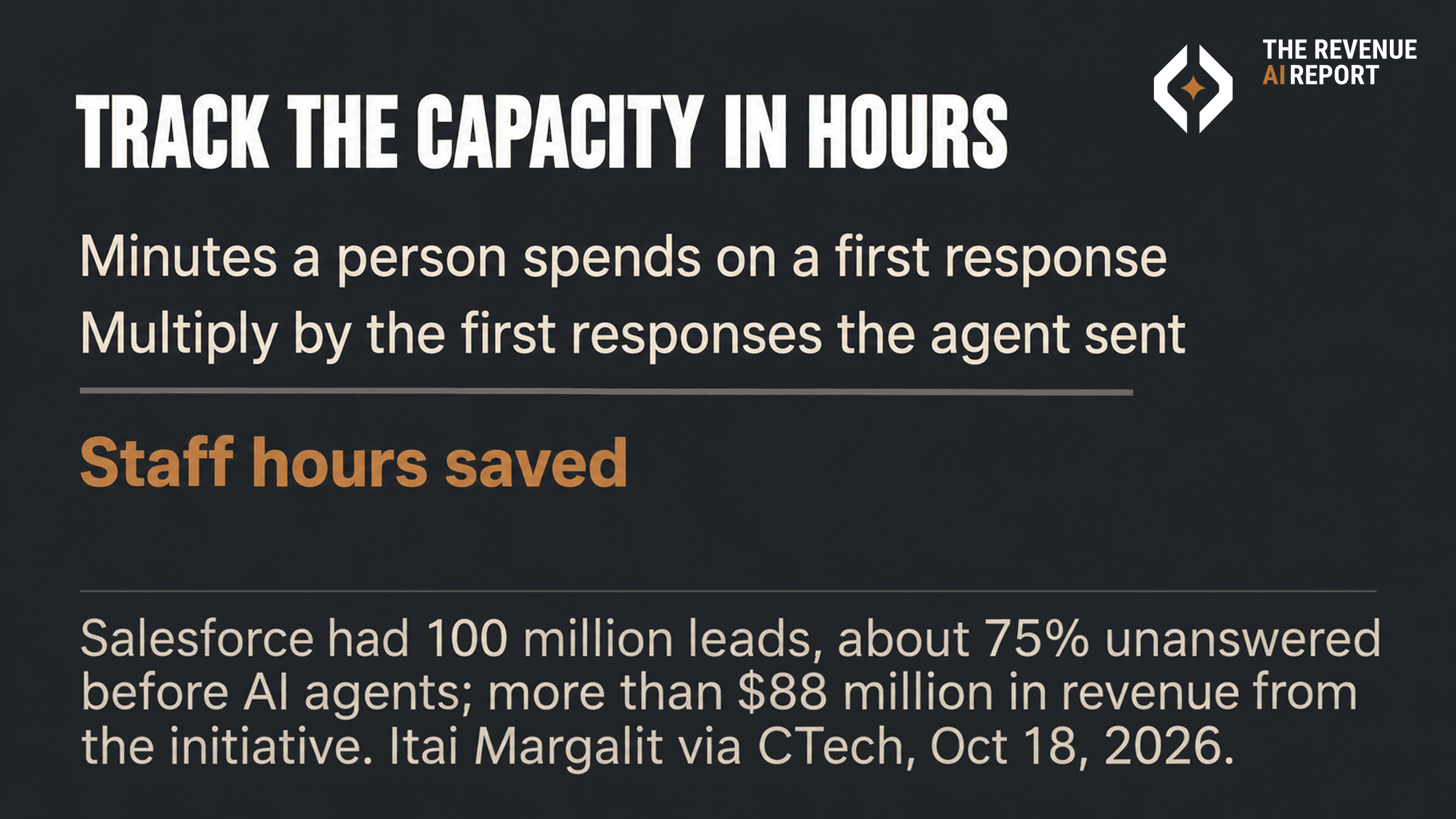
"At Salesforce, we had 100 million leads, and prior to integrating AI agents, about 75% of them went unanswered," he said. "Customers wanted to hear from us, but we lacked the capacity to reach everyone in a timely manner. Today, thanks to AI agents, no lead is left behind. The agent initiates the first contact and hands off the interaction to a human whenever a personal touch is required."
According to Margalit, the initiative has generated more than $88 million in revenue. Handling a comparable volume of first responses through conventional staffing, he said, would have required approximately 400 additional employees.
Put simply, Salesforce turned an unanswered lead backlog into a first-response channel: the agent opens the conversation, and a person takes over when the buyer needs one.
Read it as a role-mix shift
Margalit framed the work as a partnership. "Today, humans and agents work side-by-side; the challenge lies in managing this integration so that each focuses on what they do best, thereby maximizing their combined productivity," he said.
In lead response, that split is concrete. The agent handles volume and speed: the first message, the basic questions, the routing. People handle the conversations that need judgment: pricing, fit, a buyer with an unusual problem. Read the 400-employee comparison as the capacity the agents added. Your team's hours then move toward the handoffs that close business, so write those handoff tasks into the role, where they will show up in how the team is managed and paid.
Margalit also warned against bolting AI onto old habits. "You cannot simply keep an organization and its business processes as they are and just layer AI on top," he said. "You must adapt your ways of working so that the technology can truly drive the organization forward." For lead response, adapting means redesigning who owns a lead after the agent hands it off, and how fast they pick it up.
The five-field ledger
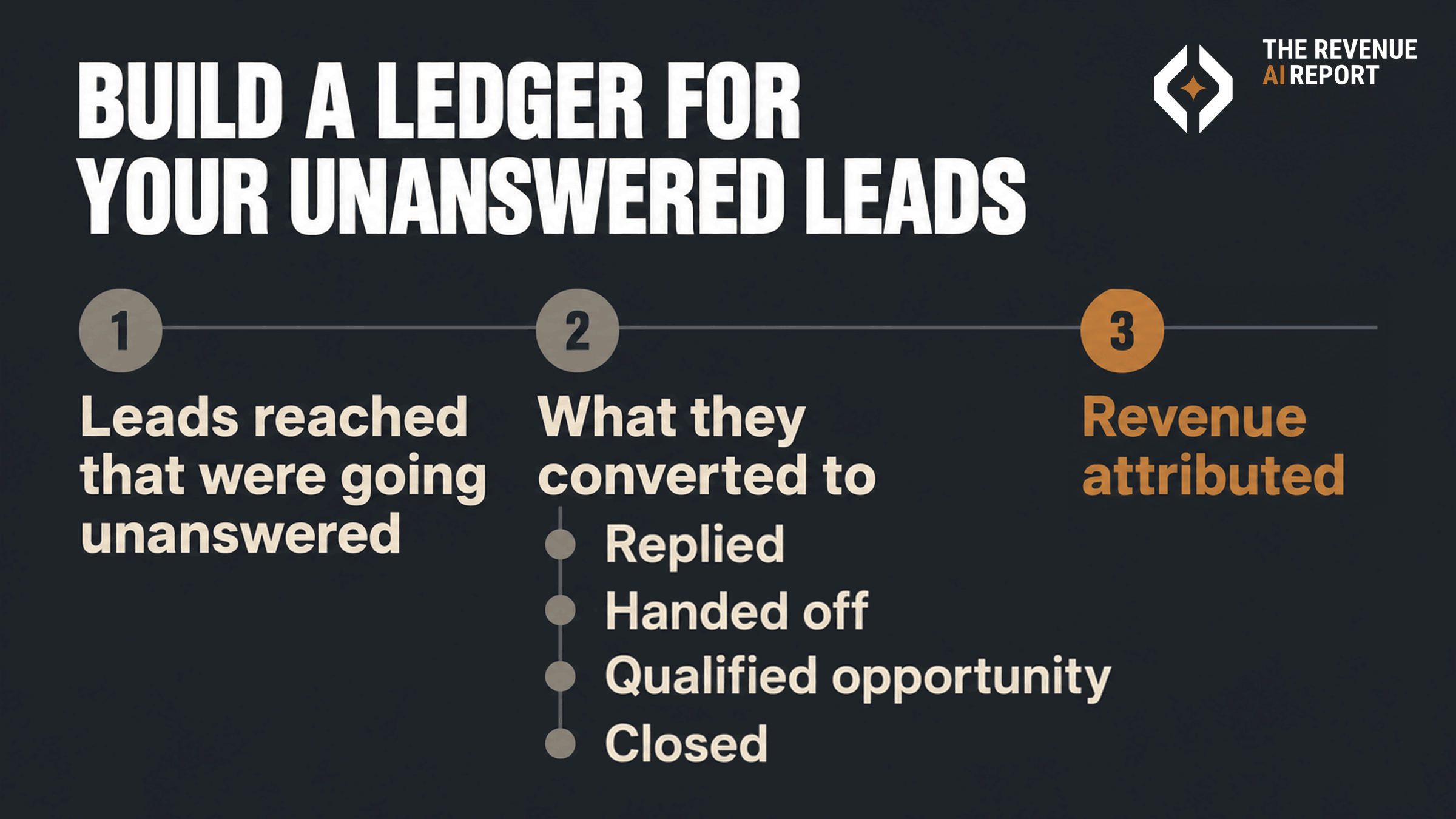
Salesforce's figure has the shape worth copying: leads reached, revenue generated and the staffing it would have taken. Build yours as one row per lead the agent contacts, rolled up monthly, with five fields.
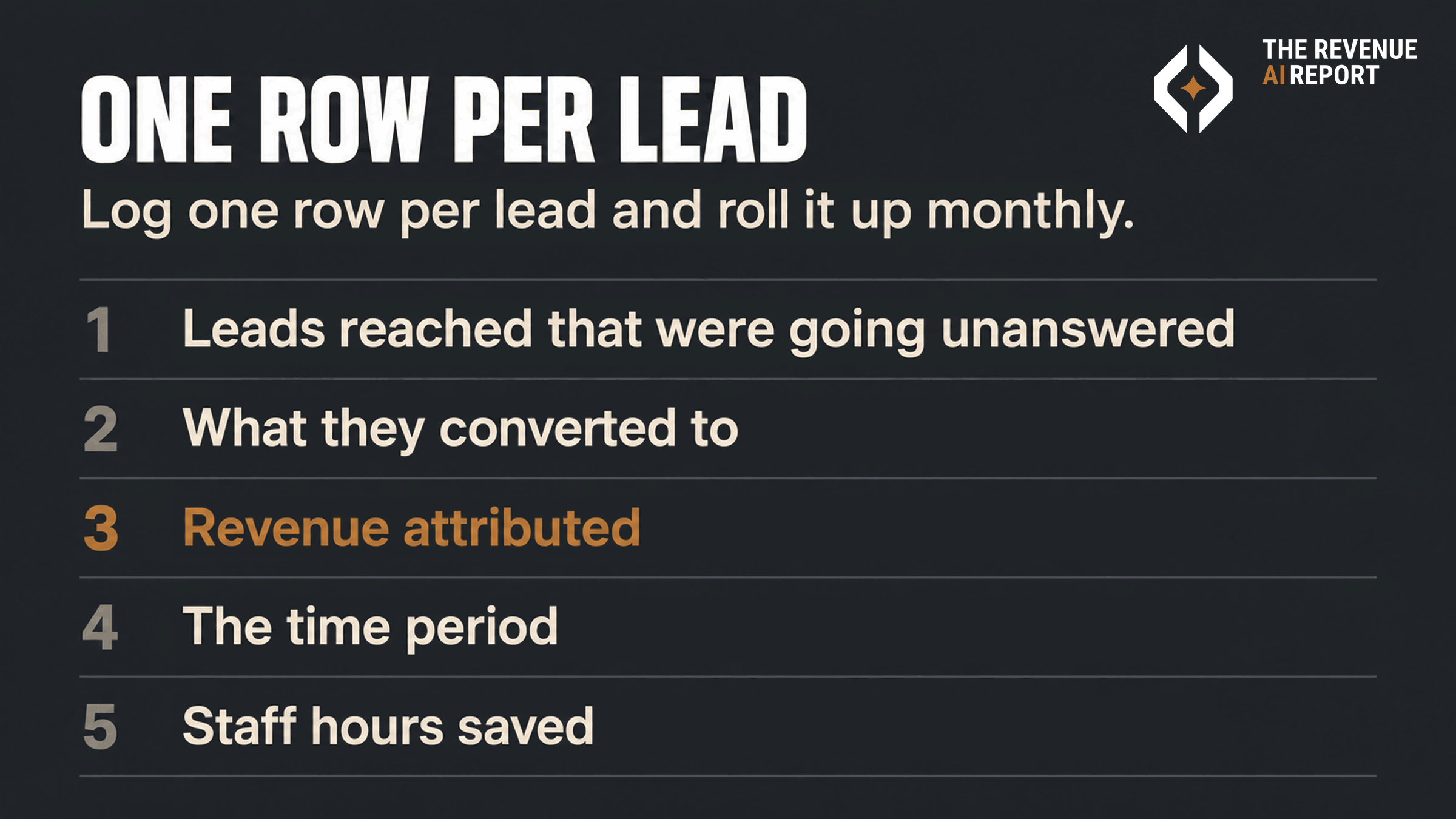
1. Leads reached that were going unanswered
Start with the backlog. Before the agent goes live, count inbound leads that got no human reply within your own response window, by source. After launch, log every lead the agent contacts and flag the ones that would have fallen in that unanswered group. Check each record is valid and not a duplicate, so the count reflects real buyers.
2. What they converted to
Track each reached lead to its next stage: replied, handed off to a person, became a qualified opportunity, closed. Note whether the agent handled the exchange or handed it off, and what the person changed. This field shows where the agent's first touch turns into pipeline, and a high handoff rate on one lead source shows where your people add the most.
3. Revenue attributed
Tie closed revenue back to leads the agent reached. Write the attribution rule down before you start and keep it fixed. One example: the agent made first touch on a lead that would otherwise have gone unanswered. For a cleaner read, compare similar leads that received timely human follow-up.
4. The time period
Put a start and end date beside your revenue figure. Pick a window long enough to cover your sales cycle and report the figure with its dates every time, for example revenue from agent-reached leads from launch month to the current month. Keep the window consistent so you can compare quarter to quarter.
5. Staff hours saved
Point freed hours at the work that needs a person: handoff conversations, follow-up on qualified opportunities and account work. Salesforce expressed the capacity its agents added as headcount it would otherwise have needed. You can track the same capacity in hours, which are easier to log month by month. Estimate the minutes a person spends on a first response, multiply by the first responses the agent sent, and log it monthly. Then record where those hours actually went, so the shift in the role shows up in the ledger.
Review the ledger monthly with marketing, sales and RevOps in the room. Margalit's own advice fits the rollout: "It is better to start small, selecting use cases that deliver significant business value while considering how easily they can be implemented." One lead source, one region or one product line is enough to fill all five fields.
Two composite examples outside software
These are composites built to show the moves. Neither is a reported case.
A commercial lender. Business-loan inquiries arrive after hours or late in the week and get no reply until the next week. An agent now sends the first reply, confirms the loan type and timing, gathers basic documents and hands the borrower to a relationship manager. The ledger counts inquiries reached that were waiting until the next week, what they converted to in applications and funded loans, revenue attributed to those loans, the months covered and relationship manager hours saved. Relationship managers now spend the freed hours on underwriting conversations and client relationships.
A commercial equipment dealer. Inquiries from the dealer's website and trade show scans go to a small inside sales team that cannot call everyone back the same week. An agent sends the first reply, answers spec and availability questions and hands buyers with a purchase timeline to a rep. The ledger tracks inquiries reached, quotes and orders that followed, order revenue, the period and inside sales hours redirected to quoting and account calls.
What to do this week
Pull last quarter's inbound leads and count the ones that never got a reply within your response window. That number is field one. If you already run a lead-response agent, open a sheet with the five fields and fill it for last month. For more on choosing the metric before launch, see Pick the AI Payback Metric Before Launch.
Related
Sources
- CTech (Calcalist), "Salesforce says AI agents generated $88 million in revenue by reaching leads its staff could not reach," Oct 18, 2026, reporting remarks by Itai Margalit, Area Vice President, Sales, Israel, Salesforce, at the Israel Information Technology Conference 2026 in Tel Aviv: calcalistech.com
Frequently asked questions
- What did Salesforce report about AI agents and unanswered leads?
- CTech reported on Oct 18, 2026 that Salesforce had 100 million leads and that about 75% went unanswered before AI agents. Itai Margalit said the initiative has generated more than $88 million in revenue.
- How do Salesforce's agents work with people?
- According to Margalit, the agent initiates first contact and hands the interaction to a human whenever a personal touch is required.
- How many employees would the same work have needed?
- Margalit said handling a comparable volume of first responses through conventional staffing would have required approximately 400 additional employees.
- What should a lead-response agent ledger track?
- Five fields: leads reached that were going unanswered, what they converted to, revenue attributed, the time period, and staff hours saved. Log one row per lead and roll it up monthly.
- How do lead-response agents change sales roles?
- In the model Salesforce describes, agents take the first contact and people take the conversations that need a personal touch. Staff hours shift toward handoffs, qualified opportunities and account work.
Hiring for revenue roles?
Post your sales, marketing, RevOps or enablement opening where revenue leaders read every week. One 30-day post is $199. Three featured posts are $299/mo.
Keep reading
Playbook
Who Answers When an AI Agent Gets It Wrong?
Wharton/GBK's Oct 2026 survey splits blame for agent errors four ways, and no single owner reaches 30%. Name an owner for each class of action before an agent acts.
Playbook
LOPAFT in Action: Two Teams, the Tools They Already Have, and the Climb to Mastery
Most teams run a weekly training and then wonder why nothing sticks. People sit through the session, nod along, and go back to doing the job the old way. Their skills don't improve. The weekly training is one piece of what it takes. Five other pieces are missing, and a team needs all six to become high-performing.