
Character.ai filed Chapter 11. Here is the AI vendor exit pattern, and the order-form clauses that cover you.
Character.ai filed Chapter 11 on Oct 12, 2026. Disney's $20M stalking-horse bid is a license, not the app. The 2024–2026 exit pattern and five order-form clauses.
Jonathan Kvarfordt · Published October 14, 2026 · Last updated October 14, 2026 · 8 min read
The short answer
What's in it for you: Character.ai's Chapter 11 filing, the 2024–2026 AI vendor exit pattern, and five order-form clauses that cover data export, insolvency, continuity, prepaid caps and notice of change.
Decision rule
Do not prepay an AI vendor for a long term without insolvency and change-of-control termination rights, a data-export path, and a written shutdown notice period.
Operator action
This week: list every AI tool your revenue team pays for, name what stops if it goes dark in 30 days, and put the five clauses below on every renewal due in the next 12 months.
Last reviewed
Character.ai filed for Chapter 11 on October 12, 2026, in Delaware (Case No. 26-11603). The opening bid is $20 million from Disney for a license to some of its IP, and the app's future depends on whether anyone else bids.
If you pay an AI startup today, this is the exit you should plan for. Founders and staff leave for a bigger company, the buyer takes a license, and the product goes to auction or gets switched off.
What happened
- The filing. Character Technologies, Inc., which does business as Character.AI, filed a voluntary Chapter 11 case in the U.S. Bankruptcy Court for the District of Delaware on October 12, 2026. The goal is a court-supervised sale of the company's assets. (First-day declaration; company statement)
- The opening bid. Disney Worldwide Services is the stalking horse at $20 million in cash. The bid buys a perpetual, worldwide, non-exclusive license to certain Character IP and technology, plus a release of certain legal claims. The license does not include the app, and Character.ai says the app will be wound down if no bid keeps it running. Other bidders can top it. (Declaration ¶¶ 62, 64)
- The people moved first. Before the filing, Disney agreed to hire most of Character's workforce, including the CEO at the time. (Declaration ¶ 62)
- The timeline. The company expects the sale to finish by the end of November or early December 2026. The Disney deal milestones require a close on or before December 17, 2026. (Company statement; Declaration ¶ 70)
- The app. The platform stays up during the sale, and subscriptions stay active. If no bid supports continued operations, the company says the platform "will be wound down." (Company statement)
The numbers behind it come from the declaration. Monthly revenue rose from about $2.8 million in December 2025 to about $5.3 million in August 2026. In August 2026 the company was losing about $8 to $9 million a month. A banker approached about 28 parties starting in August 2025. Character had no funded debt and about $57 million in unrestricted cash, cash equivalents and investments at filing. (Declaration ¶¶ 11, 12, 18)
The declaration says potential buyers cited the litigation and regulatory overhang. (Declaration ¶ 12)

The pattern, 2024 to 2026
Character.ai has already been through this once. In mid-2024, Google rehired its founders and took a non-exclusive license to its technology for about $2.7 billion in total consideration. (Declaration ¶ 19) The company kept running on what was left. Two years later, it is in court.
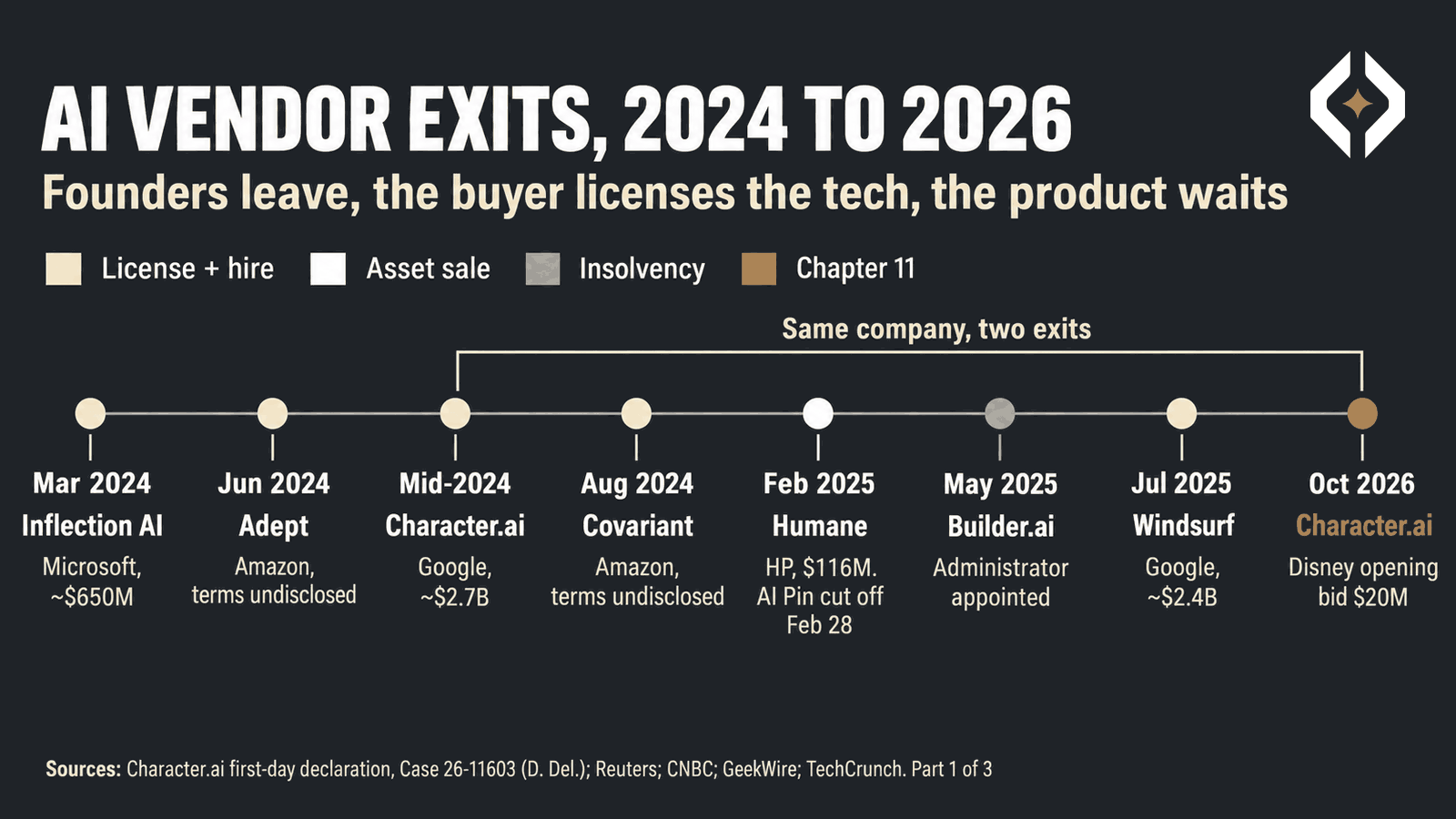
Big companies keep buying AI startups this way. They hire the founders, license the tech, and leave the company standing.
| Date | Company | What happened | Source |
|---|---|---|---|
| Mar 2024 | Inflection AI | Microsoft hired the co-founders and most of the ~70-person staff, and paid about $650M, largely to license the models | Reuters, Mar 21, 2024 |
| Jun 28, 2024 | Adept | Amazon hired the CEO and co-founders and took a non-exclusive license. Terms undisclosed. Adept said it would keep operating. | Reuters; CNBC |
| Mid-2024 | Character.ai | Google rehired the founders and took a non-exclusive license. About $2.7B total consideration. | Declaration ¶ 19 |
| Aug 30, 2024 | Covariant | Amazon hired three founders and took a non-exclusive license to its AI models | GeekWire |
| Feb 18, 2025 | Humane | HP bought most assets for $116M. The AI Pin lost its cloud features at noon PST on Feb 28, 2025, and remaining customer data was deleted. | TechCrunch; Humane support notice |
| May 20, 2025 | Builder.ai | Entered insolvency proceedings and appointed an administrator. It had raised more than $450M. | TechCrunch |
| Jul 11, 2025 | Windsurf | Google hired the CEO, a co-founder and some R&D staff and paid about $2.4B in license fees under non-exclusive terms | Reuters |
| Oct 12, 2026 | Character.ai | Chapter 11 and a 363 sale, with Disney's $20M license bid as the opening offer | Declaration; company statement |
Humane shows how fast a shutoff can happen. The sale was announced February 18. Ten days later the devices lost their core features and the data was gone. Customers got refunds only if they bought within 90 days. (TechCrunch)
The counter-view
Several of these exits left the product running. Adept said it would keep operating as a standalone company after the Amazon deal. (CNBC) Three days after Google hired Windsurf's leaders, Cognition agreed to buy the rest of Windsurf, including the product, the brand and the remaining team. Windsurf had $82 million in ARR and more than 350 enterprise customers at the time, and it kept running on its own in the near term. (Reuters, Jul 14, 2025; Cognition) Character.ai's app is also still live today.
So a shutdown is one possible outcome among several, and nobody has published odds for it. Covering it still costs only a few lines in a contract.
Why revenue teams should care
Character's own numbers show the squeeze. Revenue nearly doubled in eight months, and the company still lost more each month than it brought in. Growth alone did not keep it independent.
If your AI vendor goes dark, the work stops on your side. Sequences stop sending. Call notes stop syncing. Scoring and routing fall back to whatever ran before. That holds in insurance, banking, healthcare and manufacturing as much as in software. How much it hurts depends on your process: whether it has a written fallback and a named owner (Systems Beat Talent).
What to put in your next AI order form
This is a checklist to take to your legal team, who should adapt it to your contracts. For the questions to ask before signing, see AI vendor diligence questions.
- Data export. You can export your data, prompts, configurations and outputs in a standard format on request, and again at termination, within a set number of days. Add a written certificate of deletion after export.
- Termination on insolvency or change of control. You can terminate if the vendor files for bankruptcy, makes an assignment for the benefit of creditors, sells the business or its key assets, or loses its founding team to another company. The contract cannot be assigned to a new owner without your consent.
- Continuity commitment. The vendor commits to keep the product running for a fixed notice period before any shutdown, with transition help during that period. For tools in a critical path, ask about escrow of code or models.
- Caps on prepaid usage. Pay monthly or quarterly with small vendors. Cap prepaid credits and annual prepay. Unused prepaid fees are refunded on insolvency, shutdown or termination for cause.
- Notice of change. The vendor tells you within a set number of days about a key-staff departure, a licensing deal with a larger company, or a change of model provider.

What to do this week
Pull the list of AI tools your revenue team pays for. For each one, write down what stops working if it goes dark in 30 days, where that data lives, and the person who owns the fallback (Who Owns AI). Write the rollback before you need it (rollback plan). Then put the five clauses above on every renewal due in the next 12 months.
Sources
- Declaration of Colin M. Adams, Case 26-11603 (BLS), U.S. Bankruptcy Court for the District of Delaware, Doc 18, filed Oct 13, 2026: cases.stretto.com
- Character.ai, "An update on Character.AI," Oct 12, 2026: blog.character.ai
- Reuters, Inflection / Microsoft, Mar 21, 2024: reuters.com
- Reuters / CNBC, Adept / Amazon, Jun 28, 2024: reuters.com; cnbc.com
- GeekWire, Covariant / Amazon, Aug 30, 2024: geekwire.com
- TechCrunch / Humane support, Humane / HP, Feb 18–28, 2025: techcrunch.com; support.humane.com
- TechCrunch, Builder.ai insolvency, May 20, 2025: techcrunch.com
- Reuters, Windsurf / Google, Jul 11, 2025: reuters.com
- Reuters / Cognition, Cognition buys Windsurf, Jul 14, 2025: reuters.com; cognition.com
New Reality Checks land in the weekly issue first. Subscribe.
Frequently asked questions
- When did Character.ai file for bankruptcy?
- October 12, 2026. It filed a voluntary Chapter 11 case in the U.S. Bankruptcy Court for the District of Delaware, Case No. 26-11603.
- Is Disney buying Character.ai?
- Disney is the opening bidder. Its $20 million stalking-horse bid is for a non-exclusive license to certain IP and technology plus a release of certain legal claims. The license does not include the app, and other bidders can top it.
- Is the Character.ai app still working?
- Yes. The company says the platform stays up during the sale and subscriptions remain active. If no bid supports continued operations, the company says the platform will be wound down.
- When will the sale close?
- The company expects the process to finish by the end of November or early December 2026. The Disney deal milestones require a close on or before December 17, 2026.
- What is a licensing-and-hiring deal?
- A large company hires a startup's founders and staff and pays for a license to its technology without buying the company. Inflection, Adept, Covariant, Windsurf and Character.ai all did versions of this from 2024 to 2025.
- What should I put in an AI vendor contract?
- Data export on request and at termination, termination rights on insolvency or change of control, a continuity commitment with a shutdown notice period, caps and refunds on prepaid usage, and notice of key-staff or ownership changes.
Keep reading
Reality Check
ChatGPT Ads Added Measurement. Price the Spend You Can't Measure Yet.
ChatGPT Ads added measurement partners, a redesigned Conversions page and visual ad tests while advertisers report mixed results. A six-line order form for B2B pipeline spend you can't measure yet.
Reality Check
The dashboard was green. The answer was wrong.
Most teams judge an AI assistant by whether it is up and fast. Those checks confirm the tool responded and leave the accuracy of the answer untested. AWS recently published a clear example of the gap, from its own sales tools.