
What Evidence Does a Lesson Approval Need? Clay's Open Beta Puts That on a Second Card
Jonathan Kvarfordt · Published · Last updated · 7 min read
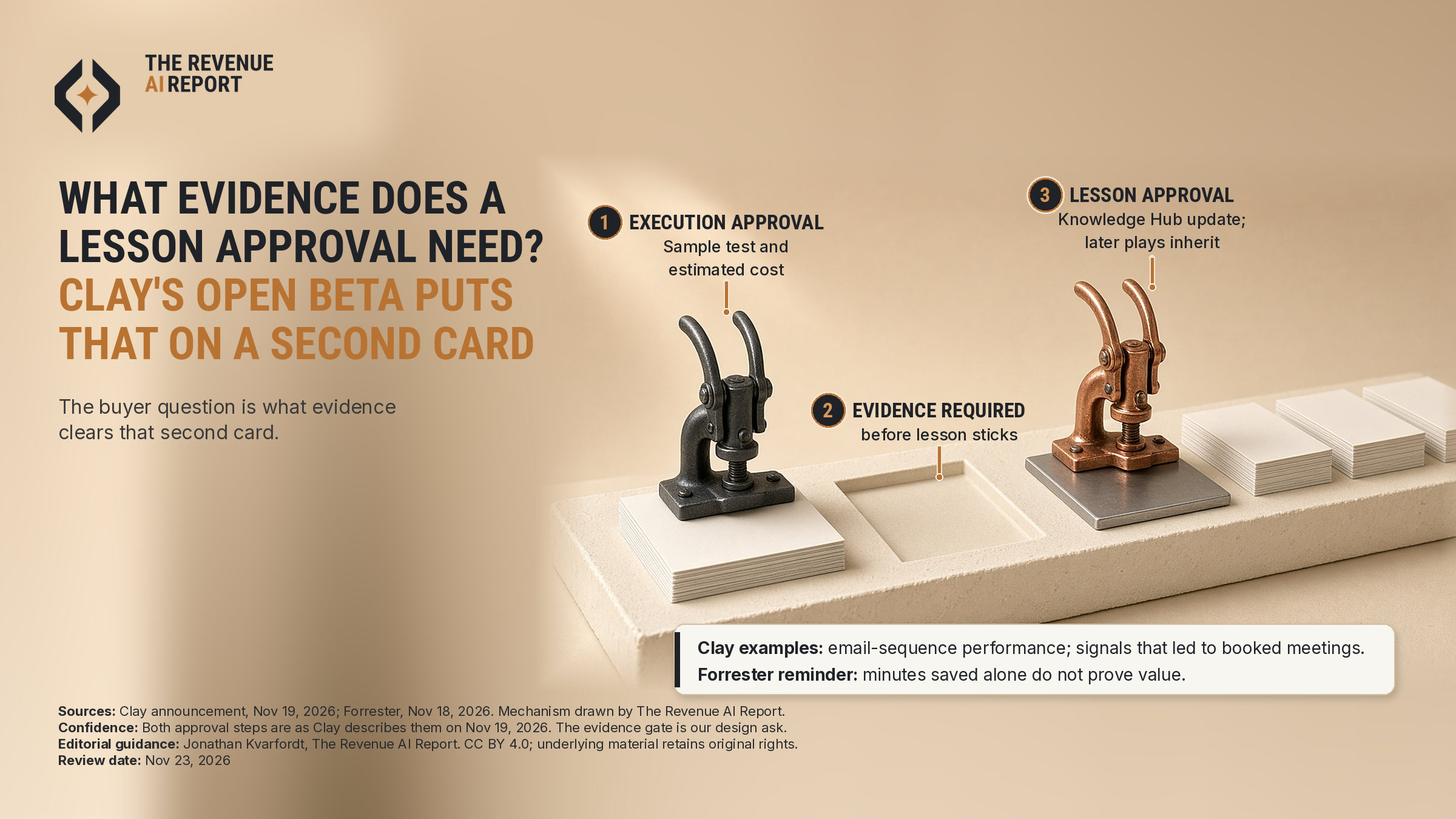
The buyer question is evidence on the second card
Clay's global agent is in open beta as of November 19, 2026. Linda Ye's announcement on Clay's blog says you describe a go-to-market play, and the agent plans and builds it across Search, Audiences, Workflows, and Sequencer. Clay's own meta description uses the phrase "GTM play." We will use Clay's "GTM" wording only when quoting Clay.
The product story has two stops for a human. Stop one is execution: Clay runs the play on a sample of real records, shows an estimated cost on an approval card, and waits before you run it at scale. Stop two is the lesson: after a run, Clay can review how the play performed and suggest updates to your business context in Knowledge Hub. Once you approve those updates, every later play starts from the updated version.
Stop two is the one that matters for a revenue leader. Approving a lesson changes the default for every play after. Our question, as The Revenue AI Report: what evidence should sit on that second card before the lesson sticks?
What Clay shipped on the two cards
Per Clay's November 19, 2026 announcement:
- Execution approval. "Clay runs the play on a sample of real records and shows the estimated cost on an approval card. When you're ready, you can run it at scale." Approval cards "show what Clay is about to do and an estimated cost." Spend by user is visible under Settings → Usage → Agent.
- Lesson approval. "Review how the play performed with Clay, like how an email sequence is performing or which signals led to booked meetings. It suggests updates to your business context based on what worked. Once you approve, every play after starts from the updated version."
Clay names those two performance examples on the page: email-sequence performance, and signals that led to booked meetings. Clay does not name pipeline or revenue results on this announcement. Stick to the examples Clay named.
Availability, per Clay: open beta on paid Enterprise, Growth, and Launch plans. The agent uses data credits. Every workspace gets a one-time bonus credit grant toward the agent during beta. The announcement does not publish a credit count or dollar amount, so this draft does not invent one.
Clay says the agent reads business context in Knowledge Hub before it plans. Through Audiences it can also read account activity from your CRM, data warehouse, Gong calls, and emails. "CRM" here is Clay's generic wording. This draft keeps it that way.
Decision block: what evidence clears a lesson
This block is our operator read for a CRO, RevOps lead, or Enablement owner who will click approve on a suggested Knowledge Hub change. It is not Clay's product copy.
Before a lesson sticks, require four things:
- Outcome evidence. Name the outcome the lesson is supposed to improve, and show evidence tied to that outcome. Forrester's November 18, 2026 post puts the bar this way: "Minutes saved make a persuasive demonstration but do not, on their own, prove that an investment creates value." Clay's named examples (email-sequence performance; signals that led to booked meetings) can feed the card. Minutes alone should not clear it.
- A named owner of the lesson. Who is accountable if the updated context is wrong? Who can reverse it? Put a name on the approval, not a shared inbox.
- What later plays inherit. Write down which Knowledge Hub fields or business-context rules change, and which play types will start from the updated version. If you cannot name what inherits, you are not ready to approve.
- How to unwind a bad lesson. Before you approve, know the rollback path: dismiss or reverse the Knowledge Hub change, pause affected plays, and re-test on a sample. If unwind is unclear, hold the approval.
Forrester also asks each investment to specify the outcome, accountable owner, expected timing, and evidence needed to demonstrate value. That four-part ask maps cleanly onto a lesson card. Use it as the evidence checklist.
Why the second card is the hard one
Execution approval is familiar. You see sample results and an estimated cost, then you decide whether to scale that run. Lesson approval asks something else. You are deciding whether the agent's suggested rewrite of business context becomes the starting point for every later play. A bad lesson compounds across plays. A sound lesson compounds the same way. That is why the evidence bar belongs on the second card.
Gartner's November 19, 2026 newsroom release reports survey expectations. In a Gartner marketing survey of 282 senior executive leaders fielded September through October 2026, 91% of C-level executives expect AI to perform at least one-quarter of CMO responsibilities within two years, and 20% expect AI to perform 50% to 74% of current CMO responsibilities over the same timeframe. Label those bands as expectations. Christy Uher Ferguson, Distinguished VP Analyst in the Gartner Marketing practice, said: "AI will always have an answer. CMOs will still be accountable for the outcome and must bring the experience and judgment needed to determine whether it's the right one." That accountability line is the point for anyone who will approve a lesson.
Forrester's same-week note is about value-evidence. Alongside the minutes-saved line, Forrester writes that "only about a fifth of US enterprises (with 250 or more employees who use AI) are developing new workflows to use AI in business processes." Keep that qualifier attached.
What AI-forward buyers would try
Our suggestion for teams already testing agent plays: build a second-approval card that only sticks when evidence clears.
Make the card show, in one place:
- The suggested Knowledge Hub or business-context change, in plain language
- The Clay-named evidence you used (email-sequence performance; booked-meeting signals), plus any outcome metric you require beyond time saved
- The named owner of the lesson
- What later plays will inherit
- The unwind steps if the lesson fails a later review
- A hard gate: approve only when those fields are filled
Clay already shows estimated cost on the execution card. The lesson card needs a parallel gate for evidence. That is our design ask, not a Clay feature claim. Teams can run this as a checklist next to Clay's approval UI until product surfaces the same fields.
Human accountability outside software sales
If you work in financial services, insurance, or manufacturing, the same rule applies when an agent suggests a lasting change to how records are written, how customers are contacted, or how regulated decisions are logged. A human still owns the outcome. The lesson that updates shared context needs a named approver, retained evidence, and a path to unwind, because the record that follows may be audited. That is true whether the reader sells software or runs a plant, a claims desk, or a branch network.
Our bottom line
Clay's open beta puts a useful shape on the screen: sample test plus estimated cost before scale, then a second approval before suggested context updates become the default for later plays. The buyer work is filling that second card with outcome evidence, a named owner, a clear inheritance list, and an unwind path. Minutes saved can sit on the card as a supporting note. They should not be the proof that clears it.
Sources
- Linda Ye, Clay, November 19, 2026, "Launch GTM plays as fast as your market moves with Clay's global agent" (open beta; Search, Audiences, Workflows, Sequencer; Knowledge Hub; approval card with estimated cost; email-sequence performance and signals that led to booked meetings; one-time bonus credit grant with no amounts; paid Enterprise, Growth, and Launch; generic CRM).
- Michael O'Grady, Brian Hopkins, Kevin Ogunsua, Greg Zorella, Forrester, November 18, 2026, "AI ROI: Move From Minutes Saved To Value Created" (minutes saved do not on their own prove value; specify outcome, accountable owner, expected timing, and evidence; about a fifth of US enterprises with 250 or more employees who use AI are developing new workflows).
- Gartner newsroom, November 19, 2026, "Gartner Survey Finds 91% of C-Level Executives Expect AI to Perform at Least 25% of CMO Responsibilities Within Two Years" (expectations from a survey of 282 senior executive leaders, September through October 2026; 91% / 20% bands; Christy Uher Ferguson quote on accountability).
Get the weekly Report: subscribe.
Hiring for revenue roles?
Post your sales, marketing, RevOps or enablement opening where revenue leaders read every week. One 30-day post is $199. Three featured posts are $299/mo.
Keep reading
Playbook
ChatGPT Can Act in Your Reps' Signed-In Browser. Write the Allowlist First.
Three decisions come before anyone turns it on: which sites stay read only, which actions wait for a human, and how an agent's edits get marked in your CRM.
Playbook
Meta's Oct 30 Ad Terms Make You Review Every AI-Made Ad. Name Who Signs Off.
Meta's Oct 30 terms make you review every ad its automation helps build. Name one approver, keep a per-campaign change record, and finish a 12-day checklist.