
Everyone Says They're a Harness Company. How to Tell What That Means
Jonathan Kvarfordt · Published · Last updated · 5 min read
Disclosure: Jonathan Kvarfordt works at Salesforce. This post is not sponsored by Salesforce or any other vendor.
In one week, "harness" became a company strategy
On November 12, Brian Halligan returned as HubSpot's CEO and posted: "Dharmesh and I are completely re-founding the company. Its day 1. We're now the Customer Harness Company." Harvey, the legal AI company, has been publishing research on what it calls harness engineering since April. And Salesforce is using the word too: a Salesforce job listing posted November 5, 2026 (JR367604) describes its Enterprise Agentic Harness as shared infrastructure for "context, agency, action, governance, and trust."
If everyone is saying they're a harness company, the word stops doing work. You're about to hear it in every vendor pitch for the next year.
What a harness is
The plain definition from our own dictionary: an agent harness is the software around an AI model that lets it work through a task. It supplies information and tools, keeps track of progress, runs checks, and applies the rules for when to stop or ask a human for approval. The full entry is here: What is an AI agent harness?
The model does the thinking. The harness decides what the model sees, what it's allowed to touch, how it knows it's done, and what happens when it gets something wrong.
Two ways to picture it
My version: the engine and the car. The AI model is the engine. The harness is the car. If you took a V10 Dodge Viper engine and dropped it into a Toyota Prius, it wouldn't perform like it does in the Viper, because the Prius was never built to handle that load. Same engine, very different result.
I'll be honest, that analogy might need another pass, and it breaks down in one spot: a model isn't stuck in one car. You can swap the engine. Try a second picture.
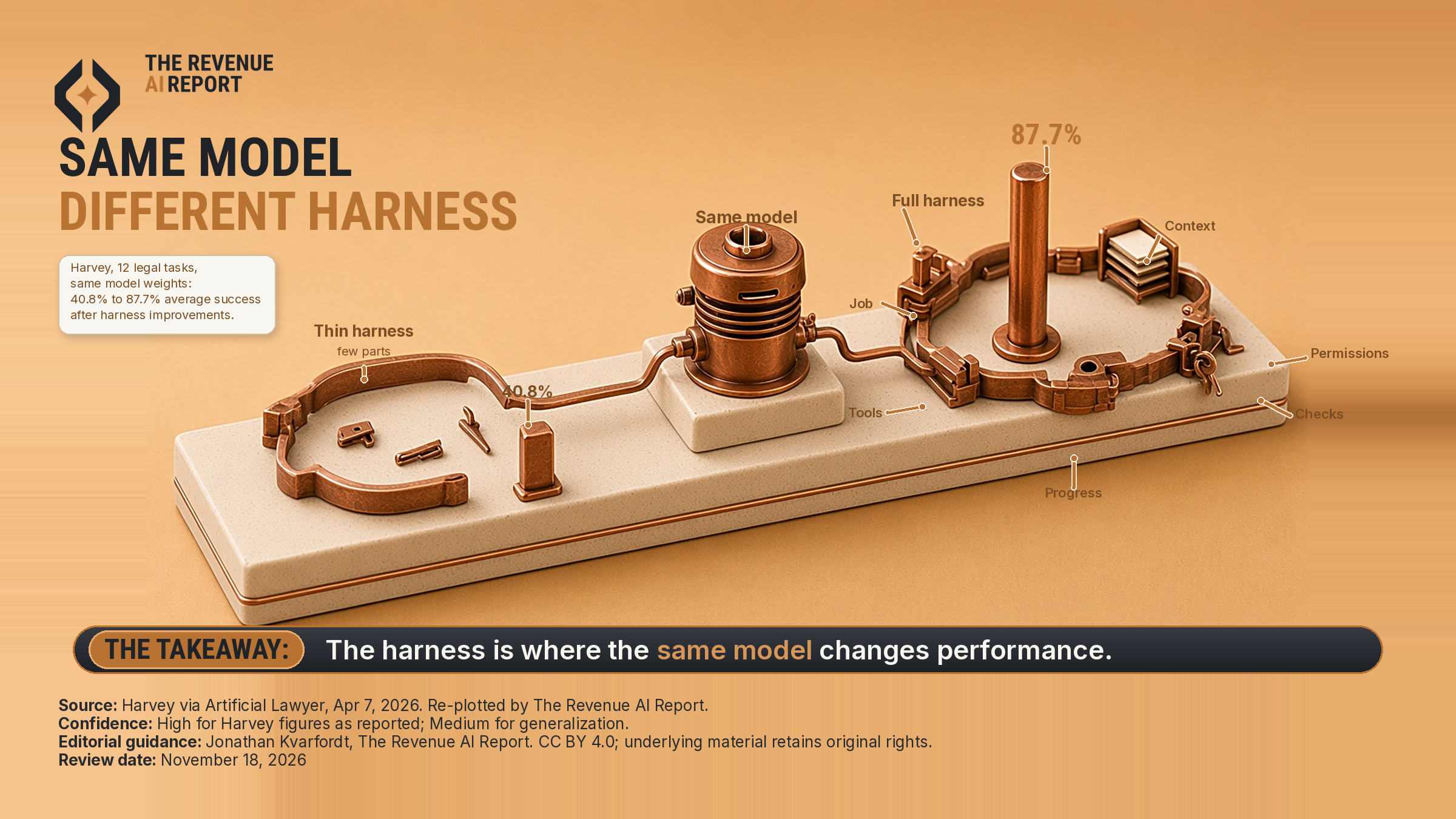
The alternative: the chef and the kitchen. The model is a great chef. The harness is the kitchen. Put that chef in a food truck with one burner and no pantry, and dinner for 200 is going to go badly. Put the same chef in a full restaurant kitchen with a stocked pantry (context), the right equipment (tools), a ticket rail that tracks every order (progress and memory), an expediter checking each plate before it goes out (checks), and a manager who decides what the kitchen is allowed to serve (permissions). Same chef. Very different night. This one works for readers outside software, because everybody's eaten at a restaurant that was slammed.
Our dictionary entry uses a third picture, a well-run workshop. Use whichever one lands with your team.
Why the same model performs differently
You don't have to take the analogy on faith. A public example shows it.
Artificial Lawyer reported in April that Harvey ran an experiment across 12 legal tasks from its internal benchmark. It kept the model weights the same and let agents improve their own harness: tools, checks and workflows. Average success went from 40.8% to 87.7%, and every task improved. Harvey called it "a small-scale experiment" that "does not generalise to all of legal work," per Artificial Lawyer. That's a vendor reporting its own test, read here as secondary coverage. Still, the direction is the point: same engine, better car, very different result.
And Jason Lemkin at SaaStr gave the sharpest definition I've seen this month: "whoever holds the most complete context on the customer and the business becomes the harness." That's the part every CRO should sit with. The harness question comes down to context. Who has your customer history, your deal notes, your pricing rules, your finance data, all in one place an agent can use? (Coverage via SaaStr.)
So should you build your own?
Where I land, in my own words from Issue 09: "Buy infrastructure. Build intelligence." (Coach tell; also on the related build-buy thread.)
Our read on what that means in practice (The Revenue AI Report's view, kept high level):
- Buy the harness for common jobs. Meeting notes, call summaries, CRM updates, research briefs. Vendors are building these, and many now plug into ChatGPT, Claude, Copilot or Gemini directly. You won't out-build them on generic work.
- Build where your process is the edge. If the way your team qualifies a deal, prices a renewal, or runs a demo is the reason you win, that knowledge is worth owning. That's where a harness of your own, or one you configure deeply, pays off.
What you need before you build
Keep it high level. If you can't check all five, start by buying.
- A job with a finish line. "Prepare the renewal brief for accounts over $100K, due five days before renewal" is a job you can test. "Help with renewals" is too vague to test.
- Access to the context. The CRM, the documents, the call history, and permission to use them. If your data is a mess, the harness will faithfully use the mess.
- Rules for authority. What the agent can do alone, what needs approval, and what it never touches.
- A way to test it on your own work. Harvey graded against rubrics. SaaStr says it tests agents "for real, with evals on our own data and workflows." Pick a set of past examples where you know the right answer and score the agent against them.
- An owner. A named person who reviews the output, fixes the harness when it breaks, and can turn it off.
If you have those five, you can build a narrow harness for one job and expand from there. If you don't, the best model in the world is still a Viper engine in a Prius.
Sources
- Brian Halligan on X, Nov 12, 2026, embedded in SaaStr's post: saastr.com
- Jason Lemkin, SaaStr, Nov 2026, "HubSpot Is Refounding as the 'Customer Harness Company'" (Lemkin's context definition and eval process; operator account). Same URL as source 1.
- Artificial Lawyer, Apr 7, 2026, "Harvey Drives Legal Agent Learning Via 'Harness Engineering'" (secondary coverage of Harvey's figures): artificiallawyer.com
- Salesforce careers, "VP, Experience Design, Informatica and Enterprise Agentic Harness," posted Nov 5, 2026 (JR367604): salesforce.com
- The Revenue AI Report, "What is an AI agent harness?" (reviewed Nov 7, 2026): dictionary/agent-harness
- Coach line "Buy infrastructure. Build intelligence." Related live page: frameworks/build-buy-thread
Get the weekly Report: subscribe.
Frequently asked questions
- What is an AI harness in simple terms?
- The software around an AI model that gives it information and tools, tracks its progress, checks its work, and sets the rules for what it can do and when to ask a person. The model is the engine; the harness is the rest of the car.
- Why do vendors call themselves harness companies?
- Because the harness is where much of the performance difference now comes from. Artificial Lawyer reported Harvey's average task success rising from 40.8% to 87.7% on 12 legal tasks by improving the harness with the model weights unchanged (vendor-reported, small-scale; secondary coverage).
- Should my company build its own AI harness?
- Our view: buy for common jobs and build where your own process is the reason you win. Before building, you need a job with a finish line, access to the right context, rules for authority, a way to test on your own examples, and a named owner.
Hiring for revenue roles?
Post your sales, marketing, RevOps or enablement opening where revenue leaders read every week. One 30-day post is $199. Three featured posts are $299/mo.
Keep reading
Playbook
ChatGPT Can Act in Your Reps' Signed-In Browser. Write the Allowlist First.
Three decisions come before anyone turns it on: which sites stay read only, which actions wait for a human, and how an agent's edits get marked in your CRM.
Playbook
Meta's Oct 30 Ad Terms Make You Review Every AI-Made Ad. Name Who Signs Off.
Meta's Oct 30 terms make you review every ad its automation helps build. Name one approver, keep a per-campaign change record, and finish a 12-day checklist.