
Pick One AI Workflow That Lifts Sales, Then Prove It
Wells Fargo credits AI meeting prep for advisers with higher product sales rates. Here is how to pick one workflow of your own, set a baseline, compare prepped and unprepped meetings, and stop in 60 days if it misses.
Jonathan Kvarfordt · Published November 7, 2026 · Last reviewed November 7, 2026 · 8 min read
Is your team running several small AI projects at once, each with a sponsor and a pilot? Does any of them have a baseline? If the CFO asks which project moved sales and nobody can answer with a number the finance team trusts, the budget review turns into a debate about anecdotes.
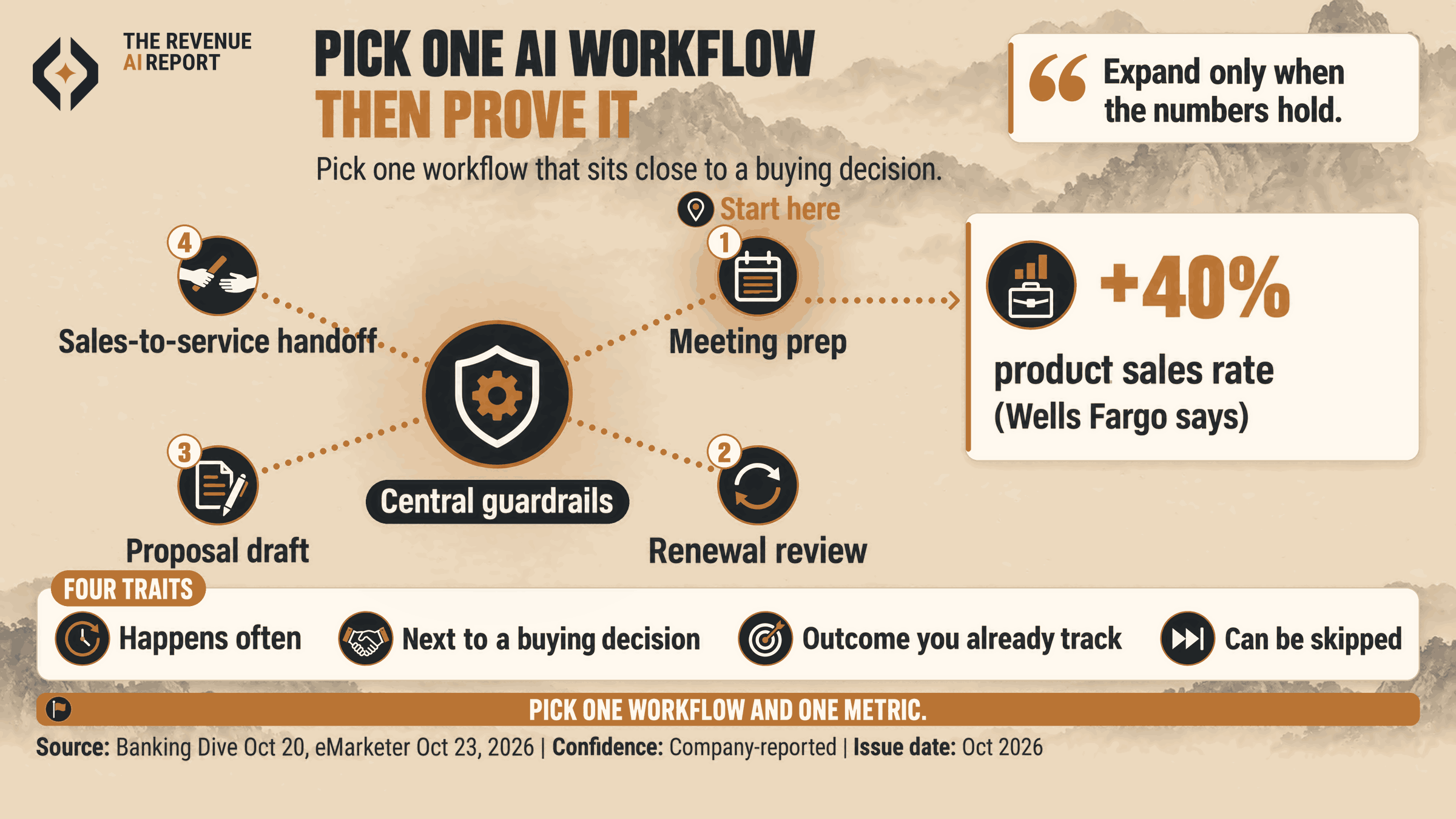
The fix is narrow. Pick one workflow that sits close to a buying decision. Measure it against meetings that skipped it. Expand only when the numbers hold.
At Money20/20, Wells Fargo said AI meeting prep for advisers is lifting product sales rates by 40%. The reporting gives no baseline, time window, product set or control group. The claim came from Faraz Shafiq, the bank's head of AI products and solutions, as Banking Dive reported on Oct 20, 2026. Treat it as a company claim about a product sales rate. It says nothing about revenue.
Shafiq also explained why the bank is putting its effort into its highest-impact uses. "There's going to be a disproportionate amount of value being created by a small number of use cases," he said, per Banking Dive.
Borrow that focus on the highest-impact uses, and test the bank's figure against your own meetings before you repeat it.
What meeting prep means outside a bank
An adviser walking into a client meeting needs to know what the client holds, what changed and what to offer next. Every revenue team has the same moment before a customer meeting.
- Insurance renewals. A VP of Sales or Distribution preps account managers before a commercial renewal call: claims history, coverage gaps, open service issues and the next policy to offer.
- Manufacturing distributor reviews. A VP of Sales preps channel managers before a quarterly distributor review: sell-through by product line, open quotes, stock problems and the price moves the distributor asked about.
- Software QBRs. A VP of Customer Success preps account teams before a quarterly business review: usage trend, open tickets, renewal date and the expansion case.
- Financial services and healthcare. A head of sales preps relationship managers or account executives before a client or provider review, with the same core fields.
The output in every case is one prep brief that fits on one screen, lands before the meeting and ends with one recommended next step.
How to pick the one workflow
Good candidates share four traits.
- It happens often. Weekly at least, across many reps or account managers.
- It sits next to a buying decision. A meeting that ends in a renewal, an order or a proposal.
- It has an outcome you already track. A next step booked, a stage moved or a deal won.
- It can be skipped. Some meetings can run without the brief, so you have something to compare against.
Meeting prep often scores well on all four. A renewal review, a proposal draft or a handoff from sales to service can score well too. Pick one.
Prove it in five steps
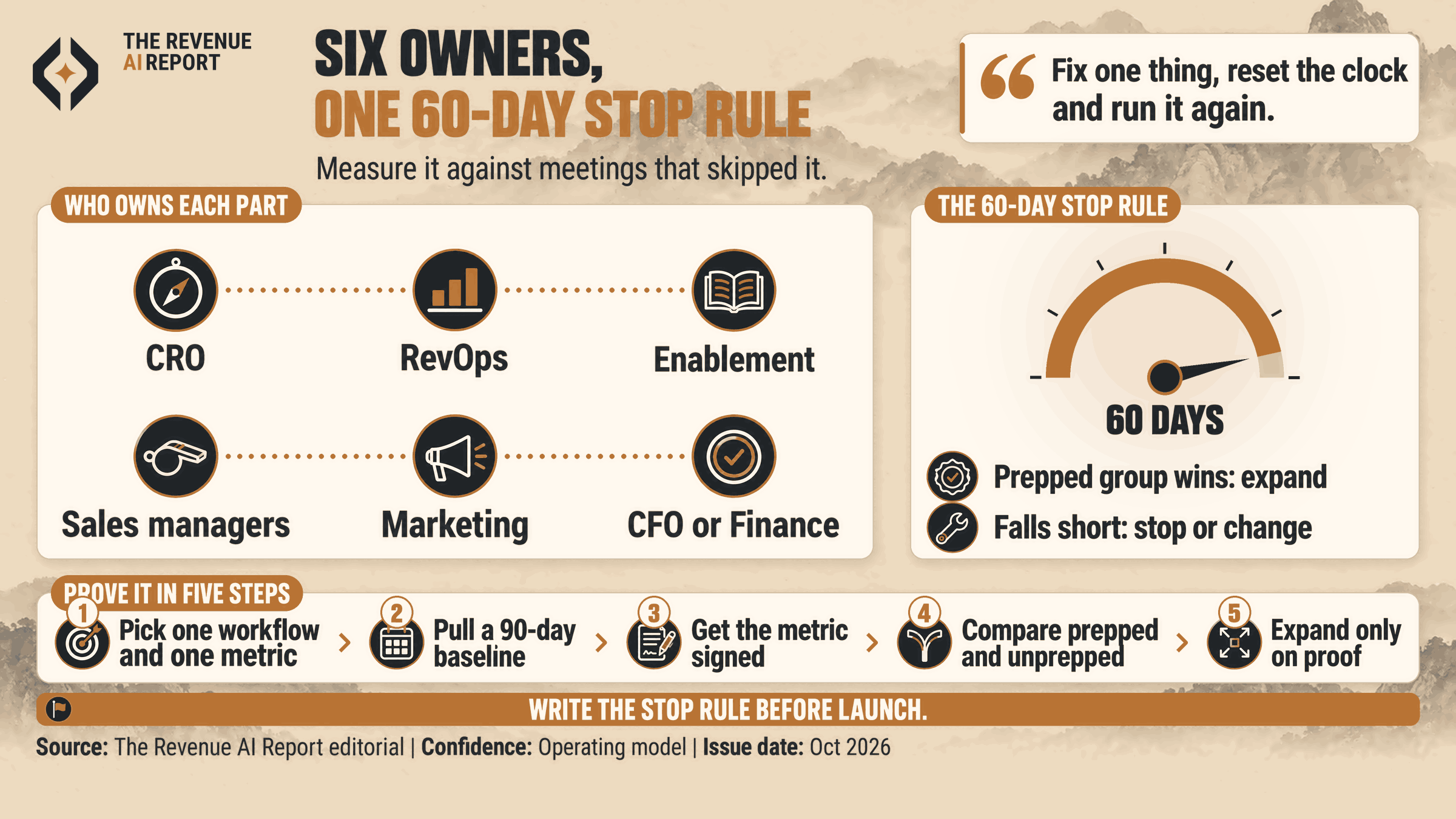
1. Pick one workflow and one metric. The CRO makes this call. Choose next-step rate or win rate. Next-step rate is the share of meetings that end with a dated next step the customer agreed to. Win rate is the share of opportunities that close won. Next-step rate shows up before the stop-rule deadline, so start there unless the CFO asks for win rate.
2. Pull a 90-day baseline. RevOps owns this. Take the 90 days before launch. Count eligible meetings, next steps booked and deals won from those meetings. Write the numbers down and date them.
3. Get the metric signed. The CFO or Finance signs the metric definition before launch: what counts as a meeting, what counts as a next step and which deals count toward win rate. With the definition signed, nobody reopens what counts after the results come in.
4. Compare prepped meetings against unprepped ones. RevOps runs the comparison. Assign the brief at random, by account or by week. If reps choose which meetings to prep, they will pick the winnable ones, and the result will flatter the brief. Set the minimum meeting count for each group before the test starts.
5. Expand only on proof. If prepped meetings beat unprepped ones on the signed metric, extend the brief to the next team. If they don't, the stop rule applies.
Who owns each part
- The CRO picks the one workflow and the one metric.
- RevOps sets the baseline, assigns prepped and unprepped meetings, and runs the comparison.
- Enablement owns the prep brief: its fields, its format and its adoption. Enablement also trains reps to use it in the meeting.
- Sales managers shift time from assembling account research to coaching. They review briefs with reps and listen to the calls that follow.
- Marketing feeds the brief with account intent signals and content history: what the account read, attended and downloaded.
- The CFO or Finance signs off on the metric definition and the baseline.
AI shifts the role mix here toward judgment work. Reps put the time they used to spend gathering facts into customer conversations, and managers put theirs into coaching on those calls. Every role stays.
The 60-day stop rule
If prepped meetings don't beat unprepped ones on next-step rate or win rate within about 60 days, stop or change the workflow before you expand it. Write the rule, the metric, the baseline and the end date before launch.
Changing the workflow counts. A brief that lands too late, runs too long or skips the field reps use most can fail on format alone. Fix one thing, reset the clock and run it again.
A composite: a commercial insurance renewal desk
This is a composite built to show the moves. No company reported it.
A mid-market commercial insurer runs renewal calls through a team of account managers. Before each call, the account manager pulls the policy, the claims file and recent service tickets from three systems. Only some calls get that prep.
The CRO picks renewal meeting prep as the one workflow and next-step rate as the metric. RevOps pulls the last 90 days of renewal calls and records how many ended with a dated next step. Finance signs the definition. Enablement builds a one-screen brief: claims history, coverage gaps, open tickets and one recommended offer. Marketing adds which renewal content the account opened.
RevOps assigns the brief to half the renewal accounts at random. The other half run as they did before. At day 60, RevOps compares next-step rates for the two groups. If the prepped group wins, the brief extends to the next region. If it doesn't, Enablement changes the brief or the team stops.
The counter-view
Felt gains and measured gains can disagree. In a 2025 randomized trial by METR, a nonprofit research group, 16 experienced open-source developers, working on their own repositories with early-2025 AI tools, expected those tools to speed them up by 24%. Measured, they took 19% longer. After the study, they still believed AI had sped them up by 20%.
METR says those results are now out of date. In a February 2026 update, it wrote that developers are likely more sped up by AI tools now. The same update warned that developer self-reports of very high speedups "can be quite unreliable."
The study measured software developers. Sales meetings differ. The lesson still applies to any AI claim made without a comparison group, including a bank's claim at a conference. Run your own comparison.
What to do this week
- The CRO names the one workflow and the one metric.
- RevOps pulls the 90-day baseline for eligible meetings.
- Finance signs the metric definition.
- Enablement drafts a one-screen prep brief with Marketing's account signals.
- Write the 60-day stop rule before the first prepped meeting.
Poll: Do you compare results on prepped vs. unprepped sales meetings? Yes / Partly / No.
Related
- Before You Credit an AI Agent With Revenue, Get These Seven Proofs
- Ship One AI Workflow This Quarter
- Why AI Pilots Work and Rollouts Stall
Sources
- Banking Dive, Caitlin Mullen, October 20, 2026 (Shafiq's product sales rate claim and quote): bankingdive.com
- eMarketer, Lauren Ashcraft, October 23, 2026 (follow-up coverage of the same claim): emarketer.com
- Money20/20 USA session page, "I Left Big Tech to Revamp a Big Bank: AI Edition," October 20, 2026: money2020.com
- METR, "Measuring the Impact of Early-2025 AI on Experienced Open-Source Developer Productivity," July 10, 2025 (independent randomized trial): metr.org
- METR, "We are Changing our Developer Productivity Experiment Design," February 24, 2026: metr.org
All pages checked October 24, 2026. The Wells Fargo figure is company-reported and unverified. The insurance renewal example is a composite. No company reported it.
Frequently asked questions
- Which AI workflow should a revenue team prove first?
- Pick one workflow that runs often, sits next to a buying decision, has an outcome you already track and can be skipped on some meetings. Account and customer meeting prep often fits: insurance renewals, distributor reviews and software QBRs all qualify. The CRO picks the workflow and the metric.
- How do you prove an AI meeting prep brief lifts sales?
- Pull a 90-day baseline. Have Finance sign the metric definition. Assign the brief at random to some meetings and leave the rest unprepped. Compare next-step rate or win rate between the two groups. Expand only if prepped meetings win.
- What did Wells Fargo say about AI meeting prep?
- Faraz Shafiq, Wells Fargo's head of AI products and solutions, said at Money20/20 that AI meeting prep for advisers is lifting product sales rates, as Banking Dive reported on Oct 20, 2026. He gave no baseline, time window, product set or control group. It is a company claim about a product sales rate.
- Who owns an AI meeting prep test?
- The CRO picks the workflow and the metric. RevOps sets the baseline and runs the comparison of prepped and unprepped meetings. Enablement owns the prep brief and its adoption. Managers shift time to coaching. Marketing feeds account intent and content history into the brief. Finance or the CFO signs off on the metric definition.
- What is the 60-day stop rule for an AI sales workflow?
- If prepped meetings don't beat unprepped ones on next-step rate or win rate within about 60 days, stop or change the workflow before you expand it. Write the rule, the metric, the baseline and the end date before launch.
Hiring for revenue roles?
Post your sales, marketing, RevOps or enablement opening where revenue leaders read every week. One 30-day post is $199. Three featured posts are $299/mo.
Keep reading
Playbook
When AI Does the Starter Work, Where Will Your Next Reps Learn?
Anthropic's Oct 16 reports show fewer junior technical hires and a wide AI expectations gap. How revenue leaders train new reps when agents do the starter work, count agent hours and close the gap.
Playbook
Who Answers When an AI Agent Gets It Wrong?
Wharton/GBK's Oct 2026 survey splits blame for agent errors four ways, and no single owner reaches 30%. Name an owner for each class of action before an agent acts.