
Pricing, procurement and paperwork: how many days can an agent take off a deal?
Jonathan Kvarfordt · Published · Last updated · 6 min read
Short answer: In a November 14, 2026 post on SaaStr, Jason Lemkin writes about 10K, the AI agent he calls SaaStr's AI VP of Marketing and Revenue. In his words, "In a single week in November, it co-closed two six-figure sponsorship deals with us." By his account, the agent built a competitive deck, priced custom work from 13 years of invoices, prepared the procurement call and filled out the buyer's vendor paperwork. A person ran every live call and approved everything the agent wrote or sent. This is one seller's account of his own agent, and SaaStr's event sells sponsorships to companies the post names, including Base44. Lemkin closes with a test any revenue team can run: count how many days an agent takes off deals that need custom pricing or procurement.
What Lemkin reports
Lemkin lists what 10K still cannot do: run a deal on its own, negotiate or sign anything. He adds that it "isn't on live calls yet."
The two deals he credits to 10K are Base44, which he describes as Wix's AI app builder, and "a well-known B2B company we'll leave unnamed." He writes that "A third sponsor deal closed the same week," and he does not credit that one to 10K, so we count two. He gives no deal values beyond "six-figure" and dates the Base44 close only as "The deal closed in November." SaaStr lists Base44 as a sponsor of SaaStr AI Annual 2027 (saastrannual2026.com/sponsors).
Base44 reached out, Lemkin writes, after seeing SaaStr's work with Replit, Lovable and Vercel at SaaStr AI Annual. The post shows no contracts, invoices or confirmation from the buyers.
The work between the calls
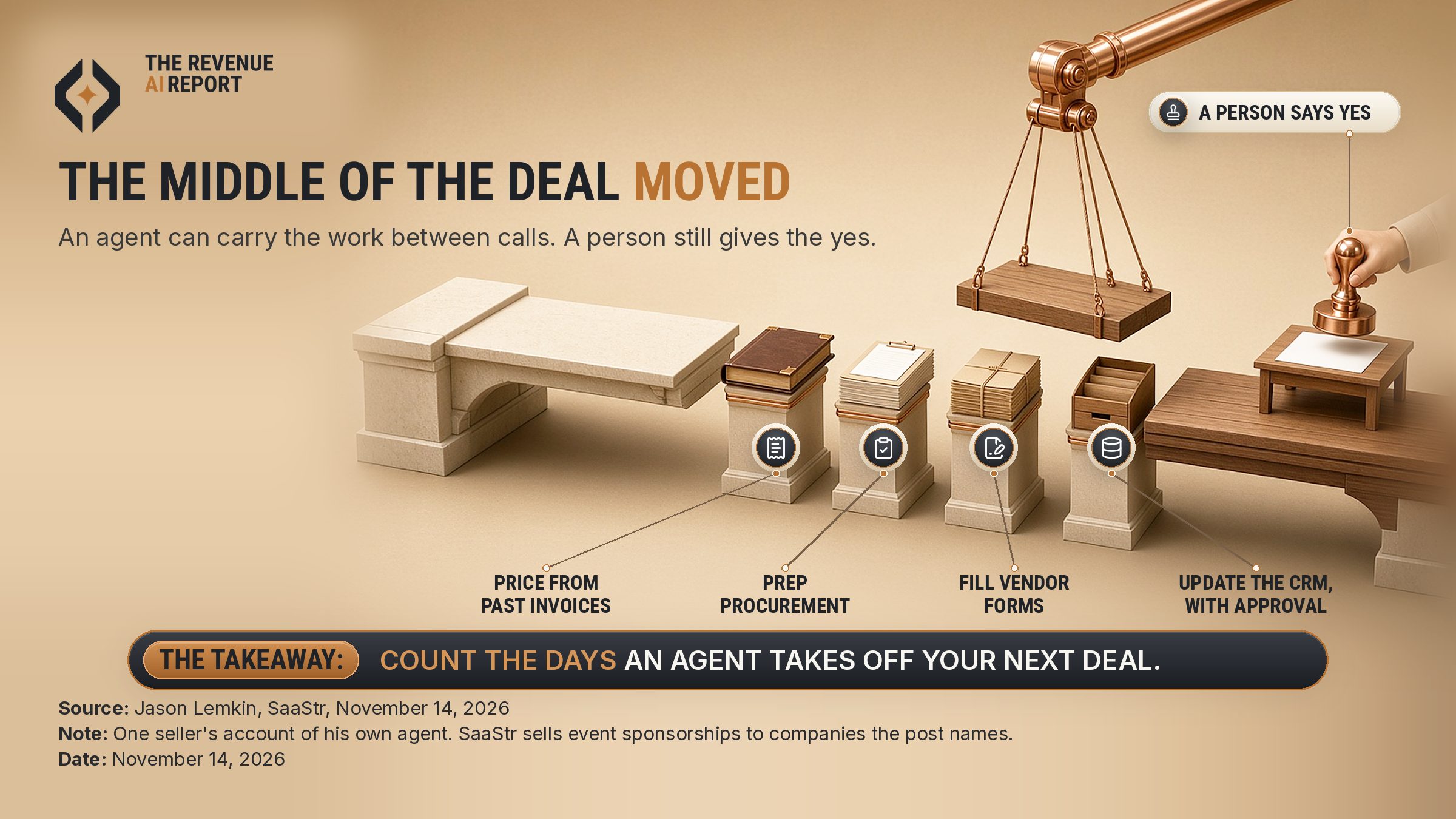
What Lemkin describes is a division of labor. He writes that the agent cannot close on its own. In his account, the work that stalls deals between calls (custom pricing, procurement questions, vendor paperwork, CRM updates) moved to an agent. He writes that the live conversation, the relationship, the judgment and the approval of every write and send stayed with a human. Revenue leaders in any industry can ask where that split sits on their own deals.
Here is the sequence as Lemkin describes it:
- The deck. While a session was still underway, 10K built a deck on how Replit, Vercel, and Lovable "performed at our show: Replit first, Vercel around fifth, Lovable around tenth." Lemkin does not name the metric. SaaStr's own October 14, 2026 leads leaderboard has Replit at #1 and Lovable at #9, and lists Vercel only among the rest of the top 25, so we cite these ranks only as what 10K's deck showed.
- Custom pricing. Base44 wanted work outside SaaStr's standard packages. Lemkin describes custom pricing that "usually takes a week," which 10K "had ... done the same afternoon." He writes that it "went through 13 years of SaaStr Annual emails and paid invoices" to estimate each custom item.
- Procurement prep. Before the procurement call, 10K flagged that Wix is Base44's parent company and listed "payment terms, T's and C's, the main points of contact, and who we'd collect from and how." "10K brings up collections on every deal, before the contract is signed."
- After the call. Lemkin writes that 10K processed the call transcript, "said it heard a verbal commit" and asked to move the deal to the Commit stage in SaaStr's CRM. It then "revised the T's and C's to match what Wix asked for, updated billing with the right addresses, and filled out Wix's vendor paperwork."
Amelia, the seller on SaaStr's side, ran every live call, held the relationship and made the judgment calls in the room, per Lemkin. She also had final approval on anything 10K wanted to write to the CRM or send.
The approval rule
Lemkin is plain about the gate: "A human approves every write and anything sent to a customer." He adds that SaaStr set it up "that way on purpose," and that "Approvals take a few seconds each."
His example comes from a different agent. The same week, he writes, Amelia's agent, Muse, "ordered $138 of flowers for her on its own after a deal closed, and we didn't know which card it would use." That was a different agent from 10K. Lemkin uses the episode to explain why a person still approves every write and send.
What the account does not settle
Lemkin reports one company's results with its own agent, written by the person who runs it. There is no control group, no outside audit and no count of days saved per deal. He also writes that renewal rates for SaaStr's $100K+ sponsors "went from the 20s to the 70s this year," that 10K called its own role "operational support," and that "We can't put a precise number on 10K's share." We treat the renewal change as context and credit none of it to the agent.
Our read
Our read is that the account is most useful as a map of where deals wait. In Lemkin's telling, the slow steps came between calls: pricing custom work, answering procurement questions and filling out vendor forms.
We think this reaches well past software and events. The examples below are our illustrations. The post covers only SaaStr's sponsorship sales.
- Manufacturing and distribution. A custom quote often depends on what the company charged for similar orders in past invoices.
- Insurance and financial services. RFPs and vendor paperwork pile up between meetings, and a person approving each send may fit the review these teams already run.
- Healthcare. Vendor onboarding packets can keep a deal waiting after both sides agree on terms.
On speed, our read is that if agents take on pricing and procurement prep, quote turnaround becomes part of how fast a team sells, and buyers' procurement teams may start sending agents of their own.
The test Lemkin suggests
Lemkin ends with a suggested test, which he does not report running: "pick your next five deals that need custom pricing or procurement. Connect an agent to your CRM, call transcripts, email and invoice history, and have it do everything except the calls. Then measure how many days it takes off each deal."
These are our suggestions for running it, by title.
- CRO. Pick the five deals and write down today's days for pricing, procurement and paperwork on each before the agent starts. Decide in advance what result would justify a wider rollout.
- Sales leaders. Keep the calls, the relationship and the judgment with the seller. Track how long each deal waits on the seller's yes for an agent's draft.
- RevOps. List what the agent can read (CRM, call transcripts, email, invoice history) and what it can change. Set the rule that a person approves every CRM write and every customer send, and log each approval.
Questions to settle before an agent works your deals
These are our questions, drawn from the account above.
- Which deals qualify. Which open deals need custom pricing or procurement, and how many days does each step take today?
- Is the history there. Can the agent reach past quotes and invoices, or does pricing still depend on one person's memory?
- Who says yes. Who approves each CRM write and each customer send, and how quickly?
- What does it raise early. Will the agent bring up payment terms, contacts and collections before the contract is signed?
- What counts as done. How will the team count days taken off a deal, and who reports the number?
Get the weekly Report: subscribe.
Hiring for revenue roles?
Post your sales, marketing, RevOps or enablement opening where revenue leaders read every week. One 30-day post is $199. Three featured posts are $299/mo.
Keep reading
Playbook
ChatGPT Can Act in Your Reps' Signed-In Browser. Write the Allowlist First.
Three decisions come before anyone turns it on: which sites stay read only, which actions wait for a human, and how an agent's edits get marked in your CRM.
Playbook
Meta's Oct 30 Ad Terms Make You Review Every AI-Made Ad. Name Who Signs Off.
Meta's Oct 30 terms make you review every ad its automation helps build. Name one approver, keep a per-campaign change record, and finish a 12-day checklist.