
Enso Raised $15 Million. The Humans Belong in the ROI Math.
Oct 1, 2026: CTech (Meir Orbach) reports Israeli startup enso raised a $15 million Series A led by MoreTech Ventures (NFX, Phenomen VC, Gil Hirsch participating). Total funding: $23 million. Model: AI agents for marketing and sales plus an engineer and a marketer embedded per customer, measured against a business and pipeline baseline. No official MoreTech/enso.bot wire found at check time. Before you treat the agent as the unit of value, put fully loaded human cost, baseline rules, playbook vs bespoke, and stop lines on the Order Form and pilot.
Jonathan Kvarfordt · Published October 1, 2026 · Last reviewed October 11, 2026 · 7 min read
The short answer
When Enso's Series A sells agent GTM with an engineer+marketer embedded per customer, which fully loaded ROI / human-cost / playbook-vs-bespoke lines belong on the Order Form and pilot before you count the agent as the unit of value?
Decision rule
Refuse to count the agent as the unit of value until fully loaded cost, embedded labor covered, baseline lock, confound log, attribution limit, playbook vs bespoke, handoff demo, named human owner, permission boundary, accepted-outcome + stop rule, and renewal reverse test are on paper. Soft-open price, meter, SKU, overage, site tiers, Dynamo/Wiliot, experiment lifts as buyer ROI, valuation beyond $15M/$23M, and GA. Do not invent beyond locked $15M Series A / $23M total / 26 headcount.
Evidence
- calcalistech.com/ctechnews/article/sy2ks2o9ml (Oct 1, 2026): CTech / Meir Orbach; enso $15M Series A led by MoreTech Ventures; NFX, Phenomen VC, Gil Hirsch; total funding $23M; Agentic Growth Hacking; engineer + marketer embed per customer; business and pipeline baseline; surfaces named (search/AI-answer, sales outreach, communities, newsletters, social); human control of strategy/brand/irreversible actions; customers named (Papaya Global, MyHeritage, Papaya Gaming, Natural Intelligence, Winn AI, Israel Canada); founder Mickey Haslavsky; founded 2024; headcount 26
- techtimes.com/articles/328315/20261001/enso-raises-15m-build-agentic-growth-hacking-category-redefine-agentic-gtm.htm (Oct 1, 2026): TechTimes secondary reprint with extra vendor detail; round totals align; forward-deployed language; outreach detail; experiment metrics; Dynamo/Wiliot extra customer names not in CTech; tag as soft
- therevenueaireport.com/reversal-ledger: log prior agent claims that later reverse
Operator action
Today: put fully loaded cost, embedded labor covered, baseline locked, confound log, attribution limit, playbook vs bespoke, handoff demo, named human owner, permission boundary, accepted-outcome + stop rule, and renewal reverse test on the Order Form and pilot before you count the agent as the unit of value. Soft-open seat price, meter, SKU, overage, site tiers, Dynamo/Wiliot, experiment lifts as buyer ROI, valuation beyond disclosed totals, GA. Checklist is buyer advisory.
Last reviewed
Enso raised $15 million. The humans belong in the ROI math.
Agent GTM with people in the loop. Your Order Form still needs fully loaded cost, baseline, and playbook-vs-bespoke lines before you credit the agent alone.
The argument
How this reality check breaks down
A map of the sections ahead, in the order the case is made. The sourced charts are in the research library.
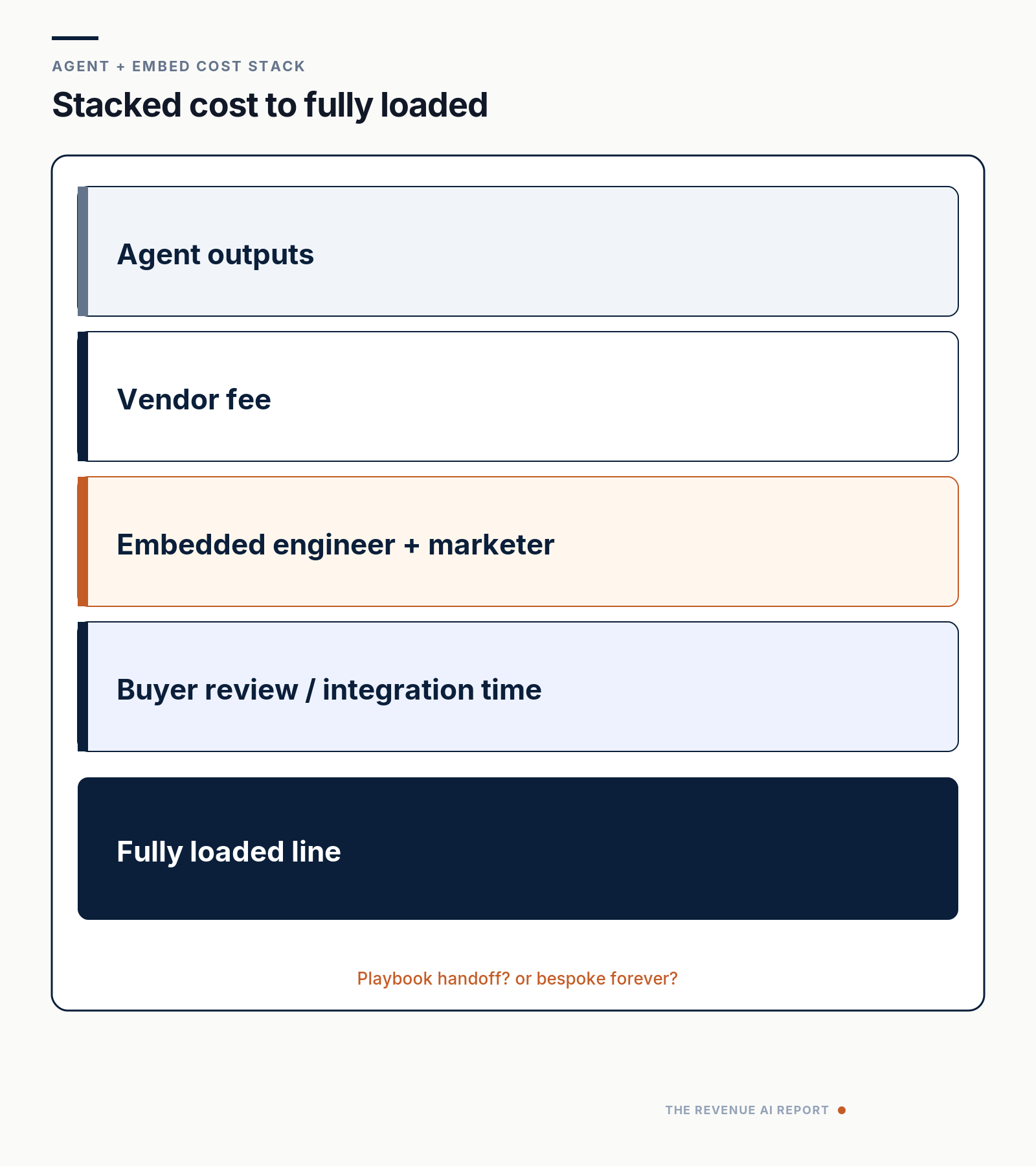
Contents diagram for Enso Raised $15 Million. The Humans Belong in the ROI Math., listing the sections: Enso Series A fully loaded ROI Order Form, Enso engineer marketer embed human cost, Agentic Growth Hacking playbook vs bespoke, Enso $15M Series A Order Form pilot checklist.enso's Series A funds "Agentic Growth Hacking": agents that test channels, plus an engineer and a marketer embedded with each customer. That is software and service in one buy. Count vendor fee, embedded labor covered by the fee, extras, and your own review time before you call the agent the unit of value. Do not invent a seat price, meter, or customer ROI. None are in the CTech report beyond the $15M / $23M round totals.
Why now
CTech / Meir Orbach, Oct 1, 2026 (MDT morning wire window). Primary journalistic source: CTech. Secondary reprint with extra vendor detail: TechTimes. No Business Wire / PR Newswire / MoreTech / enso.bot primary release located for this Series A at check time.
Reality Check
Enso Raised $15 Million. The Humans Belong in the ROI Math.
Source-cited charts live in the research library.
Enso Raised $15 Million. The Humans Belong in the ROI Math.. Diagram showing Evidence, Analysis, Decision, Outcome.Funding + model facts (LOCKED - CTech; TechTimes aligns on round)
- $15 million Series A led by MoreTech Ventures.
- Participants: existing investor NFX, Phenomen VC, Gil Hirsch.
- Total funding: $23 million.
- What they sell (reported): AI agent systems for marketing and sales; company term "Agentic Growth Hacking."
- Per-customer embed: an engineer and a marketer connect research to the customer's sales/marketing ops, systems, and brand; build agents around those workflows; measure against an established business and pipeline baseline.
- Surfaces named in CTech: search and AI-answer visibility, sales outreach, online communities, newsletters, social media.
- Human control (reported): marketers set strategy, brand boundaries, and which playbooks deploy; agents handle ongoing monitoring, testing, execution; sensitive or irreversible actions stay under human control.
- Customers named in CTech: Papaya Global, MyHeritage, Papaya Gaming, Natural Intelligence, Winn AI, Israel Canada.
- Founder: Mickey Haslavsky (CEO); co-founded RapidAPI; founded enso in 2024; coined "Agentic Growth Hacking"; writing a book under the same title.
- Headcount (CTech): 26 people, most based in Israel.
- Other CTech locks: publishes research including unsuccessful experiments; maintains open-source reference skills for AI agents.
Vendor-reported / secondary claims (tag - not buyer proof)
From TechTimes and vendor speech in coverage (soft-open; not independently verified here):
- Forward-deployed engineer + marketer language; weekly pipeline reporting vs start-of-engagement baseline.
- Outreach detail: email, LinkedIn, SMS, voice timed to prospect behavior (TechTimes) - finer than CTech's "sales outreach."
- Experiment metrics (LinkedIn reach lift, Reddit karma/inbound calls, Wikipedia citation survival, GitHub stars) - vendor study claims. Soft.
- Zack Keinan (MoreTech) category quote - investor speech.
- CTO Omry Hay; pivot from AI agent marketplace; RapidAPI acquired by Nokia 2024 - secondary bio claims.
- Extra customer names in TechTimes (Dynamo, Wiliot) - not in CTech; soft unless confirmed on buyer paper.
- Public enso.bot pricing pages ($49 / $199 tiers) conflict with "not self-serve / no price list" language elsewhere on the same site. Do not put site tiers on the Order Form as disclosed Series A economics. Soft-open until AE confirms.
Haslavsky quotes in CTech/TechTimes are vendor speech. Do not treat as measured buyer ROI.
Why the humans belong in the ROI math
The round sells agents and people. An engineer wiring systems and a marketer choosing which experiment gets budget are part of the product. If the ROI story credits only the agents, the cost side is incomplete.
Keep the humans. Count their work. Ask what remains when the embedded team thins out - a repeatable playbook your team can run, or a bespoke service that still needs expert hours.
If a prior agent claim later reverses, log it: Reversal Ledger.
Soft opens (do not invent)
- Seat / engagement price, meter, credit SKU, or consumption rate.
- How much of the fee covers the embedded engineer + marketer vs software.
- What triggers overage for extra human hours.
- Integration or GA calendar for any self-serve product.
- Customer win rates, pipeline $, or fully loaded ROI.
- Whether published experiment lifts transfer to your ICP.
- Staffing ratio as customer count grows (playbook reuse vs bespoke forever).
- Valuation, ownership %, or prior-round dollar split beyond the disclosed $15M / $23M totals.
Oct 11 update: Gartner puts a number on the exit problem
Gartner forecast on Sep 29, 2026 that by 2028, 70% of enterprises will abandon agentic AI built by vendor forward-deployed engineering (FDE), "trapped by soaring costs and unable to evolve it on their own." It is a prediction about one delivery model, vendor FDE.
Gartner also predicts that through 2028, less than 20% of FDE engagements will turn recurring customer needs into capabilities in the vendor's core product. For buyers, custom fixes may stay custom work you keep paying for.
Gartner wrote this for software engineering leaders. Applying it to revenue buyers is our reading. enso embeds an engineer and a marketer with each customer (CTech, above). Whether Gartner's FDE label fits that model is an open question. The exit risk has the same shape, so the lines below apply.
Gartner analyst Mukul Saha: "The best-scoped FDE engagements have clear guidelines on governance, business value delivery, IP ownership, project co-ownership, knowledge transfer, and an exit strategy from day one."
Buyer question: if the vendor's people built our agent, can our team run and change it the week after they leave?
Add three lines to the checklist below, one per Gartner phase:
- Before signing: knowledge-transfer deliverables with dates, and an executive sponsor accountable for the business outcome.
- During: we own the configuration: prompts, routines, eval sets and logs, in a form we can export.
- Exit: a written independence test, passed before any expansion.
For operators: before the embedded team rolls off, have your internal owner make one live change while the vendor watches. Change a routing or targeting rule, then roll back a bad release, with no vendor ticket. If that fails, the exit date moves and the expansion waits.
Order Form + pilot checklist (buyer advisory)
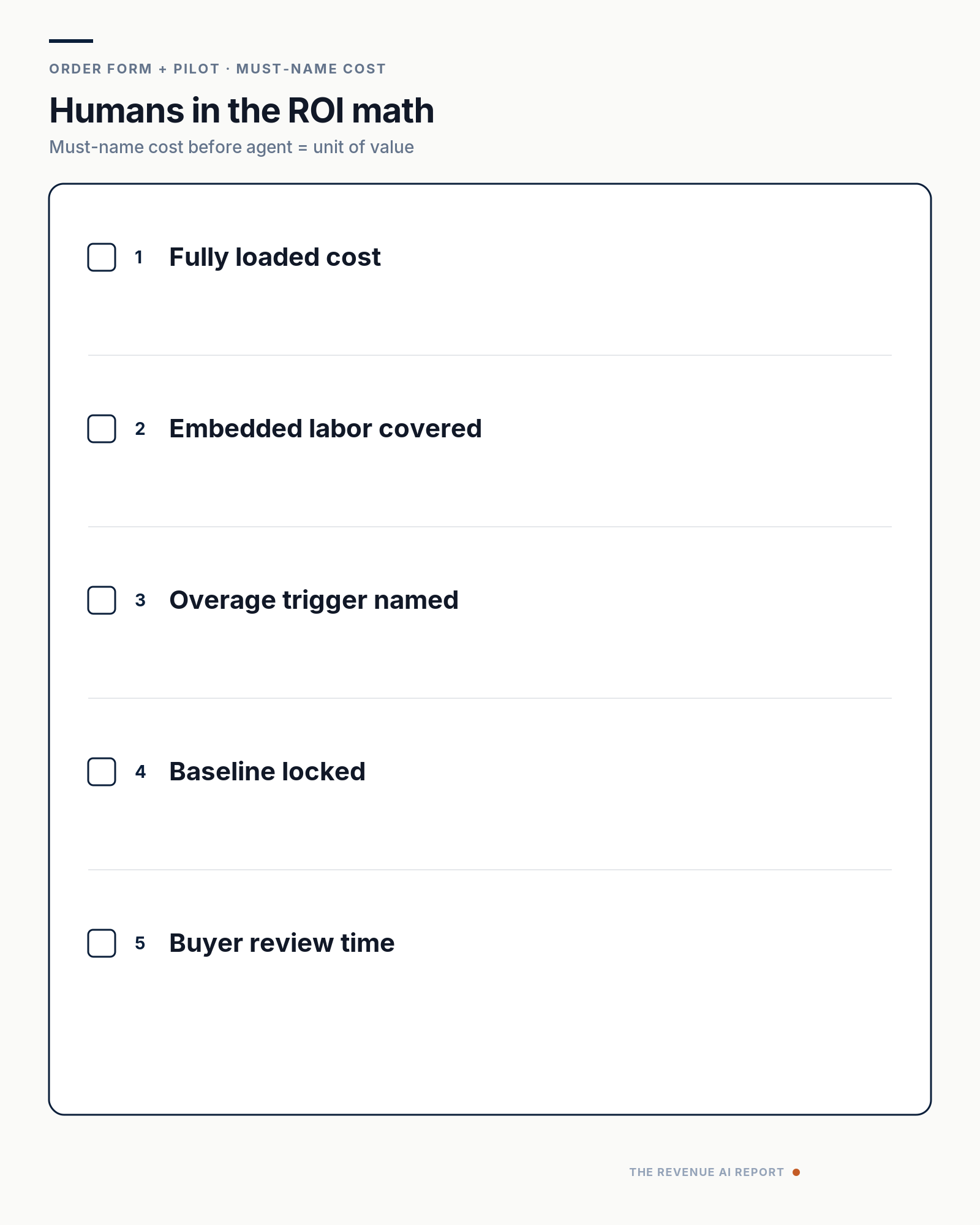
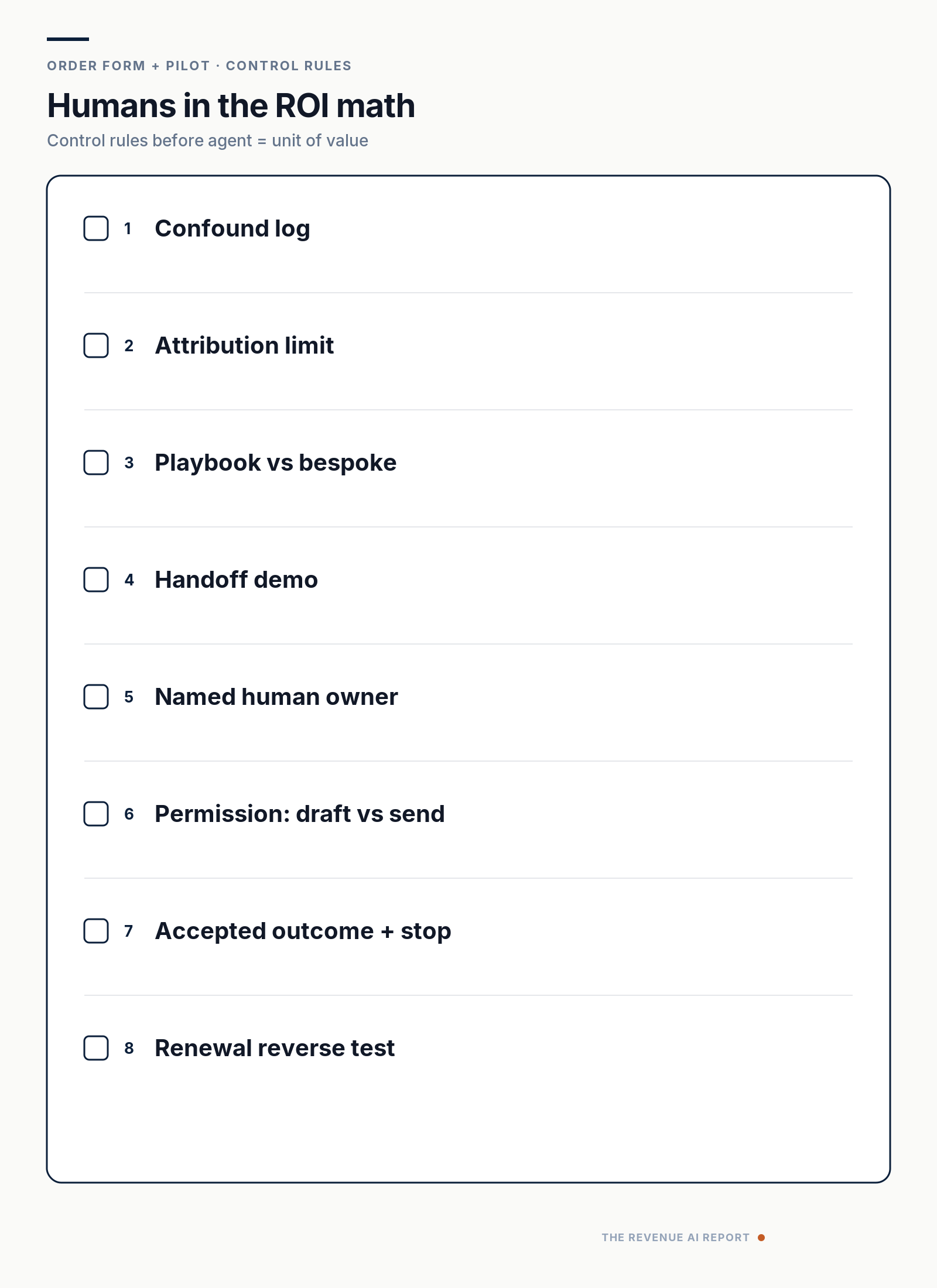
Write these before you count the agent as the unit of value. This checklist is buyer advisory. Get AE/legal to put language on the form. Do not claim fully loaded ROI language already exists on enso paper.
- Fully loaded cost line: vendor fee + separately billed services + usage + customer integration/review time. Blank for AE if missing.
- Embedded labor covered: what engineer + marketer hours the fee includes; what triggers extra charge.
- Baseline locked before agents start: comparison period; definition of qualified pipeline; who signs it.
- Confound log: ad spend, sales headcount, pricing, channel-mix changes recorded beside the experiment.
- Attribution limit: cross-channel credit rules (newsletter + community + outreach ≠ three wins on one opp). Holdout or staged rollout where business allows; else state confidence limits in writing.
- Playbook vs bespoke: conditions to re-run a successful experiment (data needed, agent decisions allowed, exception review, stop on decay or platform rule change).
- Handoff demo: can the customer team operate the workflow with a named support level? Staffing commitment and price if expert work stays permanent.
- Named human owner: one person who can stop runs and own irreversible actions - not "the team."
- Permission boundary: draft vs send / publish / write-back; surfaces named.
- Accepted-outcome + stop rule: what counts as a successful pilot; review date before expanding channels.
- Renewal / reverse test: what would keep the deployment; what would reverse it (ties to Reversal Ledger discipline).
Proof Gap
- Series A announce ≠ priced engagement, meter, or fully loaded ROI.
- Named logos ≠ your ICP, your baseline hygiene, or your win rate.
- Vendor experiment lifts ≠ production results on your stack.
- Embedded humans in the pitch ≠ those humans already priced on your Order Form.
- "Repeatable growth mechanism" (vendor claim) ≠ playbook your team can run after handoff.
Sources
- CTech / Meir Orbach (1 Oct 2026): calcalistech.com/ctechnews/article/sy2ks2o9ml
- TechTimes secondary (1 Oct 2026): techtimes.com/.../enso-raises-15m-...
- RAR Reversal Ledger: therevenueaireport.com/reversal-ledger
- Gartner press release, Sep 29, 2026: gartner.com
Soft CTA
New research lands in the weekly issue first. Subscribe
Take it to the room
The short list from this piece
Pulled from the argument above, written so you can read it out in a pipeline or board review.
Checklist diagram summarising Enso Raised $15 Million. The Humans Belong in the ROI Math.: CTech / Meir Orbach (1 Oct 2026); TechTimes secondary (1 Oct 2026); RAR Reversal Ledger; Gartner press release, Sep 29, 2026: gartner.com.Frequently asked questions
- What did enso raise?
- A $15 million Series A led by MoreTech Ventures, with NFX, Phenomen VC, and Gil Hirsch participating. Total funding: $23 million. Primary: CTech (Meir Orbach), Oct 1, 2026. No official MoreTech/enso.bot wire found at check time.
- What is the product model?
- Per CTech, AI agents for marketing and sales plus an engineer and a marketer embedded per customer, measured against a business and pipeline baseline. Company term: "Agentic Growth Hacking."
- Is there a disclosed seat or engagement price?
- Soft-open. CTech locks the $15M / $23M round totals and the embed model. Do not invent a seat price, meter, SKU, or site pricing tiers ($49/$199) as disclosed Series A economics.
- Are vendor experiment lifts buyer ROI?
- No. Experiment metrics in secondary coverage are vendor study claims. Soft. Do not treat as audited buyer results on your stack.
- What belongs on the Order Form before you count the agent as the unit of value?
- Fully loaded cost, embedded labor covered, baseline locked, confound log, attribution limit, playbook vs bespoke, handoff demo, named human owner, permission boundary, accepted-outcome + stop rule, and renewal reverse test. Checklist is buyer advisory until AE/legal put it on paper.
- What did Gartner predict about vendor forward-deployed engineering?
- Gartner predicts that by 2028, 70% of enterprises will abandon agentic AI built by vendor forward-deployed engineering (FDE), and that through 2028 less than 20% of FDE engagements will turn recurring customer needs into core product capabilities. Both are forecasts, from a Sep 29, 2026 release written for software engineering leaders.
Hiring for revenue roles?
Post your sales, marketing, RevOps or enablement opening where revenue leaders read every week. One 30-day post is $199. Three featured posts are $299/mo.
Subscribe
Get the next Reality Check before you sign the order form.
Keep reading
Reality Check
ChatGPT Ads Added Measurement. Price the Spend You Can't Measure Yet.
ChatGPT Ads added measurement partners, a redesigned Conversions page and visual ad tests while advertisers report mixed results. A six-line order form for B2B pipeline spend you can't measure yet.
Reality Check
The dashboard was green. The answer was wrong.
Most teams judge an AI assistant by whether it is up and fast. Those checks confirm the tool responded and leave the accuracy of the answer untested. AWS recently published a clear example of the gap, from its own sales tools.