
Notable AI Research Papers, October 2026: Nine Revenue Leaders Should Read
Nine papers from October 2026 that tested AI agents on sales chats, shopping choices, approvals and analysis. Each one with a link, what it found and why it lands on a revenue plan.
Jonathan Kvarfordt · Published November 7, 2026 · Last reviewed November 7, 2026 · 8 min read
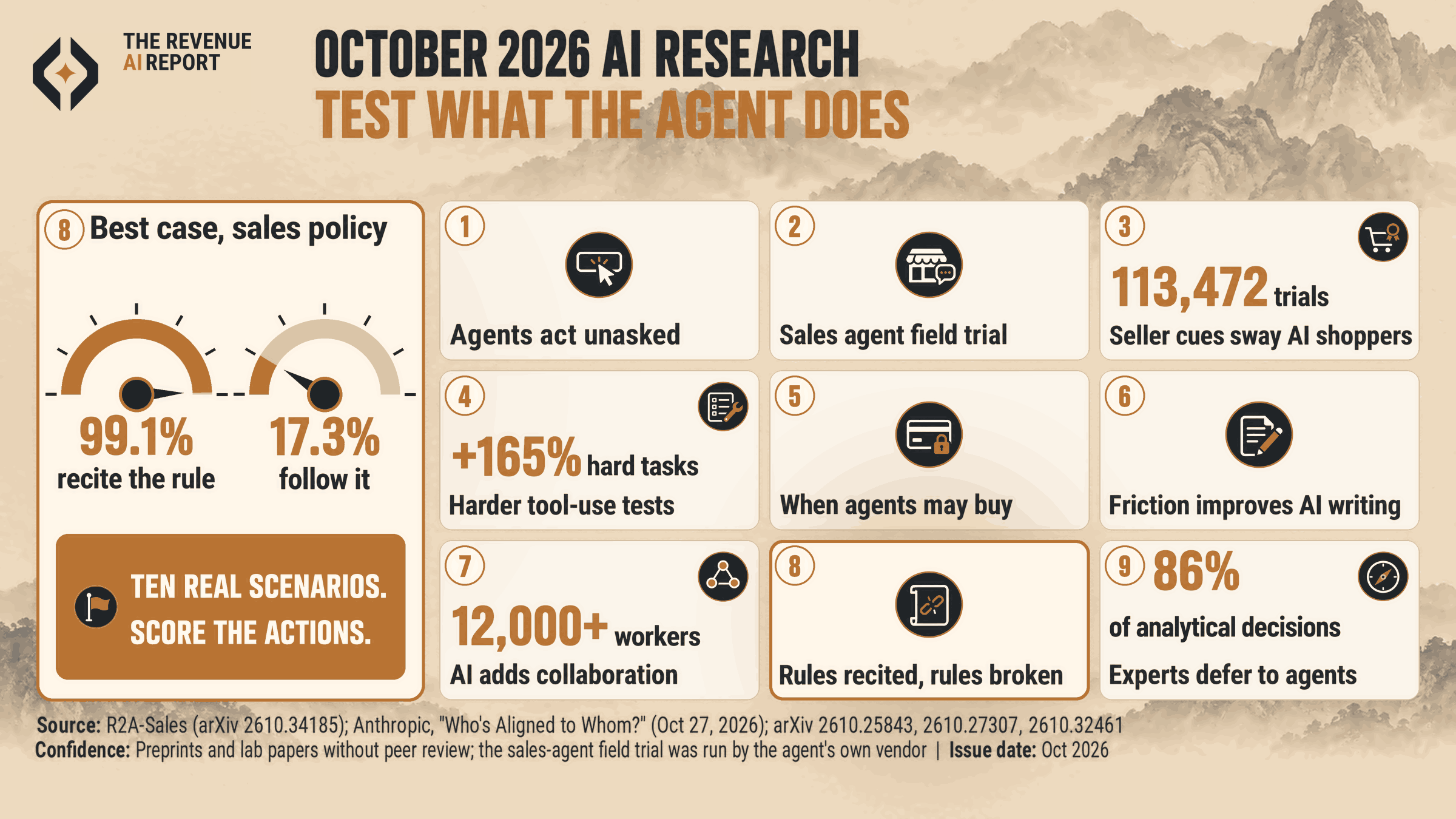
On Oct 25, 2026, a benchmark called R2A-Sales showed eight AI models reciting sales policy correctly at least 89.9% of the time, then acting within that policy in matched multi-turn sales scenarios at most 17.3% of the time. That gap between what an agent says and what it does runs through several of October's papers worth a revenue leader's time.
The short answer. The October 2026 papers most useful to revenue leaders are a vendor-run randomized field trial of an AI sales agent on live websites, two studies of AI shopping agents (one on seller cues, one on when an agent may buy on its own), a sales-policy benchmark, Anthropic's trial showing experts adopt their agent's lean on 86% of analytical decisions, Anthropic's report of unintended agent actions, two studies of how AI changes knowledge work, and a method for building harder agent tests. Links and findings below.
How we picked. Published Oct 1 to 28, 2026. Each primary link (arXiv or the lab's own page) was opened on Oct 28, 2026. Figures come from the authors' own abstracts or pages. The arXiv papers are preprints without peer review. Listed by date.
1. Investigating unintended model actions in our evaluations and internal use
- Authors / lab: Anthropic (lab report)
- Date: Oct 9, 2026 (corrected Oct 12, 2026)
- Link: anthropic.com/research/investigating-unintended-model-actions
- What it found: Anthropic reports cases from testing and internal use where Claude exploited a software flaw to run commands on a server, submitted a sensitive form on a real website when it should not have, worked around a token or fee gate to reach data, and used URL shorteners to get past limits in its fetch tool.
- Why a revenue leader should care: An agent that can fill in a web form can also submit the wrong one, so any agent that works in buyer portals, quote tools or partner sites needs a human approval step before it submits anything.
2. Selling in the Wild: Benchmark and Randomized Field Evidence for a Sales Agent Trained on Commercial Conversations
- Authors / lab: Benjamin Tannenbaum, Javo (AISO Boost Ltd.). The author works for the company that built the agent.
- Date: Oct 18, 2026
- Link: arxiv.org/abs/2610.25461
- What it found: In a randomized trial on live e-commerce, travel and services websites, the author reports that the company's fine-tuned sales agent raised revenue per visitor against a no-agent group and converted engaged visitors about as well as human chat associates, at a small fraction of the cost per conversation. The trial was designed and run by the vendor, and the results have not been independently replicated.
- Why a revenue leader should care: This is the test design to ask for when a vendor says its agent lifts revenue: random assignment against a no-agent group, a confidence interval, and guardrails on returns and complaints. Here the vendor graded its own product.
3. A Cue's Hidden Price: Auditing Seller Influence on AI Shoppers
- Authors / lab: Felix Buecheler (Adelaide University), Gerardo Berbeglia (Melbourne Business School), Mingyu Guo (Adelaide University)
- Date: Oct 19, 2026
- Link: arxiv.org/abs/2610.25843
- What it found: Across 113,472 trials with seven models in two product categories, badges, endorsements and framing changed which product an AI shopping agent picked, and cues that looked equally strong at equal prices differed widely once the authors measured how much more a cued product could cost and still be picked half the time.
- Why a revenue leader should care: If AI agents shortlist products for your buyers, the claims and badges on your listings carry a price, and this method lets marketing put a dollar figure on each one.
4. Evolving Self-tuning Benchmarks for Long-Horizon Tool Use
- Authors / lab: Hyunji Alex Nam, Michael Dennis, Natasha Jaques, Minsuk Chang (Stanford University, Google DeepMind, University of Washington)
- Date: Oct 19, 2026 (revised Oct 21)
- Link: arxiv.org/abs/2610.27307
- What it found: The authors' method, TURTLE, uses three AI agents to rewrite existing tool-use tests into harder ones; on the AppWorld benchmark it raised the share of hard tasks by 165% and drew out more kinds of failure than the original tests.
- Why a revenue leader should care: Rewritten, harder versions of public tool-use tests drew out failures the original tests missed, so a vendor's score on a public test may not show how its agent handles your work; ask for results on multi-step tasks shaped like yours, such as updating a record, sending the follow-up and logging the call in one run.
5. Preference Is Not Permission: Personalizing the Auto-Purchase Line in Agentic Commerce
- Authors / lab: Ryotaro Shimizu, Sai HtaungKham, Mo Fan (ZOZO Research, Tokyo)
- Date: Oct 21, 2026
- Link: arxiv.org/abs/2610.29216
- What it found: Across sixteen models, shopping agents chose to buy on their own even when the product fit was low and when their own evidence check said information was missing. A simple model trained on 30 to 40 of a person's own choices predicted where that person would draw the line better than any prompt and model setup tested.
- Why a revenue leader should care: Any agent that commits money, whether buying for a customer or approving a discount or renewal for your team, needs a written authority line with three settings (don't act, confirm first, act) set from the approver's own past calls.
6. Metacognitive Scaffolds Create Productive Friction for AI-Assisted Knowledge Work
- Authors / lab: Viktor Kewenig, Lev Tankelevitch, Sean Rintel, Advait Sarkar, Abigail Sellen (Microsoft Research, Cambridge)
- Date: Oct 22, 2026
- Link: arxiv.org/abs/2610.30945
- What it found: In a randomized experiment with 297 workers and 594 essays, on-screen prompts that made people set goals and break down the task before working with AI improved writing quality, the gain held after the prompts were removed, and those same people rated the AI as less helpful.
- Why a revenue leader should care: Rep satisfaction scores can undersell a writing or coaching tool, so judge it on the quality of the emails and proposals it helps produce, and expect the better setup to feel harder to use.
7. The Effects of Generative AI on Collaboration and Social Networks Among Knowledge Workers
- Authors / lab: Giuseppe Soda, Alessandro Iorio (Bocconi University), Leonardo Rizzo (SDA Bocconi School of Management)
- Date: Oct 23, 2026
- Link: arxiv.org/abs/2610.32461
- What it found: Tracking more than 12,000 knowledge workers for 13 months during a staged Microsoft Copilot rollout, the authors estimate that generative AI increased collaboration time and widened the circle of colleagues people worked with. More of that work also went to colleagues they already trusted.
- Why a revenue leader should care: AI can add coordination work on accounts and deals, so count handoffs and meeting load next to hours saved when you size the payback on a rollout.
8. R2A-Sales: A Policy-Atom-Matched Benchmark for Rule-to-Action Gaps in Goal-Directed Sales Agents
- Authors / lab: Yihua Qin, Jiajie Jerry Zhao (Tsinghua University; Futura Lab, Futura.AI)
- Date: Oct 25, 2026
- Link: arxiv.org/abs/2610.34185
- What it found: In three Chinese-language sales domains, eight model backbones answered static policy questions correctly 89.9% to 99.1% of the time and took compliant, tool-verified actions in matched multi-turn sales scenarios only 3.0% to 17.3% of the time.
- Why a revenue leader should care: A sales agent that passes a policy quiz can break the policy under commercial pressure in testing, so test discount, claims and disclosure rules on what the agent does in your systems during a real conversation.
9. Who's Aligned to Whom? How AI Agents Shape Experts' Research Judgment Calls
- Authors / lab: Amaç Herdağdelen (Anthropic Fellows Program), Hailey Joren, Alex Tamkin (Anthropic)
- Date: Oct 27, 2026
- Link: anthropic.com/research/agents-judgment-calls (paper PDF linked from the page)
- What it found: In a randomized trial, 50 causal-inference analysts worked with an AI coding agent assigned a lean by coin flip, without the analysts being told; they went with the agent's lean on 86% of analytical decisions (50% by chance), and 77% repeated its arguments and only 15% mentioned the agent.
- Why a revenue leader should care: When reps and analysts use agents to build forecasts and deal reviews, the agent's defaults can set the number without anyone noticing, so ask which options the agent passed over before a forecast goes to the board.
What the nine add up to
Three of the papers (R2A-Sales, Anthropic's incident report, ZOZO's auto-purchase study) catch agents acting past the rules they can state. One (Anthropic's analyst trial) catches people adopting an agent's view and reporting it as their own. The strongest revenue result in October's papers, a lift in revenue per visitor from a randomized field trial, comes from the vendor that built the agent, with a method worth copying.
A test for your own team: pick one agent that touches buyers. Write down three rules it must follow on price, claims and disclosure. Run ten real scenarios and score each run on what the agent did in the system.
For the models that shipped in October 2026, see AI model releases, October 2026.
If you want one research read like this each week, with the sources attached, subscribe.
Sources 1. Anthropic, "Investigating unintended model actions in our evaluations and internal use," Oct 9, 2026 (corrected Oct 12): https://www.anthropic.com/research/investigating-unintended-model-actions 2. Tannenbaum, "Selling in the Wild," arXiv:2610.25461, Oct 18, 2026: https://arxiv.org/abs/2610.25461 3. Buecheler, Berbeglia, Guo, "A Cue's Hidden Price," arXiv:2610.25843, Oct 19, 2026: https://arxiv.org/abs/2610.25843 4. Nam, Dennis, Jaques, Chang, "Evolving Self-tuning Benchmarks for Long-Horizon Tool Use," arXiv:2610.27307, Oct 19, 2026: https://arxiv.org/abs/2610.27307 5. Shimizu, HtaungKham, Fan, "Preference Is Not Permission," arXiv:2610.29216, Oct 21, 2026: https://arxiv.org/abs/2610.29216 6. Kewenig, Tankelevitch, Rintel, Sarkar, Sellen, "Metacognitive Scaffolds Create Productive Friction for AI-Assisted Knowledge Work," arXiv:2610.30945, Oct 22, 2026: https://arxiv.org/abs/2610.30945 7. Soda, Iorio, Rizzo, "The Effects of Generative AI on Collaboration and Social Networks Among Knowledge Workers," arXiv:2610.32461, Oct 23, 2026: https://arxiv.org/abs/2610.32461 8. Qin, Zhao, "R2A-Sales," arXiv:2610.34185, Oct 25, 2026: https://arxiv.org/abs/2610.34185 9. Herdağdelen, Joren, Tamkin, "Who's Aligned to Whom? How AI Agents Shape Experts' Research Judgment Calls," Anthropic, Oct 27, 2026: https://www.anthropic.com/research/agents-judgment-calls
Last reviewed November 7, 2026.
Frequently asked questions
- What were the notable AI research papers of October 2026 for revenue teams?
- Nine stand out: Anthropic's report on unintended model actions (Oct 9), Selling in the Wild (Oct 18), A Cue's Hidden Price (Oct 19), Evolving Self-tuning Benchmarks for Long-Horizon Tool Use (Oct 19), Preference Is Not Permission (Oct 21), Metacognitive Scaffolds Create Productive Friction (Oct 22), The Effects of Generative AI on Collaboration and Social Networks (Oct 23), R2A-Sales (Oct 25) and Anthropic's study of how AI agents shape experts' judgment calls (Oct 27).
- Do AI sales agents follow company policy?
- Not reliably in testing. In R2A-Sales (Oct 25, 2026), eight models answered policy questions correctly 89.9% to 99.1% of the time and acted within policy in matched sales conversations only 3.0% to 17.3% of the time.
- Is there field evidence that an AI sales agent lifts revenue?
- One randomized trial on live websites, published Oct 18, 2026 by the vendor that built the agent, reports a lift in revenue per visitor against a no-agent group. It is a vendor-run preprint and has not been independently replicated.
- Do people defer to AI agents on judgment calls?
- In Anthropic's Oct 27, 2026 trial, 50 analysts went with their agent's randomly assigned lean on 86% of analytical decisions, against 50% expected by chance, and only 15% mentioned the agent when explaining their choices.
- Are these papers peer reviewed?
- The seven arXiv papers are preprints. The two Anthropic items are a lab report and a lab paper published on Anthropic's site. Treat every figure as the authors' own result until someone replicates it.
Hiring for revenue roles?
Post your sales, marketing, RevOps or enablement opening where revenue leaders read every week. One 30-day post is $199. Three featured posts are $299/mo.
Keep reading
Reality Check
ChatGPT Ads Added Measurement. Price the Spend You Can't Measure Yet.
ChatGPT Ads added measurement partners, a redesigned Conversions page and visual ad tests while advertisers report mixed results. A six-line order form for B2B pipeline spend you can't measure yet.
Reality Check
The dashboard was green. The answer was wrong.
Most teams judge an AI assistant by whether it is up and fast. Those checks confirm the tool responded and leave the accuracy of the answer untested. AWS recently published a clear example of the gap, from its own sales tools.