
Your Rank Tracker Can Report a Drop That Never Happened
On October 10, rank-tracking firm Nozzle published research saying 8.0% of the Google results pages it judged since September 13 were swapped out, against 0.17% before. Those pages looked normal, with no error message and no captcha, so a rank tracker would store them as real and report a crash.
Jonathan Kvarfordt · Published October 15, 2026 · Last updated October 15, 2026 · 5 min read
On October 10, rank-tracking firm Nozzle published research saying 8.0% of the Google results pages it judged since September 13 were swapped out, against 0.17% before. Those pages looked normal, with no error message and no captcha, so a rank tracker would store them as real and report a crash.
If your team moves budget or rewrites pages when a tracker shows a drop, it is worth testing the tracker first.
What Nozzle says it found
All figures below are company-stated by Nozzle. Nozzle sells rank tracking, so it has a stake in this story.
- Nozzle's study sample holds 27.5 million results pages collected since September 13 and judged 17.8 million of them against each keyword's usual history.
- Poisoned pages first appeared September 20. On the worst days, September 27 to 29, they made up about a quarter of all pages. Since October 1 they have run at about 5 to 11% a day.
- On a poisoned page, the organic results kept 20.7% of the previous page's sites. Before, they kept 88.5%.
- For keywords where a project's own site is usually in the top 10, that site missed the top 10 on 58.6% of poisoned pages, against 2.7% in the baseline and 10.2% on the same keywords' other pages since September 13.
- AI Overviews appeared on 34.9% of poisoned pages, against 54.2% in the baseline. The AI Overview sources that did appear kept 42.3% of the previous sources, against 68.8%.
- Ads held steadier. They kept 83.7% of the previous advertisers, against 70.6% in the baseline.
- 77.9% of poisoned pages had their usual sites back within three days (of those re-checked within three days).
"Poisoned" is Nozzle's word and Nozzle's reading. Nozzle defines it this way: fewer than half of a keyword's usual sites appear, and at least 80% of the usual sites are back within 14 days. A keyword's usual sites are the ones in its top 10 on at least 60% of checks from August 20 to September 9.
Why this hits outside software
Some industries took more of it than others. In Nozzle's US data, legal pages ran 15.9% poisoned since September 13. Insurance ran 9.9%, finance and banking 9.3%, software and technology 8.8%. A law firm, an insurer, or a regional bank reading a weekly SEO report may be reading the worst of it.
The cost lands in the meeting. A chart shows the firm fell out of the top 10. Someone proposes new content, a paid search top-up, or an agency review. If that chart came from a swapped page, the whole discussion rests on a ranking that searchers may never have seen.
How a fake page becomes a real decision
Nozzle explains the mechanism. A refused request tells a scraper to try again. A complete page with wrong results gets stored as real. The tracker has nothing to flag, so it draws a line down, and the dashboard passes that line along to whoever opens it on Monday.
An AI Overview tracker has the same weakness. If the Overview is missing or its sources shift on a fake page, the report says your citations dropped. Nozzle's numbers suggest that report would often be wrong.
Prove the tool before you act
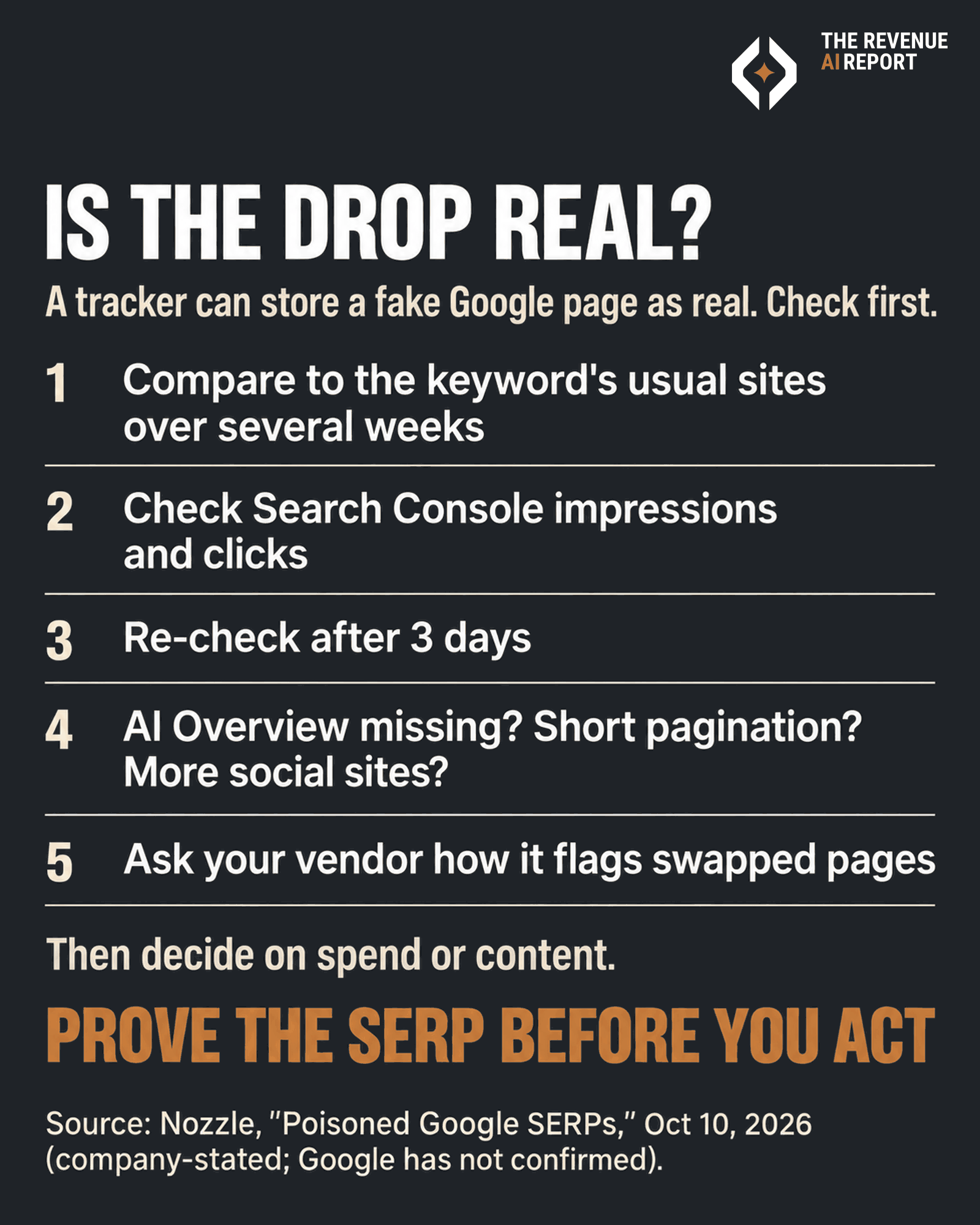
Run these checks before any budget or content change based on a tracker drop:
- Compare the page to the keyword's usual sites over several weeks. Nozzle warns that yesterday alone may also be poisoned.
- Check Search Console. If impressions and clicks held steady, the drop is less likely to be real.
- Wait three days and pull again. Nozzle says most spells end within that window, so a drop that is still there after three days deserves a closer look.
- Look at the shape of the page. Missing AI Overview, fewer "People also search for" blocks, more image packs, more social sites, and short pagination are all signs Nozzle lists. Nozzle says none is reliable alone.
- Ask your vendor in writing how it detects swapped pages and whether it flags them.
The counter-view
Google has not confirmed any of this. Neither Nozzle's page nor SEJ's coverage includes a Google statement. Treat the cause as unproven.
Nozzle's own data allows another reading. It reports that over the same days, one of its collection routes returned 1 to 7% poisoned pages and another returned 9 to 30%. If the route changes the rate that much, part of the effect may sit in how a tracker collects pages. Your tracker may see more or less of it than Nozzle did.
The motive is also open. Nozzle calls it Google's response to AI scraping. Roger Montti, writing in Search Engine Journal on October 14, offered a different possible target: spammers trying to reverse engineer how pages rank. He framed that as his opinion. Nozzle's data does not settle which, if either, is right.
Finally, the data comes from customer datasets: scraped pages, not what users saw. Because a page only counts as poisoned after its usual sites return, the most recent days undercount. Nozzle makes no claim about how many real searchers saw these pages.
Sources
Next time a chart shows a crash, pull Search Console before you call the meeting.
Frequently asked questions
- Did Google confirm it is poisoning search results?
- No. "Poisoning" is Nozzle's interpretation. Neither Nozzle nor Search Engine Journal cites a Google statement.
- How common were the swapped pages?
- Nozzle says 8.0% of 17.8 million judged pages since September 13, against 0.17% before, with about 5 to 11% a day since October 1. These are company-stated figures.
- Does this affect AI Overview tracking?
- Per Nozzle, AI Overviews appeared on 34.9% of poisoned pages against 54.2% in the baseline. A tracker could report lost AI Overview citations that real searchers never lost.
- How do I tell a fake drop from a real one?
- Check Search Console, compare against several weeks of the keyword's usual sites, and re-check after three days. Nozzle says 77.9% of poisoned pages recovered within three days (of those re-checked within three days).
- Should we stop using rank trackers?
- Nothing in the research points that way. What it does point to is checking the tracker before you act on a sudden drop, and asking your vendor how it flags swapped pages.
Hiring for revenue roles?
Post your sales, marketing, RevOps or enablement opening where revenue leaders read every week. One 30-day post is $199. Three featured posts are $299/mo.
Keep reading
Reality Check
ChatGPT Ads Added Measurement. Price the Spend You Can't Measure Yet.
ChatGPT Ads added measurement partners, a redesigned Conversions page and visual ad tests while advertisers report mixed results. A six-line order form for B2B pipeline spend you can't measure yet.
Reality Check
The dashboard was green. The answer was wrong.
Most teams judge an AI assistant by whether it is up and fast. Those checks confirm the tool responded and leave the accuracy of the answer untested. AWS recently published a clear example of the gap, from its own sales tools.