
AdGraam Raised ₹3 Crore for AI Ad Creative. A 3.7x ROAS Is Where the Test Starts.
AdGraam raised ₹3 crore on Oct 15 for AI ad creative. Its 3.7x ROAS example is company-reported. Six ledger lines to test a winning ad on margin.
Jonathan Kvarfordt · Published October 15, 2026 · Last updated October 15, 2026 · 6 min read
On October 15, 2026, AdGraam, an India-based platform that researches, generates and analyzes ad creative for paid campaigns, raised ₹3 crore (₹30 million) in seed funding. Umair Mohammad, co-founder of Nitro Commerce, led the round. (ETEntrepreneur)
The headline example in the announcement: one AI-generated video for a footwear brand scaled to about ₹40 lakh (₹4 million) in media spend at around 3.7x return on ad spend. That number is company-reported. It is a fair reason to run a test. It does not yet tell you whether the ad made money.
What was announced
- Round: ₹3 crore seed, led by Umair Mohammad. AdGraam says it will spend it on team growth, sales and marketing, and international expansion.
- Product: creative research, ideation, ad generation and performance analysis in one platform. It can use a brand's own ad-account data and competitor ads as context for the models that generate the ads.
- How it sells: a self-serve platform on pay-as-you-go credits, plus a managed studio. Co-founder Saad Mohammad told ETEntrepreneur the business is split roughly equally between the two.
- Customers (company-reported): more than 40 brands in footwear, fashion, hair care, wellness, oral care, and beauty and personal care.
- Founders: Ashish Verma, Saad Mohammad, Sahil Bhatnagar and Saksham.
Why creative volume went up
Saad Mohammad's explanation is worth reading if you run paid media in any industry. He said ad platforms now use the creative itself as a signal to decide who sees an ad. A business spending more than ₹1 crore on ads could need 20 to 25 videos a week, he said, against the three to four static ads and one or two videos it used to test.
That is the job AdGraam is built for: more variations, tested faster. It also means more ads competing for credit in the same report.
What 3.7x ROAS leaves out
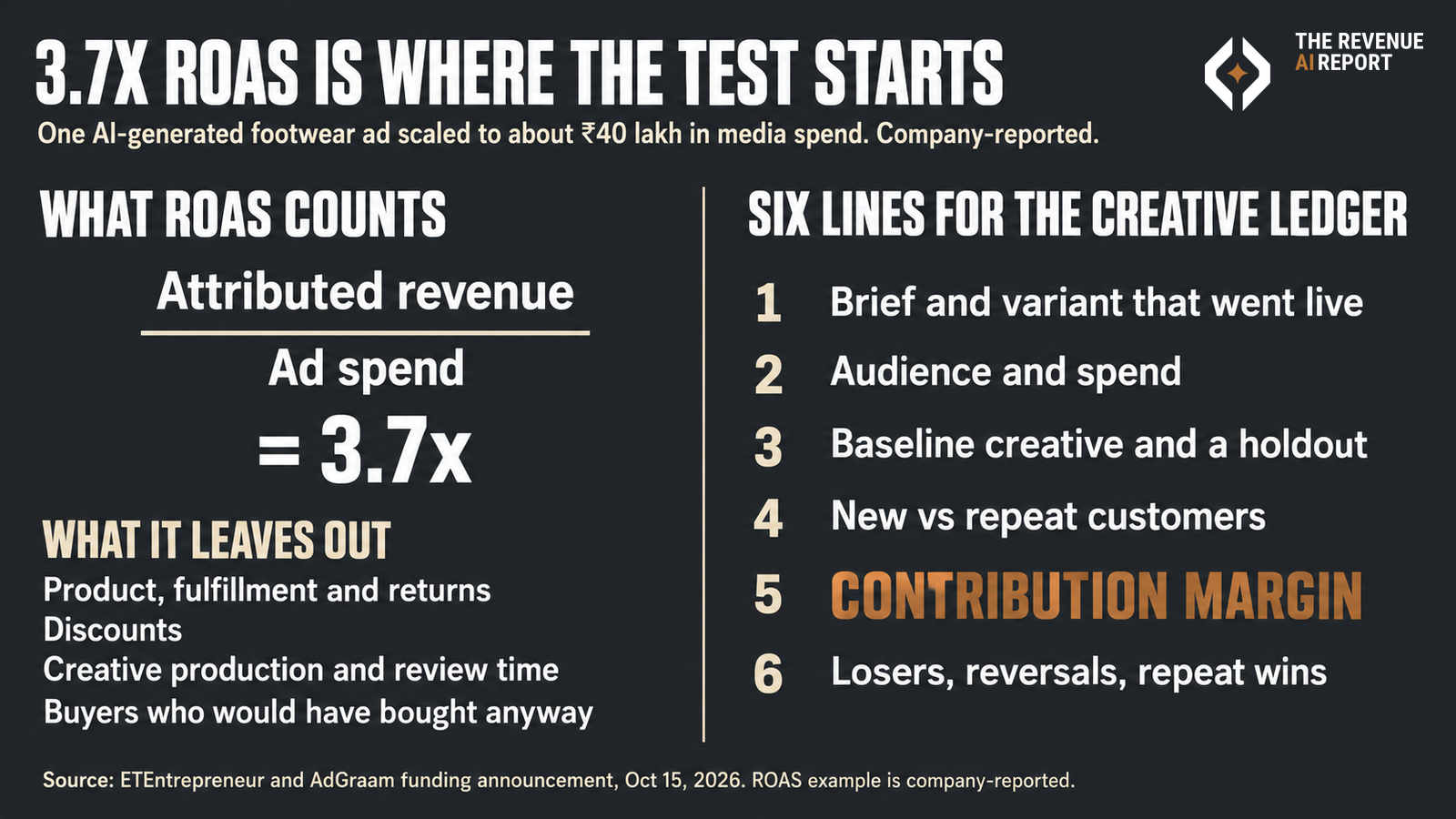
ROAS divides attributed revenue by ad spend. It leaves out:
- product cost, fulfillment and returns
- discounts used to close the order
- what it cost to produce, review and fix the creative
- buyers who would have purchased anyway
A high-ROAS ad on a thin-margin product can still lose money. One winning video can also come from a strong offer, a good season or a lucky audience. The question for a revenue leader is simple: did this creative add profitable customers compared with what we would have run anyway?
Six lines for the creative ledger
This is the Reversal Ledger applied to one ad at a time:
- Brief and variant. What the system proposed and which version went live.
- Audience and spend. Who saw it and what the media cost.
- Baseline and holdout. The brand's prior creative for the same product, plus a holdout group that did not see the new ad.
- New versus repeat customers. First orders split from repeat buyers.
- Contribution margin. After product cost, fulfillment, discounts, returns and production cost, including the hours spent reviewing or repairing generated assets.
- Losers and reversals. Which variants lost, why the team stopped them, and whether the winner held up across products, audiences and weeks.
Who owns which line
- CMO or head of performance marketing: sets the baseline every new creative must beat, and the margin floor for scaling spend.
- CRO or revenue lead: decides whether the goal is new customers, repeat revenue or both, so the ledger scores the right thing.
- Finance: contribution margin after returns, discounts and production cost.
- Creative and brand leads: claims review, local context and what generated assets need before they run. AdGraam's founders describe the tool as a way to test more angles and give creators sharper briefs. The work shifts toward people who design the test and judge the result.
- Marketing operations or RevOps: joins ad data to orders, returns and margin so the ledger can be filled in at all.
What to do this week
- Pull your top five ads by ROAS from the last 30 days.
- For each one, add contribution margin per order and the share of first-time customers.
- Re-rank the five on margin. If the order changes, your scaling rule should change with it.
- Before you scale any AI-generated winner, run it against a holdout for two weeks.
This works the same way for a footwear brand, an insurer buying leads, a regional bank running acquisition ads or a manufacturer's dealer co-op program. Only the product and the margin math change.
The counter-view
Testing creative at volume has real value. If platforms reward variety, a team that tests 25 videos a week learns faster than a team that tests five, and cheaper production makes that possible. Holdouts also cost money and time, and a small brand may not have the volume for a clean read. For that team, a simpler check is enough to start: margin per order and first-time customer share, compared with last quarter's creative.
Related
- Holo Raised €5M for Marketing Autopilot. Check Margin Before You Approve.
- Marklo Raised $5M to Tell Brands What to Market Next. Grade Every Pick on Margin.
- Miracly Raised €1.8M to Rank Brands in AI Answers. Put Visibility on a Funnel Ledger.
- Reversal Ledger
Sources
- ETEntrepreneur, "AdGraam raises ₹3 crore seed funding," Oct 15, 2026: entrepreneur.economictimes.indiatimes.com
- Passionate in Marketing, AdGraam funding announcement with the footwear campaign example (company-reported), Oct 15, 2026: passionateinmarketing.com
- AdGraam company page: adgraam.com
If you want the next funding round checked against margin the same way, subscribe.
Frequently asked questions
- How much did AdGraam raise?
- On October 15, 2026, AdGraam raised ₹3 crore (₹30 million) in seed funding led by Umair Mohammad, co-founder of Nitro Commerce.
- What does AdGraam do?
- AdGraam combines creative research, ideation, ad generation and performance analysis for brands running paid campaigns. It can use a brand's ad-account data and competitor ads as context, and it sells a pay-as-you-go self-serve platform and a managed studio.
- Is the 3.7x ROAS figure independent?
- No. The example of one AI-generated footwear video scaling to about ₹40 lakh in media spend at around 3.7x ROAS is company-reported. ROAS also leaves out product cost, returns, discounts, production cost and buyers who would have purchased anyway.
- How should a marketing leader test an AI-generated winning ad?
- Log the brief, variant, audience and spend, compare it with prior creative and a holdout, split new from repeat customers, compute contribution margin after all costs, and record which variants lost and whether the winner held up across later weeks.
Hiring for revenue roles?
Post your sales, marketing, RevOps or enablement opening where revenue leaders read every week. One 30-day post is $199. Three featured posts are $299/mo.
Keep reading
Reality Check
ChatGPT Ads Added Measurement. Price the Spend You Can't Measure Yet.
ChatGPT Ads added measurement partners, a redesigned Conversions page and visual ad tests while advertisers report mixed results. A six-line order form for B2B pipeline spend you can't measure yet.
Reality Check
The dashboard was green. The answer was wrong.
Most teams judge an AI assistant by whether it is up and fast. Those checks confirm the tool responded and leave the accuracy of the answer untested. AWS recently published a clear example of the gap, from its own sales tools.