
What Must Be Written on the Order Form (and SI SOW) Before We Fund FDE-Led Agentforce: Max Entitlements, Flex Multipliers, Outcomes Definition, and CSAT Ownership?
Max, Flex, outcomes, and FDE fees can stack on one Agentforce buy. Diginomica (Katy Ring, Sep 25 2026) reports Salesforce naming Max, consumption, and Service outcomes while SIs still struggle to price a three-to-five-year commitment. Own Order Form and SI SOW uncertainty before you fund the FDE motion. Soft subscribe only.
Jonathan Kvarfordt · Published September 25, 2026 · 9 min read
The short answer
What must be written on the Order Form (and SI SOW) before we fund FDE-led Agentforce: Max entitlements, Flex multipliers, outcomes definition (resolution vs deflection), and who owns CSAT when handoff fails?
Decision rule
Own the stack on the Order Form and SI SOW. Refuse unsigned outcomes definitions, open-ended Flex with no ceiling, and FDE SOWs without rate clarity. Assign CSAT ownership on failed handoff before go-live.
Evidence
- Diginomica Sep 25 2026 (Katy Ring): Johnston on Max, consumption, Service outcomes (resolution/deflection, customer-by-customer); SI 3-5yr certainty concern; Samady on FDE 84/800+/65+ workshops; Khoa Le on human handoff and CSAT
- Max/outcomes framing is partner interview speech, not a Flex Credits Rate Card row; Diginomica premier-partner conflict tagged in confidence notes
Operator action
This week: put Max entitlements, Flex ceilings, outcomes definition, FDE rates, and CSAT ownership on paper before funding the FDE-led build.
Last reviewed
What must be written on the Order Form (and SI SOW) before we fund FDE-led Agentforce: Max entitlements, Flex multipliers, outcomes definition, and CSAT ownership?
Max, Flex, outcomes, and FDE fees can stack on one Agentforce buy. The risk is not that partners sound confused. The risk is your Order Form and SI SOW leave the stack unsigned. Diginomica (Katy Ring, Sep 25 2026) reports Salesforce naming Max, Flex-style consumption, and Service outcomes while SIs still struggle to price a three-to-five-year Agentforce commitment. Put the unknowns on paper before you fund the FDE motion.
The argument
How this reality check breaks down
A map of the sections ahead, in the order the case is made. The sourced charts are in the research library.
Contents diagram for What Must Be Written on the Order Form (and SI SOW) Before We Fund FDE-Led Agentforce: Max Entitlements, Flex Multipliers, Outcomes Definition, and CSAT Ownership?, listing the sections: Agentforce order form max flex outcomes, Salesforce max entitlements SI SOW, Agentforce outcomes resolution vs deflection, FDE partner network pricing clarity.What Diginomica and Salesforce say
Salesforce Max is the large predictability SKU. Nick Johnston, EVP Global Partnerships at Salesforce, told Diginomica that most customers still run seat-based pricing, that new bundles exist for high-consumption customers, and that Salesforce Max is the largest SKU for customers who want predictability with built-in consumption entitlements. Max also opens most of the Salesforce portfolio for broad adoption. Johnston also describes pure consumption options for predictability. This article does not invent a Max dollar amount, a Flex multiplier table, or a claim that Max is a published Flex Credits Rate Card line. Sibling Max editions context: Core / Advanced / Max editions
Outcomes pricing starts in Service, customer by customer. Johnston says Salesforce is introducing outcomes pricing, starting with customer service, so clients can pay per resolution. He calls outcomes "the most straightforward pricing approach" and says Salesforce is trying to do more of it, including via the Fin acquisition for similar Service options. Service outcomes pricing, per Johnston, is based on a customer contact resolution or a deflection (where the query is passed to the customer to solve themselves). There is typically an agreed approach to outcome data and KPIs. It is offered customer by customer, not as a universal list SKU in this interview.
Reality Check
What Must Be Written on the Order Form (and SI SOW) Before We Fund FDE-Led Agentforce: Max Entitlements, Flex Multipliers, Outcomes Definition, and CSAT Ownership?
Source-cited charts live in the research library.
What Must Be Written on the Order Form (and SI SOW) Before We Fund FDE-Led Agentforce: Max Entitlements, Flex Multipliers, Outcomes Definition, and CSAT Ownership?. Diagram showing Evidence, Analysis, Decision, Outcome.Partners still need pricing clarity for multi-year Agentforce. Diginomica reports SIs concerned that it is hard to give clients certainty on Agentforce costs across a three-to-five-year contract. Johnston agrees partners need more clarity and says Salesforce is creating tools such as calculators and price sheets. Stephanie Sadowski (Accenture, Global Salesforce Business) told Dreamforce analysts that FDEs are scarce and that charge-out rate and pay-scale decisions are hard; what she needs from Salesforce is pricing clarity.
FDE Partner Network is real and growing. Nia Samady, Salesforce VP Global Partner Success, told Diginomica the FDE Partner Network now has 84 partners with 800+ verified practitioners and has run more than 65 workshops across GSI, RSI, and other partner sizes. Certification mixes knowledge assessment and FDE readiness in an account; practitioners attend a two-day workshop and become verified practitioners visible on AgentExchange. Samady says the FDE motion is intentional as a standalone motion that will expand beyond Agentforce. Diginomica source
CSAT ownership is still a handoff problem. Diginomica notes academic research that agents in customer service can hurt CSAT when agent-to-human handoff is full of friction. Khoa Le, Salesforce VP PM for Agentforce Service and AI, told Diginomica that human-to-human connection remains strategic end to end, that some customers will chase deflection and shorter handle time, and that professional services partners can help craft a better end-to-end experience. That is a CSAT and SOW ownership question, not a rate-card row.
Different line, same Proof Gap: Headless Platform Interaction (HPI) Flex Credits stay TBA on a separate Usage Type. See HPI TBA decoder
Decision rule for Director+ teams
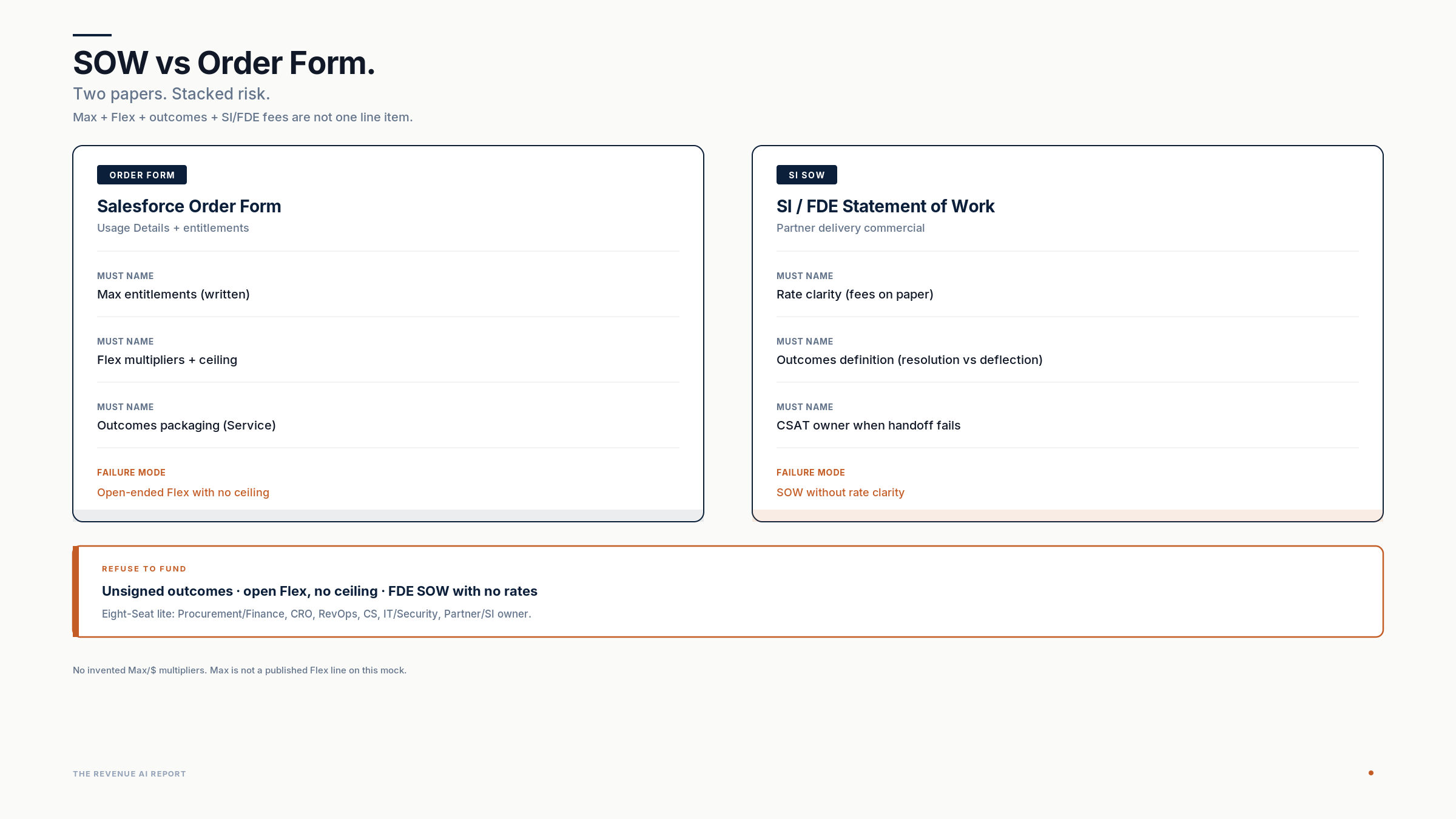
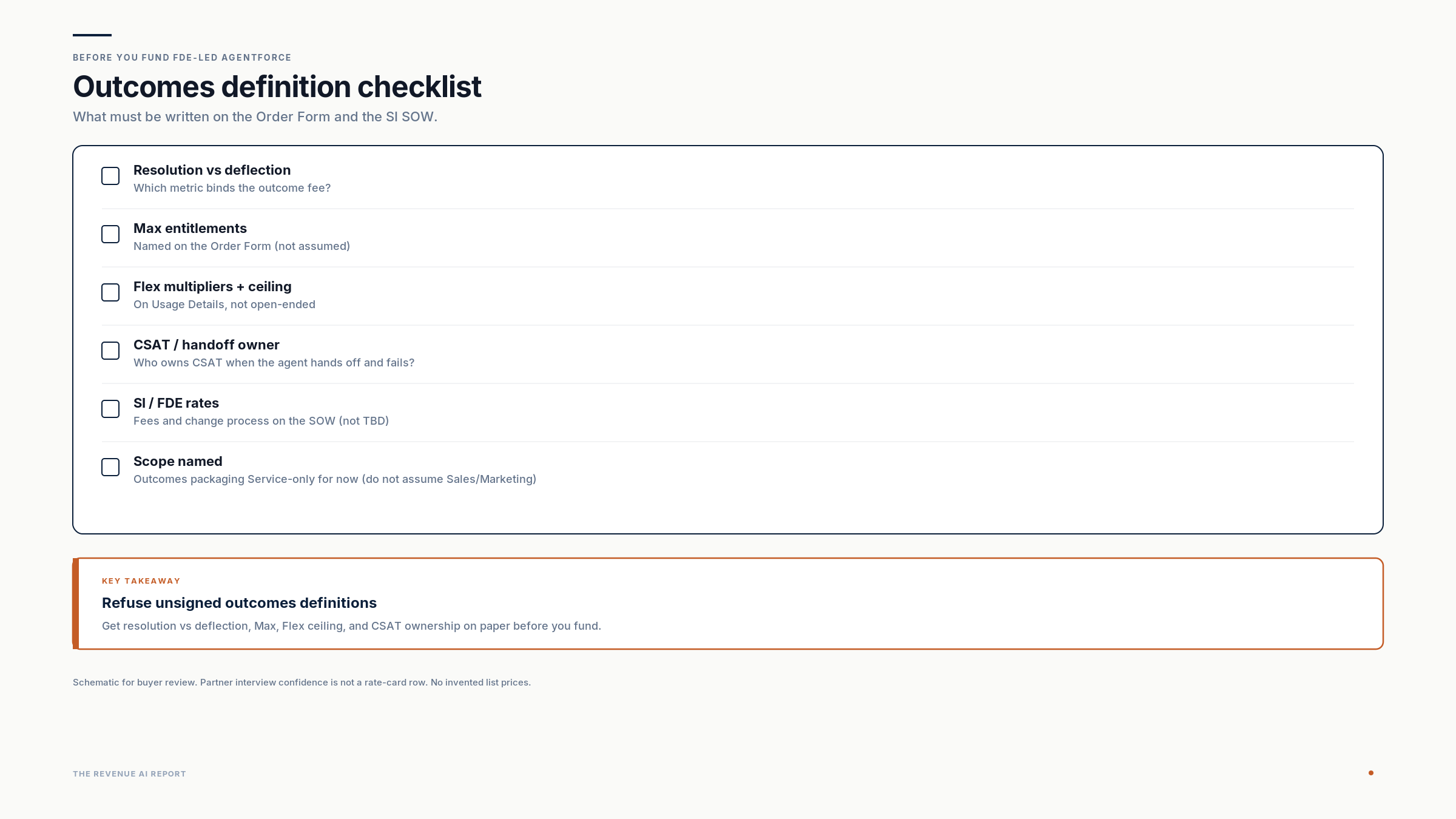
- Own the stack on the Order Form and SI SOW. Before funding FDE-led Agentforce, write Max entitlements (what is included), Flex multipliers or ceilings for any consumption lines you will use, the outcomes definition (resolution vs deflection, measurement window, dispute path), SI/FDE rates and change-order rules, and who owns CSAT when handoff fails. Do not treat partner confusion as the blocker; treat unsigned stack risk as the blocker.
- Refuse unsigned outcomes. If outcomes pricing is on the table, require a written definition of resolution vs deflection, the KPI method, and who pays when the agent hands off mid-journey. Customer-by-customer means nothing binds until your paper says it.
- Refuse open-ended Flex with no ceiling. If Flex Credits or related consumption sits beside Max or seats, demand written multipliers or a hard ceiling for the period you are funding. Sibling buy-model context: Flex Credits buying models and AELA vs Flex Credits
- Refuse an FDE SOW without rate clarity. Scarcity of FDEs is the partner's problem to staff. Your problem is a signed rate card, role definition, and what happens when Salesforce pricing tools or Max/outcomes packaging move mid-term.
- Name Max as predictability packaging, not as a Flex line you invent. Do not list Max as a published Flex Credits Rate Card usage type in this decoder. Ask what entitlements Max actually includes for your org on the Order Form.
- Assign CSAT ownership before go-live. If deflection is the billed outcome, write who owns CSAT, rework, and escalation when the agent fails the handoff. Put it in the SI SOW, not in a slide.
- Use a three-to-five-year lens. Diginomica's SI concern is multi-year certainty. If your SOW or Order Form cannot state how Max, Flex, and outcomes behave across that window, you are funding hope.
Eight-Seat Read (lite): who refuses what until the paper is signed
- Procurement / Finance: refuses to fund Max + Flex + outcomes + SI/FDE fees until entitlements, multipliers or ceilings, outcomes definition, and FDE rates are on the Order Form and SOW.
- CRO: refuses margin and capacity plans that assume Agentforce unit cost is "predictable" while outcomes stay customer-by-customer and Flex lines lack a written ceiling.
- RevOps: refuses a hard Wallet / Flex forecast for the FDE-led build until consumption lines and any outcomes measurement window are written.
- CS leader: refuses an outcomes or deflection KPI that bills the company while CSAT ownership on failed handoff is unassigned.
- IT / Security: refuses production cutover for FDE-built agents until identity, data scope, and commercial change-notice paths sit beside the SOW.
- Partner / SI owner: refuses an FDE SOW that lacks rate clarity, role definition, and a change-order path when Salesforce packaging or partner tools move.
Vendor claim score
/5: Johnston's claim that outcomes are the "most straightforward" approach and that Max delivers predictability with built-in consumption entitlements, versus Diginomica's record that outcomes are customer-by-customer and that SIs still cannot lock Agentforce certainty across three-to-five-year contracts. Predictability on the slide is not the same as predictability on your Order Form.
Confidence block (what is true from this source)
- Max / outcomes detail here is interview framing, not a rate-card row. Johnston's Max and outcomes description comes via Diginomica partner/executive interview. Do not treat it as a Flex Credits Rate Card line item or a published list price.
- FDE 84 partners / 800+ verified practitioners / 65+ workshops are Samady VP quotes via Diginomica, not an audited Salesforce rate sheet.
- Diginomica premier-partner conflict: Diginomica discloses premier-partner relationships in its coverage ecosystem. Weight quotes as reported speech, then demand Order Form and SOW text from your own AE and SI.
- No invented $/multipliers in this decoder. No Max list price, no Flex multiplier table, and Max is not listed here as a published Flex Credits usage type.
- Outcomes scope in this piece: Service Cloud / customer service start, resolution or deflection, customer by customer.
Why we might be wrong
- Salesforce calculators and price sheets land fast enough that SI three-to-five-year uncertainty shrinks before your next renewal.
- Max entitlements on your Order Form actually cap the consumption pain you care about.
- Outcomes stay Service-only long enough that Sales/other clouds are not in scope for your buy.
- Your SI already prices FDE as value-based managed services with board-level cover, so rate clarity is less of a blocker than Diginomica's broader SI sample implies.
Quick compare
- Salesforce Max: Large SKU framed for predictability with built-in consumption entitlements (Johnston via Diginomica). Ask what is included on your Order Form. Not treated here as a published Flex Credits Rate Card line.
- Flex / consumption: Pure consumption options and Flex-style burn still need written multipliers or ceilings beside any Max or seat buy. Sibling: Flex Credits buying models
- Outcomes (Service start): Pay per resolution; also deflection. Customer by customer. Write resolution vs deflection, KPIs, and dispute path before you fund.
- SI / FDE fees: Separate from Salesforce packaging. Require rate clarity, role definition, and change orders. Network size (84 / 800+) does not replace your SOW.
- HPI Flex Credits (TBA): Different Usage Type, same Proof Gap pattern. HPI TBA decoder
Sources
- Diginomica, Salesforce and the SI - partners want pricing clarity as the FDE Partner Network becomes established (Katy Ring, Sep 25 2026): Diginomica
- Sibling Max editions decoder: Core / Advanced / Max
- Sibling Flex buy models: PayGo vs precommit vs prepurchase
- Sibling AELA vs Flex: AELA vs Flex Credits
- Sibling HPI TBA (different line, same Proof Gap): HPI TBA
Soft CTA
If you want the next Agentforce Order Form decoder and the weekly receipts before the AE and SI call, subscribe
Take it to the room
The short list from this piece
Pulled from the argument above, written so you can read it out in a pipeline or board review.
Checklist diagram summarising What Must Be Written on the Order Form (and SI SOW) Before We Fund FDE-Led Agentforce: Max Entitlements, Flex Multipliers, Outcomes Definition, and CSAT Ownership?: Diginomica, Salesforce and the SI - partners want; Sibling Max editions decoder: Core / Advanced / Max; Sibling Flex buy models: PayGo vs precommit vs; Sibling AELA vs Flex: AELA vs Flex Credits; Sibling HPI TBA (different line, same Proof Gap).Frequently asked questions
- What must be on the Order Form before we fund FDE-led Agentforce?
- Max entitlements (if Max is in play), written Flex multipliers or ceilings for consumption lines you will use, outcomes definition if outcomes pricing applies (resolution vs deflection, measurement, dispute), and clear SI/FDE commercial terms. Do not invent dollars or multipliers; get them on paper.
- What is outcomes pricing in this Diginomica piece?
- Johnston describes Service outcomes as pay per resolution, with deflection as the other measured path, offered customer by customer with an agreed KPI approach. Starting with customer service / Fin-like options. Not a universal published list SKU in this interview.
- Resolution vs deflection: why does it matter?
- Resolution and deflection are different customer journeys and different CSAT risk. If deflection bills as an outcome while handoff friction tanks CSAT, you need written ownership before go-live.
- Who owns CSAT when agent-to-human handoff fails?
- Diginomica and Khoa Le surface handoff friction and the role of professional services in end-to-end experience. Your SOW must name the owner (CS, SI, or shared) and the rework path. Do not leave it implied.
- Are the FDE 84 / 800+ numbers a rate card?
- No. They are Nia Samady VP quotes via Diginomica about the FDE Partner Network. Useful as network scale context; useless as your fee schedule.
- Is Max a Flex Credits line?
- Not in this decoder. Johnston frames Max as a large predictability SKU with built-in consumption entitlements. Do not invent a Flex Credits Rate Card row for Max here. Ask your Order Form what Max includes.
- How does this relate to HPI TBA?
- Different line, same Proof Gap. HPI is a named Flex Credits Usage Type with multiplier TBA. https://www.therevenueaireport.com/blog/agentforce-headless-platform-interaction-mcp-flex-credits-tba
Hiring for revenue roles?
Post your sales, marketing, RevOps or enablement opening where revenue leaders read every week. One 30-day post is $199. Three featured posts are $299/mo.
Subscribe
Get the next Reality Check before you sign the order form.
Keep reading
Reality Check
ChatGPT Ads Added Measurement. Price the Spend You Can't Measure Yet.
ChatGPT Ads added measurement partners, a redesigned Conversions page and visual ad tests while advertisers report mixed results. A six-line order form for B2B pipeline spend you can't measure yet.
Reality Check
The dashboard was green. The answer was wrong.
Most teams judge an AI assistant by whether it is up and fast. Those checks confirm the tool responded and leave the accuracy of the answer untested. AWS recently published a clear example of the gap, from its own sales tools.