
ZoomInfo Put Workbounce in the GTM Context Graph. Demand Receipts on Every Answer.
ZoomInfo integrated 2024 acquisition Workbounce into its GTM Context Graph on Oct 14, 2026. Provenance and permissions are the buying test.
Jonathan Kvarfordt · Published October 14, 2026 · Last updated October 14, 2026 · 6 min read
The short answer
What's in it for you: ZoomInfo's Workbounce integration into the GTM Context Graph, and six diligence clauses so every agent answer shows its sources, permissions and freshness.
Decision rule
Do not let an agent recommend from internal decks, notes or Slack without a source receipt, permission bound and a wrong-account test.
Operator action
This week: ask for one sample receipt, run a wrong-account and stale-deck test on ten retrievals, and put the six clauses below on the order form next to any MCP or credit terms.
Last reviewed
On October 14, 2026, ZoomInfo announced that Workbounce, which it acquired in 2024, is integrated into its GTM Context Graph as a knowledge layer for unstructured go-to-market data. The company says agents can use internal sales knowledge alongside ZoomInfo's external market and contact data. (Business Wire; VentureBeat)
The diligence question is whether every agent answer shows where it came from, who was allowed to see it, and whether that source is current for this account.
What shipped (company-stated)
Per the Oct 14 announcement:
- Workbounce joins the GTM Context Graph / GTM.AI. ZoomInfo says the layer extends beyond external market intelligence into internal GTM knowledge.
- Internal sources listed: call transcripts, emails, decks, product documents, account notes, Slack threads, Google Drive folders and Notion pages.
- Claims on the combined layer: provenance, permissions and confidence so an agent can use market data and account knowledge together.
- Acquisition timing: Workbounce was acquired in 2024. Today's news is capability, not a new purchase.
ZoomInfo also referenced a company-reported GTM Bench comparison of its data products. That is vendor benchmark evidence, not an independent study. Do not use those scores as a buying guide.
Related order-form reading on ZoomInfo metering: ZoomInfo MCP credits.
The Proof Gap
A bigger knowledge graph gives the agent more material. It does not automatically give better judgment. A transcript may hold a tentative idea. A deck may describe an old product. A note may sit on the wrong account.
| What the launch states | What a buyer still measures |
|---|---|
| Internal + external context in one graph | Wrong-account and stale-source rates |
| Provenance and permissions claimed | Exportable receipt per recommendation |
| Semantic search over unstructured GTM data | Time to correct a bad retrieval |
| Agents more context-aware | Buyer outcome after the recommended action |
| Company GTM Bench scores | Independent task set (not published as such) |
Six diligence clauses for a knowledge layer
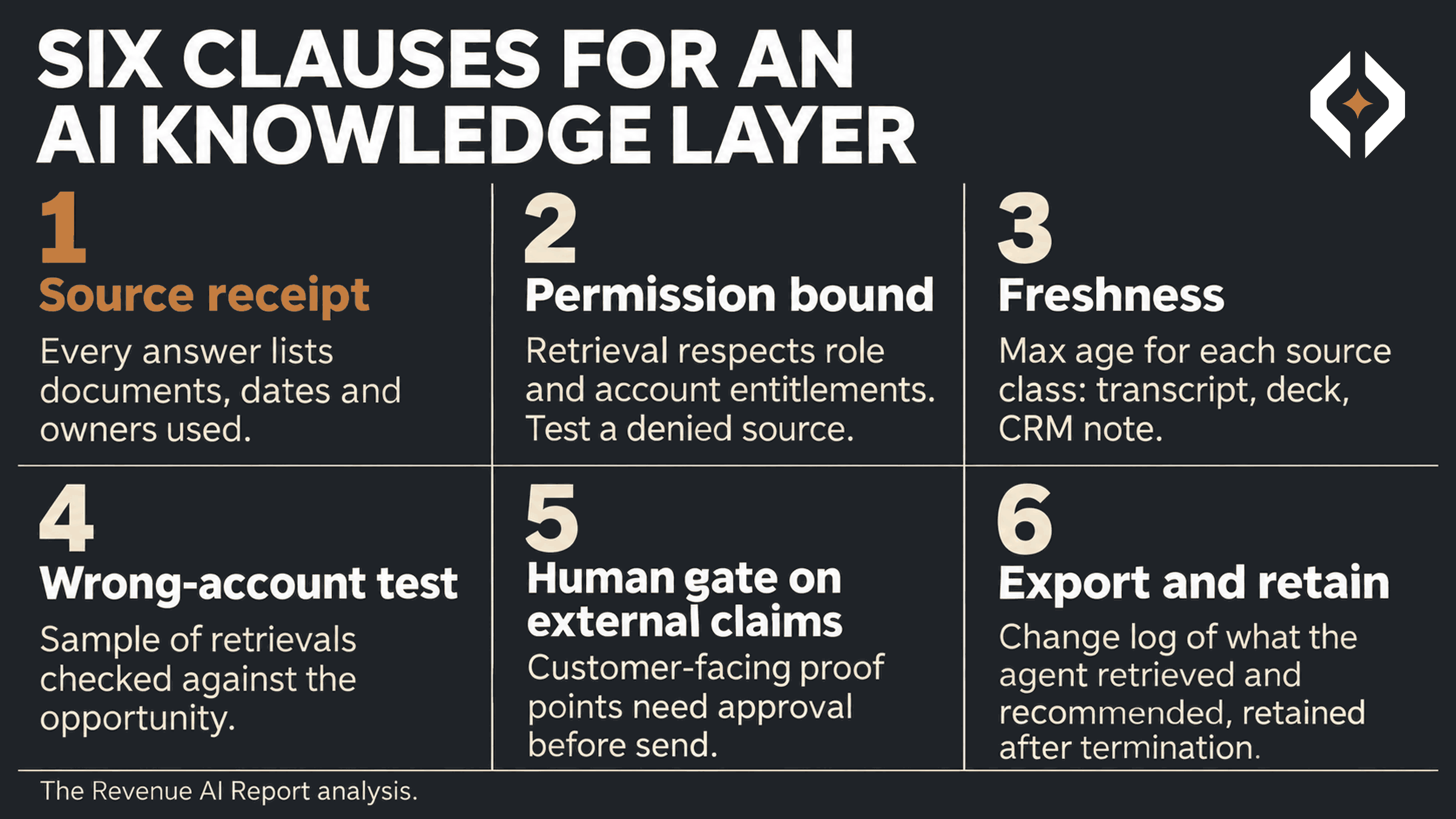
- Source receipt. Every answer lists documents, dates and owners used.
- Permission bound. Retrieval respects role and account entitlements. Test a denied source.
- Freshness. Max age for each source class (transcript, deck, CRM note).
- Wrong-account test. Sample of retrievals checked against the opportunity.
- Human gate on external claims. Customer-facing proof points need approval before send.
- Export and retain. Change log of what the agent retrieved and recommended, retained after termination.
Who owns which part
- CRO / sales leaders: which recommendations may reach a customer without a human check.
- Enablement: approved playbooks and proof points in the corpus.
- RevOps / GTM engineering: connectors, permissions model, revoke path.
- Legal / security: what leaves the tenant into model hosts; sub-processors.
- CS: whether support and renewal context can leak into the wrong account workspace.
What to do this week
- Ask for a sample receipt: one recommendation with sources, dates, permissions and confidence.
- Run a wrong-account and stale-deck test on ten retrievals.
- Put the six clauses on the order form next to any MCP or credit meter terms.
Context is becoming part of the agent product. The durable test is an audit trail you can open on a live deal.
Frequently asked questions
- Is this a new ZoomInfo acquisition?
- No. Workbounce was acquired in 2024. October 14, 2026, is the product integration announcement.
- What internal sources does ZoomInfo list?
- Call transcripts, emails, decks, product documents, account notes, Slack threads, Google Drive folders and Notion pages, per the announcement.
- Can I trust the GTM Bench numbers in the release?
- Treat them as company-reported. They are not an independent study. Use your own task set.
- What is the first proof to demand?
- An exportable receipt: sources, dates, permissions and the action a rep approved, tied to what the buyer did next.
Hiring for revenue roles?
Post your sales, marketing, RevOps or enablement opening where revenue leaders read every week. One 30-day post is $199. Three featured posts are $299/mo.
Keep reading
Reality Check
ChatGPT Ads Added Measurement. Price the Spend You Can't Measure Yet.
ChatGPT Ads added measurement partners, a redesigned Conversions page and visual ad tests while advertisers report mixed results. A six-line order form for B2B pipeline spend you can't measure yet.
Reality Check
The dashboard was green. The answer was wrong.
Most teams judge an AI assistant by whether it is up and fast. Those checks confirm the tool responded and leave the accuracy of the answer untested. AWS recently published a clear example of the gap, from its own sales tools.