
Gartner Mapped Revenue Action Orchestration. Run the Field Test Before You Buy.
Gartner's Oct 14 Critical Capabilities for Revenue Action Orchestration lists 13 vendors and four use cases. Six lines to field-test a score in your pipeline.
Jonathan Kvarfordt · Published October 15, 2026 · Last updated October 15, 2026 · 6 min read
On October 14, 2026, Gartner published Critical Capabilities for Revenue Action Orchestration, the companion to the Magic Quadrant for the same market it published on October 13. The public abstract says chief sales officers and sales operations leaders can use it to "evaluate and select the right partner to improve frontline sales productivity, pipeline and forecast visibility, and seller coaching."
That makes it a strong shortlist tool. A capability score rates how well a product meets a functional requirement in the analysts' evaluation. Whether the tool moves your pipeline is a separate question, and you answer it in your own data.
What the public abstract shows
- Published: October 14, 2026. Analysts: Dan Gottlieb, Steve Rietberg and Alyssa Cruz.
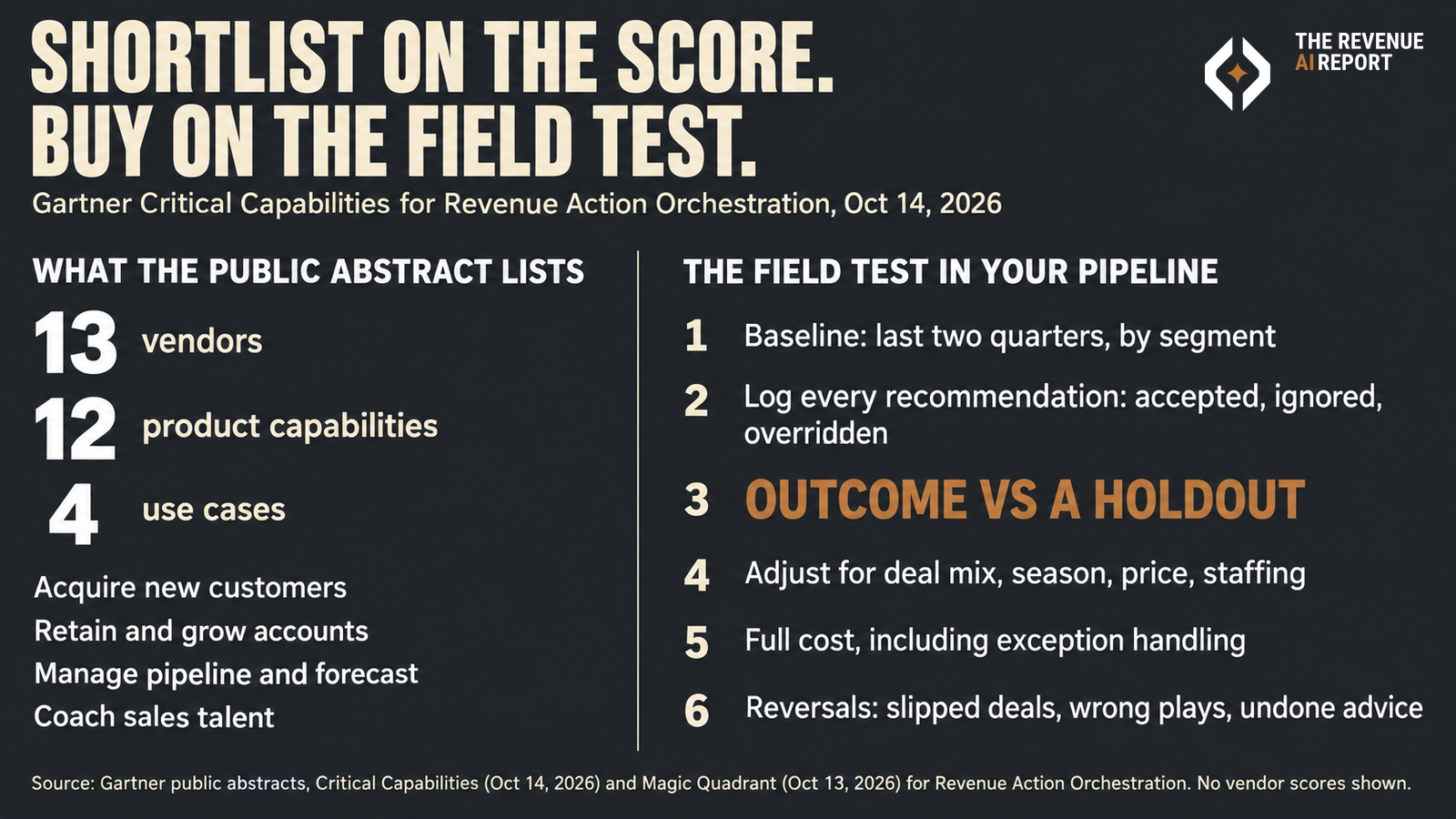
- Vendors: 13 listed.
- Capabilities: 12 in the table of contents, including AI-guided actions, deal scoring and pipeline analytics, sales forecasting, multichannel buyer engagement, data interoperability and sales skills coaching.
- Use cases: four. Acquire new customers, retain and grow accounts, manage pipeline and forecast, and coach sales talent.
- The market view: the October 13 Magic Quadrant abstract calls these platforms "the cornerstone of AI-first sales execution" and tells sales operations leaders to judge vendors on their ability to deliver "autonomous guidance," consolidate revenue signals and scale execution.
The full research, including scores and rankings, sits behind Gartner's client access. I have not seen it, and nothing here describes any vendor's position.
Where a score stops
A score can tell you a product does deal scoring well in a structured evaluation. It cannot tell you whether your managers will act on the score, whether your data feeds it cleanly, or what happens when it is wrong on a late-stage deal. Those depend on your data quality, your integrations, your managers' habits and how your team handles exceptions.
So the useful buying question is narrow: which recommended action produces a measurable improvement here, at what cost, where does it fail, and can the team catch the failure before it reaches a customer?
Turn one capability into a field test
Pick one of the four use cases. Then run the Reversal Ledger on it:
- Baseline. The last two quarters of the number that use case should move, by segment. For pipeline and forecast, that is forecast error, stage conversion and slip rate.
- Every recommendation. Log each one the tool makes as accepted, ignored or overridden, with who made the call.
- Outcome against a holdout. Compare qualified-opportunity movement, conversion, forecast error or coaching results with a holdout team or a matched baseline.
- Adjustments. Correct for deal mix, seasonality, price changes and staffing before you credit the tool.
- Full cost. License, implementation, admin time and the hours spent handling exceptions.
- Reversals. Low-risk deals that slipped, accounts routed to the wrong play, and advice managers undid. These show where the system needs repair.
Who owns which line
- Chief sales officer or CRO: picks the use case and the one number that decides the purchase.
- Sales operations or RevOps: builds the baseline and the holdout, and owns the accept, ignore and override log.
- Frontline managers: record why they overrode a recommendation. As guided actions spread, judging the exceptions becomes a bigger part of the manager's job.
- Enablement: for the coaching use case, defines the skill change you expect to see on calls and how it gets scored.
- Finance: sets total cost against measured lift and signs off on expansion.
What to do this week
- Take your current shortlist and pick one use case from the four.
- Write down the one number that would justify the purchase, such as forecast error down a set number of points within two quarters.
- Ask each finalist for a 60 to 90 day pilot with a holdout team and access to the full recommendation log.
- Put the reversal log in the pilot terms: who sees it, how often and what triggers a stop.
This works for a manufacturer's distributor sales team, an insurer's agency channel, a bank's commercial lenders or a software sales team. The use case stays the same; only the baseline changes.
The counter-view
Analyst research saves real time. It narrows a crowded category, applies one method across every vendor and surfaces questions a single buyer would miss. A field test also has limits. Holdouts are hard to set up with a small team, and a matched before-and-after comparison with adjustments is a fair fallback. Some capabilities, such as mobile access or data interoperability, are requirements you check once at selection, with no ongoing ledger needed.
Related
- Landbase GTMBench Put GTM-3 Omni Ahead. Blind-Test Your Own ICP Before You Buy
- Ebsta Reviewed: What the Revenue Intelligence Claim Actually Measures
- Twenty Questions That Separate an AI Vendor From an AI Demo
- Othello Raised $8M for Live Call Coaching. Prove the Buyer Got a Better Conversation.
- Reversal Ledger
Sources
- Gartner, Critical Capabilities for Revenue Action Orchestration, public abstract, published Oct 14, 2026: gartner.com
- Gartner, Magic Quadrant for Revenue Action Orchestration, public abstract, published Oct 13, 2026: gartner.com
If you want the next analyst report turned into a field test the same way, subscribe.
Frequently asked questions
- What did Gartner publish on October 14, 2026?
- Critical Capabilities for Revenue Action Orchestration, a companion to the Magic Quadrant for Revenue Action Orchestration published October 13, 2026. The public abstract lists 13 vendors, 12 product capabilities and four use cases.
- What are the four use cases?
- Acquire new customers, retain and grow accounts, manage pipeline and forecast, and coach sales talent.
- Does a high capability score prove revenue impact?
- No. A capability score rates how well a product meets a functional requirement in the analysts' evaluation. Revenue impact depends on your data, integrations, manager adoption and exception handling, so test it against a baseline in your own pipeline.
- How should a sales leader field-test a revenue action orchestration tool?
- Pick one use case, set a baseline, log every recommendation as accepted, ignored or overridden, compare outcomes with a holdout or matched baseline adjusted for deal mix and seasonality, count the full cost, and record reversals such as slipped low-risk deals.
Hiring for revenue roles?
Post your sales, marketing, RevOps or enablement opening where revenue leaders read every week. One 30-day post is $199. Three featured posts are $299/mo.
Keep reading
Reality Check
ChatGPT Ads Added Measurement. Price the Spend You Can't Measure Yet.
ChatGPT Ads added measurement partners, a redesigned Conversions page and visual ad tests while advertisers report mixed results. A six-line order form for B2B pipeline spend you can't measure yet.
Reality Check
The dashboard was green. The answer was wrong.
Most teams judge an AI assistant by whether it is up and fast. Those checks confirm the tool responded and leave the accuracy of the answer untested. AWS recently published a clear example of the gap, from its own sales tools.